
ragg987
-
Posts
873 -
Joined
-
Last visited
-
Days Won
1
Everything posted by ragg987
-
Not in my case. I suspect they rely on someone complaining and then comparing it to the PP conditions by exception. Just don't upset your neighbours - they may not have seen the conditions but might complain if your hardcore spills into the road. Cheapest is likely to be tarmac or waste concrete (e.g. surplus from a pour elsewhere) over the appropriate solid core. 'Half-decent' is tricky, your hell could be my heaven. Blockwork tends to be most expensive, though I am sure others will chip in with more expensive options - like gold-plated taps, I did not believe they could exist when I first heard of them!
- 11 replies
-
- 1
-

-
- moving in
- reasonable
- (and 1 more)
-
We have a similar arrangement. As a precaution I fitted an inline direct heater to bedroom MVHR supply. I think it is 1kW. It is controlled by a thermostat on the landing. So when very cold the inline heater will fire up and works well. I also leave bathroom towel rails on 24 x 7 at the lowest setting, maybe 30C, this works well.
-
Linky
-
Makes little sense to me. Defrost is part of the design, so I can not see why the need avoid it. Direct electric heating gives COP of 1. As long as you stay above this even with defrosting you are saving money.
-
You might be right. In my mind the grey area is that PP makes the land valuable as a separate property, not as part of the main residence. Not saying I am right, just how I read it.
-
Re IHT, your parents' estate will only be liable if the total value exceeds £1m. (This full £1m figure will apply from 2020/21). So this may not be a major concern if the £650k house is the major asset. Allowance is £325k per person plus £175k for primary residence, per parent. If I understand it, provided parent 1 passes on the whole estate to parent 2, then parent 2 can benefit from double the allowance when they pass it on. Them gifting you the land might be more troublesome from a CGT perspective. At point of transfer, they will come under jurisdiction of CGT at the open market value of the land. So if the market value is above 2 x £11,700 allowance (assuming they do not use the allowance elsewhere), they become liable for tax. The 7 year rule only applies to IHT - separate to CGT. The land "sale" also brings SDLT into consideration - tax is payable if the value exceeds the £150k nil band. Once you own the land, then you might also come into a CGT liability. I am not clear how this might work, I guess if you move from one main residence to another within the allotted time it should be OK, however in this case you are buying land and not a house so do check on this aspect. Also, how likely that you can build and move in within 18 months of the transfer of the asset - it is possible, but might be tight.
-
Not my experience at all. Ours can heat to 50C regardless of outside temperature. Sunamp for storage is a separate subject, 50C is too low for the regular PCM, and the 34C PCM is not hot enough for DHW. We use a 300l cylinder, the only downside is that recovery time is slow with our small heat pump.
-
Seems right, I get around 4 when heating and 3 when cooling.
-
Hitachi user. You enable cooling by a link change which is in the delivered documents. I use an original Hitachi controller for heating and cooling, it has the ability to program automatic switchover. Note that cop while cooling is not as high as when heating.
-
Are you intending the ASHP to heat the Sunamp? (Bearing in mind you need a high-temp ASHP to do that, an ordinary one will not reach the phase change temp) Some considerations: 70l of buffer water is tiny. One shower will deplete most of it Heating using ASHP / PV / direct electrical will struggle to maintain more than 1 shower when your hot water store runs out Hence you need to size your store based on a likely scenario 8 showers within 1 hr means storage for 8 showers -> approx 20-25kWh but 4 showers in the morning and 4 in the evening means you can halve your storage I understand Sunamps are modular units and allow partial heating, e.g. you can 'switch off' cells when only 2 of you and switch them on when you have guests. Probably worth checking with Sunamp how this works. PV becomes a bonus source of electrical energy that you can optimise as follows: First priority is to use the PV in your house - appliances timed to run on sunny days, or EV car charging Next priority is to supply the Sunamp - use circuit 1 on your solar diverter Last priority is to pre-heat the buffer - use circuit 2 of solar diverter If all above are satisfied, you export the excess You can experiment with buffer temperature to avoid overheating your house. Your ASHP will support 2 circuits, so you can have DHW higher (to allow Sunamp to store the energy) and buffer lower (to supply UFH or pre-heat DHW). The solar diverter is important. For instance the Immersun has ability to sequence between 3 loads. The example above uses 2 loads. On sunny days, you sequence Sunamp > buffer. On gloomy days any spare PV drives the ASHP.
-
...
-
LED mirrors?
ragg987 replied to Moira Niedzwiecka's topic in Self Build VAT, Community Infrastructure Levy (CIL), S106 & Tax
You could claim they are fitted light fittings which are definitely covered. -
Who you calling a bee! And where's the queen?
-
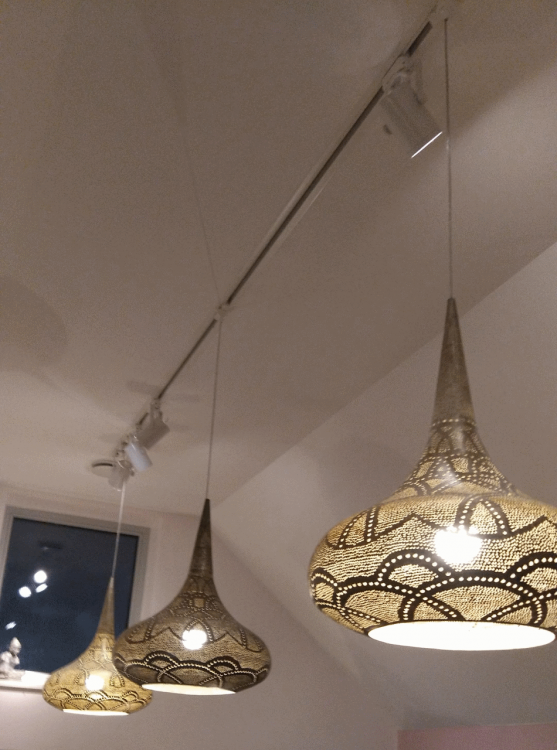
We used this in bedrooms as well as lounge and dining areas: https://intalite.co.uk/slv-145211-eutrac-3-circuit-recessed-track-2m.html Recessed into the ceiling and 3-circuit. As part of a complete lighting scheme based on multiple "layers" of light, they work really well, give flexibility but do cost quite a bit. If recessed properly there is a small lip over the ceiling, quite subtle. The tracks are very strong and you can screw them to the ceiling battens or joists at regular intervals so they are able to carry quite a large weight e.g. for your crystal chandeliers ! In our case we used the track to provide 2 circuits, each controlled by it's own dimmer at 230v mains voltage. Circuit 1 for pendants (general lighting). SLV have a clip-in adaptor and it is simple to wire your own pendant to it. The adaptor is universal and you can set it to either circuit 1, 2 or 3 on the track. Circuit 2 is for spots which I have positioned to accentuate and highlight e.g. wall hangings or work areas. Separate to this, we have 5A sockets in walls into which we plug stand-alone floor or table lamps, also controlled by a single dimmer Full control from one point, no fancy computer controlled lighting and quite effective. I understand the tracks and clip-on are semi-universal, but did not need to deviate from one brand.
-
What I did...
-
What about water inside the heat pump? I would think that is going to freeze sooner than water in an insulated or underground pipe.
-
You do not need glycol witha split ASHP. The primary loop is filled with refrigerant, in our case this was already inside the unit and once pipework was in place the pressure released to fill the system.
-
Lighting is about personal preferences, but just to share my experience. We have hidden LED strips in our kitchen. The effect feels a bit cheap and nasty, and the amount of light it gives is not great. More decorative, despite using pretty high output strips. We also have the false ceiling effect with concealed LED strips in our bathrooms, like the picture you have. These work better than the kitchen but the effect is a bit clinical, not exactly welcoming. Luckily we also have lit mirrors in the bathroom which break the monotony. This despite choosing warm LED at 3000K colour temperature. I love those low level lamps, we use these in circulation areas, stairways and bathrooms, activated by motion sensors. Practical and beautiful, ours are by SLV.
-
mvhr replacement filters
ragg987 replied to ragg987's topic in Mechanical Ventilation with Heat Recovery (MVHR)
Jasun quoted a high price. I purchased from filterworld and am replacing every 6 months, they work fine. All links above. -
Not able to offer any advise on your question, but are you sure you want porcelain tiles? IMO they add to the feeling of a cold and echoey bathroom, which I dislike. We went with Amtico which has a tiny amount of give and feels warmer as well as less reflective of noise.
-
Panels require light, either direct or indirect. A light but of dappling for a few hours will likely have minimal impact. Also, if trees go bare in winter the impact will be less. So not as clear cut, but if shading at any point covers 10% of panels then output might only decrease 5% or less. Microinverters will help. Your other question about length of cables. One company tried to tell me the inverter had to be close to the panels else losses would be high. I used one of the online models to show that the cable length on DC side has low losses, or DC cable is perhaps 50m and AC is 2m. Works well, we got 4GWh in our first full year from a 4kWp install. Just bear in mind the amount of cable in a drum, it might be better to avoid joints to reduce potential points of failure.
-
There is always an "event" just round the corner. I personally would not hold off, just invest it in a balanced way. Example: Brexit doom has been on the cards for about 2 years. Over that period markets (albeit higher risk side) have returned me over 20%. I believe there is never a right or wrong time, just do it early, spread the risk and also buy frequently and often rather than one one big lump payment.
-
Some good advise here. If I were investing this (bear in mind this is for my situation) : First clear any debts, especially the more expensive ones. Put some cash where it can earn interest and be readily accessible. Santander 123 current account give 1.5% up to £20k, some provisos and a monthly fee. Invest balance between low, medium and high risk. Vary the split according to your risk appetite and how long before you need to access it. Use ISA limits : - cash is safe and you will not lose any money with the £85k safeguard - low/medium risk like the Vanguard Lifestrategy mentioned by @Alphonsox, the 20% variant is lowest risk for lowest potential returns - higher risks like indexed-linked to S&P 500 (more suitable if for 5 years+ horizon) Of course with latter 2 you risk losing money. I am a big fan of Vanguard, they do not gobble up your savings in fees and a lot of their investments are free of buy / sell charges. But you need to have the right attitude to understanding and coping with the risk - they give no guidance.
-
Total energy consumption per m2 per annum
ragg987 replied to NSS's topic in Energy Efficient & Sustainable Design Concepts
We import 8,000kWh (all electric) and generate 4,000 in our 330m2 build. Given we only export about 3%, makes our energy demand 36kWh/m2/pa. This is for 6 people, ASHP for DHW, heating and cooling, 2 kitchens, and charging of a hybrid car. -
On our MBC build, I went with their suggested pozi-joists sizes and spacing. Topped with OSB. This is the least satisfactory aspect of our build, the floors bounce quite a bit, the OSB squeaks, and noise transmission to lower is quite high. By contrast, have beam and block floor to the basement, this is great and noise transmission is low. As mentioned above, I would pay better attention of I did it again, maybe screed and a more rigid structure.