le-cerveau
-
Posts
524 -
Joined
-
Last visited
Everything posted by le-cerveau
-

Mvhr or not
le-cerveau replied to jpinthehouse's topic in Mechanical Ventilation with Heat Recovery (MVHR)
Pipe size depends on you requirements, If you install manifold system (most people do) then there are the pipes from the manifold which has many options depending on the system you use, the pipes from the MVHR unit to the manifold and the outside world, size depend on you overall system sizing. If you put the unit in an un-insulated area then it need to be insulated, and so do all the pipes (ducts) in the un-insulated area, you also need access to the unit for filter cleaning, so the best advice is in an insulated and accessible area. Ideally it need to be considered form the outset of the house design as a retrofit will always have compromises. -
Put a thermal break in the slab in the line of the external walls then you can heat it without heating all of London.
-
Internet in the US shifts out of Neutral
le-cerveau replied to MikeSharp01's topic in Boffin's Corner
Just had a look (at the Scotland one) so 30M to 100% of homes by 2021! Really, every single home and business (no exceptions) with 30M fiber broadband. There are bound to be some get out clauses somewhere! -
The question is how are you going to insulate your basement, you ideally want to insulate outside the concrete to avoid/reduce thermal bridges. This is where ICF comes in as it forms the insulation and the former for pouring the concrete, subterranean you still have to waterproof outside the ICF with an appropriate tanking layer.
-
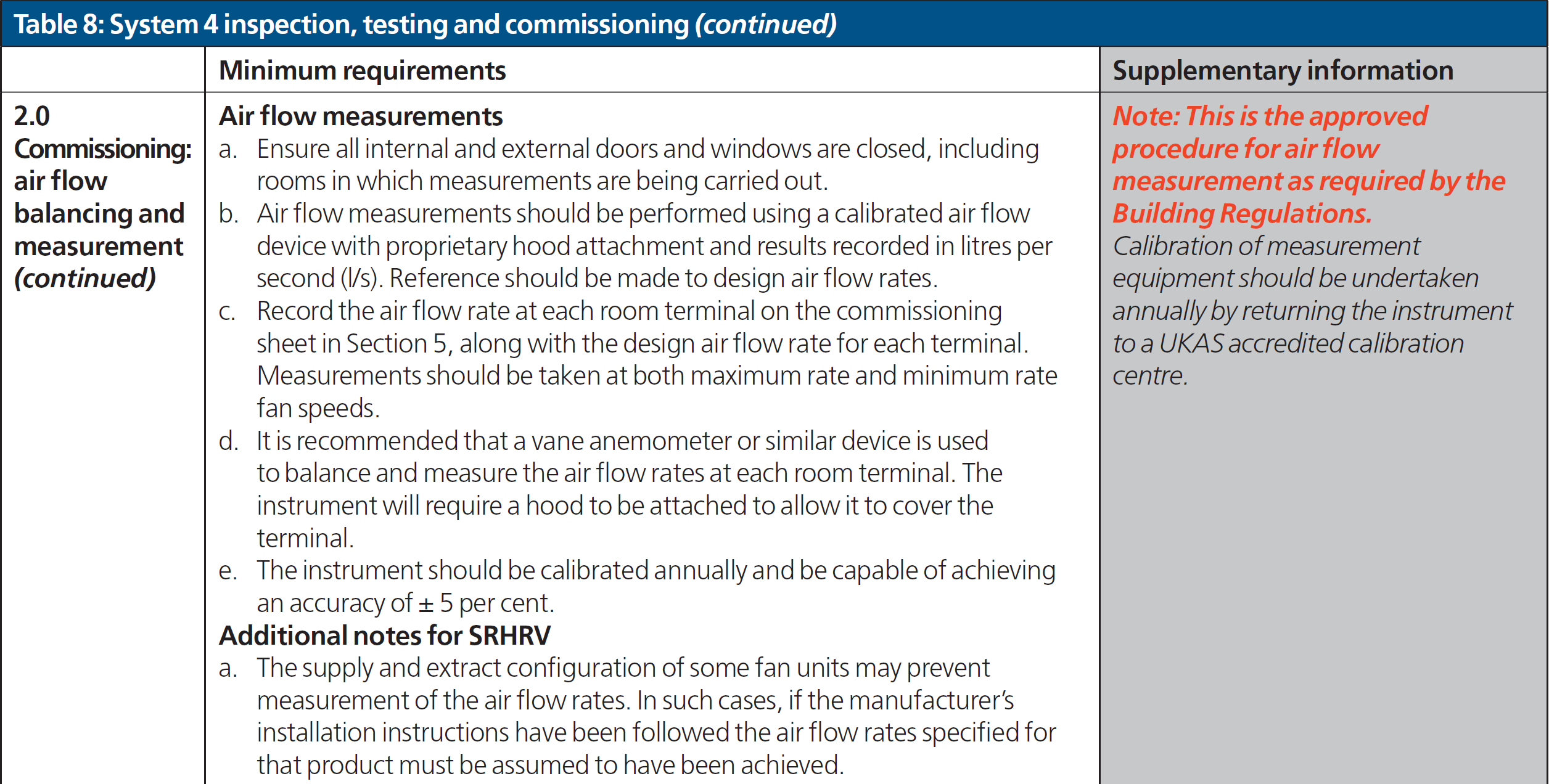
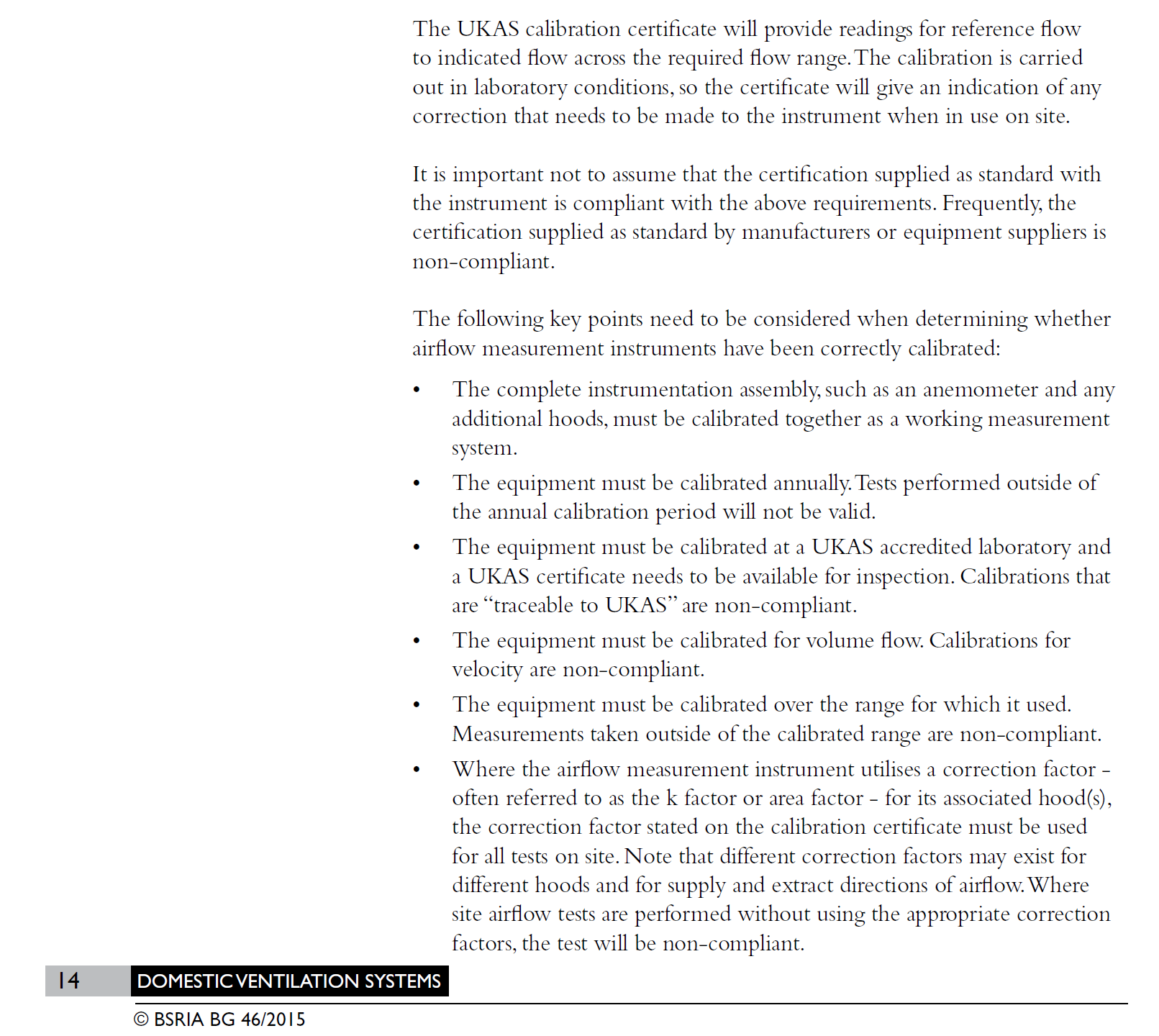
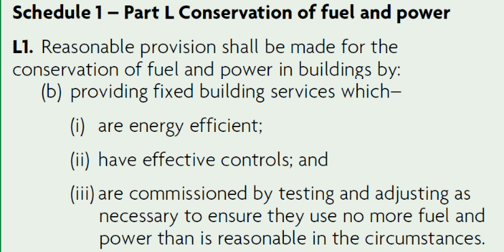
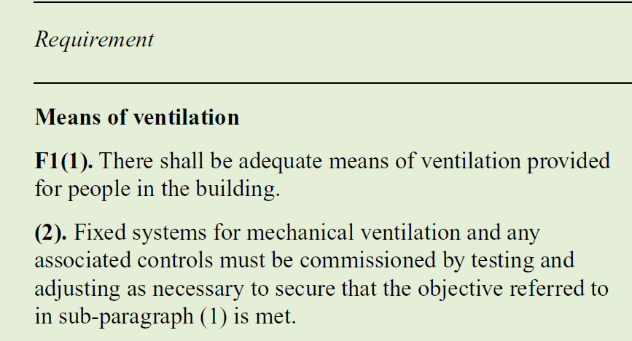
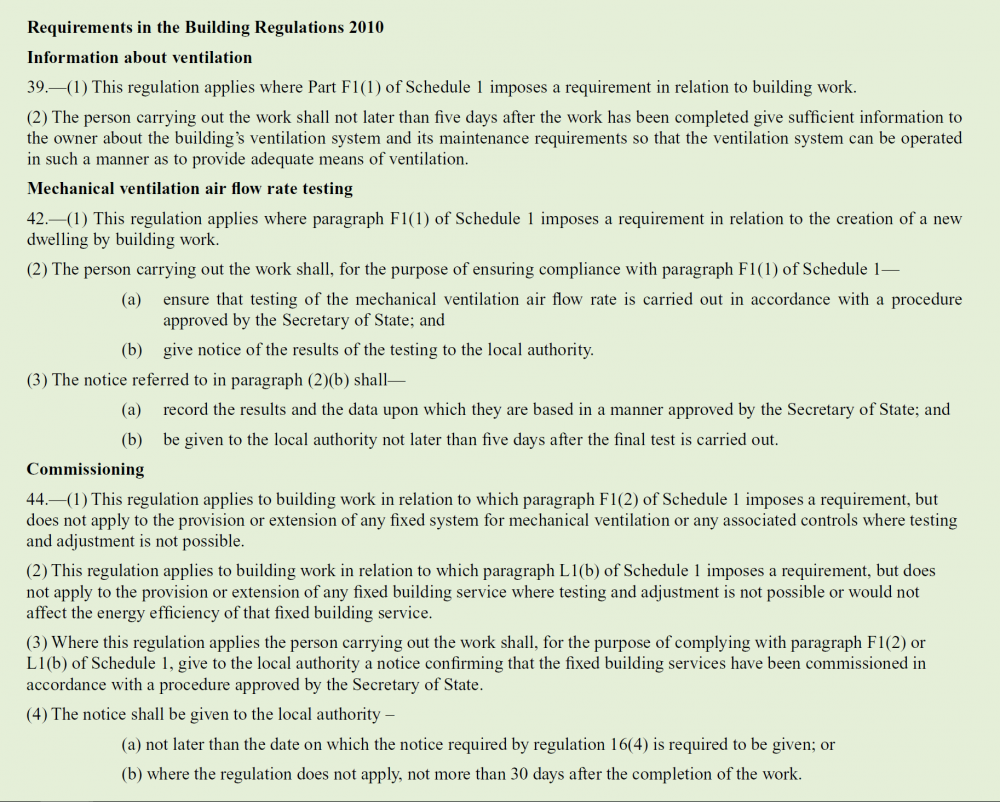
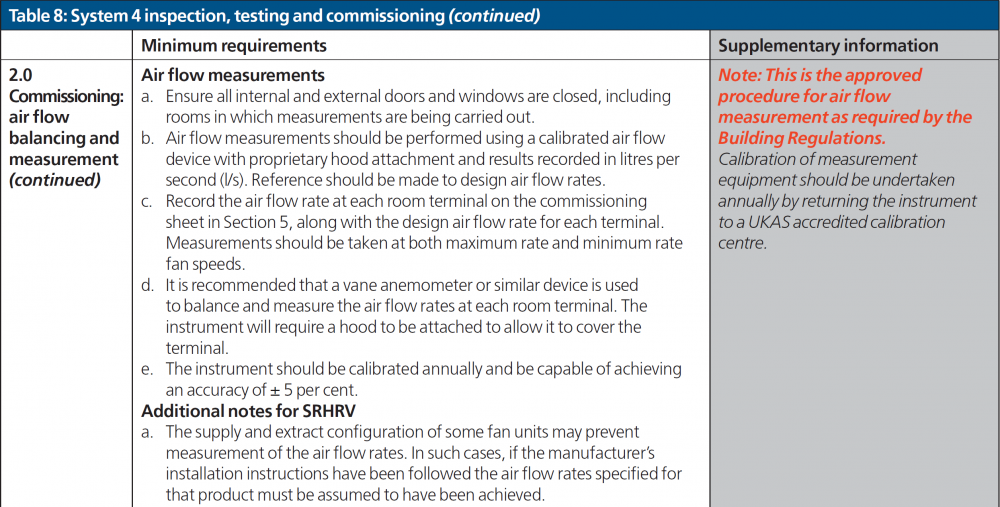
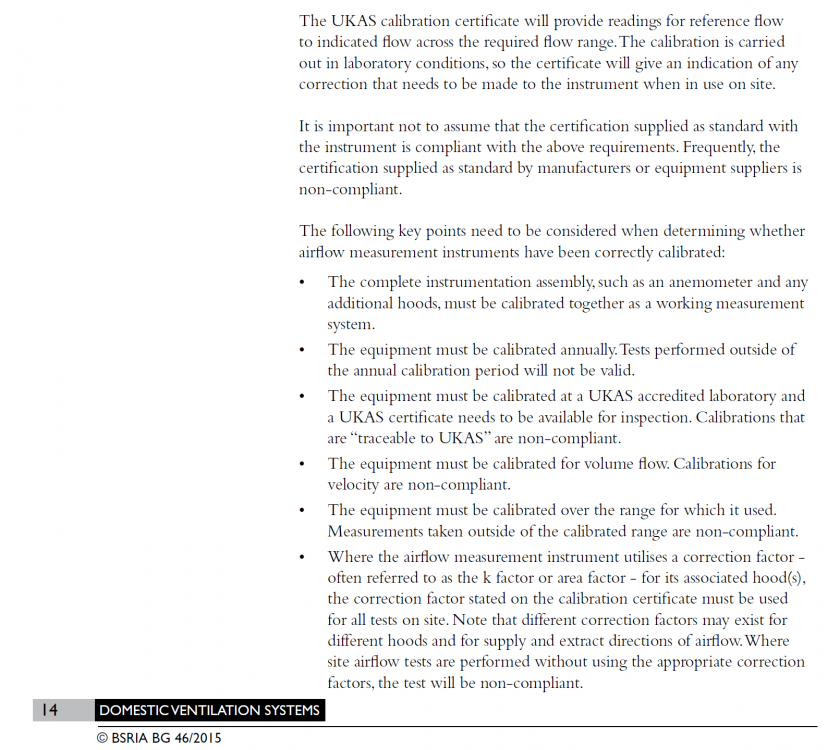
As I get ready to go to the next stage I need to prepare for MVHR testing but I am looking for collected advice: The regulations state that systems need to be “commissioned in accordance with a procedure approved by the Secretary of State.” (Regulations below): This is the Part L1(b): This is Part F1(2): Throughout it refers to procedure approved by the Secretary of State. From the Domestic Ventilation Compliance Guide Table 8 this is the approved procedure: This talks about UKAS accredited calibration. In the BSRIA guide there is details about calibration: After all that I have come up with the following: I need to use the approved methodology. The equipment need to be calibrated and in date. The calibration needs to be UKAS, and not just traceable. The calibration need to be volumetric not speed. 1 &2 easy, 3 and 4 not so. And comments advice.


-
Due to blocked pipes only 5 will fill!
-
Mine is an extreme build but the as designed SAP is 122 and environmental rating 120, this will reduce as the as designed had way more solar PV than we have installed but I expect it to still be well over 100.
-
The question is where was the skip? On the public highway, then legally you can keep it. on someones property, then that is a different question.
-
Show me your installation!
le-cerveau replied to worldwidewebs's topic in Mechanical Ventilation with Heat Recovery (MVHR)
I have also done mine, details in my blog. -
All sounds strange. DHW should come from the tank so if you have lukewarm showers then the tank was not hot and it sounds like it cools down overnight (what a surprise) and whilst the UFH is on doesn't heat up very quickly. (Solution heat it up in time for your shower). The circulation pump should have no impact on your ability to get hot water, just the time you wait for it! It should pull the return leg back to the center of the DHW tank, whilst the DHW feed should be from the top of the tank (is it all put together properly?). As you have a circulation system the pipes should all be very heavily insulated to reduce losses (shock/horror is the builder skimped on pipe insulation. We would need to see a system layout to provide proper advise then our resident plumbing expert could comment properly.
-
You will find Architects don't usually consider technical issues just the ascetics. They leave that to the engineers to sort out!
-
I won't comment on the borehole, however 25m run for a hot water pipe is not insignificant! 25m of 22mm pipework is 8l of water, 15mm is 3.65l, that is a lot of water to pull through to get to hot water. I would thing a circulation system (and well insulated pipes) would be your solution. If you go for accumulators to give you the pressure then you won'y have a cold water tank in the loft, just a sealed system. I am sure a resident plumber will be along in due course.
-
Budget wired network
le-cerveau replied to Tennentslager's topic in Networks, AV, Security & Automation
To be honest if you can just run 10m extension cables from the switch to each PC, then that is by far the simplest solution. Otherwise you will have to run the cable from the switch to each PC and put a small patch panel on the switch end and a socket at each PC end. much easier to punch down into a socket/patch panel than wire pluhs and then use short patch cables at each end. As for the switch cabinet, what is the switch being used? (19" rack mount, there must be some sort of link equipment also) If it is 19" then it should be in a rack and you can just add a 19" patch panel (not that expensive) -
Building Regs Compliance
le-cerveau replied to Woodgnome's topic in Mechanical Ventilation with Heat Recovery (MVHR)
The issue is that the Building Regs are based around standard homes, as soon as you build a big (non standard) house they struggle. You have a large house so your whole house supply rate exceeds any extract requirements so you will always be extracting above the boost rate! (system balanced). One the system is certified you can always re-adjust, as many here do, but to pass inspection your system has to supply the house (and extract in a balanced system) at the largest number! -
Plant room location
le-cerveau replied to Russell griffiths's topic in New House & Self Build Design
It is all down to what is going in! MVHR, DHW, Boiler, CU,....... I have a large plant room, but a large house, with 2 x MVHR units almost filling one wall. There is no wight/wrong answer just less than optimal decisions/compromises. -
You can definitely DIY it. I just have, see my latest blog entry: I did all the calculations my self, I have a floor area of 438m2 which was my defining limit giving a unit requirement of 472.92 m3/h, so beyond one standard unit, I ended up with 2 x Brink Renovent Excellent 400 plus units. From the blog you can see it can be installed however I did have the help of my builder (with all the tools) but you definitely need 2 people when running pipes. I spent a long time working out duct runs which paid dividends during the fitting even though we varied, as I knew the plan back to front alterations on the fly were easy. All my equipment came from CVC, they also supply Ubbink ducting, though it is not on the website, just e-mail them and they will send you a price list for all the components. For power I went with aiming between the 50-70% mark, with my theory being the slower the fan runs the less noise and if you look at the performance tables they are more efficient (heat exchange) at lower settings, so personally I would go towards the 400m3/h. As for pressure difference that depends on your duct design, the longer more complex the duct/manifold/terminal arrangement the higher the pressure! Reading into @JSHarris blog and subsequent conversation he states that he probably wouldn't fit a Genvex in hindsight (wait to be corrected) as it is not really needed in his situation. and @PeterStarck units also does DHW so not just an MVHR unit. For your calcs personnel calcs is based on 2 personnel for the first room and one thereafter, not what you can cram in, it is all building regs based, you need to work out if your extract requirements exceed your floor area supply requirement and base your system on the greater of these.
-
Go for the full topo, mine cost £475, including the existing house (demo-rebuild) and the relevant details of the neighbours houses (extremely sefull when we had to prove we wernt overbearing and overshadowing). This formed the base for all the designs there on.
-
Yes, that is what a TS does! You need to run the pipes and have a wood burner with the backboiler (heat take off) functionality! You also have to put in some specific safety features but it is all doable. The question is is your wood burner compatible and can you easily run the large bore pipework to the TS?
-
For recommendations, I can't really comment as I am fitting a custom SunAmp Stack with 2 different temperature PCM sets (v-expensive), but before I finalised on that the best I could find were the Akvaterm range of TS's as they come out a B/C efficiency (heat loss is an issue in a Passive type House). Their standard ones (just the one DHW coil are 300 & 500L (or bigger). If you are considering an ASHP then there are other versions (GEO) with stratification (option I was looking at) but as Nick says it is then getting more complex.
-
@Nickfromwales can better answer but it is a compromise, Bigger is better buts costs more and takes up more space! A Bigger TS enables you to use a smaller boiler (within reason) and not run out of hot water. A bigger boiler allows you to run a smaller TS (quicker re-heat) but again there is a size not to be dropped below. Crossed replies with Nick.
-
If you room is fairly airtight and you close the door, it will increase the resistance on the system (like closing down the vent) (as it has to pull/push past the closed door) so if you balance with a closed door on an extract room, when the door is open, the resistance drops and it will extract faster and the extraction elsewhere in the house will consequently drop.
-
You don't need a combi. A regular boiler will require pump and controls, a system boiler will have it all in and usually there isn't much difference. All your boiler does is heat up the TS when there is a demand. The UFH, Rads just take out heat as required, same as the DHW. One of the biggest issues is heat loss, even the best TS's are at best C/B rated and loose more heat than that (see @JSHarris blog on his heat loss issues). Are you considering an ASHP? make it more complex but possible savings compared to oil prices. With just an Oil Boiler then a simple TS with a large DHW coil will suffice, you want it large enough to provide your DHW requirement, this is a combined function of TS size vs boiler power, bigger boiler means smaller tank (within limits). If you add an ASHP, then you need a stratified TS or a separate buffer (and DHW preheat) and TS/UVC. A large stratified TS is the simplest option, though possibly not the most efficient (someone else do the maths) and there are plenty of companies doing them AKVATERM (Finnish) have a range with separator plates between low grade and high grade heat (GEO range). In doing your calculations, size of bath/ capacity of showers all needs to be factored in, it takes some time and you will end up making some compromises. There are numerous options and no simple answer.
-
You want to put your manifold centrally, make a small cupboard on an appropriate wall or cupboard, one by bed 2 or in the dressing area (take out a small area). You then put an insulated run from your heat source to the manifold. As you have an oil boiler you need a long burn time to be efficient. If you are running the radiators directly from the boiler then you need a buffer of some sort for the UFH. You could run the whole system of a large TS, UFH tapping low down, radiator tapping middle/top and DHW from the store. The boiler would then be heating the TS direct. It would also allow you to add solar (not our favorite) or an ASHP later. This is the advantage of a TS. However the experts here will tell you that an UVC gives better DHW performance, so what is your overall requirement. How many bathrooms/showers, what is your DHW requirement and recovery time? What is the heat load of your house? What is teh power of your boiler?.....
-
The Domestic Ventilation Compliance Guide states: Air transfer a. To ensure good transfer of air throughout the dwelling, there should be an undercut of minimum area 7600 mm2 in all internal doors above the floor finish. This is equivalent to an undercut of 10 mm for a standard 760 mm width door. b. Ensure that the air transfer provision is unrestricted after floor finishes have been laid (e.g. carpets should not encroach). This should be achieved by making an undercut of 10 mm above the floor finish if the floor finish is fitted, or by a 20 mm undercut above the floorboards, or other surface, if the finish has not been fitted. So it depends on the size of your door!
-
Geberit to MVHR extraction
le-cerveau replied to Auchlossen's topic in Bathrooms, Ensuites & Wetrooms
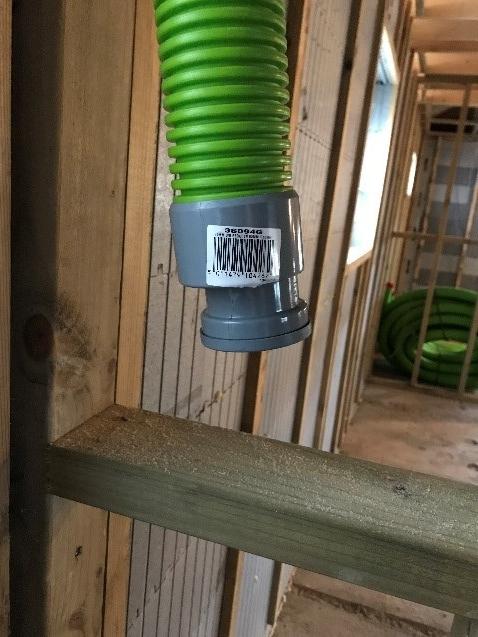
I have installed the MVHR side of my system and left the cistern extracts terminated with 50mm push fit connectors. Full details on the blog: But this what it looks like: