


MJNewton
-
Posts
1354 -
Joined
-
Last visited
-
Days Won
1
Everything posted by MJNewton
-

Vaillant VR33 Module for OpenTherm Support
MJNewton replied to Rehan Saeed's topic in Boilers & Hot Water Tanks
Here's the installation manual, albeit not in English so you'll have to run the text through Google translate or similar! Edit: There are a couple of photos here too which may be of use, although it doesn't look all that difficult. -
Not if you end up running the large machine at an output way below its sweet spot. Efficiency tends not to be constant across the range of operational output. Try doing the same journey in a 5L V8 - at the same (desired/required) speed - and the inefficiencies of using such an oversized beast for the task would become quite apparent.
-
MVHR Loft Installation - Inspiration
MJNewton replied to richo106's topic in Mechanical Ventilation with Heat Recovery (MVHR)
(Tripped the file limit with the first pic so following on here) And then more towards the end once the distribution pipework had been put in (4 extract and 8 supply if memory serves) along with insulation around everything: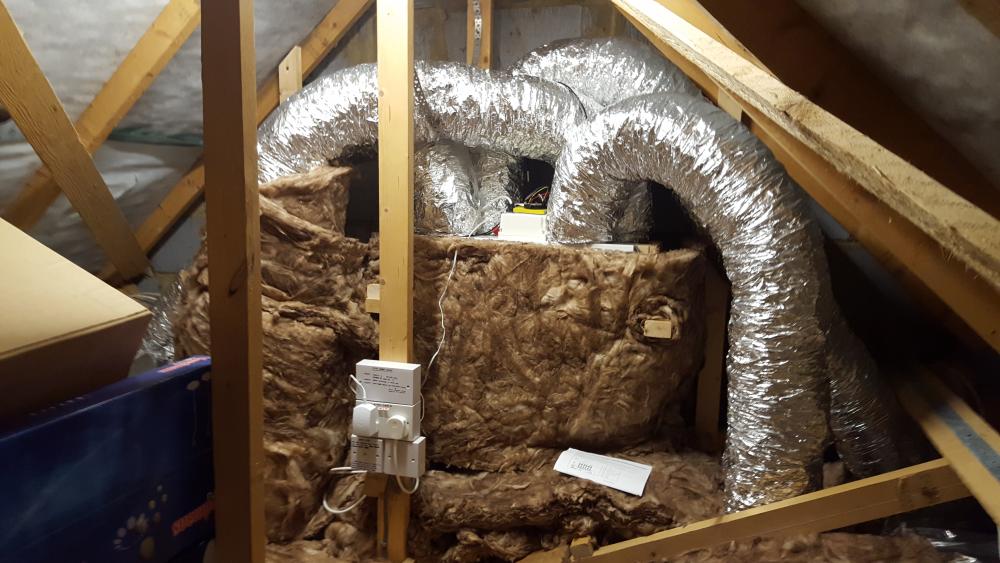
-
MVHR Loft Installation - Inspiration
MJNewton replied to richo106's topic in Mechanical Ventilation with Heat Recovery (MVHR)
Sure! Anything in particular? As a starter for ten, here's the 'bare bones' unit mounted and with the primary connections made: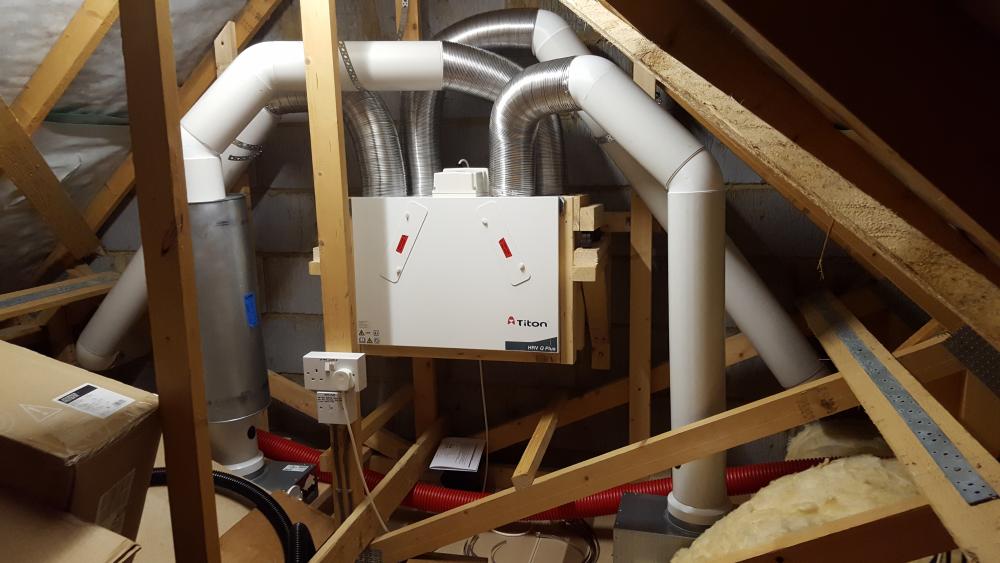
-
MVHR Loft Installation - Inspiration
MJNewton replied to richo106's topic in Mechanical Ventilation with Heat Recovery (MVHR)
Mine's in a cold loft and performs perfectly fine, and consistently over 80-90% efficiency. It was a retrofit to so much harder than a new build, but I'd happily do it all again (well, okay, happily might not be the right word to apply throughout but most of not all of that is down to the extra challenges of retrofitting). -
DIY design of MVHR acceptable?
MJNewton replied to GaryChaplin's topic in Mechanical Ventilation with Heat Recovery (MVHR)
‘Analysis paralysis’? If so, yes, I’m a regular at that!! -
DIY design of MVHR acceptable?
MJNewton replied to GaryChaplin's topic in Mechanical Ventilation with Heat Recovery (MVHR)
Can you elaborate on that? It's not something I've seen/heard before. My understanding is that the primary driver for the location of supply vents is such that maximum cross-flow/mixing of air is achieved through the room thus, usually, being as far from the door (through which the air is ultimately expelled) as possible. The exception to this is large mixed-purpose rooms (such as 'family' rooms that might combine lounge, kitchen and dining areas) which contain both supply and extract vents, but again the same principle of maximising distance between supply and extract holds true. -
Yeah I'd second/third the dual-run approach. Another benefit is the independence/redundancy it provides if there's a catastrophic problem somewhere along the way as it gives you a backup to keep you going whilst a solution is found - it turns what might otherwise be an emergency into more of just a problem. Such breathing space can often allow cheaper solutions to be employed if you want to help justify things financially.
-
DIY design of MVHR acceptable?
MJNewton replied to GaryChaplin's topic in Mechanical Ventilation with Heat Recovery (MVHR)
I think you've found it! Seriously, I can't imagine a better place to start than a (sub-)forum dedicated to the subject. You'll learn far more through ploughing through old threads on here than any book would likely tell you. Sure, it'll be very unstructured and out-of-order but you'll be covering nuances and aspects of design that would be overlooked in any attempt at a concise summary. Just have a meander through letting things flow over your head as familiarity grows and before long you'll be an 'expert' (okay, a self-proclaimed one but the label is only being sought to give yourself confidence that this is DIYable, which it most definitely is - and to a potentially better outcome than getting the pros in). -
Cue @pocster to come in and say something inappropriate in 3... 2... 1...
-
Heatmiser Neostat v2 temperature sensor problem
MJNewton replied to Ultima357's topic in Underfloor Heating
I wonder if it'd be worth exploring the possibility of substituting a different PSU inside the backbox? I can't imagine it is anything exotic, and not only might it give greater longevity but it might also improve performance of the thermostat noting the excessive heat that the original appears to give off. Edit: I see this suggestion is just a repeat (or variation at least) of what I mentioned a couple of years ago so apologies for that. I did wonder why I'd received notification of this thread updating as I didn't recall being previously involved! -
MVHR Loft Installation - Inspiration
MJNewton replied to richo106's topic in Mechanical Ventilation with Heat Recovery (MVHR)
That should be the BuildHub motto... -
Working correctly
MJNewton replied to Pocster's topic in Mechanical Ventilation with Heat Recovery (MVHR)
We are still talking about the same thing, right? I've read your posts before. Yes, I suspect so. I think at the others have said it's much harder feeling the effects of sucking rather than blowing. Oh dear. -
Working correctly
MJNewton replied to Pocster's topic in Mechanical Ventilation with Heat Recovery (MVHR)
@pocster Can you remove one of your extract valves? If so, do so and put your hand up inside it - perhaps in a small fist if you've got room - and I suspect the air flow will be much more noticeable. -
Please do ignore me... Consider me someone that's just wandered along and thrown something in without context or knowledge!
-
Noting the gate valve on the connecting pipe, and the positioning of the other pipes, I think it looks more like it's on the cold water inlet.. But that seems an odd place to put on so I might well be wrong!
-
Thermal bridge of vertical metalwork
MJNewton replied to MattMiller's topic in House Extensions & Conservatories
I'm amazed an extension like that was able to get through building regs given the amount of glazing. Presumably it takes an awful lot of heating to keep it comfortable? Is the roof definitely not of warm construction? I know you/we can see some insulation on the underside but I was just wondering if this was perhaps thrown in for extra measure (a token gesture at that) and that there's a decent amount above the OSB too (making something of a hybrid construction)? As others have mentioned I'd be interested in seeing some outside pics too. -
I have wifi 6, should I wait for wifi 6 speakers?
MJNewton replied to Adsibob's topic in Networks, AV, Security & Automation
Sorry, that should've been 6 year warranties in case there was any doubt! -
I have wifi 6, should I wait for wifi 6 speakers?
MJNewton replied to Adsibob's topic in Networks, AV, Security & Automation
I'd recommend keeping an eye on Richer Sounds and Smart Home Sounds. They both price match (sometimes undercut) Sonos themselves but offer 6 warranties as part of the price. Great customer service too. Incidentally, if the Ones are to be used primarily as surround speakers did you know that Ikea Symfonisk speakers are compatible with Sonos yet are much cheaper (arguably not quite as good sonically hence being more suited to surrounds where any such compromise wouldn't usually be noticed). -
I have wifi 6, should I wait for wifi 6 speakers?
MJNewton replied to Adsibob's topic in Networks, AV, Security & Automation
If you hardwire (as in wired ethernet) one Sonos speaker then it and the others will create their own wireless mesh thus not relying/impacting on your own WiFi (and whatever version it might be running). -
Which set point are they talking about?
MJNewton replied to Radian's topic in Boilers & Hot Water Tanks
Thanks for all the info @SimonD. I've been reading/watching a lot about the Vogue now and I think I'll definitely be going for one when the time comes. I don't think I've found a bad word about them and there seems to be plenty of positive experiences of using them in a dual-temperature PDHW setup, and with the T6 family of controllers too so all in all seems a pretty safe bet. -
Which set point are they talking about?
MJNewton replied to Radian's topic in Boilers & Hot Water Tanks
Okay, thanks - will check them out. I see there'a a Logic 2 out now so will dig deeper into what differences that brings. With the T6 being CH-only I was intending on continuing with a 'dumb' timer to control the DHW. Do the Ideal's still allow different flow temperatures to be set for CH and DHW (noting it knows which is calling given the separate SL1 and SL2 demand inputs, as well as the Opentherm connection)? A quick skim of the Vogue system boiler IMs suggest it might not be able to. If not I could always swap for a T6R which would presumably allow the controller to dictate these? Yes, it has been an obvious downside to the Intergas offerings (that and the lack of detailed documentation - it seems a lot is missed out of the English translations). I think they drop to around 6kW (possibly less?) whereas I see these Ideal's are going down to around 3kW and indeed others like Viessmann now able to go below 2kW. I'm keen to operate 'low and slow'. -
Which set point are they talking about?
MJNewton replied to Radian's topic in Boilers & Hot Water Tanks
I'd be very interested in giving weather compensation a try, I just don't want to commit without a backup plan. Its certainly a feature I'd be wanting supported by any potential boiler choice. Got to somehow narrow the options for boiler selection down despite such contradictory reviews and opinions out there. -
Which set point are they talking about?
MJNewton replied to Radian's topic in Boilers & Hot Water Tanks
It's a fair question, and perhaps part of the answer is familiarity. There are a few features such as remote control and geofencing that I'd need to work out alternative implementations of, but perhaps more so is that I'm yet to be convinced of the day-to-day effectiveness of weather compensation given variation on solar gain and wind chill etc. I'd certainly be up for giving it a try though but would make sure I had something room-temperature based to fall back on that I know first-hand works really well. -
Which set point are they talking about?
MJNewton replied to Radian's topic in Boilers & Hot Water Tanks
This is really good to hear actually as I am currently considering future boiler options. We have a 15yr old Ideal Icos which despite seemingly not being particularly well liked by the industry (perhaps the pre-upgraded PCB ones) has performed near perfectly for us but I am mindful it won't last forever and some upcoming renovation work might be the ideal time to consider replacing it. The Icos is married to an unvented cylinder and we'll keep this so looking for a heat only or system boiler to drop in. I was considering another Ideal (do you have any personal model preferences/recommendations?) or perhaps an Intergas. Either way it'd be in an X-plan arrangement with PDHW so dual temperature control would be welcome. We've got a Honeywell T6 controller so are Opentherm ready which would be good to exploit.




