


MJNewton
-
Posts
1354 -
Joined
-
Last visited
-
Days Won
1
Everything posted by MJNewton
-
Yeah, we've had a couple of Shelly Flood devices and found them really good. Whilst we've never had a real leak/flood to deal with I do periodically test them. Battery life has been great too - predicted to last 12-18mths but I've just replaced one that lasted just over 3 years!
-

Installing a small MHVR system
MJNewton replied to Mark-R's topic in Mechanical Ventilation with Heat Recovery (MVHR)
Yeah I thought it was a bit steep, but I was assuming it was just to cut holes in the frames and whack some form of louvres/shutters over the top but it turns out to have been for a separate fabricated section that would be fixed to the top of the frame. -
Is it definitely a scratch and not a mark? If the latter I'd certainly recommend giving a Magic Erase a go - it never seizes to amaze me how effective they are. Here's a link to a generic one which whilst not the exact ones I've used I am sure they are all pretty much the same.
-
Installing a small MHVR system
MJNewton replied to Mark-R's topic in Mechanical Ventilation with Heat Recovery (MVHR)
Hi Mark, welcome to the forum. We retrofitted MVHR (also a Titon HRV1.25 as it happens) and have been really pleased with it. In our case it was a 125m² 2007-built property and whilst we didn't have any condensation/mould issues to treat the initial motivation was the creation of an open plan kitchen which, primarily for aesthetics, we didn't want much on the walls (high level cupboards and, more relevant to this discussion, a hob extractor) and so started exploring the use of MVHR. Retrofitting was difficult, particularly given we're spread over three floors, although saying that we've ended up with a pretty much 'invisible' installation and so looking back it was really just a lot of planning, problem solving and head scratching but we got there in the end. We were helped massively by the flooring structure being long engineered I-joists which, surprisingly given my usual luck, nearly all happen to run in the ideal direction for us! Furthermore, given we had the ceilings down on most of the ground floor that also helped. To keep costs down we actually bought the MVHR unit off eBay for £350 as a second-hand unit albeit one that had only been installed and not used as it was one of many fitted to a small estate of houses that turned out to not be to specification so were pulled out and replaced. It still ended up costing us £1400 in total once every last component is factored in. It's been in around five years now. Electrical running costs have been ~£26/yr (based on today's rates of 22p/kWh and ~125kWh/yr consumption) and I change the filters every 6 months at around £1 a time as the frames are reusable so I just buy a square meter of filter medium to chop up. Performance in terms of humidity control and perceived air quality has been excellent. We also saved £400 in not having to have trickle vents in the lift-and-slide doors too which was a nice bonus. Based on our experience I would definitely recommend it, but it would certainly be worth exploring the alternative options raised for consideration by others above. -
Smart Meters and Preparation for Eventual EV Charger
MJNewton replied to MJNewton's topic in Consumer Units, RCDs, MCBOs
Just to follow up on this, spoke with Octopus and they were happy to fit an isolator at no charge. Due to scheduling issues it ended up being done in advance of having the smart meters fitted a couple of weeks later but now it's all done.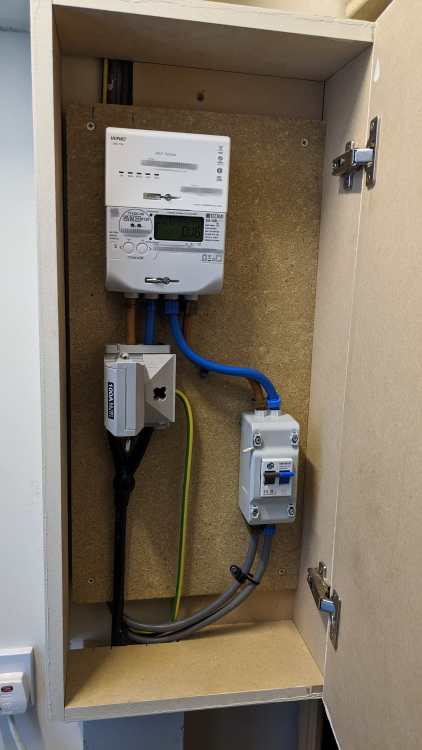
-
Was this the video? The installation has put me right off. Going from a boiler hidden neatly inside a kitchen cupboard to a grey washing machine sitting on your drive with all that pipework and black trunking going to it really doesn't feel like progress to me.
-
Pre-Filter for Log Burner Smells
MJNewton replied to benben5555's topic in Mechanical Ventilation with Heat Recovery (MVHR)
When our neighbour installed a wood burner I went in to full-on damage limitation mode, admittedly prior to even knowing whether there was any damage to limit! Instead of additional filters though what I did was install an air quality sensor in the intake duct and if/when it detects smoke particles (actually, it is not that discriminatory but smoke is within scope of what it can pick up) it triggers the MVHR to stop pumping in air for a while. There's some info of the approach here: Incidentally, it turns out that in practice my wife's cooking appears to be arguably more of a threat than the neighbour's wood burner! So, I now have *two* sensors - one that turns the MVHR down if the neighbour's wood burner goes wild and another that boosts it when dinner's nearly ready. 😂 -
Smart Meters and Preparation for Eventual EV Charger
MJNewton replied to MJNewton's topic in Consumer Units, RCDs, MCBOs
Thanks @garrymartin. Re the isolator (and/or anything else) I did wonder if it'd be worth me getting one just in case there wasn't one 'on the van' but, as you suggest, explicitly requesting it at the time of booking ought to mitigate that. -
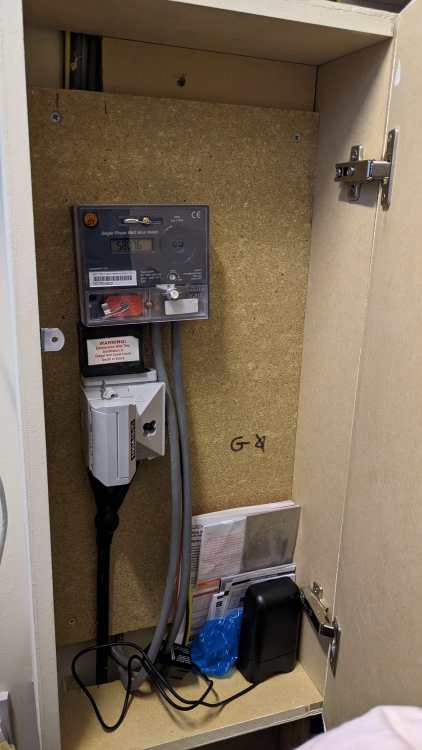
I am just in the process of moving supplier (to Octopus) and whilst I don't currently have a smart meter or require one for the new tariff I will opt for one when the opportunity arises. I was wondering: given the likelihood that I will one day require an EV charger is there anything I should be getting done when the smart meter gets fitted? It seems like the ideal opportunity (power off, all cabling disconnected etc) to do something (isolator? Henley block? etc) whether that formally or through bribes, sweet talking the installer etc. Here's the current 'electricity cupboard': At the very minimum I wouldn't want the new smart meter to be installed in such a way that might prove problematic for an eventual EV charger e.g it being fitted in such a way/location that doesn't leave space for whatever else will eventually be required so any advice as to what I should be requesting/suggesting would be welcome. In case it is relevant, the consumer unit sits just above the cupboard in the photo (you can just about make out the tails and earth cable going up to it), and the EV charger would sit on the other side of an outside wall a few metres to the right.
-
You can tape some foil to the wall (well sealed around the edge) and see which side the moisture appears. If it is the exposed room-facing side it is likely condensation, if it is on the wall-facing side it's coming from/through there.
-
Oh I see - the removal of the scale caused a leak?
-
Thanks for that! I did wonder if it was just overblown marketing blurb, or perhaps something that is technically correct but in practice might take decades or something.
-
That's interesting @marshian, and the kind of thing I was concerned. That said, the tank is stainless steel and the immersion appears to be sealed with an o-ring so finger's crossed that might mean it won't be seized in place. After 18 years though anything could've happened! The dilemma is do I wait until there's an issue (and risk not easily being able to run solution through all the component parts which might be helpful) or perform preventative maintenance (and risk causing a different problem in the process!).
-
I did think removing the immersion might be a good starting point, if only to give my visible access to gauge what state we're in. If I could get a vacuum hose in (no chance of removing the cylinder - it is too piped in) that might help too. Would need to be confident I could re-seal the immersion though so need to work out what type of seal it actually uses. Knowing my luck though the current immersion will be seized in place and I'll end up deforming the cylinder trying to unscrew it!
-
I'd seen them but glossed over them assuming they weren't intended for me - perhaps thrown by the common use of the word 'combi' in the names of these products. So, would I be looking to supply the whole house through one of these (including taps for drinking from) it just the hot water side of things? I must say, even though we've got very hard water we don't find the cleaning of taps and other wet surfaces a particular problem - the main concern is scaling of the cylinder given how expensive it (and its (re)installation) is.
-
We live in a 2007-built housing estate and over the past few years I've seen a number of unvented cylinders being replaced and, having grabbed one of the plumbers doing a job recently discovered that in that particular case (and perhaps therefore others too) the issue has been down to the cylinder scaling up and blocking the inlet at the bottom. These particular cylinders - Range Tribunes - appear to have an inlet whose design is meant to help minimise destratification but is seemingly vulnerable to to the consequences of limescale. I was wondering: is it practical to descale such a cylinder and, if so, how? I do wonder if it might actually risk causing more harm than good e.g. dislodging some scale that then blocks something, or causing a leak around the immersion if the chosen might involve its removal to hoover out scale etc. Recognising the G3 restrictions about working on these things consider it a hypothetical exam question scenario. Also, I am considering fitting a whole-house water softener (with bypass for the kitchen tap) and so presumably this would prevent further scaling occurring. Water softener manufacturers claim that it will gradually remove existing scale too - is this true? Might that be a safer approach (more gradual, no physical disruption to the cylinder and its fittings etc), and perhaps could be considered to represent value for money given that it'll hopefully negate the need for eventual cylinder replacement (at least for scaling-related issues)?
-
Why does it read 10V when it's off?
MJNewton replied to Gone West's topic in Consumer Units, RCDs, MCBOs
Yes, as above it'll almost certainly be due to the ghost/stray voltage that is picked up when using high-impedence test meters (the MTM01 has an input impedence of 10MΩ). Some further reading here: How Stray Voltage Affects Multimeter Measurements -
Modern housing estate living
MJNewton replied to flanagaj's topic in General Self Build & DIY Discussion
<Stands up> We live in an estate - a Persimmon one in fact - and love it here. <Sits down to a reassuring ripple of clapping from the amassed circle of new friends, and nods of acceptance now that I've finally been able to say such a thing out loud> Joking aside, having spent many years renovating various Victorian properties and developed skills, knowledge and experience of pretty much every aspect (including, unexpectedly, building construction photography which found its way into the Haynes Victorian House Manual!) we never expected to end up in a new build (or rather 3 years old at the time). However, an estate agent suggested we had a look round even just to rule such a property out so we did and something just felt 'right' to both of us when we did. We bought it and 14 years on have absolutely no regrets. Indeed, I can easily see us staying another 14 as it suits us (small family now) perfectly. Perhaps we've been lucky with having the show home but the house is very well built. Having extended it and retrofitted MVHR I've seen almost every last inch of the building fabric - inside and out - and the build quality is absolutely fine. I'm a fussy bugger too - non-aligned screw heads are all that's required to keep me awake at night. Compared to every single one of the older properties we've renovated it is world's apart. People say 'They don't make them like they used to' and all I can say is 'Thank God for that!'. It performs well and is an absolute dream to work on. It turns out things can be built square after all. We're not overlooked, although others are so of course not all plots are the same, and we've always had great neighbours so again maybe we've been lucky in that respect too (currently a vet one side and dentist the other so I want you to imagine a family photo hanging up in the hall showing our gleaming white smiles, even on the cat! 😂). For those that can't understand our choice I wonder what the alternative is that is being compared with? Presumably the same general location and cost, otherwise does any such comparison make any sense? -
It should be the same matting on all joins - both surface and upstands etc. For the upstands and wall abutment our roofer put down some pre-formed bends (of rigid fibreglass?) too but I think that was as an alternative to wooden angle fillets that you might normally see. I don't know if there's a benefit to this (e.g. more gradual angle transition) or whether it was just quicker/easier for him (probably the latter knowing him).
-
Yeah, all good as far as I know! It's been down five years now (where does the time go?!).
-
For what it's worth, my BCO didn't ask for anything.
-
I was just going to say that even if it was counter intuitive you'd soon get used to it, but yes - it is exactly the sort of thing that keeps me awake at night in the planning stages!!
-
Perhaps a little on the short side? More seriously, might there be benefit in hanging it on the other side so as to match the machine opening itself? Probably doesn't matter much either way, but I'm just thinking of it might have you a little more space when loading/unloading.
-
Put the heating on max and watch what happens. The pressure increase without expansion capacity will happen without having to wait too long.
-
Does the PRV outlet show any signs of passing?




