


MJNewton
-
Posts
1354 -
Joined
-
Last visited
-
Days Won
1
Everything posted by MJNewton
-
Entirely your prerogative, and a reasonable position to take. Other BCOs may take a different view and be perfectly content with it, and they'd be no less right or wrong than you in doing so. The BRs simply aren't specific enough to be able to draw a specific line on this, and their aim is only reducing risk to a 'reasonable level' - not completely eliminating it otherwise we'd also be discussing the need to put in measures to stop people putting wood-filled wicker baskets on their hearth (raised or not! )...
-
Yes, and on that I think we're in complete agreement. Here are the BRs on the subject: I can perfectly understand a BCO being content with a non-combustible finished flooring surface and construction not requiring a raised hearth.
-
Comply with what exactly? You shouldn't conflate Approved Documents with the Building Regulations. The ADs merely offer practical guidance on how the BRs can be met which, generally (but not always) speaking, means that if you follow the ADs then there is a presumption of compliance with the BRs. Following the ADs makes the BCO's job relatively straightforward, however they are always in the position of allowing consideration of alternative approaches which, if they are content still meet the provisions of the BRs (which are very high-level and not detailed like the ADs are), can be accepted and signed off as such. There is nothing in the BRs that explicitly requires a change in level.
-
That falls to Diagram 26: And the corresponding text in particular: 2.26 An appliance should be located on a hearth so that it is surrounded by a surface free of combustible material as shown in Diagram 26. This surface may be part of the surface of the hearth provided in accordance with Paragraph 2.23, or it may be the surface of a superimposed hearth laid wholly or partly upon a constructional hearth. The boundary of this surface should be visually apparent to provide a warning to the building occupants and to discourage combustible floor finishes such as carpet from being laid too close to the appliance. A way of achieving this would be to provide a change in level.

-
You don't need it. It's only required when fitting directly into a thin sink e.g. a pressed metal sink that would otherwise flex when operating the tap.
-
No, the bushes you showed have the wrong male/female orientation (they fit into a 1/2" female and accept a 3/8" male bit you've got a 3/8" female on the end of your tap connector).
-
Apologies - I screwed up the link. Here it is again.
-
Don't be fooled into thinking you can just measure what you've got in front of you - it all gets very misleading. With a European tap connector you likely need a 3/8" BSP connection e.g. via these which will get you to a standard 15mm pipe for inserting into a compression/pushfit fitting. What white triangle piece? Apologies if it's staring me in the face! I can see the blue plastic piece in the installation booklet; that's required for sinks less 5mm thick in order to provide additional rigidity to the tap fixing. Or is the white component of the dishwasher hose? That's to detect/stop leaks from a split hose, or within the machine depending on specific implementation, and will turn off the supply in such a situation. Might a HepVO waterless trap fit without fouling the drawer? Might be a tight fit for the gap to the wall though. Or a McAlpine WHB-1 shallow space saver:
-
There's a simpler calculator here - just enter the outside temperature, outside humidity and inside temperature and it'll tell you the resulting inside humidity (assuming no additional moisture or dehumidification taking place as S2D2 says).
-
 They serve different purposes - the trap prevents smells from the downstream drain/sewer and the tundish provides visibility of activation - particularly unintended passing, dripping etc that would otherwise go unnoticed.
 -
I was meaning to ask about the gurgling concern - can you elaborate? I've had lots of these types of connections and never had any such issues. Can't be just luck or can it?
-
Might it be to avoid any impediment to pressure relief that might otherwise occur from, say, a blocked drain?
-
You may not have seen my edit (apologies) but I think your idea (teeing in) would be fine on the top pipe.
-
The issue with that is that it is downstream of the trap (and its water seal) and thus exposed to the sewer. Whilst the connected appliance almost certainly has a sealing sump thus blocking smells from coming through I wouldn't want to rely on it. Edit: It could go on the top pipe though, although note that it is likely a non-standard diameter (but decent compression fittings usually have a decent amount of tolerance).
-
I think that'd lower the trap outlet too much. Personally I'd remove the current setup and replace it with a McAlpine SSK2 double bowl space save kit: It gives two appliance inlets and a third universal inlet should it be required for something else. It also pushes all the gubbins out of the way (often to the back wall but obviously you've got pipework there already but it could sit in front of that) thus freeing up loads of cupboard space.
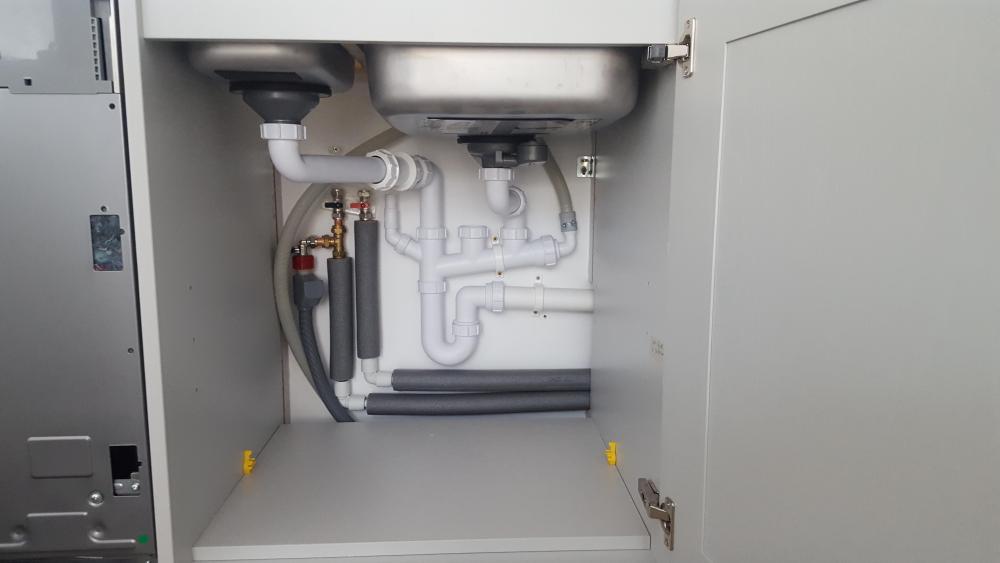
-
Yeah I'm exactly the same. I really do wonder how the word 'professional' ever became synonymous with 'good', 'quality' or whatever. Perhaps I'm just at the extreme end of the fussy spectrum but I seem to be always disappointed with at least something about the work when I have to get the pros in. That said, funnily enough the one guy I was 100% pleased with was the one who came out on Christmas Eve to unblock what we believed to be a shared drain, but turned out not to be but he unblocked it anyway and didn't charge us. For wholly-owned blocked drains I'd invest in a drain cleaner/unblocker hose attachment for my pressure washer. Costs a fraction of getting someone round and are handy things to have around. Fewer risks and a bit easier to use than rods too.
-
300kg or thereabouts I think I read/heard! That's a really good point, and having now looking at my previous peak-winter heating demands I see we can going through 50-70kWh/day (sometimes briefly higher) so it would certainly need day/realtime topups which would of course undermine the timeshifting benefits realised through its storage ability. Perhaps not so viable an option for me, and hopefully if we can get a few more years out of the current gas boiler it might become more obvious what its replacement should look like. My main concern is that I don't think we could make our radiators bigger without severely ruining the aesthetics, and not to mention the 10mm plumbing that serves the majority of radiators too, and so I am hoping that ASHPs continue to evolve such this might not remain an issue.
-
I searched before posting this and found a couple of threads on this product, but the latest was from back in 2019 which seems like a lifetime ago in terms of where the energy market has gone since... The 'ZEB' seems to be an electrically-powered thermal heat store which purports to store up to 40kWh of energy with cost savings promised by using low cost off-peak (or, more specifically, time-of-use) charging. It claims high compatibility with existing housing stock that might not be well suited to fully benefit from heat pumps that ideally require better insulation and larger radiators etc, and I am wondering if behind the inevitable marketing shine there might indeed be some merits with it? There's a video here which covers some aspects, albeit in not all that much detail, but it is presented by Kryten which I think is how it ended up in my Youtube feed! Does anyone know much about them? Like all things there will be pros and cons, but there are a few things about it that have intrigued me. Our gas boiler is 15 years old and so is sure to be on a countdown timer to eventual retirement and I've been thinking about what I might replace it with and an ASHP isn't looking too attractive given the small radiators and 10mm piping we've got here, and with the gas-electricity price differential now narrowing (factoring in off-peak electricity at least) I am wondering if something like the ZEB may turn out to be a possible candidate when the time comes? With it being such a simple single-box approach it looks like it could potentially be a DIY install too which greatly appeals to me, as does the presumably low maintenance overhead too? Would be grateful for anyone's thoughts!
-
I don’t think you’d really notice it, and you could always fit the dishwasher hard to the right and take up some of the excess with the door on the left. If you can see it then remind yourself how much worse would’ve been had it been the other way and you were a few mm short!
-
What type of joists?
MJNewton replied to osmononame's topic in Mechanical Ventilation with Heat Recovery (MVHR)
You can also get reinforcement plates that allow you to remove the entire web to quite a hole size (full height and at least 30cm a cross). Pricey but handy when/where needs must. -
Reducing heat loss through the keyhole of an exterior door
MJNewton replied to november romeo's topic in Heat Insulation
Whilst shouting 'Fire in the hole!!!', presumably? -
The thought process had barely lasted a couple of seconds before being aborted, but it was involving some combination of magnetic attraction of something-or-other coupled with perhaps a similar mechanism to how activated carbon filtration works. I don't think it's worth taking any further though.
-
And for a brief moment I was actually trying to work out how 'magnetic iron composite printer filament' could absorb moisture and almost had a theory in mind that I was comfortable with!
-
I don't yet have a smart meter so don't have first-hand experience but lots of people recommend the 'Bright' phone app which gives access to smart meter information (far more than most in-home displays). Not sure if it's live or only historical though.
-
What's the consensus on legionella and dhw storage temps
MJNewton replied to SimonD's topic in Boilers & Hot Water Tanks
Heat Geek did a video on this recently which may be of interest/help: https://youtu.be/oJeyc_cGIMU (Sorry SimonD, just reread your post and see you’ve seen this already!)




