
Dreadnaught
-
Posts
1819 -
Joined
-
Last visited
-
Days Won
5
Everything posted by Dreadnaught
-
 Basic question if I may. Anyone with an MBC-style raft will be able to answer in a flash I expect. With an insulated reinforced concrete raft foundation (200mm concrete over EPS), how does a conduit run to a kitchen island (or, for example, to floor sockets in the sitting area) for electrical cabling? Possible answer 1: does the conduit penetrate all the way through the raft and the EPS into the soil beneath, like a service penetration, and then re-emerge elsewhere in the build next to a wall? Possible answer 2: does the conduit penetrate laterally throughs the raft spanning from a wall to the island without penetrating the EPS?
 -
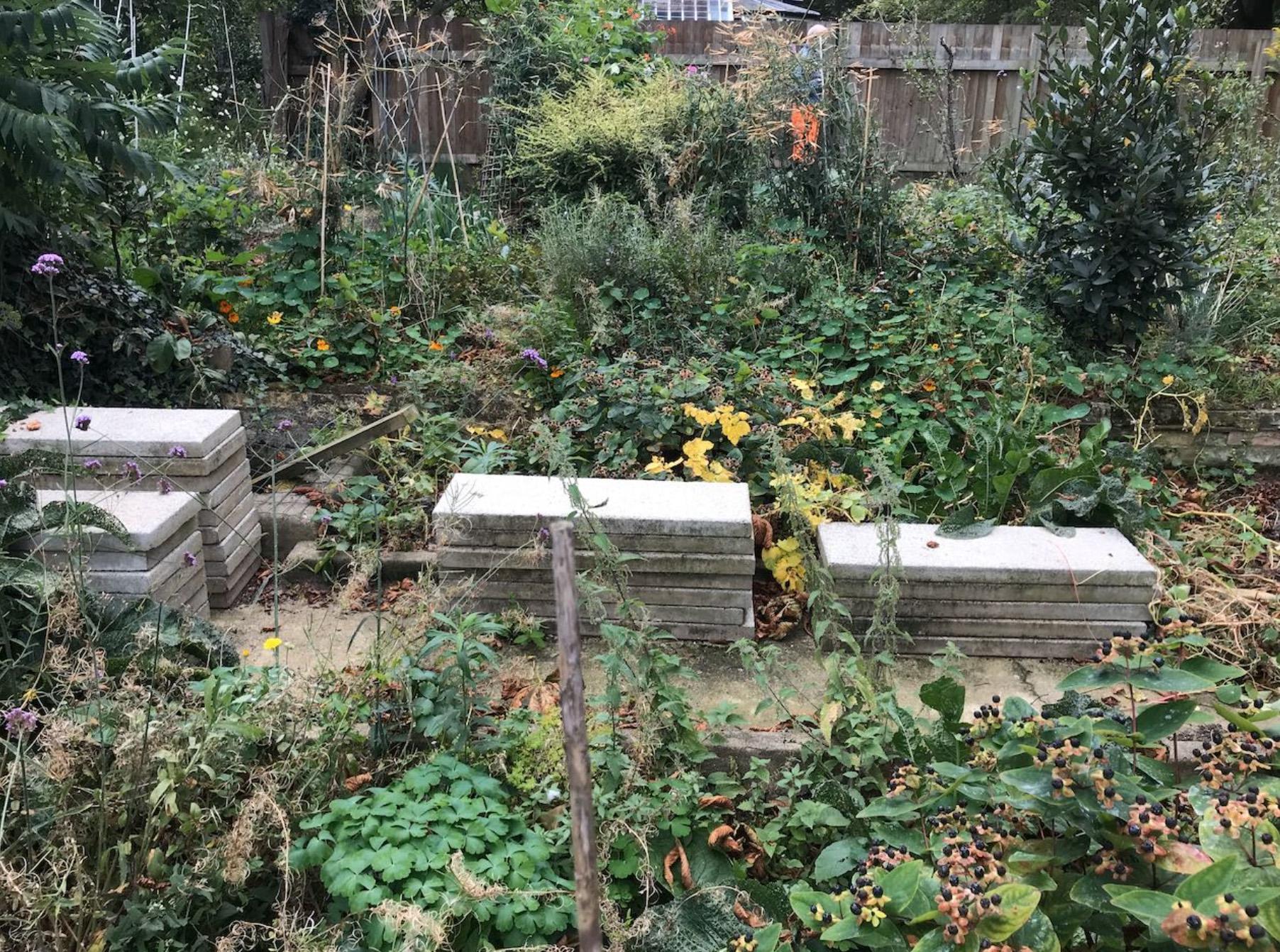
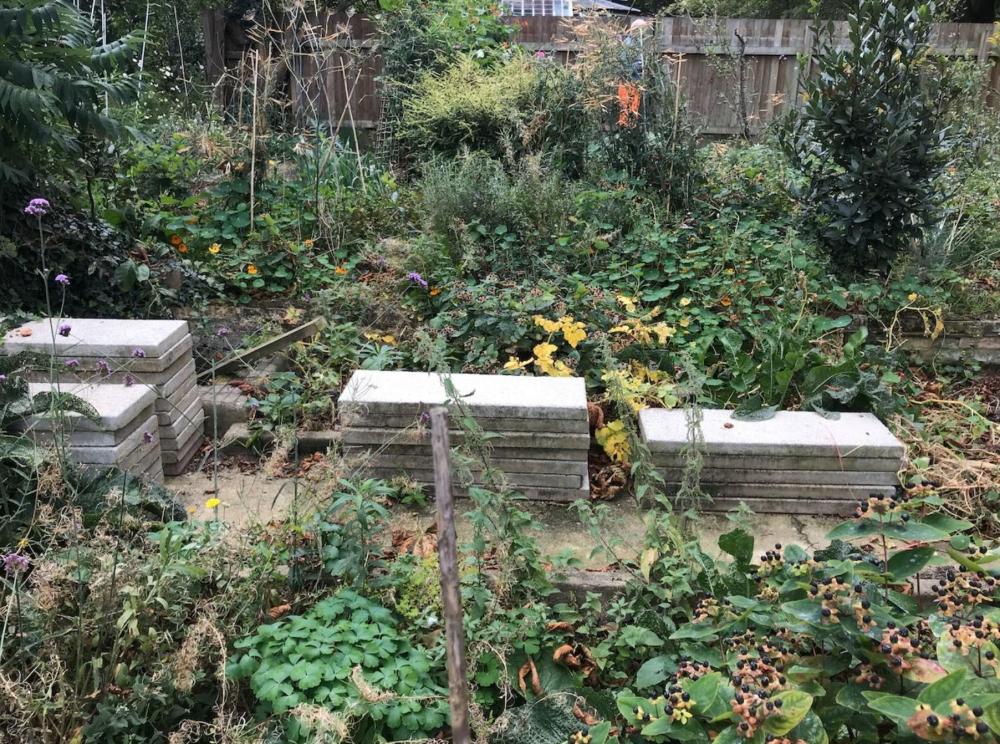
I am going spend a couple of days clearing my plot of vegetation. I'm not a gardener so any advice would be gratefully received. The photo gives an indication of the job at hand, taken last September. Its a rear garden plot so fill of small shrubs, bushes and paths, two small trees (which I can remove) but no grass. Thinking I will clear it now before the spring growth. I have no garden tools at all. The plan is to borrow secateurs from my mother, who has a shed full of vintage (non powered) tools. How to do it? I will be working alone. Snip all the stalks and pile the branches it to a big pile. Hire a chipper and convert everything into mulch? Or buy root membrane and pegs and cover the soil? Any ideas? I can't have a big bonfire as I am in the centre of town and the neighbours would throw me in the river. Many thanks!
-
Can you define a realistic outcome that you wish to achieve as a result of getting "formal"? Be as specific as you can. Work backwards from the outcome you want to decide on the course of action to achieve it. For example, do you want the current installer to go away but still pay you compensation sufficient to pay for a third-party to come-in, investigate and fix? Or are you looking for a way to pressure the the installer to come back and re-do the job again but properly? Or something else? The answer will define your course.
-
If you happen to be on a Mac and assuming the feature stands alone and does not overlap something else that you wish to retain as visisble then you can do it in the built-in Preview App using its annotation tools. Block-out the required feature with one or more white boxes. Print the document as a fresh PDF. Done.
-
Is there such a thing as a domestic doppler scanner (to detect fluid moving through the pipes)?
-
I thought the same, so it being work ideal for me. I asked a sparky if I could do this on my build and he was reluctant, saying he wanted the whole job.
-
Butlers pantry
Dreadnaught replied to Russell griffiths's topic in General Self Build & DIY Discussion
I'm planning one for my forthcoming bungalow. A pantry of storage shelves which will also contain the (inevitably noisy) freezer and so keep it out of the open plan kitchen/living/dining room. In the kitchen proper I will only have an under counter fridge (no freezer and so quieter). The pantry will also have worktops and a (second) sink. -
It sounds like most of your problems stem from the underlying timber frame itself being somewhat irregular, not a problem with Fermacel per se? Is that impression correct?
-
I agree with @epsilonGreedy. I'm following this thread with great interest too.
-
Hi @Sommy, welcome to BuildHub. I don't know if this model will provide you enough airflow but this is the model I am thinking of using for my forthcoming build: Cookology CDD900BK from here. There is also a model that includes a carbon filter if your hood needs to be recirculating, rather than venting to the outside. It states an extraction capacity: 700 m³/hr if that is helpful for you.
-
any ipad users here? I need some urgent help with email
Dreadnaught replied to ProDave's topic in Boffin's Corner
No, only Gmail. For any other mail, use the standard Apple Mail App (aka "Mail"), as you have done. By the way, there are third-party apps on the App Store that work like Apple Mail but I personally stick to using Apple Mail for everything except Gmail (as @Adrian Walker suggested). Edited to add: You can if you wish setup forwards in any of the email accounts to forward mail to any other of your email accounts, while retaining a copy or not in the original account. This could effectively simplify the arrangement to having a single account to monitor. Personally, I have (i) a work Gmail account, (ii) a personal Gmail account, and (iii) a personal non-Gmail account. I forward (i) to (ii) and use the Apple Mail App to monitor only (ii). In the Gmail App I only have (iii), which I like to keep separate. -
any ipad users here? I need some urgent help with email
Dreadnaught replied to ProDave's topic in Boffin's Corner
Try this… https://support.apple.com/en-gb/HT201320. And other helpful guides here about iPad things … https://support.apple.com/en-gb/ipad -
Counter Top Basins : snog, marry, avoid?
Dreadnaught replied to ToughButterCup's topic in Bathrooms, Ensuites & Wetrooms
Taps: protruding from the wall perhaps. -
Welcome! It will be interesting to hear how you find it as you go. On may build, which is starting in the spring, I am hoping to do quite a lot of the work myself too… but without the benefit of any of your building experience I hasten to add. Good luck with the planning!
-
Passivehaus / EnerPHit PLUS rating for generation
Dreadnaught replied to joth's topic in Photovoltaics (PV)
@Dan Feist, just checking that you know that Peter Warm developed an additional sheet for PHPP 9 for shading? It adds certain extra functionality which improves to some extent the basic shading controls, which are helpful if your site is tree-shaded. I used it in 2018 for my modelling and corresponded briefly with Peter about it then. Peter Warm's notes on the sheet: "An add-in sheet for PHPP 9, which allows you to easily model shading objects that are discontinuous and/or which have transparency. These include trees, tower blocks, brise-soleils, juliet balconies and plant-on glazing bars." Here is a link to download the additional sheet: http://www.peterwarm.co.uk/?dl_id=52 -
I've had it with steel rools
Dreadnaught replied to ToughButterCup's topic in General Self Build & DIY Discussion
Purchased on your recommendation. £13 from eBay. Thanks! -
(smart?) things that should be in every room
Dreadnaught replied to puntloos's topic in New House & Self Build Design
This sort of thing: https://www.aliexpress.com/item/10000003718589.html. Other (Chinese) brands are available. It works with DT82 curtain tracks. I hasten to add that I am still researching my purchase. Caveat emptor. Edit: to add that I think these systems are similar to the ones sometimes used in modern hotels. -
(smart?) things that should be in every room
Dreadnaught replied to puntloos's topic in New House & Self Build Design
Smart curtains/blinds? I'm eyeing up some automatic curtain-openers on AliExpress. I would an early adopter, at least here in Britain but am very tempted. They require power to the top of windows but probably not ethernet, relying as they do on WiFi instead of wires for smart control. They also require a special curtain rail but all-in-all they are not terribly expensive. -
Cabinet glass shelves light up green, any simple fix?
Dreadnaught replied to Wagas's topic in Kitchen Units & Worktops
A layer of enamel model-makers paint on the glass edge in a colour that matches the cabinets? -
The basics of waste-water plumbing… how many stacks?
Dreadnaught replied to Dreadnaught's topic in General Plumbing
Thanks @Temp. That's really helpful. I think the shower waste also explains why @PeterW suggested a second stack next to the shower (I was puzzling over it). On the 1-in-10 rule for SVPs, when I am next on site I am going go around the neighbours and see if I can spot any other local SVPs. The nearest boathouse has just been rebuilt. I hope that they will have one. On a related point, I recall a while ago that @PeterW implied that the waste from a washing machine was uniquely useful for keeping the drains clean. The regular outflow of soapy water (often containing digestive enzymes too) was ideal for the purpose. I was therefore attracted by the idea of a single stack with the washing-machine waste-water flowing past the WC. But I now realise that the longer run from the shower might then be a problem. I will now pay close attention to the shower wastes (both of them). And I assume I should also pay attention to the bath drain. Not as low as a shower but still quite low, especially as I plan to have a freestanding bath.- 10 replies
-
- 1
-

-
- plumbing
- waste water
- (and 1 more)
-
The basics of waste-water plumbing… how many stacks?
Dreadnaught replied to Dreadnaught's topic in General Plumbing
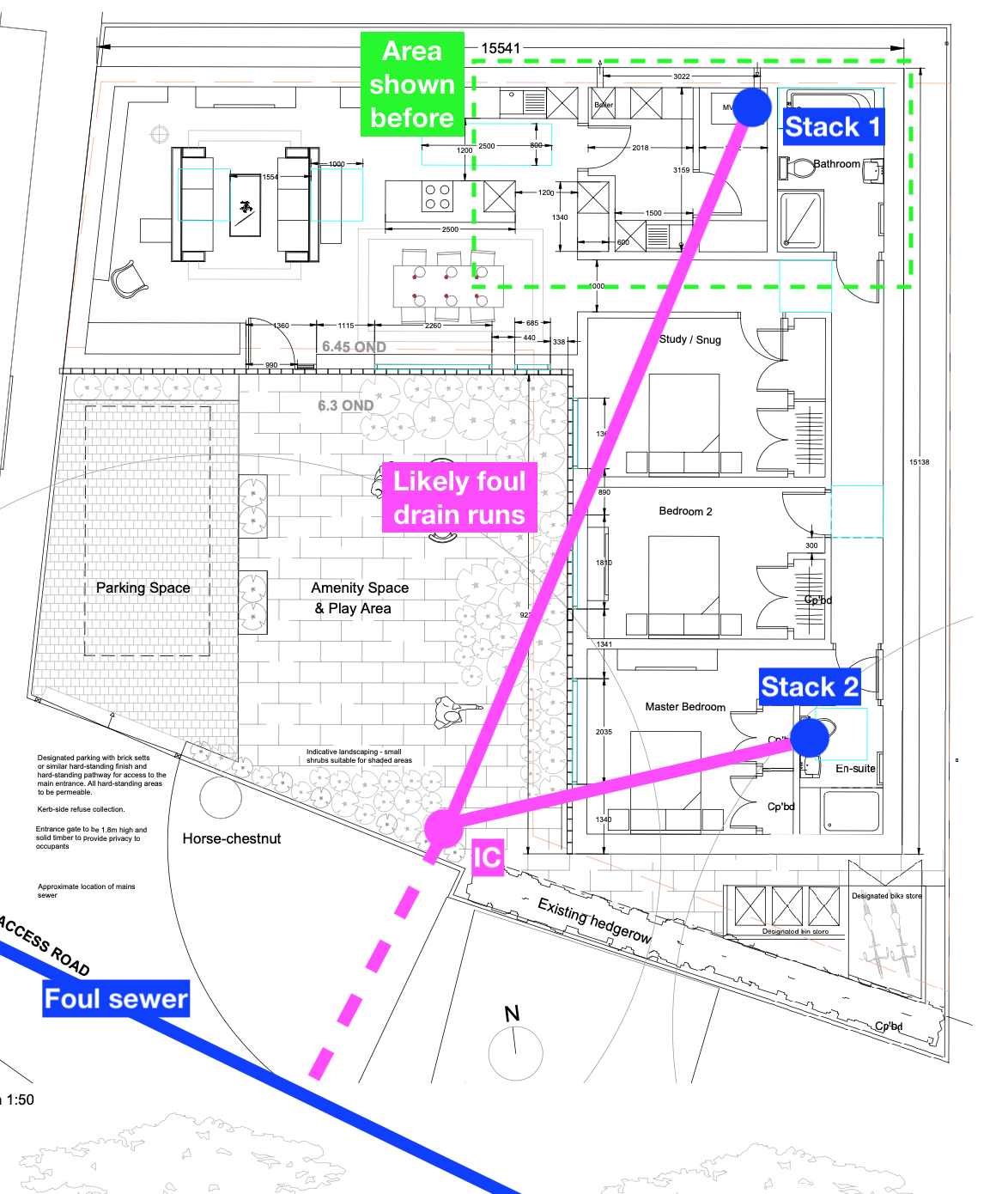
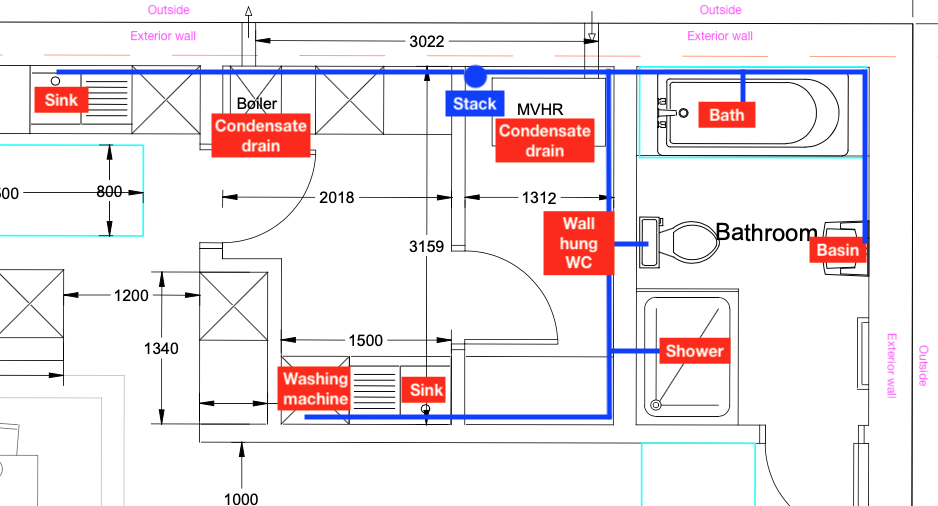
Thanks @Temp. Here you go … As you can see, I don't think I can avoid having the drain run under the house. I fully agree with having everything you said, including having the stack in the corner and using a radius bend. As I plan to be building my own partition walls throughout (using MF), I intend to build-in the wall-hung WCs. At Stack 1, the wall-hung WC will protrude into the neighbouring plant room. At Stack 2, I will do as you suggest and box it in with a half-height false wall with a useful shelf atop.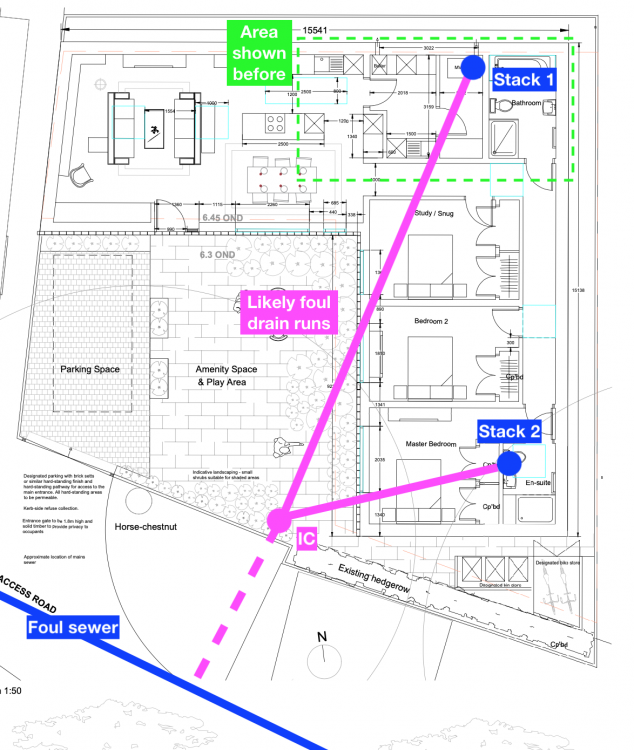
-
Can I run waste pipes (such as from a washbasin or sink) through the wooden I-beams of my exterior wall, which will later be filled with blown-cellulose insulation (Warmcel)? (I know its OK for water pipes. And only use a continuous pipe runs, so there are no inaccessible joints.)
-
The basics of waste-water plumbing… how many stacks?
Dreadnaught replied to Dreadnaught's topic in General Plumbing
Oh, by stack I meant a penetration through the concrete-raft (slab) foundation (i.e. the floor) by soil pipe which connects to an underground foul waste-water drain. I didn't mean an SVP (soil vent pipe). Did I use the wrong term? (Its a modern bungalow so only a single floor.)- 10 replies
-
- 1
-

-
- plumbing
- waste water
- (and 1 more)
-
Where do I need a slab penetration for a stack? I have this cluster of waste appliances (see diagram). Can I use a single stack for eveything or do I need multiple? And if so, where should it go? I have read Part H but I am still working out how things are implemented in practice. I suspect there is much wrong with this guess:
-
Thanks everyone. Helpful, thoughtful and thought-proving as always! This has got me thinking about gas too. What about gas? Would the same principle apply to bringing in the gas pipe straight in? Or is there some reason why that has to go underground?