
Dreadnaught
-
Posts
1819 -
Joined
-
Last visited
-
Days Won
5
Everything posted by Dreadnaught
-
Me I suspect not. Wisely or not, I am intending to use both (1) resilient bars in key areas; and (2) to use metal framing for all internal stud walls. I think both will necessitate screws.
-

Possibly interesting book for architects (and self-builders?)
Dreadnaught replied to jack's topic in Research Resources
And what on Earth is the "Mesh Energy Hierarchy" as mentioned in the ToC? Sounds like Doctor Who. -
Possibly interesting book for architects (and self-builders?)
Dreadnaught replied to jack's topic in Research Resources
Reviews please. 99p is a lot to stake without reviews -
Looking good! May I propose BuildHub-branded honey?
-
An update from the original poster here. Following my request on 15 November, and with just a little prompting, my local planning department has today confirmed that my planning fee will be refunded (via the Planning Portal). Thanks again everyone for your advice! What happened was that after I had received planning approval (I spoke at the planning meeting and witnessed the unanimous vote in favour) but before receiving the formal letter from the head of the planning department, my planning officer emailed as follows: Following your collective advice, I of course politely declined to confirm any such thing. And as soon as I received the decision letter, I emailed asking for my fee to be refunded.
-
@Russell griffiths, which boards will you be using, not Fermacell?
-
We need more ornamentation in our builds …
Dreadnaught posted a topic in Rainwater, Guttering & SuDS
Perhaps modern minimalism has had its day: time to embrace ornamentation again. And I love the hashtag #DotD (downpipe-of-the-day). And I'd love to have downpipes like this… -
@Visti, @Russdl, will you both be choosing square edged boards (over tapered edge)? Can see the point of tapered edge myself. It seems to a product only for those transitioning from conventional drywalling and used to tapered edge. And what did you think of using 10mm board vs 12.5 mm? I assume you are intending to use Fermacel everywhere, even on ceilings, in which case would have you ordered some 12.5 mm and some 10 mm? And you won't be using a different board for the first layer where you will be doubling up for acoustic reasons, such as Gypwall Soundbloc?
-
My situation is also different from yours @Visti if understood your intensions correctly, but I think closer to that of @Russdl. I intend to DIY the boarding of my house so choosing a board size that I can handle myself (or with one other) is paramount, whereas I think you are going to use a contractor team for yours.
-
Yes, I just chose the first supplier I found on the Internet (actually the second). Good to hear that I can probably get them cheaper from other suppliers. The intent was to start understanding relative prices of different size and thickness of boards. And of course, as I only used information from one supplier and one point in time, the results might be subject to one-off factors. Don't know how many boards I will need yet (I have not yet done my version of your earlier splendid spreadsheet) but if I remember the size of your house correctly my guess is that I will need about half your number.
-
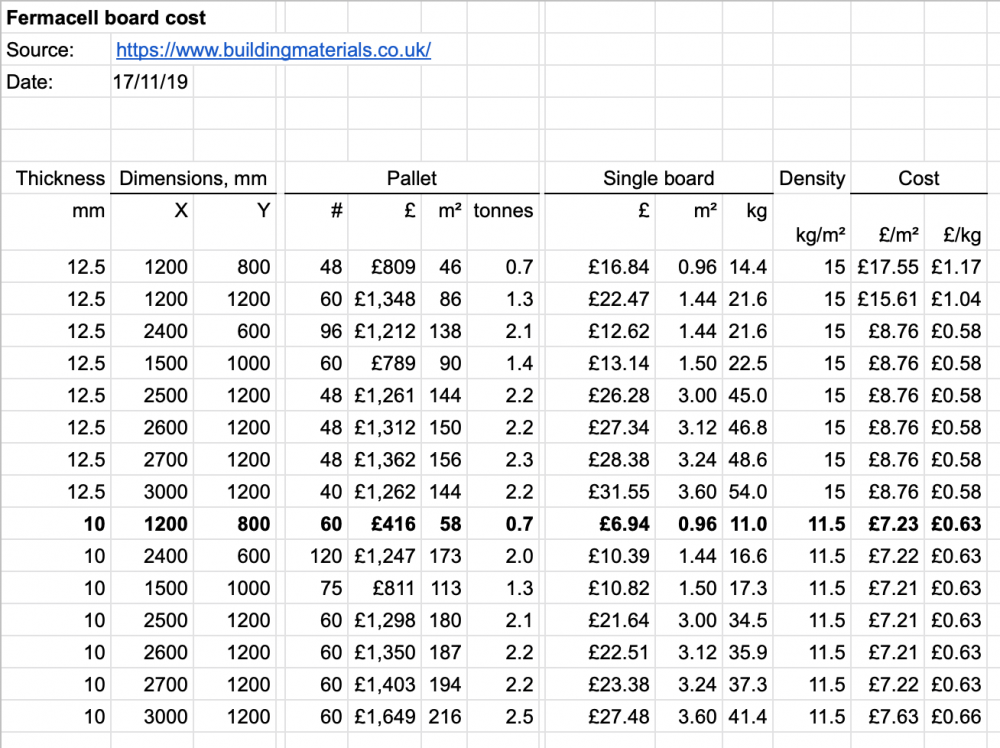
Here are the numbers I prepared:
-
I looked recently at Fermacel prices and prepared a small spreadsheet (see next post). I concluded that 10mm boards were probably the best option from weight and cost. And then I could double-up in locations that required higher sound attenuation. That way I could just buy a single board for use everywhere. The optimum board size and cost was: 1200 x 800 x 10 at 11 kg per board and £7.23 per m². A pallet of such boards was: 60 boards at 0.7 tonnes, so I am maybe thinking of getting them on the slab before the frame goes up (!) Interestingly, the one-man boards in 12.5 mm were much more expensive per m² as I assume they are a special order item.
-
I bought all my Philips Hue bits on eBay secondhand. I am trialling at present with just four bulbs, a switch, a motion sensor and the hub. Works well. I really like the idea that when I sell the house I just need to remove all the Hue bulbs, switches, motion sensors and other gubbins and leave with them all in a carrier bag or two, reverting the house lighting to a normal non-automated setup for the new buyer.
-
I am keen on having an automation system I can strip-out and take with me if/when I sell my house (or charge the buyer extra for if they want to keep it). Am thinking of going all-in with Philips Hue. Hue GU10 bulbs and normal bulbs in normal light fittings, down-lighters, lamps, both inside and outdoors. Hue motion sensors. Normal light switches present but blanked off, etc. I have been experimenting with a few in my current temporary house and found them to work remarkably well. I hope they will work as well when I have dozens of bulbs. And also hope I can find someone who will sell me the bulbs at trade rates for a bulk purchase.
-
MVHR newbie.. help needed
Dreadnaught replied to Savage87's topic in Mechanical Ventilation with Heat Recovery (MVHR)
A new technology coming to mobile devices soon (already in the latest iPhones and maybe non-Apple ones too, I don't know) is a more accurate way of positioning devices in 3D space. It is known as Ultra Wideband (UWB). Rather than measuring signal strength it measures round-trip time. I suspect it will have a wider and a more fundamental impact that we can presently predict. It could, for example, allow highly precise indoor mapping. I suspect home automation will eventually be transformed by it. The technology adoption cycle: the impact of technology is generally over estimated in the short term but under estimated in the long term. -
MVHR newbie.. help needed
Dreadnaught replied to Savage87's topic in Mechanical Ventilation with Heat Recovery (MVHR)
I wonder, do you think it might be possible to trigger the "away" low ventilation rate when you leave home using a smartphones geofencing? (On iOS, I already have a setup whereby the lights turn off when the last person leaves home. It might be nice to reduce the ventilation rate similarly too.) -
Ground floor for bungalow: joists better than a slab?
Dreadnaught replied to Dreadnaught's topic in Timber Frame
To support the point made earlier about other types of pile being cheaper than screw piles, I just had a look through my piling quotes and one company kindly gave prices for multiple systems for the same job, as follows (2018 prices; rough estimates only; only the piles themselves, not installation or other services): Screw piles: £8,400, requiring 30 piles to 4m. Steel cased driven piles: £4,600, requiring 20 piles to 6m. But vibration and noise. Hollow-stem bored grout injection system: £9,000+ and require 20 piles. As you can see, screw piles needed more piles as the shaft in comparatively quite slender so can take less of a load. It is also worthy of note that a ground beam, if needed, can cost more than the piles. -
Ground floor for bungalow: joists better than a slab?
Dreadnaught replied to Dreadnaught's topic in Timber Frame
Yes, makes sense. I have protected tree roots under part of my foundations and neighbours close by too so that weighs the decision in favour of screw piles. Indeed, in my case, screw piles were specifically mentioned in our planning application to persuade the tree officer to come on side. And for neighbours, screw piles are quieter and you can side step a Party-Wall agreement too, which is nice. -
Ground floor for bungalow: joists better than a slab?
Dreadnaught replied to Dreadnaught's topic in Timber Frame
Oh I suppose it depends on what you consider expensive. The budget estimate provided by the company I will probably use (which I admit is a little old now and needs refreshing) is £12,500 for the design, supply, delivery, plant, installation, and capping detail. This is for a modern bungalow of 125 m². I don't know how many screw piles will be used but I guess it will be between 15 and 25. -
Ground floor for bungalow: joists better than a slab?
Dreadnaught replied to Dreadnaught's topic in Timber Frame
Yes, in the example I watched welding was indeed prior to UFH-pipe laying. Yes. Its modelled thermally so the heat loss is quantified and the piles can be sheathed for their first section if needed. -
Ground floor for bungalow: joists better than a slab?
Dreadnaught replied to Dreadnaught's topic in Timber Frame
Yes, @Big Jimbo. Here's how it works: The screw piles are inserted and capped. (Which interestingly does not count as excavation for Party Wall purposes.) Then the EPS is built up as follows: The lowest level is CellCore HXS, which is a sacrificial honeycomb heave-protection layer (not primarily for insulation). This is in place of a void. Then on top of the CellCore goes EPS for insulation forming the usual polystyrene tray with edges in the usual way for a raft. Then rebar and mesh is arranged inside the tray for structural support. (And UFH pipes are attached to the mesh). And then, crucially, the rebar is welded to the top of the screw piles. Then finally concrete is poured in to the correct depth and levelled to form the raft. Thus the weight of the structure built atop the raft is transmitted through the piles, and not on to the ground surface. Makes sense? The various foundation companies have standard details for this. And interestingly one of the timber-frame companies I contacted was keen to do my build because they hadn't had a chance to use this approach so far, and it was attractive to them because they thought it should have wider applicability than it currently has for sites with difficult soil make-ups. -
Choosing a timber-frame …
Dreadnaught commented on Dreadnaught's blog entry in Under the Chestnut Tree
Yes @vk108, will do. -
I would guess it is lower incidence angle combined with shorter days. The panels being cooler will actually help the generation.
-
Ground floor for bungalow: joists better than a slab?
Dreadnaught replied to Dreadnaught's topic in Timber Frame
Thanks all! Good advice. Just spoke to the MD of a different timber-frame company this morning. When I mentioned this choice he also said emphatically to choose the concrete slab every time as it gives a much better result and he said it won't cost much more. And his company offers joist-floor solution! I will be visiting him next week and he said he has test-built examples at his factory of houses using both floor types to show me. -
Ground floor for bungalow: joists better than a slab?
Dreadnaught replied to Dreadnaught's topic in Timber Frame
This company is a specialist Passivehaus provider. I haven't got all the details but I assume the floor would be insulated like a wall, 300 mm or so of blown cellulose insulation between the joists.