ProDave
-
Posts
30682 -
Joined
-
Last visited
-
Days Won
424
Everything posted by ProDave
-
Hi and welcome. If you find my blog interesting, please read JSHarris's blog and many others as well. there is a wealth of information and ideas in all of them. +1 to roughly where are you, that might help with ideas for plots.
-
I was just thinking demolish the inner skin to floor level, not slab level, and build up from there? I have seen a 145 timber frame built up from 100mm block foundations but am sure that was just a mistake.
-
The giveaway is you don't hear other parts of the UK referring to a "building warrant" And the trouble with a building warrant, is you must build what the plans show. If you want to change the design e.g for insulated cavity block that will need re submitted drawings. Didn't whoever did the drawings address what to do and how to detail it at the transition where the original wall stops?
-
To meet building regs these days, you will need a 145mm filled timber frame, AND some sheet insulation over the inside of the frame before plasterboard. Personally I would take down the inner concrete block skin and fit a timber frame from floor level inside. P.S Do I take it you are another from Scotland?
-
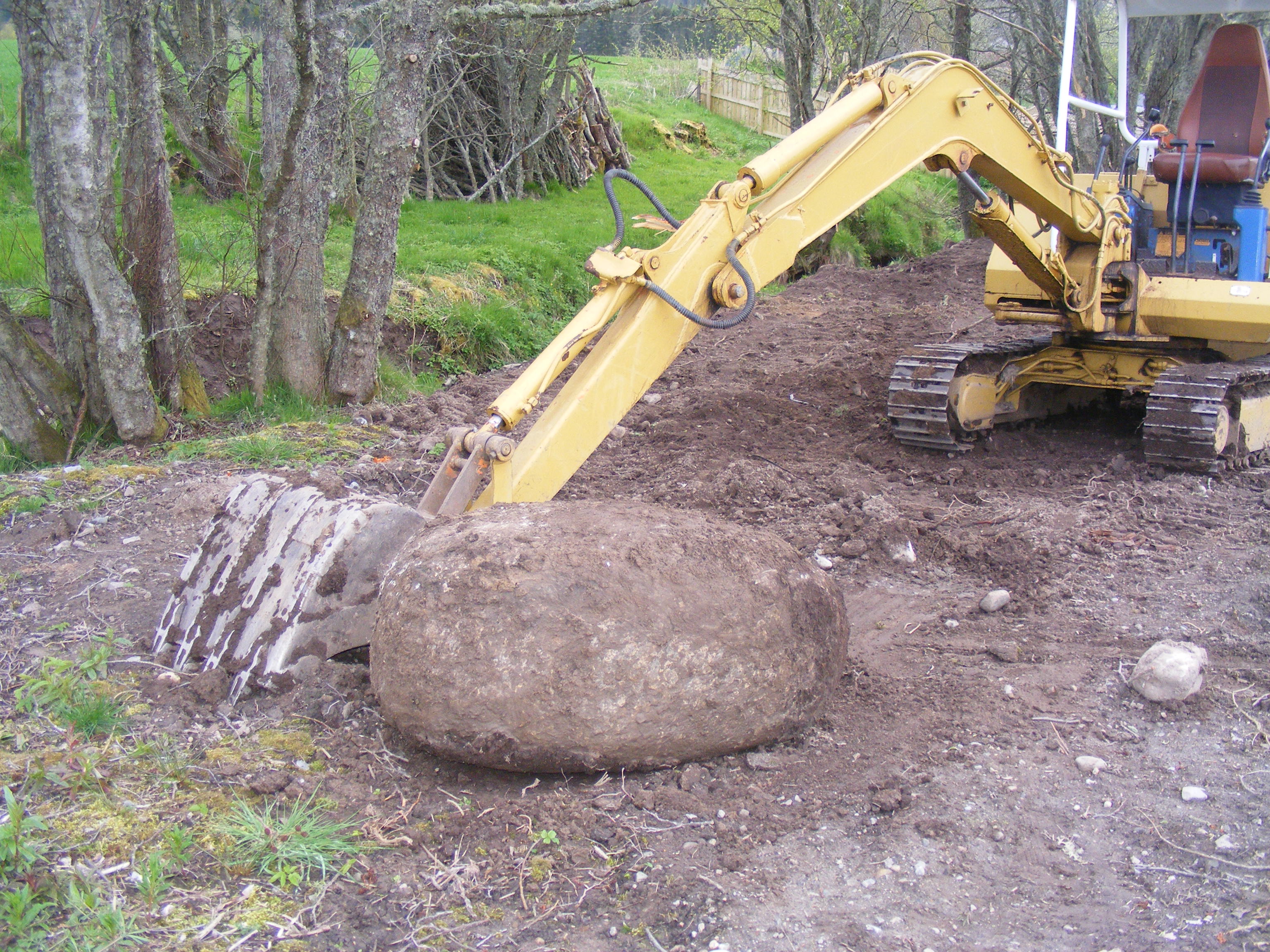
That must be a biggie if a 13t machine won't shift it. Even my little 3t machine lifted this one (that's a 2ft bucket to give some scale)

-
Does the house you want share the same footprint as the one already approved? If so I would demolish the old, install the foundations (to lock in PP) then apply for the new design.
-
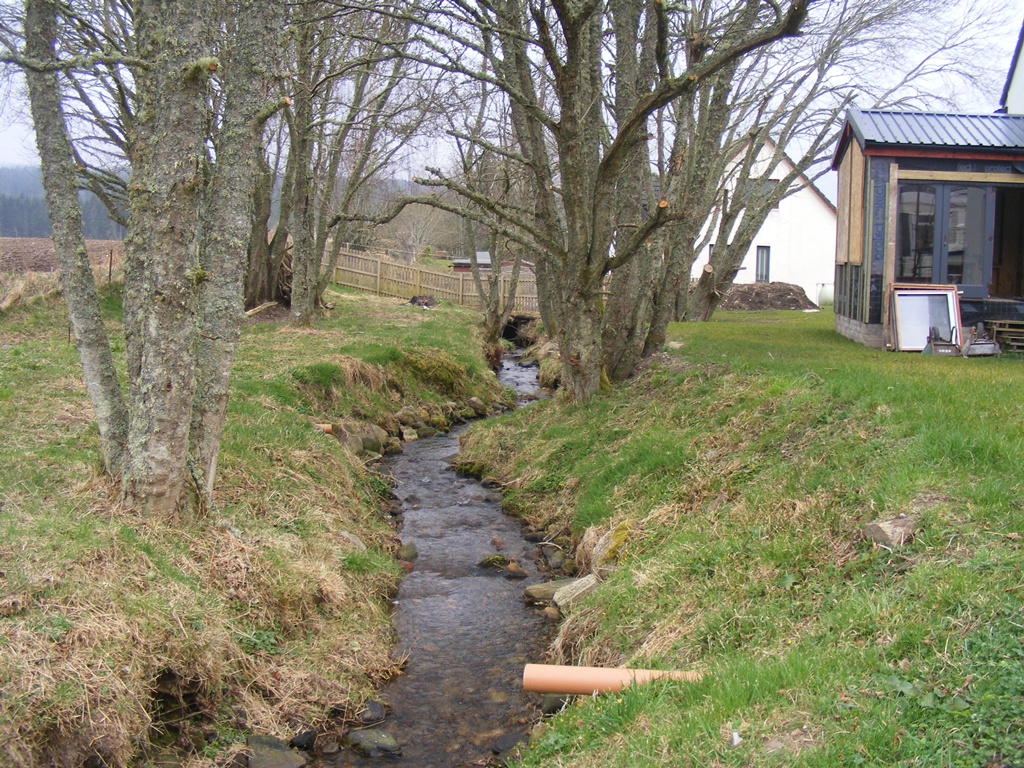
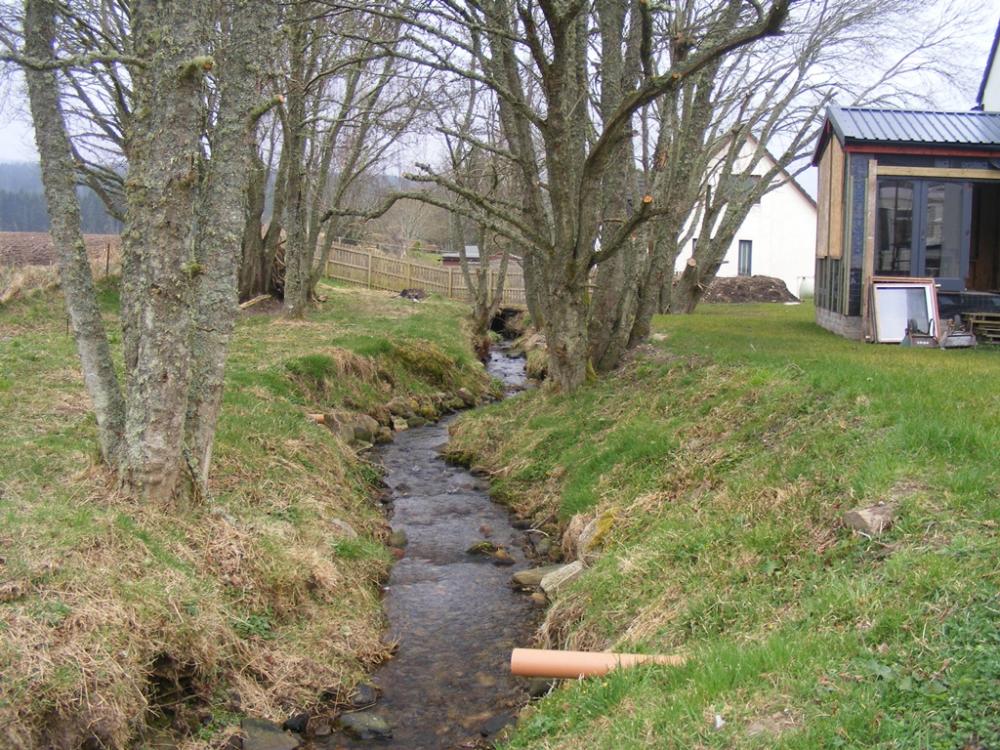
 My thoughts entirely. If you wanted a house with a large flat garden, why would you buy one that has a burn running across the garden with the ground rising steeply the other side? I agree it's a lovely feature to have and I would not want to hide it. What's not to like?
 -
Well I thought I would update what happened. My neighbour "digested" the SEPA document I gave him. No pipes turned up. 2 weeks later the digger was taken away having done nothing. I am now billy no mates. I walked down the road while he was out at his van the other day, and barely got a grunt to acknowledge I was there. ~Normally he would have a good chat. At least I don't have to worry about being flooded.
-
That sounds very much like our burn More like about 3 feet wide when it's in a nice mood like that, but it can come up a lot and then flows very fast. Our house is probably closer than yours will be, and our floor is also bout 2 metres above the water. Plenty of places for it to flood to without causing problems.
-
Graf waste water treatment plant, any thoughts?
ProDave replied to joe90's topic in General Self Build & DIY Discussion
underneath an upturned plastic dustbin then just to get it working for now. Graff do a waterproof kiosk to house the blower, I have one of those coming up soon to wire. https://www.drainagesuperstore.co.uk/product/graf-one2clean-external-cabinet-upgrade.html -
As long as their is room for the plumbing. Ours is in the airing cupboard, built around it once the tank was in. We have 250L. SWMBO has showered until it went cold, then complained the tank was not big enough. Don't under estimate how long a woman can spend in a shower.
-
Graf waste water treatment plant, any thoughts?
ProDave replied to joe90's topic in General Self Build & DIY Discussion
The Graff units mount the pump remote from the tank, so you just need to find somewhere to put it, e.g a shed, put a plug on the flex and plug it in. -
Air blower treatment plants - power consumption.
ProDave replied to ProDave's topic in Waste & Sewerage
I don't know if the Graff works on a timer, or pressure. The pipes from the blower pass through the control box so it may be reacting to pressure changes, or that might just be to detect blower failure. It will be interesting to see if those timings are repeated. -
Air blower treatment plants - power consumption.
ProDave replied to ProDave's topic in Waste & Sewerage
Further to this. Where I was working today, they have a Graff treatment plant. That has the air blower mounted remote from the plant, in this case in the garage. The garage was serving as the site tea hut, so during lunch, I observed the blower was running for 5 minutes on, then 10 minutes off, -
+1, PROVIDING it's done by a good spread. If there is any doubt, ask to see a job he has done to check his skill. We are intending ours to be plastered.
-
A first time builder making a timber frame home
ProDave replied to climbinggeorge's topic in Introduce Yourself
A ridge beam is a large beam running the length of the ridge of the roof. The two sides of the roof are hung from and supported from this substantial beam. It means there are no other cross timbers or trusses supporting the roof. Combined with a warm roof (insulation at roof level) means the entire volume of the building is free to use as you wish. Have a look at this page of my blog http://ardross.altervista.org/Wilowburn/insulating-the-roof/ 4th picture you can see the ridge beam, and there are pictures of the mezanine we have formed from one bedroom. -
A first time builder making a timber frame home
ProDave replied to climbinggeorge's topic in Introduce Yourself
Hi and welcome. That sounds like a fantastic chance to self build your first home. Something I wanted to do 30 years ago, but back then I could not find anyone willing to lend me the money to buy the land, so had instead buy a grotty little starter home and save my self build ambitions until later in life. There is no need to compromise insulation to get a mezanine. Build a warm roof, supported on a ridge beam and the entire interior of the house is inside the insulated and sealed envelope of the building. In fact now we have just done that, I think it is in so many ways superior to putting the insulation at ceiling level and having a cold loft, and then trying to seal that cold space from the rest of the house. Your budget should be doable if you can do a lot yourself, it's the sort of build cost we are trying to achieve. Lots of options. A timber framed house does not have to be clad with bricks or blocks, ours is clad with wood fibre board to add more insulation and then rendered. -
There is no such thing as "The Scottish Scheme" * Unlike England and Wales, there is no "Part P" to the building regulations. All that building control require for completion sign off is a Electrical Installation Certificate as defined in BS7671 I have done this several times now in this situation of the original electrician either having gone AWOL, or (more likely?) never existed in the first place. To solve this, you need to get an electrician to issue a "3 signature" version of the EIC form. This has one signature for design, one for installation, and one for inspection and testing. I only ever sign the inspection and testing part of the form (I can't sign the other bits as I did not do them). I then tell the client to get the original installer to sign the other 2 parts. I strongly suspect (with a nod and a wink) that those parts might (cough) not actually be signed by the person that did the original work. But building control accept it. After all, they only want a bit of paper to say it is safe. * Scotland tried to introduce a "Certificate of Conformity" scheme a number of years ago. As far as I can tell it fell flat on it's face. It was a purely optional scheme that if you registered with an approved body then by using a COC acredited tradesman, you got a very small reduction in the cost of the building warrant. Because it was an optional scheme, and the costs of joining it were high, I never bothered. I continue, just as I always have, to just issue an EIC and the three different council's who's areas I work in (Highland, Inverness-Shire and Moray), all still accept this for building control sign off.
-
Dowsing rods. And no I am not being silly.
-
Another vote for a rotating laser level and measuring staff with laser detector. This is what my builders used, checking the level about every foot or so as they went along with a rake leveling it.
-
Yes indeed what a saga. I guess you took a risk by "starting" before all the pre comencement conditions were signed off, and got away with it. I guess the worst thing that could have happened was they could have issued a stop notice, but the important thing was you got it far enough for building control to agree it was "started" without issue from the planners. Let's hope the rest of the build goes more smoothly.
-
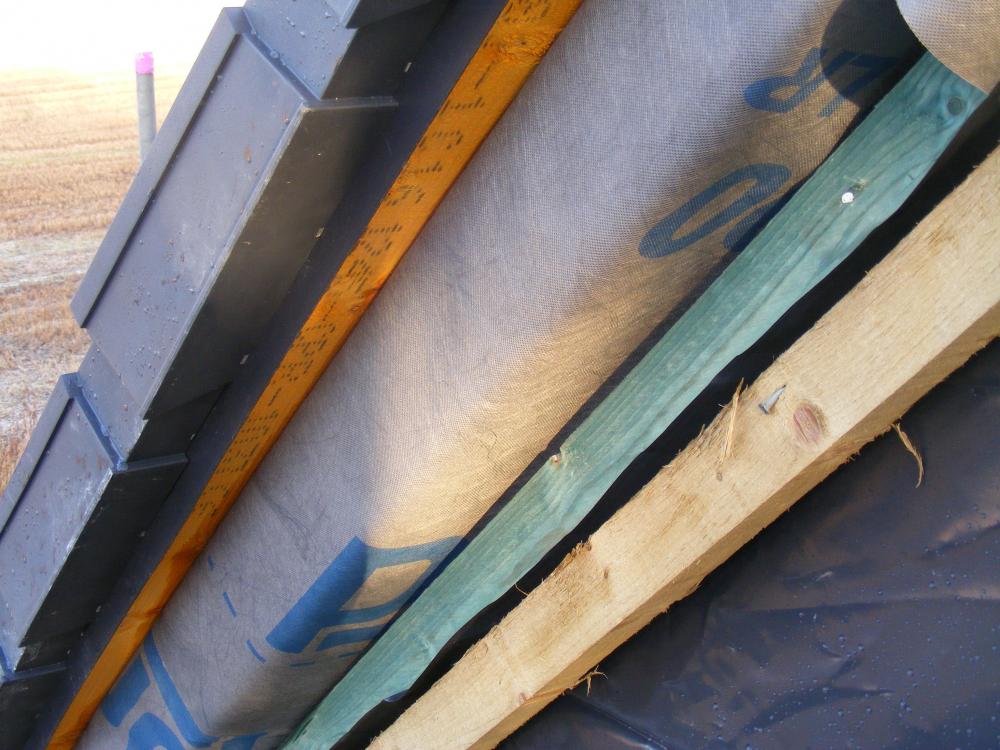
We had a similar detail issue. In my case I am wanting to avoid all exposed woodwork, and eventually the fascias will be clad with aluminium. On my gable end, the verge cloak fittings were not quite large enough to cover all the wood, so I fitted a plastic drip bead to keep any blown water off the wood, but it has the effect of making the water run down the drip bead rather than drip off (that detail is irellevant for me, as long as it keeps it off the wood) This photo was taken before the cladding and render were fitted. The drip bead is just a strip of plastic fitted before the cloaks went on. The under side of the timber is still exposed but that has now been treated but it never gets wet anyway (thanks to the drip bead)
-
Hi and welcome (back) That looks a good project. We look forward to hearing about your year long planning battle.
-
Renting an anemometer
ProDave replied to Jayobn's topic in Mechanical Ventilation with Heat Recovery (MVHR)
I was watching a "professional" ballance an mvhr system just last week. The device he was using was a wind vane anemometer, the sort with a small fan blade to measure the wind speed remote from the instrument (on a short curly cord). This was attached to a large square "funnel" large enough to go over the external intake and exhaust vents (the flower pot idea should work just as well). He used the same attachment for all the measurements including from the internal vents. -
Getting the phone connected at my new house...
ProDave replied to ProDave's topic in General Self Build & DIY Discussion
Hr said that's a topic we will address once the line and broadband is complete, so on the agenda for this week I believe.