ProDave
-
Posts
30688 -
Joined
-
Last visited
-
Days Won
424
Everything posted by ProDave
-
Glad you have found the leak, but I would be worried by a design that relies 100% on mastic. It should be designed so that components overlap correctly so water runs off not in, and any mastic should be for good measure.
-
That does sound a lot for 3 windows and 3 large door sets. My guess is the doors are the expensive bit. I paid about £8K a few years ago for one French door pair, two single doors, and 10 windows of varying sizes. The first price given was not their "best price"
-
Newbie: Self Build in Dunlop, East Ayrshire
ProDave replied to Ayrshire_Bill's topic in Introduce Yourself
Hi and welcome. You might find planning won't allow full 2 storey, they won't here, but at least worth asking them. Otherwise stretch the definition of 1.5 storey as far as they will allow. Most of us found ASHP's make better sense. they are so simple and easy to fit. There is a LOT of extra work and cost (and ongoing cost) for a GSHP and it is doubtful the small improvement in eficciency is worth all the extra work and cost. Even having my own digger at the time I decided GSHP did not make sense. If you are getting close to passive house levels of insulation and air tightness then like many of us, you won't need any heating upstairs. Ours is a bespoke build pretty close to passive house standard, quote well air tight and mvhr fitted. Not only will mvhr reduce your heating costs it will also give you very good air quality inside. I had a minor falling out with Scotframe as I wanted better levels of insulation than they offered. And as soon as I mooted the possibility of having one of their builds and adding extra insulation to get to the level I wanted, they halted the discussion. -
You should find the joists / rafters above and screw a batten into those, to which you can fix your curtain rail.
-
New member, renovating a stone croft house!
ProDave replied to MMeNDtal's topic in Introduce Yourself
Hi and welcome. We already have another member from Shetland @Hobbiniho I wonder which of you is the most northerly? That looks a nice house, in generally sound condition. I have worked on plenty of these, which were the "standard" house construction for a long time up here. Most renovations of these are as you suggest, an internal timber frame with insulation not touching the outside walls. The problem with this is you create a "tent" inside the house and the void between the frame and the stone is cold because it must be ventilated. Most people fail miserably on the detail, e,g remove a switch or a socket and you are greeted by a howling cold gale blowing in. If I was doing this, I would make the insulated timber frame, and then seal the inside with air tightness membrane taped and sealed, and then create a small service void inside that for wiring and plumbing without letting the cold air in. The performance of the house will be down to how thick you make the frame and how much insulation you fit. Sadly most builders seem to think 25mm of kingspan is okay and 50mm is fantastic. I would be aiming for a very minimum of 100mm if not more. The other thing I would do in the part of the roof that forms the sloping coombs, is I would sister some more timber onto the rafters so you can get a decent level of insulation in there while still maintaining a ventilation gap between the insulation and the sarking board. That looks a very small stair opening, it must have had a near vertical ladder originally? -
Phone your local emptying companies and ask them. The crucial thing is how much hose they carry or can carry. Ours is only 5M from the road and they usually use just 2 lengths of hose and they have at least another 2 lengths, so 10M should be okay, but I suspect 20M would be more than they routinely carry with them.
-
I am one hoping to come in at a finished price of £1000 per square metre. Just to warn you, I am into year 5 of the build as I have been doing so much of it myself.
-
Advice on installing roof window please
ProDave replied to mersu's topic in Skylights & Roof Windows
That roof is seriously out of square, what's going on? -
I didn't realise your panels were so new, I thought they were on the house when you bought it? So no FIT for you then?
-
Solar PV and immersion diverter advice please
ProDave replied to jamieled's topic in Electrics - Other
A quick search finds this one https://www.ebay.co.uk/itm/Solar-iBoost-Free-Hot-water-from-your-PV-Solar-Array-Immersion-controller/123863648409?_trkparms=aid%3D1110001%26algo%3DSPLICE.SIM%26ao%3D1%26asc%3D225114%26meid%3D29b39850189049778a4f90ca1f0dc22f%26pid%3D100005%26rk%3D10%26rkt%3D12%26mehot%3Dpf%26sd%3D282178038088%26itm%3D123863648409%26pmt%3D0%26noa%3D1%26pg%3D2047675&_trksid=p2047675.c100005.m1851 It has a wireless sensor. It would be worth digging into the specs to see what it's range is. that might save having to run a cable to the meter box. It says "The distance between the water tank and utility meter is less than 30m." so it might work for you with no extra wiring. -
Solar PV and immersion diverter advice please
ProDave replied to jamieled's topic in Electrics - Other
Find out what solar PV diverter you will be using first. I am out of touch with what is available. -
Solar PV and immersion diverter advice please
ProDave replied to jamieled's topic in Electrics - Other
I am staggered that your electrician can't or won't do this. It is just a radial circuit from the consumer unit to the inverter, with an ac isolator switch and a generation meter. And a DC isolator switch between the inverter and the panels. If your remote meter is in a decent cubicle it could remain there, mine is about 20 metres from the house. As for the PV diverter. That will have a current clamp on one of the meter tails. Even if the meter is still in the remote cabinet, that can be fitted in the house, as long as the external meter box does not feed off to other places, just the house. If like us, the external meter box feeds to other places, then the current clamp would have to go in the outside meter box. I provisioned for that by laying a length of spare SWA telephone cable to the meter box. Before you go any further I would choose which PV diverter you are going to use. Others will have to recommend one as I made my own. You will need to register the PV with your DNO and they will need a bit of paperwork, including a schematic of the instalation. -
I once saw what looked like a pretty standard small dumper with a back hoe on it. At first I thought what a neat idea, until I realised there was no way it could self load.
-
Is there anywhere on the site to use the excavated soil? I used all ours to raise the ground level of the lower parts of the site, no muck away at all.
-
£55 for an 84 page book actually makes the wiring regs book sound like good value. When I needed is similarly expensive but even shorter BRE book, I went to our local library and borrowed it on an inter library loan, it cost me just over £1 in postage costs to do so. That would be my advice for something you only want once.
-
I do agree it was probably the wrong place to build a house, but was just pointing out it has not "flooded" i.e. the water level is not above even the garden level (what is left of the garden) let alone the floor level. Had the river bank held, there would have been no story. I also agree the local planners and appeal both made the right decision. Do buyers of new builds never look at the planning history? If I saw it had twice been rejected due to flood risk, I would not have bought it. It reminds me of this one https://www.pressandjournal.co.uk/fp/news/aberdeenshire/795497/abergeldie-castle-brink-fearsome-river-dee-closes/ Abergeldie Castle nearly suffered the same fate in 2016, but it did not collapse, the bank did not erode quite that far, and I believe they rebuilt and shored up the riverbank and it still stands today. I suspect this house won't be as lucky. In that case 60ft of riverbank and several mature trees were swept away. They probably thought 60ft from the river was safe.
-
I chose the all GU10 LED option. And in 2 years have not had a singe failure. I like the ability just by choosing what lamp, to have different brightness and colour. I have fitted (for others) many of the LED flat panel fittings. They do seem to work very well indeed and give a nice light. But my concern would be, are they still going to be available in the same size and style in 10 years time? I would pretty much guarantee the humble GU10 or MR16 lamps will be. So if I were fitting flat panel fittings, I think I would want a good number of spares just in case.
-
To be fair, this house has not flooded. It is in danger of being swept away as the river bank has eroded, so was it built too close to the river or was the failure of the bank unforeseen?
-
I would extend the pipe up above the WC and fit the AAV there. There is a risk of sucking the water out of the basin trap when you flush the WC.
-
There will only be the one central adjustable foot. The rest of it is supported by screwing to the wall. That one foot is made up from bits in one of the various "useful items" hoards I have, Just a foot from something, screwing into an aluminium spacer, and a handy bracket to attach that spacer to the underside of the timber.
-
Be careful the cost of the battery and periodic replacement of it does not end up making your "free" electricity cost more than from the grid. Look at NiFe cells. Very long life and very forgiving. I might experiment with a small battery system based on those eventually.
-
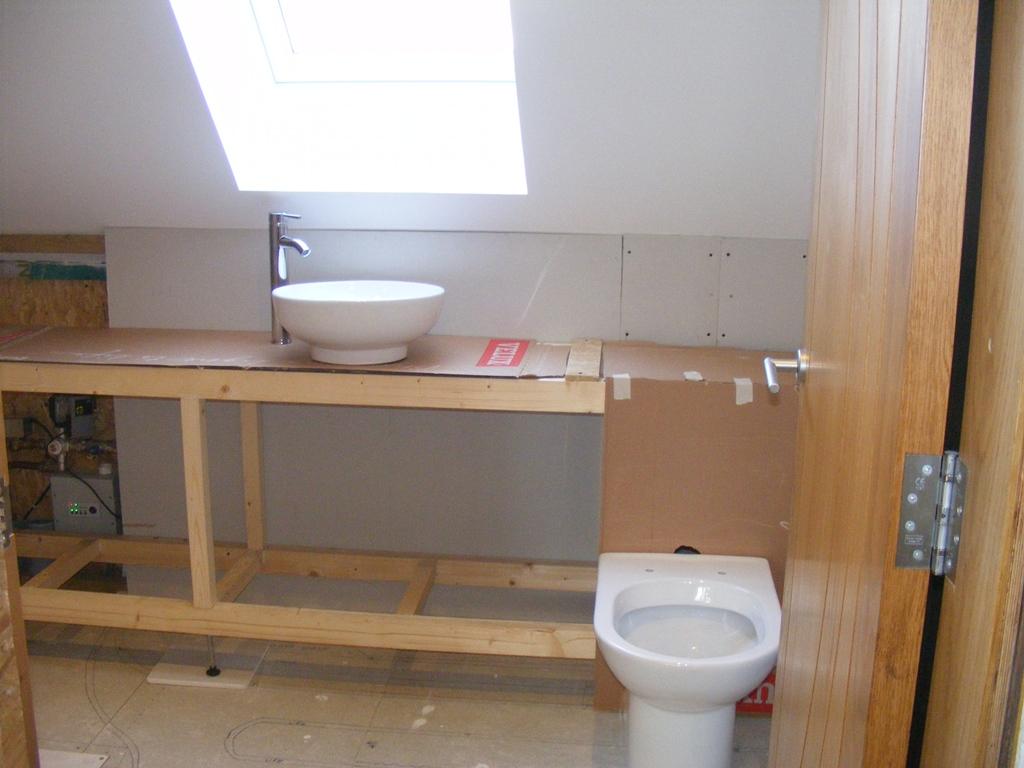
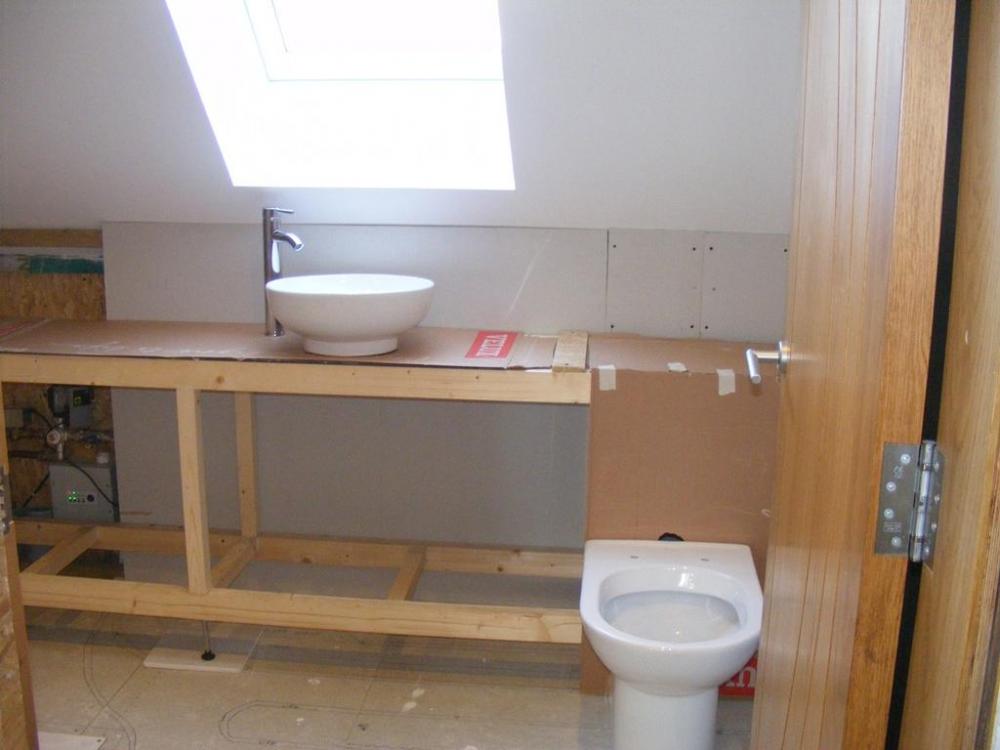
Getting further. That's the main framework for the base unit built. There will be a slatted shelf along the bottom and the wood will be painted. Worktop all across the top. the bit behind the WC will be boxed in with Multipanel to match the walls. An access hatch will be provided at the right to access the WC cistern and at the rear left to access the UFH manifold. It is being built to look a bit like a free standing bit of furniture but it will be very much fixed in place. Latest CAD model for the next "design review"
-
'you've got a problem'
ProDave replied to Simplysimon's topic in General Self Build & DIY Discussion
So the architect cocked up. The steel beam that is the cause of the issues can't be shown on the drawing or is shown in the wrong place. This is way beyond a few mm drawing tolerance. I would be saying "you designed it to fit that window, you make whatever aerations are required to fit that window, at your expense. As it is, you have a house built that does not match the drawings by a long way. Are you happy with that?- 14 replies
-
- 1
-

-
- architects
- mistakes
- (and 1 more)
-
I had a call today. The plumber tried to start up the heating today but it kept tripping. when i wired it I connected it to a B32 mcb as that was all I had, but every time the compressor tried to start the mcb tripped. so I went over there this afternoon and swapped it for a C32 and all is well. The operation as I suspected is very basic. By default it has a target temperature of 55 degrees for the buffer tank and it runs the HP continuously until that is reached. It then turns off until the buffer tank temperature drops to 50 degrees when it re starts. The highest running current I measured was 19 amps, which is a power input of about 4.3kW but more typically it was running at about 14 amps or 3.2kW input power.
-
Personally I have never seen the need for a dimmer in a bathroom. I would just put it back to being a normal switch, particularly as we now know the fan is on the dimmer.