ProDave
-
Posts
30688 -
Joined
-
Last visited
-
Days Won
424
Everything posted by ProDave
-
LG Therma V mono block Air Source Heat Pump
ProDave replied to ProDave's topic in Air Source Heat Pumps (ASHP)
Hi Mo679 I only tried mine in cooling mode once, last summer in a really hot spell. It was only "rigged up" to test it and not properly engineered. To do it properly I need to source a couple of fan coil units, add some more plumbing and another motorised valve and change some of the control wiring. So I never got to test how well it modulates. Interesting (and good) that your unit is working reliably. I am particularly interested to know if your setup uses the room thermostat input to the heat pump or not, as that is what appeard to be the source of my problems. -
Digging and swapping soil for sand - work estimate
ProDave replied to ReX's topic in Landscaping, Decking & Patios
What weed killer have you been using? A Glyphosate weed killer e.g. gallup360 should kill those. -
You could always be creative and replace the entire roof, with the part level with or behind the principle elevation pitched, and the portion in front of the principle elevation still flat at the original height. At a previous house I had to go to appeal to get a garage in front of the principle elevation.
-
About £1000 for SSE in the north of Scotland, to connect to an existing cable literally in the verge on the other side of a single track road. the road crossing was done by others so not included. This was a revised price, after other work had been done and I had already opened up the connection pit in the verge and laid a dict with draw string all the way from the connection pit to the meter box, so it had reduced their work to just pull the cable through and make the connection both ends. I then filled in the connection pit.
-
Examining the 'house sandwich' - working with 8250mm
ProDave replied to puntloos's topic in New House & Self Build Design
Just don't mention the loft, you don't even need to tell them you are using attic trusses, that's only building control need to know that. Just show "loft" on the plans with just a loft hatch as access. No, I really don't think the planners care about the volume of a loft space. If you think they do, then show me a planning clause in your local plan that says you cannot build a house that has a loft space that is large enough to convert at some time in the future. WHEN you choose to convert the loft is when the planners will look at it and decide if there is a planning reason why it cannot happen. -
Scottish Water, north of Scotland. connection to water main the other side of a single track road and about 3 metres into the field, was about £1000 for the connection including all fees, and another £1000 to make the road crossing (which was also used for other services) No main drainage here so private treatment plant.
-
Yes I used Multipanel in 1200 wide by 2400 tall sheets. They were about £100 each from Jewson to order, WAY cheaper than the same thing in any of the bathroom shops. If you need to cut any, as I did with a "room in roof" bathroom, I templated first with large sheets of cardboard, get that right then use that to mark the real panels for cutting.
-
Examining the 'house sandwich' - working with 8250mm
ProDave replied to puntloos's topic in New House & Self Build Design
I appreciate that and of course the LPA will need to know if you convert the loft later. But my point is the OP thinks PP will be refused if they think there is a chance the loft could be converted later. I don't think that would be the case. -
Extension built smaller than plans
ProDave replied to oldoaktree's topic in Party Wall & Property Legal Issues
Check the measurements. Is the external dimension correct? Are the walls the correct thickness? Did the architect draw the walls too thin? Was the drawing size even possible? Before going in all guns blazing, you need to find the cause of the error, which wall is wrong, is it a building error or drawn impossible to build? Only when you know what is wrong can you start the discussion. you don't yet know who to get angry with. -
Final part of loft insulation
ProDave commented on MikeGrahamT21's blog entry in Back on the self-build waggon...
I have seen plenty worse, but that is not good. All junction boxes that are hidden should be maintenance free which means Wago or similar and must be inside a junction box rather than just open connections. You will need to leave gaps around the downlights, which is one reason I personally hate them in a ceiling with a cold loft space above it. -
Examining the 'house sandwich' - working with 8250mm
ProDave replied to puntloos's topic in New House & Self Build Design
Design for what you want. Planning won't be looking for "oh my god they could convert the loft" Height of roof is dictated by size and pitch. Just choose those so the loft is tall enough for rooms, and choose other ceiling heights for what you want. Build the roof structure with attic trusses properly designed for the later loft conversion. Planning don't need to know you are doing that, that is a building regs issue. All planning need is the size pitch and type of tile not how the roof is physically constructed. Better still build as a warm roof from a ridge beam and you have so much more flexibility. Build in structural openings for roof windows then frame over them and tile to make it easy to open up later and fit roof windows. -
It would have to be a fireproof window wouldn't it being that close to the neighbour?
-
Then forget anything to do with the wall or the pointing of where the upstand meets the wall. If it leaks just by pouring water on the upstand, it is a defect in the roof which may be where the upstand joins the main flat roof. Can you remove the deck planks close to the wall so you can see that edge of the roof and any joint? Then wet small areas at a time until you find where the water is getting in.
-
Digging and swapping soil for sand - work estimate
ProDave replied to ReX's topic in Landscaping, Decking & Patios
Biggest problem you will have is intermediate storage of material. e.g you want to dig out soil from one area and put it somewhere else, but you first have to remove what's at the destination and store that temporarily somewhere. You will have to do it in small stages so you have space to temporarily store materials. Once one bit is finished you can lay temporary sheeting to use that as your storage area. I would do it with a shovel and wheelbarrow and accept it is going to take a long time and be hard work. -
Ufh manifold, blending valve with ASHP.
ProDave replied to Russell griffiths's topic in Underfloor Heating
Even IF they were "practically redundant" they are an essential safety feature to protect the floor from overheating IF the ASHP malfunctioned and was delivering water too hot. Do these installers also tell you the over pressure and over temperature blow off valves on an UVC are "practically redundant" so can be omitted? -
75mm Radial Pipe Max run length
ProDave replied to MikeGrahamT21's topic in Mechanical Ventilation with Heat Recovery (MVHR)
I used double runs for all of mine, including the really short ones. Why? Because I thought that was what you were supposed to do. The Architectural Technician that detailed the house drew up the MVHR system plan with it all shown as twin runs. I then bought the kit from BPC and installed it myself, with a few changes to the details of the runs. BPC never said anything. All the celing outlets came ported for 2 pipes, so it all just seemed logical and correct. It was only AFTER doing this I started to read most people only used one run of pipe on anything but the very longest runs. -
A Timber framed house with external wall insulation
ProDave replied to ProDave's topic in Timber Frame
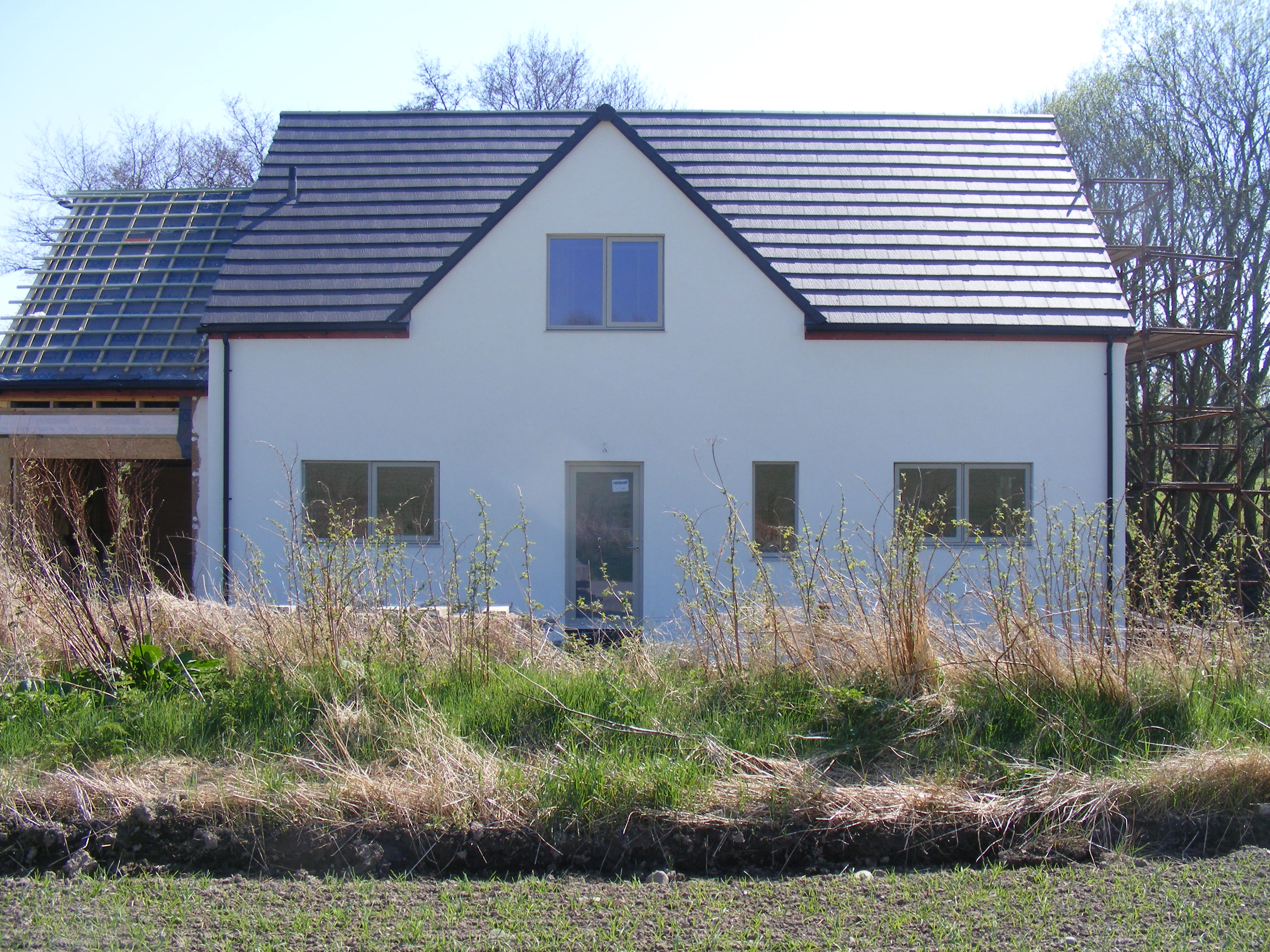
I didn't seem to suffer any warping or twisting of the big structural timbers. The frame did sit a while before getting boarded out inside so I guess it had a lot of time to settle. there are no cracks in the plasterboard or plastering or anything at all to suggest structural movement or shrinkage. That is more than I can say for the smaller non structural stuff like 4 by 2's for stud walls that seemed to delight in warping or twisting just to wind me up. The only thing I am not entirely happy with is the thin coat render. I have an ongoing problem with the top layer delaminating in a few places. the investigation and remedial work to correct that is on hold due to the current situation. But even when the defects are reworked, it leaves the feeling of a render system that is not robust and may give further trouble in the future. I long for the dependability and longevity of a cement render but that would have meant blockwork walls which was what I wanted to avoid. -
^^ I like that much better, everything just flows so much better. Plus it is nice to have the route to the garage covered.
-
I suspect what you are trying to depict is a pumped system. If the septic tank is higher than the invert level of the house drainage, it is draining into a small holding tank where a pump operating on a float switch will be pumping raw sewage up to the septic tank. It is not necessarily a macerator but a pump capable of pumping solds. I would have expected the input pipe to enter the top though and the holding tank not to be especially deep. And no rainwater involved.
-
You should not have to buy this. Open Reach should come to your site and survey. they will tell you what cable has to go and where it has to go to. They normally then free issue the cable and duct that it goes in. It does seem a regional thing, in some places OR are happy with armoured cable direct burried. In other places they provide a non armoured cable and duct to bury it in. I think ours was 6 pair, but only one pair is actually used.
-
Sounds like you need to call them back again and thank them for their efforts so far, but it is still not right. With the hot tank sitting, and no hot water being drawn off for a while, feel around the tank and see what (if any) pipes feel hot, and post some pictures. There is definitely something wrong still but we can only guess at what.
-
It sounds tome like the heating is still "on" but is up to temperature, but they have left it so the circulating pump runs continuously. On the ASHP controller as well as setting heating temperature (which you have turned right down) you should be able to turn heating completely off. See if you can find that setting?
-
You could always demolish the existing rear bit and rebuild it as part of the extension, that would be PD. That would be my reply to any planning officer trying to enforce anything else.
-
As this building will need building control approval, are you sire that is deep enough? BC will have to approve it.
-
Hi and welcome. Great feeling to move in. Re electricity usage. We use about 10kwh per day powering "stuff" where my definition of "stuff" is anything but heating and hot water. The usual suspects are washing machine, dishwasher, tumble dryer and fridge. Our heating usage typically is less than the "stuff" takes so hopefully you should find the same.