

ProDave
-
Posts
30862 -
Joined
-
Last visited
-
Days Won
427
Everything posted by ProDave
-

Insulation in studs and insulated plasterboard
ProDave replied to revelation's topic in Heat Insulation
I seem to be in the minority of electricians that routinely runs cables horizontally around the room at socket height. As long as you have at least 1 socket on each wall you can run the cable all the way round at socket height meaning if you want to add another socket later at any point, the cable is there. I even had a stand up finger wagging argument once with a joiner working on the job who told me I could not do it like that and the cable must only come up or down to a socket. The main thing to get right on a job like this is the detail. As the back of the insulation will be open to a cold space, you need to be sure the insulation cannot fall out the back, and be sure there are no gaps in the insulation to let cold air in. It is very disappointing even on a new build today to find a howling blast of cold air come out of a back box when you remove a switch or a socket due to poor detailing. -
That round black "plug" to the right of the fuse. Does it unscrew or otherwise pop out? If so it will give access tot he screws for the earth wire and there will be knock outs to the right of it. At least that's how the old style cut outs work.
-
South Wales double extension and full gut
ProDave replied to Gareththesparky's topic in Introduce Yourself
In the picture of our extension a few posts up. The planners wanted the roof line stepped back, but we quietly ignored that and ran the roof line flat. We did step the new wall back by half a brick meaning the eaves overhang was slightly larger on that bit. -
South Wales double extension and full gut
ProDave replied to Gareththesparky's topic in Introduce Yourself
This was our 1930's house that we extended. It's easy to build onto the side and extend the roof.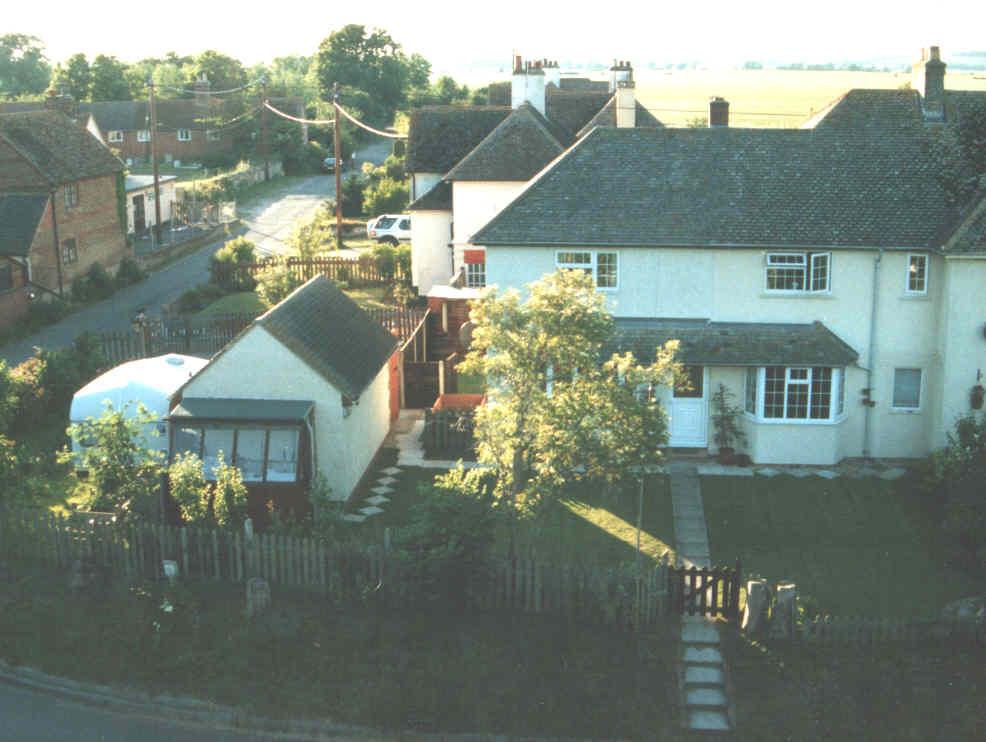
-
South Wales double extension and full gut
ProDave replied to Gareththesparky's topic in Introduce Yourself
It's a 35MB .MOV file. I have downloaded it and tried to play it directly from the OS, not within a browser VLC media player just shows a static image of the back of your house and won't play. Parole media player shows a black screen. SM player plays it, but with a horribly stretched out aspect ratio. I think part of the problem is it's a massive 3840 by 2160 pixel video. Filming at a lower resolution might help? Anyway having now seen it, it reinforces my view that you have a house plot there and to extend an old house is not doing justice to the site, so I would have a long hard think and sketch of what you could actually fit on the site. -
South Wales double extension and full gut
ProDave replied to Gareththesparky's topic in Introduce Yourself
Yes but what video format and where is it hosted. It is not a criticism but it annoys me that what I believe to be an up to date browser on an up to date OS cannot view it. Anyone else cannot see the video? -
I am not shouting "victory". Lets not forget, we were sold Brexit on the promise that we would have a free trade deal, easiest deal in history, can be settled in an afternoon over a cup of teat, Oven ready etc etc. Well that turned out to be a lie, it was hard fought over a whole year. So it is a victory for common sense and a big relief that at the last minute we pulled back from the brink and avoided no deal. All we have got is what we were promised, so lets not over do the celebrations.
-
South Wales double extension and full gut
ProDave replied to Gareththesparky's topic in Introduce Yourself
What video format is that, because my up to date Firefox browser only "sees" it as an audio clip? It is well worth evaluating if it could be a plot for a new house, leaving the old one as it is, it could potentially give you your forever home in your perfect location but built to a much higher standard than the old house. Perhaps a sketch of the plot layout or a map view? -
Congratulations. It's great to move in, even if not finished.
-
I will be buying through a UK distributor so playing UK VAT so no issue.
-
We had a bit of experience of this when we returned from a 2 week holiday in the Autumn. It was unusually cold here for the time of year and the house had been sat empty for 2 weeks with no heating and no incidental heating from occupancy and was down to 12 degrees when we got home. Heating on and stove lit and by the next morning it was getting comfortable but probably more like 2 days before it was all back to normal. Our house thrives on a regular low level of heat input and takes a long time to cool down if the heating goes off then a long time to heat up again.
-
Most news outlets are now saying a deal is imminent, so it looks like this thread can stand down. That will be a big relief to me as someone expecting to order some foreign windows very shortly.
-
Kingspan aeromax plus - flashing code 14?
ProDave replied to RossG21's topic in Air Source Heat Pumps (ASHP)
I doubt the leak is in a copper to ally joint, rather I suspect to a copper component close to where the aluminium heatsink fins are (I could be wrong) Any chance of a picture of where the leak is? If you want to have a go at fixing the leak yourself, you will find a schrader valve somewhere (car tyre valve) Pump it up with compressed air to say 1 bar and check for pressure drop. If you can fix the leak and get it to hold pressure properly with no drop it would be worth getting him round to have a go at re gassing it. Don't try running it with just compressed air in there. -
Kingspan aeromax plus - flashing code 14?
ProDave replied to RossG21's topic in Air Source Heat Pumps (ASHP)
Is he going to persevere and have another go at fixing the leak? It would be a shame for it to end up as scrap because of that. -
Error code Samsung ASHP
ProDave replied to canalsiderenovation's topic in Air Source Heat Pumps (ASHP)
In summer they will but not so in winter. We had a discussion on here and concluded if you are fed by treated mains water and have an unvented hot water tank, then there really is no risk of legionaires so no need to heat the tank hot periodically. so I have mine turned off, and if the solar PV heats it hotter on a good day then that is a bonus. -
Error code Samsung ASHP
ProDave replied to canalsiderenovation's topic in Air Source Heat Pumps (ASHP)
Simple solution for now is turn the legionairs cycle off. -
Surely the issue is you have changed the spec to include more opening windows? So the price will go up, and what they mean is they can't honour the original price and sell them at a loss?
-
2020 ends on a high note (surprisingly)
ProDave replied to ProDave's topic in General Self Build & DIY Discussion
Thanks for you kind wishes. you are most welcome to visit when you are next allowed to venture onto Plague Island the Mainland. -
You and I will be treading that path together. I plan to submit mine in early January, but I want to try and contact them first to make sure they are at least open in some form to receive applications. I don't want it posted and then sitting unopened in an empty office for months.
-
What flow temperature have you got coming out of the ASHP? I would not expect much defrosting unless you have that set really high. Set it down to about 35 degrees if it's presently higher.
-
Leave it on overnight and you should feel some warmth by the morning. Yes it is slow compared to radiators.
-
Our plumbing saga.... Advice please.
ProDave replied to canalsiderenovation's topic in General Plumbing
It won't be a faulty item, it will be fitting. I have not seen one of these in the flesh, but for the hose to pull out of the tap, an equal amount of hose must go up into the fitting under the sink. Am i right saying that hose with a "bulb" on it is the hose in question? Gently pull the house out of the tap, I am willing to bet if you look under the sink unit you will see that hose with a bulb rising up as you pull the tap hose down, and I am also willing to bet due to the shambolic install, there is not enough free hose, or it is jaming on something which is restricting its travel. Once you see what is jaming on what, you can show him what needs to be changed. You shouldn't be charged for snagging. -
You can get a lot of LED flat panel lights that literally fit into the thickness of a bit of plasterboard, some small ones that just look like downlights, only ultra slim. Only tip would be buy plenty of spares because in 5 or 10 years when one fails you probably won't buy one the same.
-
This tells it like it is on "plague Island" https://www.theguardian.com/world/2020/dec/22/worlds-media-ask-how-it-went-so-wrong-for-plague-island-britain-covid
-
If you like a good conspiracy theory, BoJo had to cancel the Christmas relaxations as he could see it was going to be a disaster but he could not possibly just change his mind so needed something "big" as an excuse. Of course that is almost certainly just speculation.......

