ProDave
-
Posts
30862 -
Joined
-
Last visited
-
Days Won
427
Everything posted by ProDave
-
Timber houses will only become mainstream when mortgage lenders stop thinking of them as "sub standard" or at least "non standard construction" Same with insurers. What's that standard question "is it brick or block construction with a tile or slate roof!? Erm no. So £££ to insure. At the moment timber houses are popular with self builders, but I am willing to bet if you try and sell one at say 30 years old, you might have problems. We took the decision to go all timber on the basis it was our retirement house and selling is not on the agenda, but if we ever did, I suspect it would be valued less than an equivalent brick house.
-
Changes to Short Term Lettings regulations in Scotland
ProDave replied to Crofter's topic in Planning Permission
Yes the last holiday let we stayed in, we just got a text with the number for the key safe and there was an instruction book in the property telling you what is what. Never met anybody in person. -
Changes to Short Term Lettings regulations in Scotland
ProDave replied to Crofter's topic in Planning Permission
Was you self build not built with PP as a holiday rental? There are benefits of being a holiday rental, no council tax, business rates instead that will probably be £0 Does this new rule apply just to self catering or are there implications for B&B's and guest houses? So it boils down to is this a planning change? Or a business change in the same way as residential landlords need to be registered but you don't need PP to let your house as a rental? There will no doubt be some mandatory standards like there are for residential lettings, e.g. a current EICR, gas certificate, smoke alarms etc. -
Just buy a reputable make of stove, it will comply to the regulations in force at the time. Don't get paniced into a rushed purchase.
-
Query on if this is right - Loft Insulation
ProDave replied to canalsiderenovation's topic in Heat Insulation
Perfectly normal January winter weather. Think yourself lucky you are not up here, -8 several nights and barely above 0 in the daytime for the last week. -
Kitchen is just a little over 7M by 5M.
-
Running mvhr in new build
ProDave replied to Pete's topic in Mechanical Ventilation with Heat Recovery (MVHR)
No draughts from ours at normal rate unless you stand on a stool right by a vent. Full boost mode when showering is a different matter, quite noisy and I can feel a draught on my (bald) head in places. -
Yes my stove is different to most, it's a convection model which means it has extra plate hung on the sides back and top with a small air gap to the main body of the stove. This reduces radiant heat and gives more convected heat instead, as you say a bit more like a radiator. Room was about 24 degrees. The stove is not our main source of heat, that is UFH with the thermostats set to 20 degrees. The stove is when we want to indulge and roast ourselves, but being mostly our own wood, at zero cost. Though at 5kW the stove would heat the whole house if you wanted it to. We have to keep the room doors open when the stove is on to let the heat into the whole downstairs and up the stairwell to upstairs. Shut the doors and you would very quickly overheat the room the stove is in. The original plan had another stove in the snug living room, we quickly dropped that off the plans as the room would have been too small for it.
-
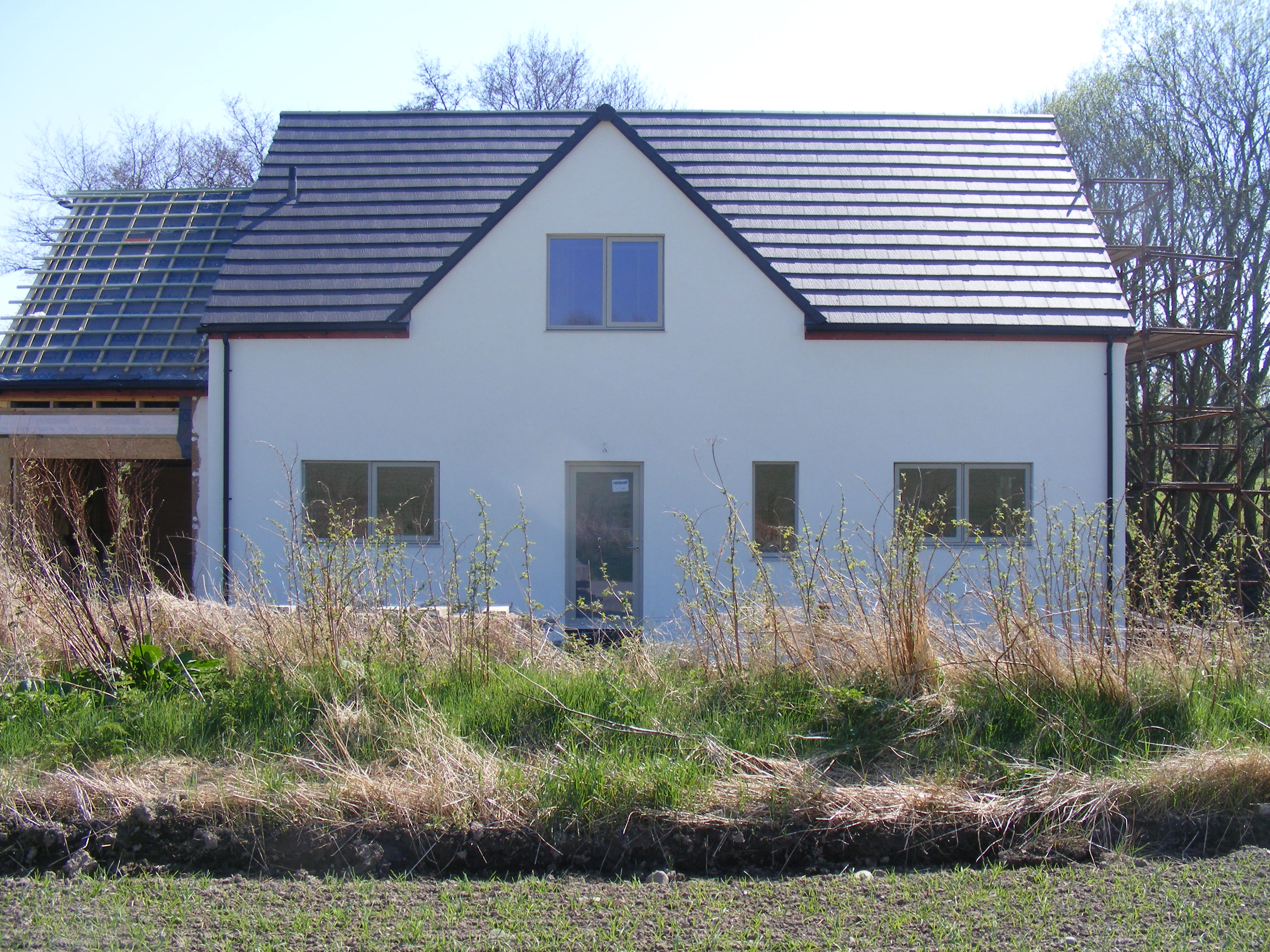
Finished shell. The shell did not get finished until late 2020 so I would be immensely impress if the interior was finished yet.
-
So you have flow to all loops now. Temperature is probably reasonable if it feels warm. All you can do is wait and see, perhaps run the upstairs UFH for longer if possible? If water comes out of the bleed valves you have no air so that is okay.
-
Do you have any form of thermometer, e.g a handheld IR thermometer to get a measure on flow and return temperatures? Are you SURE all the loops showing no flow are really off and not just flowing? If the rooms are all below their target temperature, I would have expected them all to be on. There are a lot of loops there so almost certainly 2 per room.
-
The normal for smoke alarms is one in the living room, one in the hall and a HEAT alarm in the kitchen. you don't need one in a bedroom but the bedroom door must be within 3 metres of an alarm and the living room would cover that, All smoke alarms have a button that has the dual function as a test button and a silence button when they do go off.
-
48 degrees sounds very warm for UFH. How many heating loops upstairs? It is possible there are 2 runs of pipe for the larger rooms and perhaps one is flowing and one is airlocked so only half the room is being heated which would explain hot and cold spots. Time to get the teenager out of bed?
-
So no blending valve and no manifold pump? Time was I only ever saw UFH done "properly" with all the kit, but there is an increasing number of "basic" systems popping up on here. When you next have access to the upstairs manifold, try as above bleeding air from the bleed valves, and then check that all the flow meters (the things on the top manifold) are registering flow.
-
The walls are a local sandstone. But why is the upper stone work darker? Has it not dried out from building yet? Or is it prone to absorbing water and it's always going to look "wet" like that? SWMBO said "what's the line of Sentry boxes at the right all about?"
-
There is usually a thermometer on the manifolds to show the flow and possibly the return temperatures. Can you post a picture of your upstairs manifold while the UFH is on please? Carpets will slow down the rate of heat into a room. What times of day is the heating on? It could be as simple as needing the heating on for longer? Can upstairs and downstairs be set at different times? What is the level of loft insulation like? it would not be the first time a mass market builder has not fitted enough.
-
Assuming it's a rural plot, 1 or 1.5 storey is what the planners will expect, it's rare to be allowed a full 2 storey house outside the towns. P.S are you already local to the area or are you relocating here?
-
If the plan is to build basic and upgrade later, get the basics of the build right, decent insulation and air tightness and go for a basic finish that you can improve on later. Another popular plan is only complete the downstairs initially but get the structure of the building built for the rooms upstairs but leave them to do later. My neighbour did that building a 1 bedroom bungalow initially and adding 3 upstairs bedrooms and another bathroom later.
-
Mine is going to come in at about £1000 per square metre but that is right at the bottom end of pricing as I have done so much of the work myself, so realistically expect to pay more. the upper floor is not "free" The roof structure is more complicated than a basic cheap bungalow roof so probably not that much cheaper. In due course as your plans evolve the forum can give you lots of advice. And I am 23 miles north of Inverness. I wonder where you are building? Do you have a plot yet?
-
Yes, new information. Those loops will have filled with air. It is very bad practice to feed a room above the manifold as even if it works to start with, it will collect every air bubble in the system. A manual hose pipe purge will get it working but you really want to insert an air bleed point in the loop at it's highest point which might not be a trivial task. Can you post a picture of your manifold?
-
UFH is very much in the realms of DIY, many of us have done it ourselves. Use at least 150mm of PIR / PUR type insulation and a thinner screed. But would it even matter if you fitted more insulation and ended up with a slightly higher finished floor level? Unless there is a very srict planning condition on floor or building height, nobody is going to notice another 50 oe 100mm.
-
You might want to change some browser settings. I use firefox and if I close it down, re boot, then open it again it comes back with all the same tabs I had open from the last session.
-
If you can remember a key phrase in the thread, use the forum search.
-
I like these ones https://www.ebay.co.uk/itm/CENTRAL-HEATING-ROOM-THERMOSTAT-WITH-MANIFOLDS-ACTUATOR-IDEAL-FOR-UFH/323866870601?hash=item4b67f84349:g:1OsAAOSwEetV8s17 Sold there as a package but available on their own for about £10 each. I have to dash no so no time to search for them.
-
I am pretty sure it has been colder this last week here than with any of the rest of you. I have just done my weekly meter readings and in the last week used 60kWh on heating and 29kWh on DHW Re defrosting, I don't think I have ever seen mine do that when space heating, it only does it when heating DHW. It is pretty clear to see if you witness it. you hear the compressor slow and stop, a click and a whirr as the 4 port valve reverses, the compressor starts up this time taking heat from the house and heating up the fins. It only takes about a minute and as the ice melts you see the cloud of "steam" puff out. then the compressor stops, the 4 port valve reverses again and it starts up normally again. It does push up the DHW usage as the COP will be lower, last week when it was less cold we only used 25kWh for DHW What analysis have you had done on your house to predict the actual heating requirements?