

ProDave
-
Posts
30862 -
Joined
-
Last visited
-
Days Won
427
Everything posted by ProDave
-
12kW
-
No, 5kW is the maximum instantaneous power it would generate at mid day on a sunny day. In summer it would typically generate in the region of 20kWh per day, and not much in mid winter. You would probably get about 4000kWh per year.
-
Yes. And volt drop on the DC side is not an issue, the MPPT controller adjusts for that with no problems. It is volt drop (rise) on the ac side that has to be limited otherwise the inverter trips or power limits on "over voltage"
-
Download the instalation manual from the "documents" tab; or here https://www.nibe.eu/assets/documents/25739/231846-8.pdf Page 65. Max operating current 23A which at 230V is 5.29kW Starting current is given as 5A
-
Can you post a link to the one you are considering and I will see if I can find it.
-
A 12kW ASHP will probably need no more than 5kW of electricity (12kW is the heat output) and don't forget to tell them it is inverter drive soft start. The DNO starts at a position of zero knowledge about what you are about to build and what supply you need. Depending where you are, 3 phase might be slightly more expensive, or astronomically and prohibitively more expensive (as it would be here)
-
For me it was flexibility. The Kit suppliers tended to only do standard packages and none met the insulation and air tightness I wanted and one even stopped talking to me when i talked about taking their kit and improving the insulation, so for me it was architect and local builder to stick build it to their plans.
-
The DNO's system assumes that all you generate might be exported so they size to allow for that. So if you want more than 3.68kW then you need permission. Now your second battery charging system would be allowed as an off grid system if the items that the batteries powered were on a separate off grid circuit and there was no way the batteries could discharge into the grid. You could argue until you are blue in the face that you will not discharge the batteries into the grid and they will only be discharged when you have high power loads running, but they won't believe you unless you have a type approved "G98 relay" even if such a thing were available. I only have 4kWp of panels and have concluded batteries for this amount of power are not required, I can self use 95% of what I generate without.
-

Loft height is 2.0m at the centre
ProDave replied to Maggie's topic in Lofts, Dormers & Loft Conversions
Plenty of examples of old croft houses here converted, where basically the whole roof has been taken off and a "box" build on top, front and back, with the top of the "box" higher than the original ridge, and a token 6" of sloping roof at each end following the original pitch. They often look ridiculous and it's a lot of work and cost for 1 or at most 2 extra rooms. I would put my money towards moving to a larger property, or one that lends itself to extending in an easier way. -
Get rid of Gas - replace heating / DHW boiler, with what?
ProDave replied to tex360's topic in Air Source Heat Pumps (ASHP)
Don't have heating upstairs of you don't like it hot (we have no heating upstairs) -
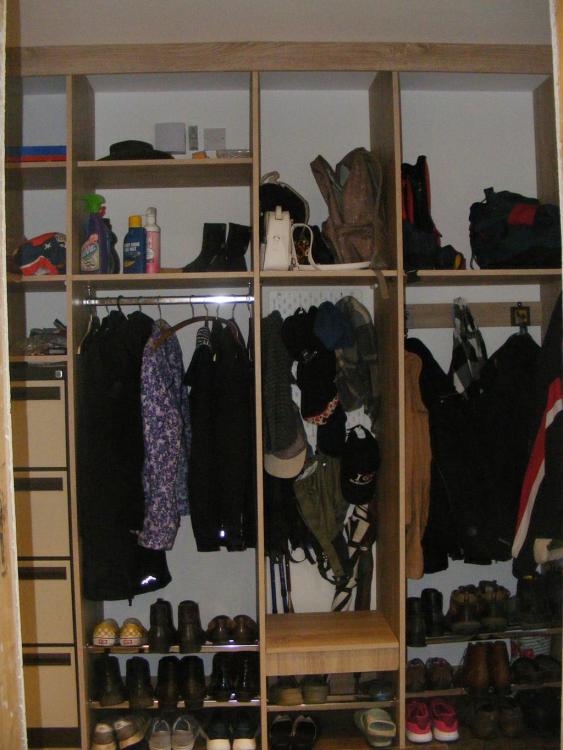
This is what I built next to the front door. the middle section is a seat to sit on to put on your shoes.
-
I started with a "plant room" ALL that is in my "plant room" now is the mvhr unit, a few controls, and the heating circulating pump. The airing cupboard and hot water tank is in the corner of a bedroom to get the tank in particular closer to the kitchen while still being close to the bathrooms. An Air source heat pump does not need much inside, perhaps a buffer tank and some motorised valves etc, they can be anywhere so they can be in the plant room. Under floor heating manifolds are best placed central to each floor so again the plant room is not the best place.
-
If that IS one cable feeding both, then it cannot operate the normal way with one being connected to the switched off peak feed and the other on a 24/7 feed. So yes please photos of ALL consumer units and anything that looks even remotely like a timer or boost controller.
-
Wow that looks nice (it makes you giddy until you turn your computer on it's side)
-
Did you not read this post?
-
I would just add, leave the switch that leads to the BOTTOM of the 2 heaters on all the time. That will heat up the whole tank over night on the cheap E7 rate. Only turn on the switch to the top heater as a boost if you have used all your hot water and need more before the next overnight charge up. Very often there is another, more accessible switch for this function, sometimes even a boost timer.
-
Have you ever seen mice have a nibble on vertical plastic pipes?
ProDave replied to Oxbow16's topic in General Plumbing
You can replace plastic pipe with copper and the problem is solved (or use copper in the first place) It is nigh on impossible to stop mice entering an old house. Out new air tight house has been pretty good, none have yet got in, apart from one that came in through an open velux one night. That took nearly a week to dispatch him. -
Have you ever seen mice have a nibble on vertical plastic pipes?
ProDave replied to Oxbow16's topic in General Plumbing
All horizontal between floor and ceiling. -
Have you ever seen mice have a nibble on vertical plastic pipes?
ProDave replied to Oxbow16's topic in General Plumbing
I had to help a neighbour fix a number of leaks all caused by one mouse eating through plastic water pipe in 4 different locations before the poison got him. That is why I am not a fan of plastic pipe, -
Frame erection is just that. Wind and watertight is roof doors and windows in as well.
-
grid-tied retrofit with battery storage -FIT meter
ProDave replied to javiermi's topic in Photovoltaics (PV)
Connect it AFTER the generation meter. BUT check the fine print of a FIT contract to see if this is allowed or not first. -
Suppliers of low u value / 3g quite large IGU?
ProDave replied to ElliotP's topic in Windows & Glazing
Rationel would probably do that as well. -
3 phase electric supply from 3 same phase cables?
ProDave replied to WWilts's topic in Electrics - Other
That raises an interesting question: So a 3 phase EV charger actually need 3 phases? If it just goes into a rectifier to produce DC to charge a battery, then probably not. I wonder what manufacturers would say? -
3 phase electric supply from 3 same phase cables?
ProDave replied to WWilts's topic in Electrics - Other
What is the reason for wanting 3 phase? If it is just more capacity then three single phase supplies would do that. If you NEED to run some 3 phase equipment, you will need a phase converter, but they are expensive and not a whole house solution. -
I picture would help, but the obvious solution is reduce the ground level next to the house?

