Roundtuit
-
Posts
1280 -
Joined
-
Last visited
-
Days Won
2
Everything posted by Roundtuit
-
Thanks! I didn't use the design tool, they did the design from dimensions. I think it was what they call the ClearCut design. I had several phone conversations with them; definitely worth giving them a call to explore options but I don't think a half-landing will be a problem.
-
I've got a bit you can have foc if its what you're looking for. Drop me a pm and we can go from there!
-
Alarm unit wired to plug socket
Roundtuit replied to Dan1983's topic in Networks, AV, Security & Automation
As above, I think I'd ask them to swap it for a fused flex outlet with no switch. -
Another vote for hand saw. With a bit of practice, cutting at a shallow angle, you can get a consistently tight fit, and cutting square wasn't difficult.
-
Maybe remove smoke alarm, seal hole around cable with suitable sealant, replace smoke alarm ?
-
Yes, pretty much. I put letter-box size vents in on either side of the boxing, top and bottom (so 4 in total).
-
I did, but not an 'official' one.... where the flue exited the airtight layer into the loft space (first floor ceiling), I replaced the ventilated thing with cement board and sealed it with fireproof mastic. I can't see as that's significantly different from, say, a twin wall flue exiting a vaulted ceiling tbh. Between floors is boxed in and ventilated top and bottom.
-
Looks like an nursery school project, but probably nothing that couldn't come down and be done properly. Looks like a hole in the roof too...is this a renovation job?
-
Can't recall off the top of my head. As a guess, they must have been maybe 2m wide, 6m long and 1m deep. I hired a JCB and driver locally for two half days (half day to dig, then back a few days later to fill in after everyone had seen enough soil).
-
Well done! I suspect that a lot of people have paid sdlt where none was due, due to ill-informed solicitors and conveyancers who are used to doing straight forward residential work.
-
So the planners consulted Herts Archeaology, received no response, and added a condition anyway? Is there anything from the Archeaology guys on the planning portal for your application that would add clarity perhaps? I spoke to our Archeaology department directly (Cambs) to establish exactly what the requirement was, and to understand what would happen if they found anything 'interesting'. We had to dig 2 trenches (under house and garage footprints), but no dramas.
-
Whoever the planners consult (County archaeology department?) will spec the planning condition, so you really need that first. I saved a lot of money finding an independent archaeologist rather than one of the larger consultancies that seem to dominate in our area.
-
How to go about a refund from builder?
Roundtuit replied to johnhenstock83's topic in General Self Build & DIY Discussion
..or tell the builder that's what your plan is, then try and negotiate a refund as an alternative -
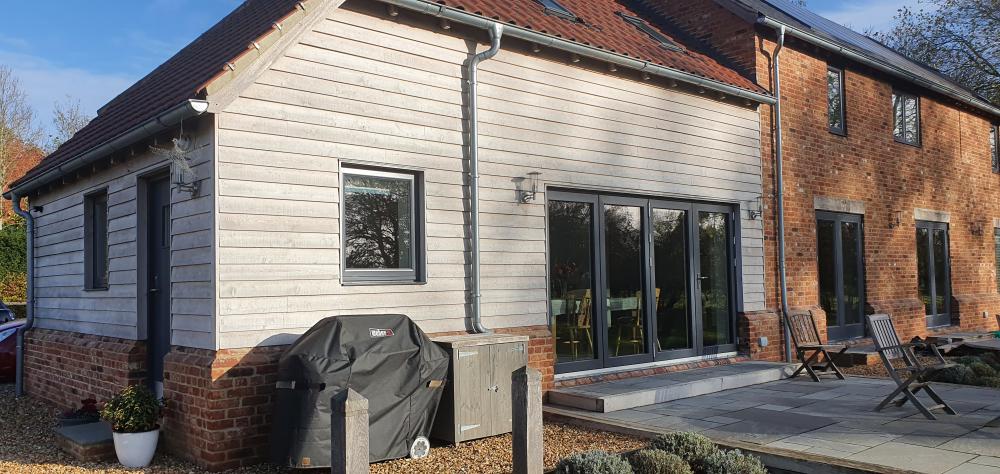
I loose track of time, but it's probably been treated for about 3 years. Most of the silvering happened in the first 12 months I reckon.
-
Yes, a nice even grey. The only downside is some black mould spots that I'm hoping will fade in time, but you don't really notice them unless you're up close.
-
It's nothing like creosote in terms of colour, but SiOO:X should give you 10 yrs + without re-treating. Perhaps not everyone's cup of tea, but I've used it on the house cladding, and I'll be using it on the garage when I get round to building it. Planed timber might need a rough sanding first though.
-
Yes, definitely set up for a couple of gas bottles. Maybe a gas hob, past or present.
-
https://www.a1airtesting.co.uk/ They do appear to cover your area, so probably worth a try. To be fair, it was a new build with no need for thermal imaging, but as above, airtightness and cold-bridging are a bit different.
-
£600? Good luck. I think mine was £180. Not Norfolk, but the next county.
-
Our alu clad trim is held on by clips and it just pops off with a bit of gentle persuasion. If you really did find that you could no longer live with the colour in a few years time, you could change the trim without changing the windows I suppose.
-
Ledge Issue at Masonry-Timber Frame Junction
Roundtuit replied to R2021's topic in General Construction Issues
This really shouldn't be your problem to sort out if you've used a professional design service. Gut feel is that your timber frame company need to use wider battens on the cladding and suck-up any additional costs on the windows. Failing that, you can get aluminium pressings made in whatever size and colour you want that would sit behind the cladding, cover the cavity and overhang the slate slips (like a big aluminium window cill pressing). -
Maybe, but the openings were as planned, with recommended tolerances all round (timber frame so easy to do), but the brackets were so inflexible that there was zero tolerance. The jambs bowed in on a couple of windows in the first few days after fitting due to the leverage over time. Rationel sent someone out to have a look, and judged that it was something the site fitting team would have been expected to anticipate and overcome. So, a few windows needed re-fitting. Not a biggie in the scheme of things, but worth a thought.
-
Same here. I like it.
-
That sounds about right. They also have a crank in them which I found was too much, and started to bow some jambs slightly. I ended up hammering them all flat before fitting.
-
I'd be interested in buying it if I were you, but there's a few things to consider. Firstly, I suspect that as you're the end of the row the land has little value to anyone else, so bear that in mind when negotiating. Secondly, you need to be clear what the current land classification is. I'd guess unlikely to be agricultural. If it's amenity land that forms part of the developers overall scheme, you might find you're not permitted to change the use or fence it in, or are restricted in fence height. More investigation to do perhaps!