SimonD
-
Posts
1941 -
Joined
-
Last visited
-
Days Won
10
Everything posted by SimonD
-
Reassurance and ideas please!
SimonD replied to Jilly's topic in General Self Build & DIY Discussion
And before you get to this point of pre-action protocol you still need to demonstrate that you have given the person you're claiming against the chance to rectify the problem/satisfy the contract. If you walk into court and say to the judge something like, I hadn't heard from the builder for a while so I sent a letter of claim and commenced legal action, without having tried to take every effort to resolve the problem, you're not going to get very far with your claim. The judge might very well sit there as say, 'oh so you just started with a threat to take legal action?' My view, which is also based on experience in the courts, is that you need to take every opportunity you can to avoid going down that route. Sometimes this may be painfully slow and frustrating. However, you need to show that you've no other option available to you for recourse other than legal proceedings. Hence why, right now, I suggested it was more sensible to try to re-engage with the builder without any mention of legal action. It's simply premature. I think @Jilly 's approach not to be confrontational is the best bet right now, although that doesn't mean she can't be firm and assertive ? -
Reassurance and ideas please!
SimonD replied to Jilly's topic in General Self Build & DIY Discussion
Have you chased up the builder you've already paid? It sounds like things just went a bit wishy washy and he drifted off to something else. I'd try to get him re-engaged to finish off the work before making it formal with a letter before action. With taking things the legal route too quickly and too soon, you'll harm your position if and when you need to take things forwards legally and you'll likely get the back up of the builder. You also loose more control of the situation. You have to give him the opportunity to come back and fix/complete what was agreed. I'd make a list of what was agreed, what was done and what is remaining so you can get both yours and the builder's minds clear on what is outstanding. Then write down exactly what you want done by him and when. Then get in touch with him with some clear instructions and ask him to provide a reasonable timescale. This is a step you'll need to demonstrate you've done if you try with a letter before action. If the other builder is part of the same company that you originally contracted, you're fully in your rights to ask him to complete the work as you'll have paid the company not an individual/sole trader - assuming that's what you did? As others have suggested, I wouldn't get the other builder involved to do any other work than what is outstanding right now as it just muddies the waters and if they don't get on, it may add friction the situation. You also want to avoid paying out any more money to anyone else until you know more about getting things on track, or if you've really got a serious problem with the builder who's gone AWOL. -
I have this dilemma right now. What is the cost implication of wet rooms and are they more difficult to build?
-
I'm not sure any showroom, lockdown or not, allows for real world dangly bit interference tests, do they? ?
-
Unfortunately, the image is too small for me to read the detail. But basically it's because their *rse is on the line if something goes wrong ?. It also depends on the predilection of the engineer. Some might have a x 1.6 margin, with some it's only x1.2. As per @Mr Punter I've found it most helpful to call my SE to ask the questions and to understand their point of view and reasoning. This can then open up a discussion about potentially simpler alternatives.
-
Hello, Yes, lime does open up a whole can of worms. Even within the lime community. The best info I've so far found about lime comes from a little book called Lime: A Practical Guide by Jane Schofield. You can buy is for £4 from the Society for the Protection of Old Buildings: Lime: A Practical Guide This guide explains all the types of lime but focusses on the non-hydraulic, i.e. lime putty, and will no doubt cover everything you'd need to know about the mortar mix and process of repairing your walls. HTH
-
Don't suck it up. This seems to be all too common. A long term client of mine who is very experienced in the world of construction and project management gave me one piece of advice about the industry when I started out on my journey. That was that I needed to question everything anyone told me or did on my project because inevitably they will be working in their own interests and not mine when it comes to delivering either products or services. Cynical as it might be, it has shown itself to be incredibly accurate. Your architect seems to be taking this route by pushing you to do things to her agenda not yours. My client's advice was don't take it, push back for want you want and hold yourself strong and make decisions how and when you need to. It's your money. If they refuse to play ball, then find someone else to work with. Yes, this is a pain, but just imagine what it might be like to continue to work with someone behaving like this to you as a paying client so early on in the project.
-
Seamed metal roofing or catnic SSR2 advice required
SimonD replied to ruggers's topic in Roofing, Tiling & Slating
Not really, the osb for my roof at 126sqm cost me under £600. Would you really want to compromise a roof you're spending 1000s on for a fraction of the total cost? The standing seam roof cover has little if any structural integrity as it's only about 0.7mm thick. On top of that a standing seam roof needs a defined number off fixed and sliding clips to prevent uplift, usually a maximum of 380mm apart and closer (perhaps 200-220mm) around eaves, ridges, and verges. -
Insulating Single Skin concrete block Wall
SimonD replied to mazzlebizzle's topic in Garages & Workshops
Is EPS EWI either rendered or clad not an option? -
I'd agree with you on that as there's almost always going to be some level of confirmation bias. I think there's also a skewed demographic here on this forum because most self-builders take an active interest in the tech they're installing and also put some effort into how to use it. Hence they take the time to commission, install and use the technology. They also seem to me to take on the challenge of changing their behaviour to accommodate it. There is also the methodological problem with control - not many self-builders are going to build a copy house to test if natural ventilation provides the same results ?? Reading some of the wider research on natural ventilation and MVHR, I've found there seems to be a pattern between those who choose to install the tech and those that get it as part of a house they've bought. When an occupant gets it ready installed, there's almost always a significant need to change behaviour and halt our natural unconscious reactions to indoor air quality. For example, researchers have found that occupiers unconsciously react to raised CO2 levels by simply opening windows rather than consider alternative action. But likewise in natural ventilation there's been a history of people plugging up vents due to their experience of draughts, but that's largely due to badly designed vents in the first place. It is indeed absolutely not a conclusive study, but does helps to start a discussion about different perspectives which I hope is more constructive than the assumptions often bandied around that suggest natural ventilation doesn't work or is energy wasteful and inefficient and that MVHR is the solution. Unfortunately, there is a deficit of recent high quality research on natural ventilation, but there is increasing research on using intelligent natural ventilation systems in commercial premises, offices in particular and which do test some forms of heat recovery. There are actually some solutions on the market now. The other thing is that the research alludes to is one of the commonly accepted advantages of natural ventilation compared to MVHR in that it can provide better micro control of ventilation through the house. For instance, this is advantageous if you like to have different temperatures in different rooms, and/or zones. And from the perpective of indoor comfort, there are those that propose that contrary to providing uniform and constant indoor climates, wider and varing indoor climates are more healthy environments within which to live, IIRC Susan Roaf is one of those. I'm not trying to be evangelical about any of this, I just think that our understanding of ventilation in houses and its relationship with healthy indoor environments and its occupiers is still in its infancy. From some of the books I've read on the subject that were published back in the 1800s, it doesn't seem a huge amount has moved forwards (as an intresting aside a couple of papers I've read that were published in the late 1800s can tell me the exact maximum airflow through a vent that prevents occupants from percieving a draught!) For me, there's also a final question about any form of ventilation and how it relates to building fabric.Some researcher in Canada and other countries like Finland have found that buildings using hygroscopic materials may need modified ventilation designs and that designs of MVHR are rarely, if ever design with this in mind. Anyway food for thought, if you're so inclined.. or find you nerd out on some things like I clearly have the tendency to do ?
-
Well, I'm one of those opting not to go for MVHR. Having done plenty of research on ventilation, there's still lots to learn about the whole subject when it comes to domestic properties. There are also lots of myths about the effectiveness of natural ventilation (I suspect often perpetuated by the marketers of MVHR system makers). This goes for the eco perspective too. When it comes to MVHR location is often overlooked. If I was back up in the north of Sweden building a house, MVHR would be high on my list due to the very long and cold winters. Down here it the southwest of England it's a very different matter because the climate is so mild. Here is a piece of fairly recent research suggesting similar. In this study, they used two new passivhaus flats built in Cardiff. One used MVHR and the other natural ventilation. The naturally ventilated flat consumed 36 kWh primary energy/m²a less than the flat with MVHR with no reduction in indoor air quality or comfort. A Natural Ventilation Alternative to the Passivhaus Standard for a Mild Maritime Climate At the end of the day there are plenty of studies looking at problems associated with MVHR but there are also issues with natural ventilation where it hasn't been thought through or implemented properly either.
-
Would you not want a vcl to the inside of those studs for this buildup? That's one area breathable wall systems have the advantage although certainly not the budget option.
-
I think unravelling quotes for supply and fit metal roofing is a bit like doing the same for windows. You need to understand what they're quoting for. For example, are the roofers expecting you to fit the roof boarding or will they do it? If so what are they proposing? 18mm plywood or timber/sarking board? What membrane are they proposing? Plywood is faster and cheaper whereas timber board is preferred but more expensive. There are also different methods of joining lengths of fascia and soffits, for instance. The simplest and probably most common is a basic lap joint but it's nicer to use a welted joint which can be matched with the main roof seams, but this takes a lot more work. You've got a fair few changes in your roof slope due to both dormer roof and rooflights but without seeing drawings it's difficult to know how many upstands need to be formed, which also play into the labour cost as does the need for valley gutters. Internal and external corners also have an impact on this. Additionally, there's the quesion of pitch as this plays into the material requirements as the girth for flashings depends on roof pitch. There's also the question as to whether they will be buying pre-formed materials or whether they have, or need to hire, forming machinery for on-site installation. So, in short, can you break down the quotations you've received and post them up here? The other things is that a 600mm coil will only cover 530mm after it's been formed with upstands and some flashing girths can be more expensive due to wastage. I guess they've all quoted for gutter installation as the guttering needs to be installed before the roof as the eaves flashing should be tucked over the gutter. I've done a video as a guide to installing a standing seam roof. As a caveat I'm not a pro, I've done it all myself and it's the first time I've installed such a roof, but it should give you an idea of what's involved as I've followed the Federation of Traditional Metal Roofing Contractor's UK Guide to Good Practice.
-
It's probably just excess moisture under the tarp that's making it swell. In my experience tarps are terrible for protecting timber, they're often not entirely waterproof either, even when sold as such. Better off using sacrificial breather membrane.
-
Windows....which company did you choose and why?
SimonD replied to Tom's Barn's topic in Windows & Glazing
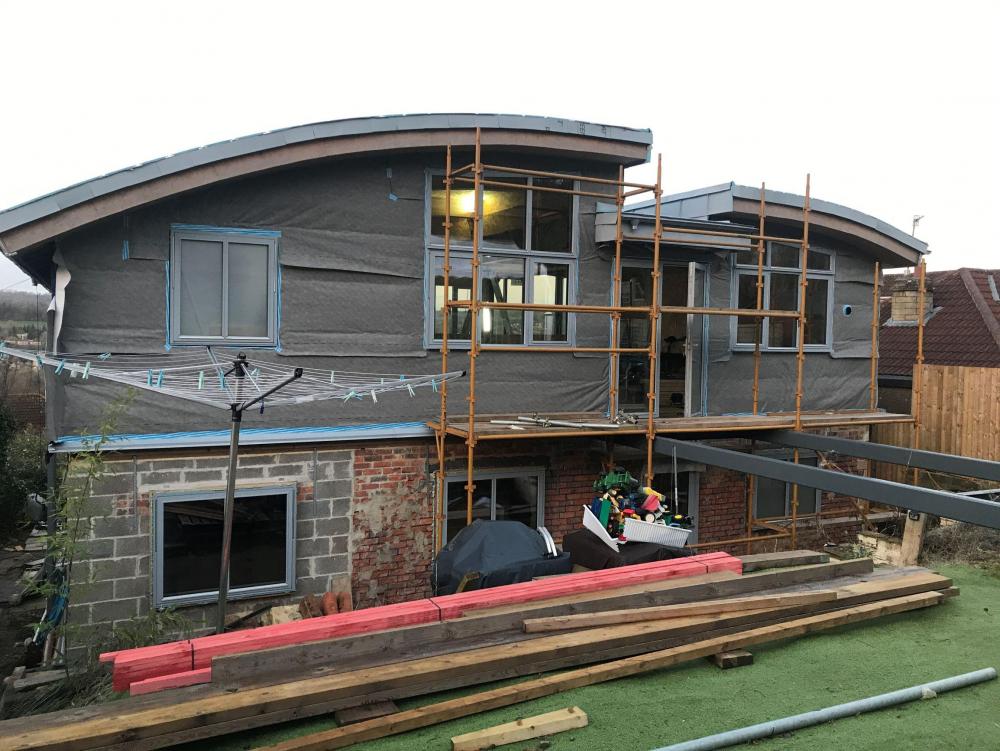
Are you sitting down? I received quotes of between £4000 and £7800 plus VAT labour only to install my windows. Up to 4 man team x 4 days. I know they wouldn't have done it without a crane and even then they'd have struggled around the back of the house. I had to build my own scaffold hoist contraption as no other lifting equipment I could get hold of would fit in the area. I did it all myself with some friends in the end.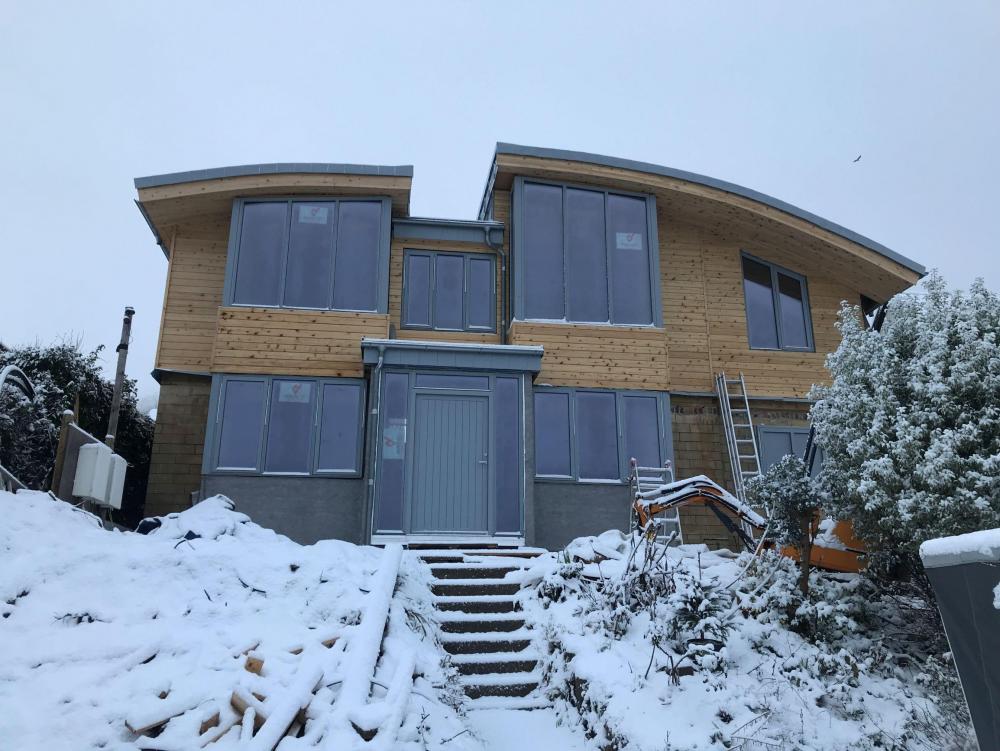
-
I have some cantilevers within my structure which are entirely timber, but they're not multistorey. You'll most likely get a structure that includes a steel frame component as part of the timber frame, like @Bitpipe has said. I didn't use a timber frame company but built the whole frame myself.
-
I actually have one of those. It was a bungalow built mid 1920s. Ours is 1st generation cavity wall of all things. We bought it as a development property, and following professional advice (from several sources) decided to go for renovation and extension. Taking it from about 76sqm to 200sqm. I really do kick myself on many days we didn't explore knocking it down and building new, especially because we're building an energy efficient home. (the reality is that the planners probably wouldn't have let us knock down and rebuild but we'll never know). Sometimes these projects can be amazing and fun, but you really do need to love the house because you'll be problem solving all the way. This has been the most difficult part for me. In our last place we renovated a mid 1800s cottage and I loved it to bits. This one I didn't love so it has been much harder. However, I'm now getting to a different place since the windows went in and I'm really warming to it again.
- 10 replies
-
- 2
-

-
- insulation
- solid walls
- (and 1 more)
-
What period house is it? This will inform the choice of EWI and render system. If it's period property you may want to go down the route of using natural insulations with lime render. Otherwise an EPS EWI system, but you need to consider breathability for the sake of the building fabric.
- 10 replies
-
- 1
-

-
- insulation
- solid walls
- (and 1 more)
-
Haha, hopefully they've decided to give you a break! ?
-
Connecting sole plate to block work with Marmox in between.
SimonD replied to SeanDean's topic in Timber Frame
I've got something similar on my current timber frame, although that is sitting on an existing ground floor masonry wall. In our case the SE also specified Tapcon anchors through the sole plate into the masonry but our roof is curved so there's increased uplift. I think it would be okay to use resin fixed anchor bolts and then use mastic to seal around the penetrations. In the US, when they're aiming for high airtighness levels, they'll add an EDPM strip to the dpm/dpc layer below the sole plate. The brackets you show above are really just uplift restraints so if you do need additional fixing, restraint straps as @Mr Punter suggests would probably be easier to install. -
Connecting sole plate to block work with Marmox in between.
SimonD replied to SeanDean's topic in Timber Frame
? -
Connecting sole plate to block work with Marmox in between.
SimonD replied to SeanDean's topic in Timber Frame
That was the orginal plan for this project - it was designed to have woodfibre insulation throughout. However, the supplier then tried to stiff me on the price, hiking it massively compared to the price given during technical design. I then changed the timber frame design and now we have sheepswool throughout; so it's OSB as internal sheathing that doubles as vapour control and airtightness layer, sheepswool between studs and then I've counterbattened outside the timber frame for additional sheepswool, beather membrane, battens and cladding. Overall it'll perform on a par with the woodfibre and saved me nearly £9k overall on insulation. -
Connecting sole plate to block work with Marmox in between.
SimonD replied to SeanDean's topic in Timber Frame
I'm not entirely sure what you're getting at here @Russell griffiths. You're now saying something different from your OP which said: What I said was that 'sheathing' is the term typically used in modern timber stick framing to denote a structural component in the timber frame (which, by definition would be done with a proper fixing schedule). This provides the wall with its racking strength. It was to help the OP find the information he was looking for which he'd failed to find using the term "racking." If you don't use a structural sheathing board you do, of course, need something to provide racking strength. But generally speaking: Again from the Structural Timber Association: "The racking wall gains its strength from a wood-based board sheathing material or plasterboard lining material fixed to the wall studs which provides racking stability and sliding resistance by its connection to the horizontal diaphragms and foundations." (http://www.structuraltimber.co.uk/assets/InformationCentre/eb4.pdf) A mere search on google for racking or sheathing will tell you the difference in how those terms are generally used in this context. There are always exceptions and alternative ways to do things. On my current project I have an unusual structural design that uses structural osb lining boards on the inside of the timber frame with no external sheathing. What I've said has nothing to do with minimum or better standards, nor poor workmanship, it's about terminology. If at the end of the day you prefer to use "racking," that's fine by me. I just won't and will stick with "sheathing." ? -
Connecting sole plate to block work with Marmox in between.
SimonD replied to SeanDean's topic in Timber Frame
Splitting hairs there me thinks ? and potentially misleading and vague. At the risk of being pedantic "sheathing" is both common and formal parlence in modern stick framing. If you doubt what I say here are definitions of timber frame by: 1. TRADA: "Timber frame construction uses timber studs and rails, together with a structural sheathing board, to form a structural frame that transmits all vertical and horizontal loads to the foundations. (https://www.trada.co.uk/start-here/timber-frame-construction/)" 2. Structural Timber Association: "Design of timber frame wall panels The lateral stability of the studs against buckling is provided by either a sheathing material or from the provision of timber blockings i.e. noggins or dwangs at intermediate positions in the stud height, to allow fixing of sheathings or to provide lateral restraint about the minor axis of the studs" Resistance to horizontal actions is provided by the in-plane shear resistance (or racking resistance) of sheathed wall panels which are connected together to act as contiguous wall diaphragms. Racking resistance is covered in part 2. " (http://www.structuraltimber.co.uk/assets/InformationCentre/timberframeeb3.pdf) There really is no need to double up sheathing to both sides of the studs in most cases for domestic buildings, except perhaps under particular circumstances where you need a specialist shear wall. -
That's good to know! Edit, ours were rejected for this and I've just looked on our regional requirements which still contain this, even with the latest guidance dated 2017. Has there been more recent change?