


SimonD
-
Posts
2215 -
Joined
-
Last visited
-
Days Won
13
Everything posted by SimonD
-
Insulating a pebbledash solid wall and damp concerns
SimonD replied to Ben Weston's topic in Heat Insulation
FWIW that's exactly what I did with my infill extension. Photo attached after basecoat applied with no difference between the parts of the house. The ideal thing about this is that you can then design the house details such as window reveals etc. to fit the design 'theme' of the house. In my photo you'll see that my windows have been moved out from the walls on the house and sit in the ewi to reduce thermal bridging around the frames. The negative side of this is that the depth of the reveals meant I had to make myself a bespoke reveal detail because the normal window/corner beads/ and reveal boards would not fit within such shallow reveals. As you'll see from the image I also curved my reveals as I didn't want the square sharp corners typically found on new ewi. This is where you ideally need someone with experience working with ewi as they'll be able to guide you with the detailing, something you don't want to find out about when it's too late and the renderers are on site. Your architect is merely suggesting what is a more mainstream approach and using the typical system sold by Weber which will be installed on a lot of houses across the UK. He/she may also be reflecting what you already mentioned as a lack of understanding of ewi systems. Like you, it's not the direction I would choose to take although if installed and detailed properly it will probably last the lifetime of the building providing it's maintained correctly too. There's nothing wrong with asking your architect to reconsider and include the works for removing the pebbledash and alternative buildup, but what I would personally strongly recommend is that based on your personal preference of materials you find and then use a complete ewi system and avoid selecting individual layers yourself that aren't part of the system. As mentioned before, get the manufacturer's technical department to complete a condensation risk analysis to demonstrate suitability of the buildup. You can also play with online tools like ubakus.com to get a feel for what you want. As a side note, please do remember to remove the pebbledash before you remove the roof and gut the house - old walls can become terribly unstable when you take the load off them and you don't want to be hammering the existing render off then! ? You're clearly doing your research so I'm sure you'll settle of the right solution for you. Good luck with it.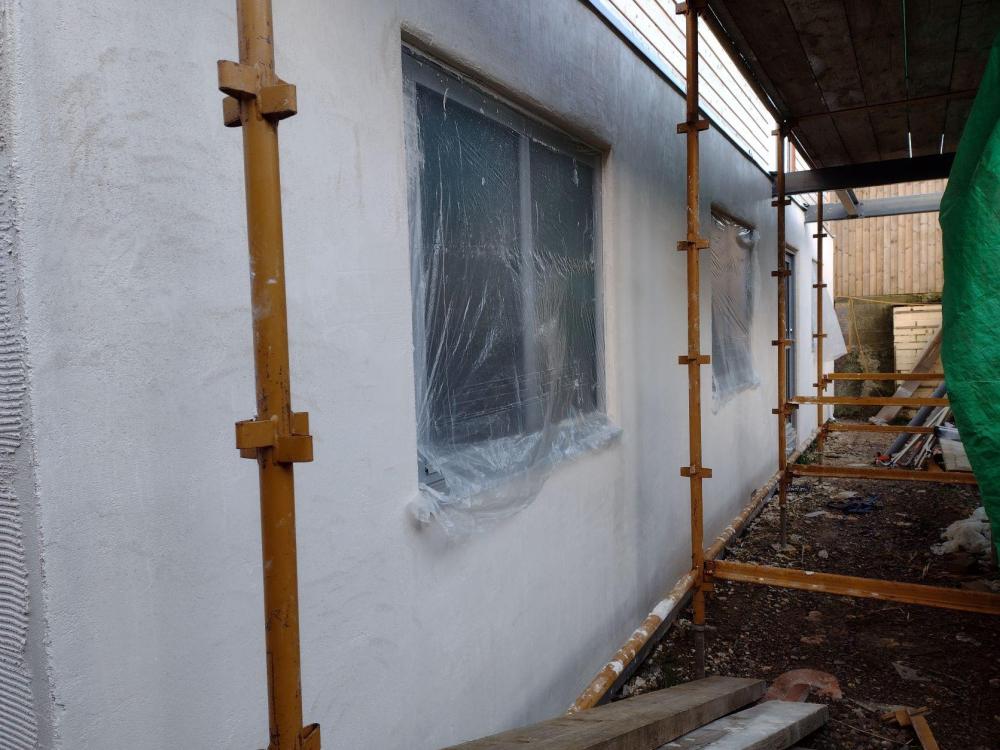
-
I'm rapidly becoming a fan of Rubio Monocoat instead of Osmo. It's a dream to apply and as per the tin it only needs one coat - touch up is simple and invisible where needed. I can't personally attest to longevity yet.
-
I once had to take apart a significant proportion of the roof on an 1840s workers cottage in situe and salvage the timbers for reuse. Two tools I came to love for this are 1, a japanese nail puller, 2, A nail puller similar to this Hultafors version I bought years ago in Sweden https://www.hultafors.com/products/hammers/H0208-nail-puller-atle/79452 - I've rescued a good number of floor joists from metal hangers with this tool too. Both will put out square twists as once they're dislodged, they pull out realy easily. If you go for cutting, then a circular saw with suitable blade for chomping nails work well, providing you can support the truss to avoid pinch.
-
But we do have a significant amount of feedstock available, if we tried a re-think. And there's current technology and efficient technologt that produces high gas yields. Just like both hydrogen and renewable electicity, we don't make anough of those either. Whatever way we go, there's got to be some form of transformation. Biogas production can provide an additional benefit in that its waste products/solids can be used as fertiliser.
-
I too suspect gas boilers are going to be around for a lot longer. As you say, the push for ASHPs doesn't fit for much of UK housing, at least as it stands. First I think we need a massive push, including funding, to retrofit the houses we can, and then radically reassess those we can't. We do need to reduce or get rid of our reliance on fossil fuels and I think that one part of the solution is going to be biogas which seems to be much more feasible and cheaper than other solutions, yet it's being kept under the radar. Ecotricity is pushing biogas and Norway's parliament voted to include biogas as equal to the other options of electricity and hydrogen in their future energy strategy.
-
I think so, it's even more important than before as we're now just finding out how exposed we really are in terms of energy security. And what does the government do? Suggests loans to utility companies and short term grants instead of looking to the long term and dealing with the structural problems they themselves created. Next week they'll probably announce the building of a few new coal fired powerstations, all to be ready by October...
-
In a previous project, I had a SE, my father in law actually, who spent most of his life designing large steel and concrete buildings, design a steel frame for this. He designed some steel trusses that were tied at the ridge, negating any need for ties anywhere else, so left the whole space open. This solution also got rid of the need for a large ridge beam. In our case we had one large central truss and two smaller ones at each end of the building supporting smaller steel purlins, and cross braced (to provide racking strength) with small steels in tension on a diagonal from ridge to bottom corner. The span was about 7m compared to your 5m and for the length you could just add several steel trusses.
-
Do you "really" need to skim Plasterboard?
SimonD replied to idontknowwhatiamdoing's topic in Decorating
I've done a little test in my house to compare the two on a complete novice DIY basis. At first, I thought tape & joint would be fairly easy and how wrong I was. From only doing a small amount, I prefer skim, but that may be because I've had some practise using pretty much the same tools when rendering. There also seem to be many more UK youtube videos on plastering, which helps. My secret weapons for skim finish are the Carta 101 plasterers trowel and two Refina Plaziflex sputala rules, one long and one short. Sponging can also be helpful as a beginner. You also don't have to do so much sanding, which is just so boring..and takes a long time. My plastering is by no means perfect, but it doesn't have the same regular irregularities as drywall so I find it looks much better overall. -
Insulating a pebbledash solid wall and damp concerns
SimonD replied to Ben Weston's topic in Heat Insulation
I haven't looked at their current IWI systems so can't really comment on those. -
I did this with quite a lot of stuff before Brexit. In one sense I'm happy I did it because it involved a lot of timber and I have saved a massive amount of money on it. The problem is that I've had a load of materials cluttering up my space which has made the process of getting on with building much more difficult and risks inadvertent damage - this week I've got to move 56 sheets of Birch plywood to be able to start making the kitchen. I've also bought a few other items which have being laying around and found that warranty is now compromised because I didn't register within a certain period, or that I didn't fit the item and report a problem with its function within 30 days etc. It makes it a pain. Suppliers are being a little flexible on this due to the current circumstances, but it takes some effort and pressure.. Personally, if it's big ticket items like the ones you're looking at, I would hold off until you know you need them, even if it costs you a few quid. At present there are supply problems so you might find that supply has eased by the time you need them. On the other hand, it might also be worth seeing what current lead times are for the products you want and if they're long enough, you can place an order for delayed delivery? It's worth checking with the manufecturer/supplier what their usual price review periods are as some will already have reviewed prices for Jan, and may not review until Mid year, or even Sept/Oct but with timber it's gone from quarterly to sometimes several changes per month. It's all a frustrating balancing act!
-
Insulating a pebbledash solid wall and damp concerns
SimonD replied to Ben Weston's topic in Heat Insulation
This is the go to for plinth insulation although you can use EPS with no problem as EPS performs fine sub grade and even when it's wet. Saves a few quid on the project. -
Insulating a pebbledash solid wall and damp concerns
SimonD replied to Ben Weston's topic in Heat Insulation
You're on the right track, but think modified lime render on the outside. Generally speaking it's mostly lime/cement with additives or the Lime Green render which is lime modified with various polymers. Your internal plaster performs this role together with providing airtightness. Driving rain in exposed areas is potentially an issue with EWI and needs to be considered carefully. If you are in an exposed location, then probably better to look at: lime render > render carrier board > battens > cavity > insulation > wall > plaster. Your render carrier boards for lime would be something like Celenit wood-wool exterior boards. In other areas, then the modified lime render - across all its coats - contains resistant agents to prevent excessive moisture ingress. Final coating can be a silicate paint, silicon paint, or a silicon/mineral finishing coat. Depends on the system in question. Not at all, you're asking all the right questions and doing your due diligence. Totally understandable IMHO. Yes, it is. Once you get into the realms of retrofit/conservation and the subject of lime, you can get caught in the shackles of lime purists as well as get loads of different opinions coming at you from all directions. In terms of EWI the most common options are EPS and Mineral Wool. Woodfibre is still fairly niche. Then there is cork. Both EPS and Mineral wool are vapour permeable so with the right system, you would still have a 'breathable' wall, so I wouldn't totally discount them yet. It all depends on your budget and goals. Worth finding some people to speak to on this as all the major companies are selling EPS and Mineral wool systems, for example Weber, K-Rend, Baumit, EWI Pro etc. If you are set on the natural insulation route, I'd suggest you speak to those who are supplying complete systems properly tested by the manufacturers first. Some options for companies to speak to are Back to Earth, Mike Wye, Lime Green (Actual Manufacturer), Ecological Building Systems (EWI Pro does have some woodfibre systems but not for solid masonry retrofit). I haven't included Ty Mawr for obvious reasons as I think their EWI system is a bit experimental, although I believe they would like to call it innovative ? I'm sure you can find others in the business but hopefully this helps you on your way. -
Insulating a pebbledash solid wall and damp concerns
SimonD replied to Ben Weston's topic in Heat Insulation
Yes, a lot of words of caution here. The buildup you have linked to uses Secil Reabilita CAL AC as the render on Schneider woodfibre boards. However, if you look at the technical data sheet for the Reabilita, it is a finishing render for SecilTek's Cork EWI system. There is no mention of suitability for use on a woodfibre board. If you go to the Scheider woodfibre page and download their European Technical Assessment document for alternative renders on their woodfibre boards installed on masonry substrates, Reabilita CAL AC is not present. https://www.schneider-holz.com/en/service/the-plus-in-service-accessories/downloads/download/eta-15-0731-different-plaster-manufacturers-on-mineral-substrates/ Also, the Reabilita Cal RB listed in the buildup by Ty Mawr is not given to be suitable as a render basecoat on Woodfibre by SecilTek - it's for masonry substrates. My experience has been that Ty Mawr have changed the finishing render they use on this system but other than a registered LABC detail, there doesn't appear to be any technical assessment as to the suitability of the buildup. You will also find that there is scant information on the whole ewi buildup by Ty Mawr; missing are, for example, reveal details, corner beads, stop beads, mesh detailing around window and door openings etc. If you go to Schneider's website, the technical details can be found for their render system, but given that it is totally different from the one Ty Mawr are proposing, it is unlikely to be in line with Reabilita CAL AC/Cal RB. https://www.schneider-holz.com/en/service/the-plus-in-service-accessories/downloads/download/installation-guidelines-etics/ . As this is going to be a thin-coat render system, there is no way you want to be installing it without all these requisite details and reinforcements. In addition, the layers given by Ty Mawr for the Reabilita renders, take it to 15mm, which is not suitable for woodfibre, which uses lighter weight thin coater render systems at approx 8mm. The only pure lime render that I'm aware of that is technically developed specifically for woodfibre EWI is by Lime Green - https://www.lime-green.co.uk/warmshell/warmshell-exterior I could of course be wrong here and the best way to test it is by asking Ty Mawr for the technical assessment and approval for the use of Reabilita CAL AC/ Cal RB on woodfibre and for their documentation on the system buildup detailing and specific installation instructions. Also, is there any warranty with their system? What thickness ewi is your AT suggesting? -
Good stuff ?
-
I don't think anybody knows, least of all the policy makers...my perspective is aligned with @ProDave's in that the only way to future proof yourself is to focus on reducing your energy demand mainly through a good, well insulated and airtight building fabric. Depending on where you are in the country, you might also want to look at designing the fabric of your house to keep you cool too. You could also hedge your bets by using a low temperature heating system that runs off the energy you have easy access to.
-
At a local scale, yet this is very different from what would be required when scaled-up to replace natural gas where, if it is to be environmentally friendly as well as economic and sustainable, much of the required technology is still at the sci-fi stage. Hence why the latest government heat in buildings strategy kicked many of the cans re alternative energy generation down the road. Blue hydrogen in particular seems like an insane idea. But of course the sci-fi notion doesn't just apply to technology, but also how we live. The fundamental issue here is that we don't have an infinite amount of energy available to us so it seems that the focus on a technological solution for energy generation misses the mark. The real question should be how we reduce our energy consumption - and that would have to lead to a fundamental reassessment of how our world works. Right now it is based on both fossil fuel energy and the continuous growth of consumption.
-
Lime Plaster for breathability and insulation
SimonD replied to robot enthusiast's topic in Heat Insulation
Depending on how to look at it, part L does thankfully contain numerous caveats to allow for flexibility here, and generally that u-value should not exceed 0.7 on improved elements. In some cases you can actually get away with more. IWI or EWI definitely best if you can do it mind you. -
Gas boilers typically have a life design of about 12 years. Gas is going to be around for this long. The reality of hydrogen is still in the realms of sci-fi as are most of the large scale alternatives, even heat pumps as a direct replacement.
-
Please recommend an internal door and lining company
SimonD replied to SimonD's topic in Doors & Door Frames
For the sake of narrative, I've just put in an order with Todd Doors, and also ordered at set of their door linings - laminated hardwood 28mm thick, so just want I needed. Delivery should be a week Wednesday. For reference, the lining width I first tried to order turned out to be in production...with a 5 month wait for delivery! Some things are still silly with supplies right now. -
Lime Plaster for breathability and insulation
SimonD replied to robot enthusiast's topic in Heat Insulation
You could have a look at Seciltek ecoCork Insulating render as a potential solution. I've used the ecocork internally and will be doing a long wall with it in my current project - weird stuff to work with as it's literally like pasting cork granules to the wall. Here's a link: https://www.mikewye.co.uk/product/secil-ecocork/ -
Love this. Spot on. Even more of a sh1t show when it was someone else who made the decision assuring you it's no problem! ?
-
Okay, so the laying guidelines from the company you link says this: Secondly, for fine porcelain stoneware polished tiles, it says waterproof treatment required (this is sometimes only required when installed on floor). Here is a link to the document: https://www.marazzitile.co.uk/media/filer_public/e9/5f/e95f3156-f66b-4e26-9ae8-c51edfe8bd14/posa_manutenzione_marazzi.pdf I reckon you need to call the tile company to get their view of it.
-
Have these been cut on site, or were they delivered as long and thin? Is this a porous porcelain and have they been fully sealed before installation? Personally I think there are potentially several problems that might arise from this as even if the tiles are tightly butted together, if not sealed, moisture will get in there.
-
Please recommend an internal door and lining company
SimonD replied to SimonD's topic in Doors & Door Frames
They do look rather nice! -
Please recommend an internal door and lining company
SimonD replied to SimonD's topic in Doors & Door Frames
Well, in my haste, I thought I had. Now, I've just realised what I found was clear glazed not obscure glazed. Now I'm back to the search for just this one door! I'm going to make my linings.

