


Gus Potter
-
Posts
2384 -
Joined
-
Last visited
-
Days Won
34
Everything posted by Gus Potter
-
Boiler frequent cycling with underfloor heating - Common problem??
Gus Potter replied to Pipes's topic in Underfloor Heating
Hi Onoff. Don't knock the oil boiler too much, had one of those when living in country. It did the UF heating over two storeys each with timber suspended floors. For all, is your boiler is going Off for a little bit then coming back On for a while, or is it really short cycling.. Onoff...Onoff..and again Onoff? If off for a little bit and on for a long time then as Onoff says this may be because the house is a bit drafty. The great thing about an old oil burner is that it's (reputably) quite easy to get a handle on how it works. For me I thought I did but maybe I was just living in ignorant bliss. From memory it has a thermostat that detects when the water in the box surrounding the burner cools below a certain point. It struck me when I first open it up that it was basically the same as a wood burning stove that also heats the water but instead of putting wood in it you just shoved a blow lamp into the front where the door should normally go on a stove. That stat triggers the burner to come on. Once the water gets to a certain temperature the stat turns the burner off. Maybe you can add a pipe stat in series so that you can allow the temperature of the return water to drop more before the burner triggers ( thus over riding the internal boiler stat range), but not too much as often they are linked to the hot water cylinder. It occured to me that if you set the return temperature to the boiler too low then you could start sucking the heat out the hot water tank, in other words the coil in the tank might start to work in reverse? I'm not sure if this concept works yet. Also, another past reason (it's hearsay) for not knocking the oil boiler is that in the bad snow and when the garages are shut you could top up a Bedford van with a bit of kerosene in an emergency. I think that those days are in the past... but it can make for a good story?
-
New build with basement Essex/London boarder
Gus Potter replied to Hyside's topic in Introduce Yourself
As a general point maybe to get started assume neighbour's founds are 18" (~ 450mm below finished ground level) and formed in stepped brick - corbelled. Draw your line of ground pressure influence from there. If the neighbours founds are deeper then it can be your lucky day. If you have SE calcs then they will probably have considered this already. All the best, proposals look great. -
Boiler frequent cycling with underfloor heating - Common problem??
Gus Potter replied to Pipes's topic in Underfloor Heating
Can see why this is a common problem @Pipes and one that could be heading my way too. I'm doing up the house; extension with a mix of solid concrete slab, plus suspended timber floors in an open plan area on the ground floor. Also have some ground floor rooms with rads. Upstairs rads too. The rads are on different zones. I want to add some extra bathrooms, have no room for a system boiler + hot water tank so need to go for combie, a bit like Pipe's. Now you seem to get stuck as you get a big boiler to provide lots of hot water.. but when everything else shuts down apart from the UF this cycling thing crops up. My understanding is that for the boiler to go into condensing mode you need a cool return flow and it wants to just chug away, which makes it difficult when you have sized combi for plenty hot water. This may be blasphemy and offend the purists of UF heating.. but.. If you have UF heating that has an element of concrete slab then you have a good heat sink... which you may be able to use as the buffer. While you are supposed to keep the water pipe temperature constant maybe it's ok to allow the concrete temperature around the pipes vary a bit locally. So can this be the "buffer", heat sink... as after all, if the bit in the middle of the slab varies by 5 or 10 deg will you notice this at the surface? Also, you do turn the heating off in the summer so some minor variation may be ok when in use. How about trying to "trick" the mixer valve. The idea is that you let the return temperature drop a bit more so that when the system does call for hot flow from the boiler it can run for longer? Maybe you can experiment by just installing a couple of gate valves and manually operating them and see if the boiler settles down a bit, if so then buy the 2 port valves and stat, if not just blank off the pipes with stop ends and say "well at least I tried that and it has not cost me to much". I put some values on the diagram but I think they are a bit off. See diagram below. I may well have missed a trick here, but no harm in getting some guidance.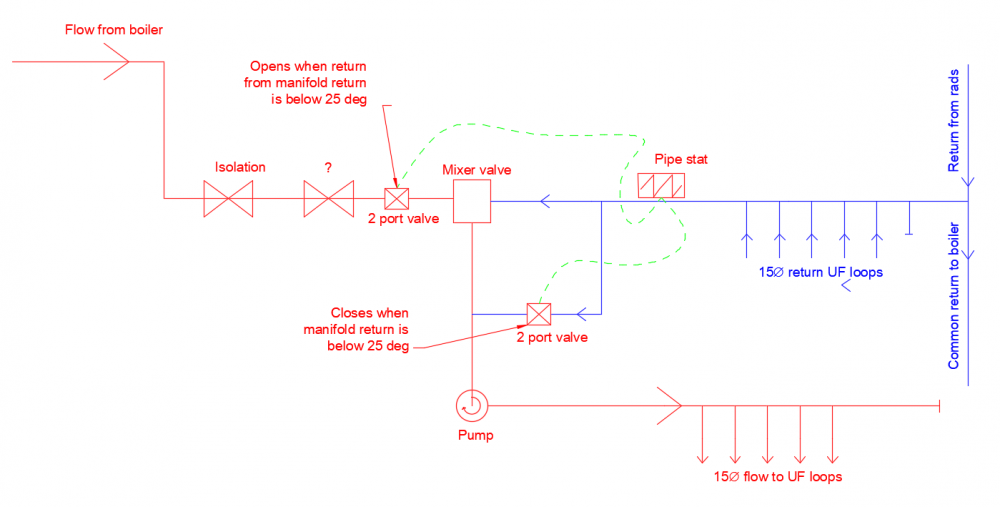
-
Steel Beams vs Cavity Lintels
Gus Potter replied to MortarThePoint's topic in RSJs, Lintels & Steelwork
Hi Dave I chucked that in at the end about the pre camber as food for thought. Yes a bit unsual. You would only consider it on long span (wide openings) where you have say a lot of masonry above, maybe a heavy long span floor to support too. All beams bend once loaded up with masonry so once the stonework is build and you string a line between the points of support you may find say 7 - 10mm mm downwards deflection i.e the underside of the beam is bowed down and it will stay like that. With modern glazing systems and a lot of the slender frames anything near or against them that is not too straight (like the underside of a beam) can show up more to the keen eye. Now suprisingly it's not that difficulat to put a little upwards precamber in a modest sized beam...you're not arching it, just tweeking. There is a fabricator in Scunthorpe who uses a hydraulic ram (off an old crane) in a rig. They lay the beam in on it's side. Run a string line from one end to the other and crank up the ram, easing the beam back and forward until they get say a gentle 10mm precamber. The beam is installed with the camber upwards, masonry on top. Hopefully you can then stand back and have a perfectly flat beam soffit... Yes not run of the mill stuff but if you are spendings thousands on the glazing then why two or three hundred more just to get it a little more perfect? In reality it's on most folks wish list and thus unusual to see on site for domestic applications. It was pointed out to me the other day that quite a lot of heat loss occurs due to the window frame, particularly aluninium, thus the less frame you have exposed the better the performance... how much I'm not sure? -
Maybe you can unclip the controller on the pump. This might let you access the shaft of the pump without draining the system, sometimes there is a screw cap covering the shaft, when you take this off some water drips out, but not a flood. Some of the pumps I have seen have a slot on the shaft, give it a couple of turns with a screwdriver to see if it is rotating freely.
-
Steel Beams vs Cavity Lintels
Gus Potter replied to MortarThePoint's topic in RSJs, Lintels & Steelwork
Good points @MortarThePoint One way of looking at Mortar's question particularly, to sensitive doors (say some bifolds, sliding doors) in wide openings is to start with the finished article and work back. Steel beams - First split the loading on the lintel up into two types; you have the dead weight (dead load) bricks, blocks, floors and roofs etc. You can calculate how much the beam will bend (deflection) under this load. Now the bottom of the beam will not be flat but bowed down in the middle. But the dead load tends to be fairly constant, give or take moisture content changes in the materials and so on.. You can allow for this initial defection when taking the ball park first door sizes. Next you calculate what the extra deflection will be when you get say snow on the roof, have a party, fill the house with book cases etc, that is called the live (imposed load) deflection. Now you can add the two deflections together and this gives the overall deflection. Just remember that when say the snow melts the beam will move back up a bit. Let's say you have an opening 4000 mm wide. You can start by saying let's keep the deflection limit under imposed loading to say span / 360 = 4000 / 360 ~= 11.1mm, maybe a bit too much for sensitive doors. Plug this 11.1mm (or a lower value) deflection back into the formula that Mortar gives and this will give you the beam second moment of area, now go to the tables and find a beam with a greater value than this. Next go back and calculate the overall beam deflection under dead + live load, and just as a check do the imposed load only again. Have a look at the figures you get and cross check with the door manufacture's tolerances in terms of deflection, they generally won't be too forgiving. Now you have got a handle on the beam size that you need to control the deflection. The next thing to do it to check that the beam will be safely carry all the loads, these are the "strength checks". Now you are nearly there. It's tempting to stop there as you think.. well I know what I need to allow for beam deflection, I'll just give it a few millimetres for the mastic seal. But mastic is not as compressible as you think when it is thin, you can accidentally transfer load to the tops of the doors, they bend and start to stick. The last part of this jigsaw is to detail the seals / insulation so you avoid transferring load to top of the doors. Cold formed steel "Catnic" type lintels These are a bit of a different animal. Generally they are designed with similar deflection criteria to the above. However, you need to look closely at what is called the "load ratio" A cavity lintel supports the inner and outer leaves. The two leaves have different loadings and this can cause the lintel to twist a bit as well as bowing downwards. if you follow the manufactures guidance (particularly the installation instructions) to the letter then the lintel should be safe. I think the key here is to get the detailing right in terms where and how you allow the beam / cold rolled lintel movement to take place. This is not that easy when you are trying at the same time to prevent cold bridging and so on. With big expensive doors that are not that tolerant to vertical deflection, loading on the top side I would look to start with a lower deflection limit, design the beam for that, detail the vertical movement joint over the doors and see if it looks pleasing to the eye and fits with the insulation detail. All easier said than done as a lot of the aluminium sections are pretty slender these days. If you have steel Universal beams and an expensive glazing system you can put a bit of precamber on the beams. In other words you work out the deflection, pre bend the beam up so that when the load is applied the bottom of the beam is flatter rather than bowed down. It's not that expensive to do on modest sections funnily enough. look at how flat the underside of the beam needs to be.- 15 replies
-
- 2
-

-

-
- rsj
- universal beam
- (and 1 more)
-
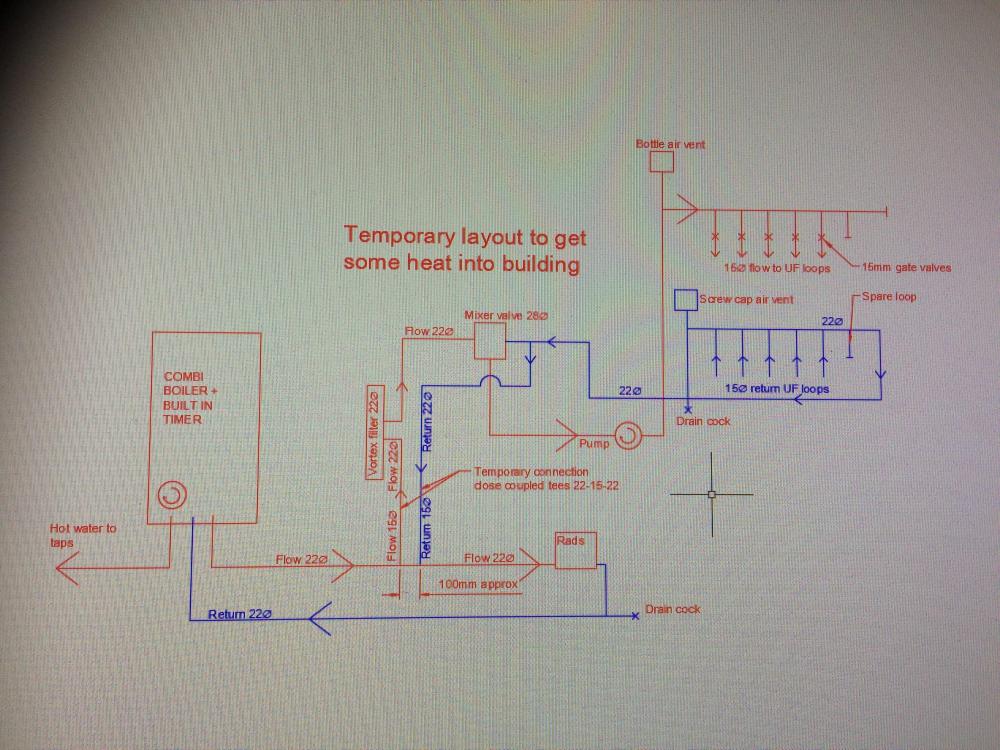
Hi @Onoff Schematic as requested, its' not a work of art I'll admit.
-
What type of piles are you using, size, type, predicted length etc. How big a rig / type do you need? If you can take a step back then you can maybe make progress re temporary work matt design and how you can maybe incorporate this into the final design. Also, have a look to see if / how you may be able to recycle stuff as this can offset the matt cost. As a word of encouragement it may not cost as much as you think, although a bit of a stinger up front.
-
Please help! Would you say this drainage stone is clean / washed?
Gus Potter replied to Oxbow16's topic in Building Materials
Good looking stuff. Gravels in particular are washed, crushed rock sometimes, sometimes not. What you have here are often described as single sized aggregates. Yes you have a bit of "dust" (in terms of sieve size when grading aggregates) but I would have no problem accepting the stuff you have in the photos for drainage. I think you are fine, march on and enjoy your project. -
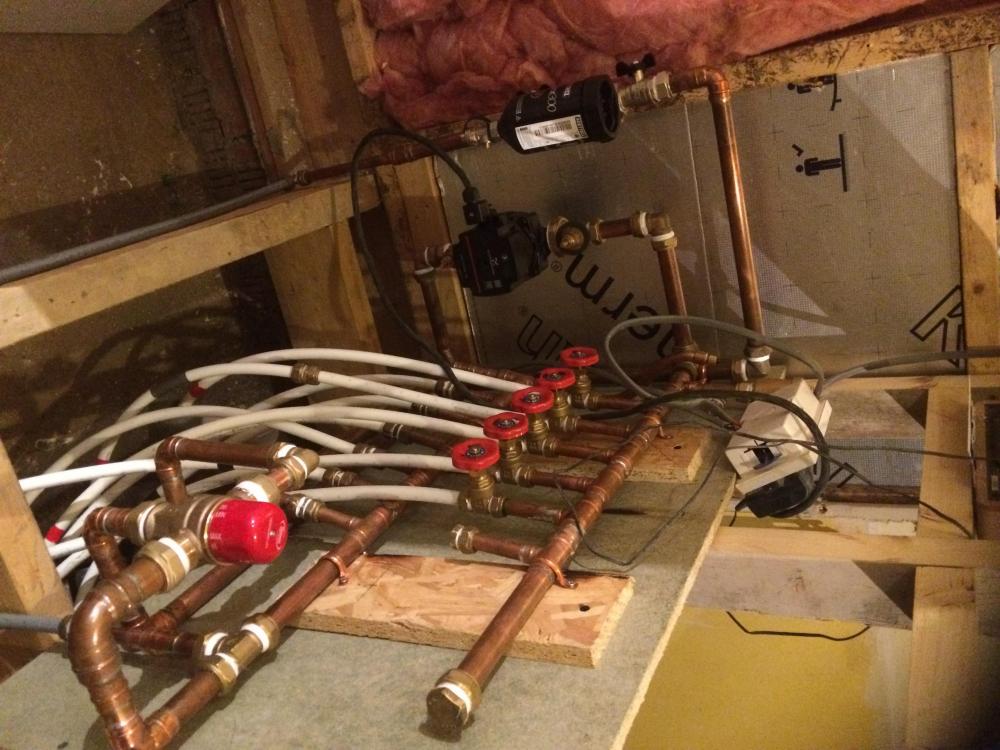
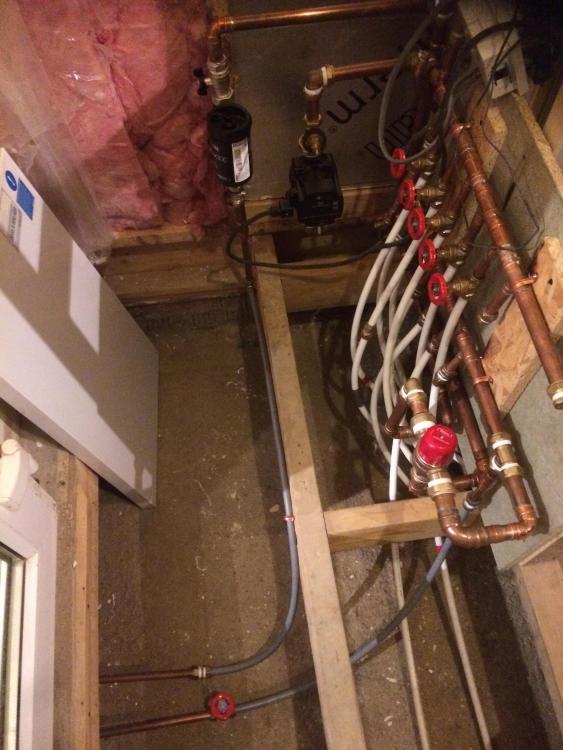
Hi all. Thanks for the positive response, much appreciated. The top manifold with the gate valves is on the flow side. I stuck a 22mm compression stop end on it in case I wanted to flip it round later (made a pigs ear of it), or got a huge bit of gunk in it. There are a couple of stubs pointing down from the hot manifold on top / cold side on the bottom with compression stop ends. These are so I can add another loop later. The five loops you see all serve one room / open plan area. Pipes are 15mm as they are compatible with standard off the shelf kit. I kept the loops to about 50 - 75m in length so that if one fails it's not a massive disaster. Also, I can let the pump tick over so not thrashing it with the noise that comes later when it gets a bit worn. I'm pretty deaf so don't mind but wife still has good hearing! I've got a temporary drain cock down at solum level for now. The next step is to add in more circuits for other rooms, bathroom, hall way etc. I want to use room thermostats so can control the temp of the different areas. I think I might make up a another manifold and start adding two port valves to these , controlled by the room stats. I'm going to get a new combi boiler that will do the hot water, feed the old rads and do the new UF part. Nick - yes I think you are warning that a lot of heat will come off my DIY pipework.. yes but it's going to be in the utility room, we want a pully for drying clothes an so on. Once I box it all in if it gets too hot I'll block up some of the vent holes in the box. Got a gut feeling it will last a while with the odd bit of TLC. Yes looked at a low loss header but was put off by the price.. my house is not that big compared to some of the projects on here... Now to serious matters. Do I put another bank (manifold) above or somewhere else, the new boiler is to go above the filter. I think it would be a good sub commander look if you can have both arms spread, adjusting the knobs while looking at the gas flame through the small combustion port on the boiler (the periscope). One's posture may invite the vulgar here to make adverse comment though. Can you make your project your own? Have a quick glance at Yuri Gargarin in the Vostok, first man in space and so on. That craft has gate valves too. They look like the ones Screwfix used to do before B & Q bought them over. if it was good enough for Yuri then.. potential new look. Watching the US election results so diving onto build hub to make a night of it! Thanks Pro Dave et al for the input. It's not my area of expertise so in a lighthearted note you may want to class me as one of those folk who know just enough to be dangerous / daft
-
Hi Dave, Thanks for piling in. I just rigged it up to get a bit of heat. Still need to finish the job. But I just thought I would wing it to get a bit of heat into the place as it's my own house. Would I spec it at work.. not that brave. I'm more on the structures side. Surprisingly to get things kicked off, I just tapped off the radiator flow side with a couple of 15mm pipes using the close coupled tee principle ( I read this on the internet and thought, I|'ll see if it works) and it works fine for a temp supply. Yes, no flow meters, or fancy stuff, it's my own house so I can go "old school" and just face the fact that the UF system is a massive heat sink. Wife said I looked like a submarine commander just adjusting the gate valves, never mind flow meters. Pratically, in a few years time all these gadgets get gummed up, and few folk know how to fix this stuff, hence my Flintstone approach! If part of the floor is a bit too hot I'll just put my hand on the floor, too hot, then turn it down a bit.. Ignorance is bliss.. I may come back on here later asking how do I fix my oak flooring as the UF was too hot!
-
Hello Gav_P Ta. Yes the solder fittings are on the manifold part as I know that they leak less if you can do a half decent job of the soldiering. To be honest once I pressurised it there were a couple of leaks in the soldering (I'm an Engineer not a pro Plumber) so it was easy to strip it down and fix the bad joints as I had put in the compression fittings. Can't rememeber the film but there is a quote something like " know you limitations" The compression fittings are so that I can take it apart easily later on when the gate valves fail, get the pump out and so on. I was aiming for stuff I can get from screwfix etc to fix stuff when it goes wrong. I have some boss white...if need be, hopefully I won't need to strip down that often. Saying that I spent a bit extra on an oversize mixer valve as it's onto an old system. Just wish I had spent a bit more on maybe the lay flat UF type pipe. I''ll take another photo later but on the flow side after the filter which is on the flow side I have a 15mm bottle vent valve, then on the return I have a 15mm manual air vent. It's not a work of art I admit and as always on reflection you think, hey, I could have improved on that.
-
Thanks CC45 for the encouragement, stuck my head above the parapet here.
-
Hello all. Cheepish, chearful and it seems to work! This is my "Covid temporary manifold", looks like it will be the permenant one. Components: Filter, pump, 22mm manifold cut and soldered in a couple of hours, mixer valve - 28 mm reduced down to 22 mm to maintain a good flow, 15mm gate valves. Does it work? - yes better than expected. How did I calibrate it - flow ect - with my hand - too hot turn the valve down etc. Attractions, can get all the parts off the shelf. Connected to a standard heating system, combi boiler. Tapped into the flow side to the heating using close coupled tees. Still got the electrical controls to do etc, but great warm feet. Mistakes..cut one of the pipes too short, pride comes before the fall! Simple stupid.. yes, so pile on folks.
-
Hi Jamie. I'll have a stab at at some answers! Good points you make, there is always more than one solution! 1/ Different look.. yes my thoughts were that to get this within the budget of 10k it may be worth while conducting an appraisal of the concept design so far. Sometimes this can really help, although it seems at times you are going backwards. But that is part of the design process. 2/ Portalised structure - I spent time working with a few contractors a couple of years ago who were developing the "higher end man cave / garden room concepts. These were coming in at about 20k and the world was you oyster after that, well insulated with adequate founds. We were looking at both hot / cold rolled steel and also diaphragm structures - similar to SIPS. With these the labour cost initially was round about 1/2 to 1/3 of the overall cost, broadly extensions and so on tend to be closer to 1/2 the cost. The aim was to drive down the labour towards the 25% mark. I think the SIPS are another option, matter of preferance really, SIPS have less cold bridges perhaps, portalising things provides more of a "mechno" type frame that folk may more comfortable with? If you want a ball park figure for a cold formed steel shed go online and ask for just the frame only, you this may give you and idea. As a commercial venture the savings lay in deriving an acceptable ground / foundation solution that could be rolled out to the mass market, the cost of the superstructure had less of an influence in comparison. 3/ I would think carefully before you rely on the SIPS panel to straighten a plate, especially once its bolted to the timbers which themselves may not to true, these too will warp and move about. 4/ Yes a glulam would be quite chunky, heavy too as you say, but you can fix stuff to them easily, especially if you are more DIY orientated. 5/ Welding a top and bottom plate on? I think you can detail this so you get most of the insulation on the outer side of the web, thus more of the steel is on the warm side? .. apart from the edge of top and bottom plate.. food for thought? Yes, you are making a goal post but if you want to keep the top of the goal post as shallow as you can this is a way of doing it. The force distibution and connection design can be / is different around the goal post but the explanation is very lengthy so I'll leave it out as folk may loose the will to live. 6/ Origional plan for RSJ. You can site drill a 12mm dia hole fairly easily with a cobalt tipped drill bit on site provided the steel is on the ground before you need to resort to a mag drill. I use a 110v Bosch drill I've had for years. Don't be put off buy having to site drill a few holes, just a few mind, say ten or twenty in an accessible part of the beam or plate. In summary it looks like you are well on your way with the SIPS route and happy with the approximate costs. In this case, if it was me, I would cart on, get it built and start to enjoy it! You seem to have put a good amount of effort into finding something that suits you, that is important too! All the best.
-
Good points from the Punter.. but the developer has to win on all structural points as they have to at least to show that they have constructed a safe building, then you get to the serviceability issues. Historically, many buildings were often constructed with a good amount of redundancy and robustness built in. Now Engineers are pressed more than ever to come up with the most economic design. There is less fat left in the bank to cope with when say tolerances stray beyond those recommended in the codes. Once they move outwith the recommendations in say the Eurocodes and outwith the manufacturer's recommendations (the materials they are using that are not exlicitly covered by the Codes or a European Technical Standard say) then they are on their own and often on a "shoogly peg". While they may be able to justify one tolerance being out when you have several it can become very difficult to justify the safety of the structure as a whole.
-
Yes agree with Water, so long as you can deliver good value. At the top end that may swing more towards creativity (time spent) vs cost (your fee), at the self build end that may be driven by cost primarily with a bit of uplift for the flare / unique personal touch that an interior designer can bring. Really at the top end your work / reputation should speak for it's self and folk will seek you out anyway by way of personal recommendation. Is there any milage in having a look at what sort of uplift the kitchen / bathroom companies are putting on the base cost of the units say as many of them seem to be offering a "free design service" I don't know but maybe some parts of their model can be adapted to suit the interior design? At the self build end, if you are thinking about the business side of things then they (kitchen bathroom companies) have a pretty heavy software developement cost, but when you actually look a how functional the software it's not too flexible which leaves another door open for the interior designer?
-
Thorfun ..Thanks for posting, also great posts from all, so thank you. There may be space on Build hub for a section that explains the geotechnical side of things. I don't know? It's great to see folk delving into this stuff and trying to get a handle on it. There is a lot of information on build hub about this aspect, but from time to time there seems to be the "elephant" in the room. If you are a lay person how do you interperate the geotechnical info, what the Engineers are saying and how the other "water proofing" companies are digesting this, quoting and caveating. What is required in lay terms is clarity (often missing) regarding what the ground conditions are and so on, and more importantly a layman's guide to the implications of this. But the problem is that for the professional this carries a serious amount of liability, also some are not good at explaining / engaging with the self builder so sometimes it also a people thing. It looks like from the posts that you still have options but can't get the clarity on the actual ground. In other words you have the icing on the cake nearly sorted but have no idea what the base of the cake will be.. and if it's a different base this introduces lots of uncertainty.. and that is not comfortable. Anyway I'll have a stab at Thorfuns last post for members that may not be so familiar with the terms used. "No ground water encountered" Well that was at the time of the investigation. Thorfun... you may have to post more detail. One elephant / caveat is the mention of a "perched water table" One simple way you can look at this is to take the different glacial periods. During this time various layers of materials were laid down. You could have bed rock, a gravel / chalk layer over a large area but just below your house is a layer of clay (cohesive material). What happens here is that the main aquifer / water table is well down but locally you have a more "water proof" layer just below the surface and the water this traps (leaky drains or just rainfall) will run into your house. So when you read that last paragraph of Thorfun's post it's caveated such that it has less value. This will have a major impact on the design and associated cost.
-
How much is it off the level? Are you fairly sure that the difference in levels is just due to the age of the house rather than some on going "structural issue" Also, how does the daylight come into the room. If you have say a window in a bedroom and you run the flooring parallel to the window cill this can show up more the changes in level, but if you run the new flooring perpendicular to the window cill it can be a bit more forgiving. Lastly, do you think that once you put all the furniture back it will still be a thing that will annoy you?
-
Hello Harman. Firstly, thanks to all for the posts, great informative reading. I make my living in the construction industry but taking that hat off, difficult though. But to go through your questions in an informal way. 1/ Yes, because as you get older you find you don't know it all. 2/ Yes to benefit from professional expertise.. see above. Not all professionals charge Queen's Council rates. 3/ One facet is that you could get more for the same amount. If you want to spend a bit more then there is a lot of fun to be had. For me a lot of the stuff I do is often hidden, no one sees it. What clients do see, and live with is the the finishes and how they suit with their way of living. They will often attach a value to that, you maybe need to find a way of getting the message over and understand what matters to them and how they percieve value. 4/ I'll avoid this question, suffice to say, the fee could be offset by the savings they could bring. See Steamy Tea's post. 5/ Would not get one in at the "planning permission in principle stage" say, but once that is cleared then I would say that it does no harm just to start making tentative contact with an interior designer. 6/ Word of mouth. 7/ Non really, after all you can go to a shop and get a "personal shopper", go online if you want blinds for windows and get advice when they come to measure up and so on. This extra time has to be paid for at some point. The shops/ window blind people are trying to find a way of "adding value" to the basic garment / blind etc. 8a/ Using a different analogy. A lot of the kitchen / bathroom companies these days are providing an in house design service. These costs are built into the price you pay. Let's face it, if you go to many main stream suppliers and sit down with say a kitchen designer then the customer has to pay their wages at some point? This could be a model to use as a template for interior design? 8b/ Much will depend on your motive. Online as I understand is a very competetive market and to get established in the low end mass market often needs some heavy investment. Hope this helps.
-
On the next project have a look at using skirting blocks. More traditional but as a skirting block is a bit thicker you get a bit of play in the butt joint between the bottom of the door facing and the top of the block, also you get the same where the skirting meets the block. This cuts you the slack to get the mitres right. Glue them to death and let the shrinkage take place at the block where it is more easy to hide. While some of these traditional methods may seem like a lot of extra work they were not daft in these days and knew how to work with the materials they had at hand.
-
On a positive note to start.. the lead brazing looks acceptable on the left hand side, pity they didn't get the same angle of bevel on the right but... hey ho. As and aside I got pulled up years ago by a Clerk of Works who told me the hinges on a door were not fitted correctly. I had used slotted screws and not left the slots vertical, so this encourages drips when the painter comes along. Looking at the photos I'm curious as to: 1/ What is actually holding this moulding up, is it just relying on 50mm embedment into the block? If so, what is at the back of it to give the masonry above a full rest? If the masonry above is offset from that below then this can introduce another stability issue. 2/ There seems to be lead on top. Thus, how is this lead dressed in to stop water penetrating in rather than shedding outwards. Sometime these have a small boot on the back like a cill. It would be worth trying to see into the cavity just to see how it is build in, then work from there.
-
NHBC vs architect certificate vs any other
Gus Potter replied to WWilts's topic in New House & Structural Warranties
Sad to see (but not unexpected) the lack of satisfaction here with warranty providers. Historically the NHBC was set up to improve the housing stock in the UK and more recently other providers have come to the market as it has moved from more research and development to a more fiscal (insurance) set up / model. The system in my view is more than ready for an overhaul. In other European countries a lot of folk don't buy from large developers as they do in the UK, their model is different as many folk "build their own" Hopefully things will change, swing back to favour the self builder, small local builder while improving on the quality of the build. -
It's doable on you own.. but! You can build a house just on your own and do say 95% of the work yourself, you can't do gas, and sign off on electrics unless you have the registrations nowadays. I did this a while back and it took me three years to do a 1 and a 1/2 storey house of a similar size. Just on you own with a half bag Belle mixer, a good barrow, under cover, with not too many windows, tricky bits, and loading out the blocks each night for the next day, cleaning the mixer then with this amount of blocks I would go for 150 blocks a day (15m sq) if you are fit and tenatious. Expect this to drop off from time to time, well quite often, go for a hundered a day (10m sq) tops as you aslo need to order materials etc. I'm developing a formula for just for this. Variables so far are: T = time ..how much of a life do you want h = how old are you.. performance tends to drop with each decade (speaking very much from experience although this is not applicable to all) i = how much is it worth to you for the independance of choosing the pace of the works n = new.. will the work still look fresh and new when it's finished and .. will you too? k = Keen? will you go off the idea halfway through, rush it so as you can get onto something more interesting? [{(T * h * i * n * k) * (constant variables)] + (more variables) A constant variable is a value that can be changed if you don't like the answer, unlike gravity say. That said by building a house on my own I created a job for myself for a while and saved / made a good bit, tax free so don't be put off thinking about it, it may well suit some
-
Raw plug spec for wallplate strap fixing.
Gus Potter replied to epsilonGreedy's topic in Roofing, Tiling & Slating
Eplison. That's interesting about how a sail works in more detail, learn something new all the time. Your spot on about how the velocity of the wind leads to an exponential increase in the wind force. The wind acting on a house is pretty turbulant, it has small vortices that can act over a small area causing significant uplift and also larger areas of lower pressure / suction that can easily lift a whole roof off. In summary the key is to fix your tiles ect as per the manufacture's guidance, follow good practice in terms of fixing the timbers ect of the roof together and again follow good practice re truss clips, holding down straps etc. Sometimes you need to dig a bit deeper. If you build at the top of a cliff, or on a large hillside say the wind can be more severe so deploy common sense as Joe90 says. Ask the local folk. Some farmers may say in passing.. "that is a windy bit of the hill"..or " the stock avoid that bit in the winter", no barns built there as the last one blew down... Also, if you are in built up areas you can get a bit of wind funneling if you have tall buildings round about. There is lots of information about the wind etc available on the internet but there comes a point where once you have done your due dilligence then maybe as others have noted it's time to move on as you do want to finish the job at some point.


