Gus Potter
-
Posts
2155 -
Joined
-
Last visited
-
Days Won
26
Everything posted by Gus Potter
-
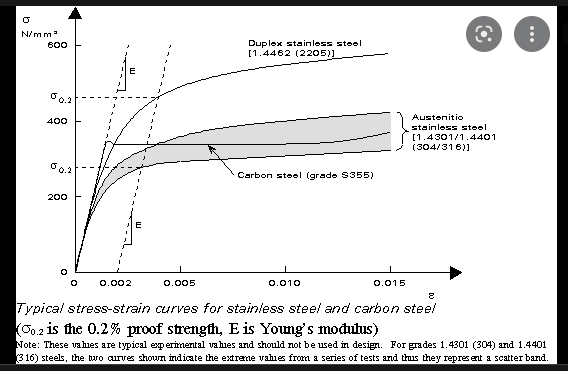
Good point. PU foams may behave more like say stainless steel or cold formed steel. For all. A typical steel beam you get for your house is quite stretchy (elastic) and you can load it up a fair bit until it starts to "yield" . If you take the load back off it before it gets to the yield point it will return to it's original shape if say the masonry above allows it to. But stainless steels and cold formed steels are different. The elasticity changes depending on the load.. how "stretched / compressed they are. Have been lazy and copied a graph off internet below that shows you how carbon steels behave linearly up until a defined yield point but stainless does not. Cold formed steels are similar but the shape is a little different. Youngs modulus E is the stress / the strain. Now it may be and I suspect as @SteamyTea is alluding to? is that PU foams and say EPS may have a similar behaviour to stainless steel in that they may not be quite as elastic as we think when heavily loaded on a long term basis. Now you may have wondered in my previous post about why I chose a value of 2% compression to get a bearing capacity... a spin off is that we are not pushing the insulation that hard in terms of it's elastic performance. In some way we are mitigating / minimising risk where we are not quite sure just how well a material may behave when pushed to the maximum declared manufacture's loadings. That's a long building. On something like that you could have a lot of changes in the ground, need free movement joints, big floor slabs that will shirink a lot end to end and thus the roof should be designed to move / have joint's that suit the building under. I thing the roof sheets tend to move less than the building underneath so they don't dominate the movement / settlement design. Quite common up my neck of the woods. After the second war there was a drive to upgrade the housing stock and re purpose the factories that had been concentrating on the war effort. This manifested in what we call "non traditional housing" To us now it seems "daft" but back then there was a great need to provide houses that were forecast to have a lifetime of 20 - 50 years. Remember that a lot of folk were living in slums, outside toilets and so on. My house would have seemed like paradise at the time. My ex council house is now some 55 - 60 years old... but know if I insulate the wrong way it and rot the built in wall plate there will be trouble.
-
Steamy, it all sounds like a can of worms. Yes.. If you are talking about say a ground bearing floor slab that has PIR under then the possibility that the PIR could shrink.. due to a change in the chemical structure, could cause a potential issue say in 20 to 30 years time. If you extrapolate this further then could the chemical structure change such that say the material completely fails and turns to dust. You could apply this to a lot of products we use.. EPS for example.. we just have to partly rely on past experience of the perfomance of the material or similar materials, the expertise of the "Chemists" when developing new formulas and the knowledge and experience of the people developing the test and validation procedures. In terms of how SE's may approach this. I'll work in kg a bit as this may help BH members get a feel for the "weight" of things. Take an insulated ground bearing slab or say an ICF structural raft foundation that both sit on a layer of insulation. Say the insulation is 150mm thick PIR with a compressive strength of 150 kPa ( 150 kN/m^2 ~= 15 tonnes per m^2) at 10% compression. Now say we load up the insulation at 15 tonnes per m^2. 10% of 150mm is 15mm. To carry the full load the insulation is going to compress down by 15mm. Iif we had say a concrete slab that was isolated from everything else and we could guarentee that the load was always going to be perfectly uniform then in theory we could maybe get it to work and just let it slab / house move up and down by 15mm. But in real life we have concentrated loading, loads that occur at the edges. These types of uneven loads could introduce a potential 15mm differential movement.. thus we could need a serious concrete slab with a lot of rebar and invite other problems. Then you have to add to that the fact that the ground under the insulation may also settle, swell and shrink as moisture levels change say. The building above will also be moving about thus in some cases you could suddenly end up with 40 - 50mm of movement if all the cards fall the wrong way. In the round as a rule of thumb a medium sized house can cope with say 20 -25mm of movement over all, say corner to corner before bad things start to happen... a few cracks accepted. Yes we can design for more movement if need be.. but that all adds to the cost. Now on slabs and ICF raft founds in particular we say.. we may need a raft as the allowable ground bearing capacity of the soil is say 60 kN/m^2 =~ 6 tonnes per m^2. Now you may have a soil report that mentions a presumed allowable soil bearing capacity. This value is a prediction of what load you can put on the soil without it settling / compressing by more than 25mm.. and / or not completely failing. Now you can see that we have 15mm compression of the insulation and potentially up to 25mm in the soil = 40mm + plus any say other superstructure shrinkages / movements. To come up with some sort of initial answer we say.. Let's look at the insulation. What compressive strength will it have at 2% compression say. 10% gives 15mm thus 2% would be 3mm. We assume the insulation behaves like an elastic band so the response is linear. At 2% compression we can load the insulation by 150 kPa x 2% / 10 % = 30 kPa. Then we could say the soil has an allowable bearing capacity of 60 kN/m^2 based on 25mm of settlement so half that (as that is what the insulation can carry) gives 12.5mm of settlement. It's a massive simplification but for ease of argument just add the insulation and soil movement together = 3.0mm plus 12.5 = about 15mm. That we could live with as a starting point. BUT.. all of the above is based on a building being fully loaded for often a long time.. Clay soils can often take a high short term load as they can't settle until the water is squeezed out. So in summary we kind of design for full loading which does not happen very often so that is maybe why we get away with the insulation shrinking a bit and not see it cropping up a big construction/ design problem? ----------------- Yes can't quite remember the max lengths but there are a number of guidance notes published by the SCI / BRE that mention designing in movement joints in the roof. I'll dig out the info when I get a chance. I think if you follow this guidance the shrinkage of the PIR roof panels can end up being a mute point. If you have an long shed / office say with glazing panels you need to make sure you put in enough movement joints so you dont' jamb the doors and break the glass. It should be obvious that if you don't put enough joints in the roof then something is going to give. A dilemma I face is that my timber floor joists are built into the external walls in my 1960's brick cavity walls. The joist ends are not wrapped, they may have a splash of bitumen but I doubt it. The cavity is drafty but that is why maybe the timbers have lasted so long. Also I have a timber wall plate that is built into the inner leaf of masonry which is the main load bearing element. Any rot here is going to cause the building / walls / roof to settle badly.. very badly. I too have been mulling over filling the cavity but I just can't convince myself that it's a safe thing to do. I would have a look at how all your structural elements interact with the walls before progressing.
-
Buying tiles. Discount to expect, comments on wood effect.
Gus Potter replied to saveasteading's topic in Wall Tiles & Tiling
I think it's a far do at 10% Take a bathroom. Do the floor tile joints need to be symmetric with the wall tiles? It's a steading.. the floors will not be square so can't have slivers of tiles running to zero at the skitings as it will look crap. In the round though.. if it's a forever home it's a big ask to get it all right straight off the bat even if it is your day job. I would live in it a bit, do the main rooms and then finish once you have got to grips with how you are actually using it from day to day... that is part of the fun of moving into a rural location.. new friends.. new way of life. -
We're out of the ground....(Nudura build)
Gus Potter replied to Mulberry View's topic in General Self Build & DIY Discussion
We have all been there and I hope you are still friends. Have done / started a quick post for all. -
External air ventilation for log burner
Gus Potter replied to SBMS's topic in Energy Efficient & Sustainable Design Concepts
Just edited my post to lay it on a bit thicker. -
External air ventilation for log burner
Gus Potter replied to SBMS's topic in Energy Efficient & Sustainable Design Concepts
Stuffy room.. You light the stove.. big flames.. warm the room up.. then you turn it down to ticking over. After a while you'll notice that the air in the room does not "smell fresh".. very difficult to desrcibe but you just know that the air in the room has changed since you lit the stove. Your nose is very sensitive so trust it. Another way is to think of this. If you are a parent with a young child and you go into their bedroom.. instinctively you know if the air is bad.. "just not right". You open a window for example. That is the test.. it's in our genes as parents. Yes MHVR is great but I have Clients that send their kids to "outdoor schools" see my point? And no amount of technology is going to over ride a mother's instinct in terms of air quality. That is a diffucult question. For me having grown up in the country and abroad (Africa) I'm not that keen on relying on the gas / electric company / modern interconnected electronics to save the day in the short term when the shops are shut for a few days. At least with a stove you could keep one room warm for your kids, boil a kettle and cook a meal on the top in the short term. I'm not a "survivalist" say like in the US but have lived in the borders of Scotland where the power used to go off for days. I admire what you are trying to achieve and hope this helps you to reach a conclusion that works for you. -
External air ventilation for log burner
Gus Potter replied to SBMS's topic in Energy Efficient & Sustainable Design Concepts
Ok on paper if you have a floor vent directy under the stove that is not connected to the stove air inlet and you do an air test.. it will contribute to a bad result. Yes.. I acknowledge that folk want to have an air tight house and agonize about having a stove that is "room sealed" like a gas balcanced flue boiler. But if this is your forever home you need to be aware that unless you want to change the door seals on your stove yearly you'll end up with a "stuffy room". Your strive for air tighness could come back and bite you! For those that are concerned about PM 2.5 levels this is the last thing you want and for those that want an easily maintained house it is also the last thing you need. If you don't create a negative pressure near your stove then these PM 2.5s are well into the house! Buy the time they get filtered out by any other system you'll have breathed a lot of them in. You may have some semi automation or internet connected central heating thermostats that need some wireless control. The idea of a stove is often to give you a "Flintstone" backup when all your electronics/ phone apps break down. This is not the time for "posing" it's a time for praticalities and thinking.. what if the gas / electricity goes off and god forbid.. my phone stops working! Keep it simple and stupid. Think about it.. are you really going to do this (change the stove door seals every year) with all the other things in life you need to do. What I have is a duct from under the floor that rises directly under the stove.. there is a ~75mm gap. When the stove is working cold air gets sucked directly into the stove bottom air intake. When not it provides trickle venitlation.. in the summer. If the door leaks a bit during use there is some positive suction that stops the PM 2.5 from getting into the room as they are sucked mostly back into the intake flow by the Venturie effect. I would encourage all to think about this in the round.. how you are going to live and use your home rather than blindly following the air tight current doctrine. In summary it's your house so make it suit your and your way of living. -
No not mad as asking good questions. I would try and insulate as best you / seal up drafty areas for the winter at least cost. Keep it all (stair) in place for now until you make up your mind if you want to convert the attic or not. You could spend £1000+ mucking about.. that could go towards the extra heating cost anyway.. pragmatically look at in the round? What Peter says can be really important, you could indavertantly blow it and regret later. Take plenty photographs and record.
-
Timber Frame Construction- when to fit windows
Gus Potter replied to benben5555's topic in Timber Frame
Now that is "arse" covering" or maybe the lift supplier (like a good few contractors do) was pointing out to the SE that they did not know what they were doing and should stick to designing garden walls? Off the top of my head I would go for 25- 30mm shrinkage on a three storey at concept design stage.. with some good site contol.. big difference.. as any more than that all the wall ties will be out of spec for example.. and they won't sell any lifts these days based on that 50mm caveat. The Architect will have a blue fit if you go back and "give them the good news".. on floor levels and how they may change. I suspect that if you went to an Architect as an SE and said.. this is the best I can do you may not be invited to work with them again. Ok.. what do you do when you have to meet the accessibilty threshold for BC at say 10-15mm.. then a year or so later disabled folk can't get out their flat as they need to wheel up 30mm to get to the communal landing as the flats have shrunk but the main stairwell is as built.. storey for another day.. but is goes along the lines of once the completion certitificate is issued then disabled folk are left to their own devices... which is bad design and bad for everyone. For all.. timber frames shrink and swell a fair bit! But with careful design this can be effectively managed. Good advice. -
Buying tiles. Discount to expect, comments on wood effect.
Gus Potter replied to saveasteading's topic in Wall Tiles & Tiling
Are you getting that "twitchy feeling" I'm making a bit of progress on my own house, the big part of the job is done internally, now moving onto master bathroom downstairs. Lucky here as my wife is pretty strong on the interior design side. Anyway this bathroom has a suspended timber floor with UFH so it is going to move about a bit. Wife has spied some large format tiles but I'm saying.. hey last house I built with UFH the floor tiles cracked.. very embarrassing as it was in the bathroom that every visitor used. When I say cracked it was cracked! Thus large format tiles 1200 x 600mm are proposed for the walls, smaller for the floor... tonight! Design is a journey although fun. With the lastest tile printing technology we are looking at wood effect printed tiles in a smallish format. If they crack then I maybe can replace them.. hopefully not as will be using a decoupling mat. I know you know @saveasteadingbut for all ask are the tiles and substrate compatible with under floor heating. Target advice. I reckon if you pitch in with a 300 sqm order then you'll hold the whip hand. Also do you want to include a decoupling matt. What about adhesive and trims / threshold bars. Also what about the shower rooms etc. It is all these things that can make or break a good deal. Yes you may get a good deal on the tiles but it's always been the "other bits" that make a good deal a real deal. Remember when Topps set up in Edinburgh.. they knew how to sell even to the "pros" Problem is that when you're in the heat of battle doing a big renovation you struggle to find the time to do it all and still do the day job. At this area you are talking about, and I think you said you have a good few bathrooms to do, then you are into the teratory of saying.. a pallat of tile adhesive.. xxx amount of packs of tile trims in these sizes and types. I know it will take a pile of work to do a material list for all of that.. the trims and gestimating how much adhesive you need is a big challenge.. @nod can you help? -
Timber Frame Construction- when to fit windows
Gus Potter replied to benben5555's topic in Timber Frame
Now that is a dilemma. Here are two facets. In the past lenders would release funding at certain stages. Underbuilding out of the ground, wind and water tight, first fix, completion say. Their idea of wind and water tight was that the windows / doors had to be in and the roof weather tight but no tiles say. But for self builders windows and doors are a big ticket item so you wanted to buy them as late as you can in terms of the cost curve / interest paid on the loan. Also windows and doors can get damaged so best left until you have stopped using Sthill saws etc in close proximity. Structurally wise the windows are often fitted to the timber frame which moves up and down and thus so does the window with it and the finishes on the inside. To accommodate this movement we put a compressible material under the cill where it extends over the outside leaf of masonry which for all intents and purposes stays still. Over the head we allow a gap between the top of the window and the timber frame lintel (to account for deflection from roof loads.. tiles etc) and a flexible mastic joint between the outside of the window frame and the outer leaf of masonry. In Scotland we have been doing this for decades so know that it works ok if the drawings are followed... that is what we strive for! Remember that a timber framed house is very much a "living" structure. Yes when the frame is first built it will shrink a fair bit but in autumn after the heating has been off over the summer it will swell a bit. It is always moving. The problem is that if you fix your windows to the outer leaf of masonry is that it is much harder to create the aesthetic movement joints between the timber frame / attached finishes and the inside face of the window frame. The window frame then be still as it is fixed to the masonry, the window cill, wall paper ect will then be moving up and down. Best to keep the big flexible mastic joints outside than on the inside? Would I fix a window to the outer skin of masonry on a standard structural timber frame if it was my own house.. no. -
Bay windows for complete beginners
Gus Potter replied to MortarThePoint's topic in Windows & Glazing
That's looking good.. everthing looks nice and clean. Nice brickwork / blockwork, lead flashings not over length (as per Cookson guide to good leadwork), good drip (min 40mm recommended) on the cills. Looks like a clever detail at the bottom of the wall abutment flashing.. any chance of a close up photo? Well done I say. For all. In principle you can stick a lot of load down a short strut bay pole before it buckles. Hence the two tonnes mentioned. But when the manufacture's test these they work on the basis that you have a material top and bottom that has a high compressive strength and is stable side to side (laterally) which is not often the case as you may have brickwork below and timber above. SE wise I would always look at any bay pole visually. Any more than 200 kg load say invites a fag packet calculation check on the suitability / stability of the materials that are above and below it. In summary.. if you are putting more than say 200kg down a bay pole then don't take just the advise of the window fitter, always use common sense and look at what is below it.. old brickwork, soft stone.. and what is transferring the load to the bay pole at the top.. say timber... let common sense prevail. Also remember that what is above and below may want to move sideways as it is essentially "balanced on a pole" so you need to take measures to prevent this. Remember that if the material starts to crush a bit at the top and bottom of your bay pole load will be transferred to your new windows which may start to "protest". -
Safety first here for me. Now winter is coming can you smell any flue gasses. I would make a hole in the plaster where there is a void behind and put a CO detector there and monitor. You could also get a Gas Engineer to investigate with their gas analyser but the nighbour's fire would need to be on. Or you could ask your neighbour when they last had the fire serviced ect in passing. Remember that burnt gas contains water vapour that can condense if not properly controlled. If all the roof leaks have been fixed it could take a good few months for things to dry out.. but I would want to know more about the gas fire on the other side. Is the neighbour's old chimney lined with a flexible duct for example. Is the duct installed the right way up? Next would be to open up the wall more and look inside, then lift the floor locally and look under. Have a go at this and report back on BH and folk will give you ideas on what and where to look next to help diagnose the problem.
-
Off to Stockton on Tees .. to buy a bath.. but
Gus Potter replied to Gus Potter's topic in Waste & Sewerage
Just as well you did.. for me.. thanks.. another thing learnt! -
Off to Stockton on Tees .. to buy a bath.. but
Gus Potter replied to Gus Potter's topic in Waste & Sewerage
That's great Dave, thanks for that. Thanks Russdl. All been of great help, know how to do it now as was stuck! -
Land grab of unregistered land
Gus Potter replied to JonC's topic in Party Wall & Property Legal Issues
Hi Jon. Are you in Scotland? It makes a big difference! If you are then there is quite a few levers you can pull before you need to go full legal and incur expense... but you will need to put in a bit of legwork. -
Good point. In the "very old" days before my time we had lead pipes. When I started out in the construction industry we worked a lot on renovating tenenments and so on. The apprentices were taught how to marry up new copper with the old lead.. what metals you could join and the ones to avoid.. the Nobel series (Galvanic series) was all taught. Part of the course module was also lead work as they has to do the lead flashings where the pipes went up through the roof for example. That was part of the requirement to become a professional Plumber and gain the required acknowledgement from the Professional body. Now the modern plumbing profession has become more restricted. But now they have to be certified for all sort of things such as direct (mains pressure) water tanks.. they can't do it all.. but you can see how the plumbing trade has moved away from some of the traditional skills that they needed in the past.
-
Ah.. appreciate your frustration. That chimney cap leadwork is great.. lifts your spirits.. then.. next day your "baw is burst" You'll know that lot needs lifted, the battens and vapour barrier sorted etc. I get it too, one day great work from the builders.. next day they have put the wrong brain when going to work. But we all have "off" days!
-
Yes technically but I suspect that @Carrerahill will set your mind at rest. Don't want to say more as I probably know enough to be dangerous!
-
Land grab of unregistered land
Gus Potter replied to JonC's topic in Party Wall & Property Legal Issues
Thanks Mike. The law in Scotland is a little different but the same principles apply I think. Ta Dave. -
Will defer but @Carrerahill will know / have the answer.
-
It's because I'm having discussion with BC about why they need a pile of trickle ventilation installed in an old Victorian house when I'm doing an internal slapping in a wall to make an open plan kitchen. My argument is.. the place is freezing and draughty already.. we don't want to make it worse. As loads of folk have said on BH.. and lot's know much more about it than I do.. it only takes a small hole to reduce air tightness. If that hole is next to a solum vent on an east facing elevation say then it's akin to leaving a window open on a night latch? Yes I'm being dramatic but I think I have a point?
-
Oh Nod I made a post about a bath trap.. any ideas?
-
Nod.. love your style, ta.
-
I don't think there is a cartel in the true sense.. deliberate and determined criminal activity. Yes you may get the odd few idiots that are at it but at some point they will get caught and I suspect they may be made an example of. The Polsen scandal springs to mind where some jail time was served. Depends on what you consider faking. In the past it was the BRE that did the fire tests (long ago they were a government body not an arms length organisation), laterally some of the big suppliers developed their own test facilities. Surprisingly we do quite well here in the UK and are I think are ahead of the game when compared to many other countries.. so take heart. The lay person may think that faking means that in the lab you just manipulated the figures to get the right answer, went for a cup of tea and just made all the results up. From my experience I doubt this happens. I have met some real fire experts that are involved in testing and can assure that the ones I have met are consumate professionals that really take public safety very seriously. However.. it can depend on the brief that you send to the lab! Here is a good example that can invite discussion. You have a block of luxury flats that are constructed with a cold formed steel structural frame. These flats tend to have one or two big principle rooms. The flat party walls / public hall ways / main doors to the flats are all well fire protected. But.. some of the internal walls in the lower flats particularly need to be load bearing both vertically and horizontally for economic purposes. But the doors between the rooms in the flat are not fire doors as big thick heavy internal doors are not a selling point for a developer. A big thick front door is..folk feel that they won't get burgled and feel safe! Now a good few fire details are tested for one sided fire exposure (a fire in one room) but if you don't separate the room the same way as you would flat to flat then you have two sided exposure and that is a different animal. If that wall happens to be load bearing wall that is holding up the flats above then you have a problem. Now if you ask the lab to test from one side you'll get one answer.. from two sides another.. the later will be less favourable if you are a developer seeking to make profit. So you go to the Building regs and try and interpret them to suit you, put pressure on BC and so on. You phone your big supplier and say.. BC are giving us hassle can you help?.. Help could come by way of a barrage of overwhelming technical info. When I was much younger I had heard stories about folk from BC getting a free holiday but these days are past. Now BC don't have the resources to argue the case, there is political pressure from above. This does not bode well for public safety. Unless we address this then I feel Grenfell won't be the last, may not be a fire..but lives will be lost. Now I have owned a flat that had fire doors to every room. But as we know folk remove the self closers, jamb them open and so on. In terms of fire risk management you are now placing all you eggs in one basket to some extent in that the behavoir of one occupant can compromise the whole fire design of a building. To put this another way. When we as SE's design a building we calculate the loads, factor them up an design for that. These are safety factors that cover everything from us making a calculation error / small loading misjudgement that will not be spotted ( SE's are human too).. say a dodgy batch of concrete that slips through the net, a bit of timber that has too many knots in it, a builder that is having a bad day and so on. Looking at this in the round.. for something to go badly wrong you very often need a number of events to occur at one time. The Grenfell tragety happend because our system of checks and balances has broken down. If only one person had made a stand and importantly been listened to then these lives could have been saved. We are seeing a lot of changes in the insulation market. Up in Scotland there is a big review going on in a lot of councils relating to fire performance of materials. Insulation is a big part of that. The insulation manufactures' are having to spend a fortune reviewing and in cases recertifying / reviewing their design guidance. Some big well known names have withdrawn products, some have so many caveats that it puts designers off going any where near their products as the designer carries a big liability. Everyone is trying to shed risk. All of the above is limiting the choice of materials and thus I can see why you may think there is a Cartel. Hopefully in a few months time I will be able to comment in a more upbeat way. I know I sound like a gloom and doom merchant!