


Gus Potter
-
Posts
2383 -
Joined
-
Last visited
-
Days Won
34
Everything posted by Gus Potter
-
Compressive Strength - insulation behind ledger board
Gus Potter replied to jayc89's topic in General Structural Issues
Hi all. I don't think this is safe for the following reasons. Mind you you can ask ten SE's and you'll get ten different answers.. here are my thoughts. Agree that the ledger distributes the load over a number of the fixings. Mainly to account for a few badly installed ones. Also agree that if you use EPS or foam 200 you will get initially nominal tension in the anchors (as the say load increases due to snow) as the EPS will compress as the ledger rotates (and the fixings start to bend) due to the added eccentricity of the load. If the ledger was hard against the wall, it was 50 mm thick and with joist hangers then the eccentricity would be would be 50mm, maybe a bit less if the hangers are of wrap over type.. If you put a compressible insulation behind the ledger the eccentricity is now doubled to roughly 100mm and this completely changes the behavoir of the connection in a dramatic way. The insulation is not strong enough to deal with the forces until it compresses by a long way and by that time other things will fail.. probably suddenly which is dangerous. An EPS or Compacfoam 200 insulation means that it will often carry a load of 200 kN/m^2 at 10% compression.. thus before it can carry that much compressive load it needs to compress by 50 x 10% = 5.0mm and by that time your ledger will have rotated a lot and dropped a bit. All the bending forces will by that time get transferred to the fixing which is into brittle masonry. The fixing will now be subject to the same downwards loads (call these vertical shear forces) but also a significant bending force due to the compressible nature of the insulation. This causes the masonry to not least crush as the fixing enters the wall and that can reduce the capacity of the fixing by more than 50%. I have only touched here on some of the basics.. the behavoir of these types of stand off connections is much more complex and you enter into this world at your peril. I think your starting point here is to get a feel for the difference in load capacity of a fixing with a stand off (which is what you have) is to go to the Hilti website and see how much difference it makes when you have a a column base plate set above say a concrete pad stone. You can see this often on lighting standards next to motorways / railways where you can see the column base plates set above the bases with the bolts exposed.. you have something similar. Now even navigating the Hilti or similar site and interpreting the load data is going to take a lot of knowledge, but just have a look.. they have some pretty user friendly diagrams. I hope you'll then see the big load capacity reduction and realise that what you are proposing is not safe unless you design for the completely diiferent behavoir. However there is often more to this than meets the eye. When we design a building we want to tie different bits together for overall stability. In your case this could mean that we want to tie the rafters back to other parts of the house so the whole thing acts as a oner rather than individual elements.. we call this as SE's not least robustness (if one bit fails the rest hangs in there) and look at alternative load paths. We think.. just say the builder cocks that bit up.. is there another way the building can hang in there before it falls down? So rather than pushing the connections to the limit we need to introduce a bit of redundancy to account for human and material error. In principle you could make you thermal break using say something like this https://www.armatherm.co.uk/thermal-break-materials/armatherm-frr/.. I think it is a waste of money.. just accept you have a bit of a cold bridge and beef up insulation elsewhere to compensate. Also remember that you are fixing into old masonry, maybe bricks with holes in them, for the fixings to work well they need to be away from the mortar beds etc.. you are asking too much here.. in theory it may work but can you build it in real life and make it safe? So to conclude my thoughts are DON'T do this. Fit the ledger against the wall, maybe with a DPC behind. -
What about going for the simple stupid.. an insulated garage door and then you could treat the garage floor as a quasi party wall.. just horizontal? Next would be to look at how often would condensation really occur? In the coldest weather you may want to introduce a little background heating any way in the garage.. it would be a few quid over a week or so? During normal use a bit of PIR would help. So long as it's not a kitchen or bathroom your level of water gas generation will probably be less onerous. Ok so you shift the dew point down.. but the premise here is that the concrete is breathable.. which it is not really.. if the garage floor has a painted surface then shifting the dew point down ain't going to make much difference?
-
Indeed.. my mistake. that changes the game!
-
What a good question. My starting point here is to look at the direction of travel of the moist air (call this air that contains water gas) and where this gas will condense into a liquid (water which causes the problem) that is called the dew point. The garage is colder than the upper floor thus if water gas gets past the existing ceiling and migrates up it won't condense as the temperature above is higher as you move up the floor depth.. you move towards the habitable heated space... warm air can carry more water gas without it condensing out...hitting the dew point. Most intergral garage ceilings I have seen have two layers of plasterboard for fire protection. Before you do anything you need to make sure you don't compromise the fire protection. Now if you were to add an extra layer of insulated plasterboard (which is often has it's own vapour membrane) below the fire protected ceiling then as the garage is cold the water gas still won't encounter a lower temperature zone as it move upwards so you should not hit the dew point. In theory you could have a very moist bedroom and the water gas migrates downwards and condenses.. but that will happen anyway as it hits / nears the cold side of the existing garage ceiling. But in real life elevated levels of mositure will go up towards the bedroom ceiling. If the bedroom even approaches that level of moisture you must have another problem that would make it close to uninhabitable.
-
Hiya. Here is the link to a post I made a while ago about how I go about getting build over permissions and the different types of sewer.. I have tried to paste the link but if you click on the pic below it takes you to the thread where I posted info. Scroll down a bit and you'll get to my post. Big thing here is you need to know what the different types of sewers are. A private sewer is a drain that only serves your house.. you tend to own that. A public sewer is one that serves more than one house. You often see them up the back of a row of terraced houses. Often at the end of the terrace they turn towards the street and run into a main sewer.. which is a big (don't want to be rude) often deep large diameter pipe with potential very costly problems attached. Your 3.0 m rules are often out the window when you encounter a main sewer. To get best advice you need to give more info with a drawing and tell us what kind of drain it is. If you read my old post this should help you navigate this minefield. Have a read at that and then we can maybe help you a bit more?
-
I thought from reading the above you had a hybrid roof working from the top down. If you have tiles, membrane, a gap, insulation between rafters and insulated plasterboard below the rafters then that is a standard install... no drama. But if you had ended up with a hybrid roof then.. when you said part the insulation was over the rafter that is a big game changer.. I went to a job last week where the builder has changed one of my designs from a warm dormer roof to a hybrid roof and not asked me if it will work.. if they can't demonstrate to me that it will work by calculation .. it's going to have to come off and get built the way I designed it... and that is about 15 - 20 k plus down the pan. It's not just the roof it's all the plaster board inside as on a warm roof no need for MR plasterboard in bathrooms and vapour membranes etc.
-
Pity you wasted all that money then, why did you ask the question if you we just going to do your own thing anyway? Take it that the 50mm air gap is ventilated to keep BC happy? If so the insulation above that 50mm gap is doing nothing.. other than making you feel good. Or have you sealed off the 50mm gap.. seems odd how you can make that work.. If that is the case then you have dodge a bullet as what you have is a roof with less thermal perfomance (75mm PIR) but likely to last a lot longer as you won't be getting interstitial condensation.
-
Never mind about upsetting BC.. you should be more concerned about knackering your house and wasting your money. It seems you are suggesting a hybrid roof.. and these are fraught with condensation issues... like it will start raining inside! Can you tell us more about how are proposing to build up the layers of insulation, the membrane if any on the top side of the roof... and the type of plaster board etc you are going to use on the underside..do you have bituminous felt (not breathable) etc. There are a lot of things you need to get your head round before you take this route. Don't be put off as often the solution is simple.. you just need to know how these seemingly simple things work if put together in the right way.
-
No because they are wary. A 1500 tread width increases all the potential forces significantly.. you are in the region of a commercial stair. An SE will look at realistic and probable loading. If you look on the internet at family photos you often see groups of people gathering on the stair at xmas time say... that is a realistic and probable loading. That said the cost to design for this should not be an arm and a leg.. but BC will query if you try it on with the "stairbox" etc
-
More foundation fun - straw bale garden room on clay
Gus Potter replied to Nick Thomas's topic in Foundations
@Sparrowhawk Distaster strikes at my end. Thanks for pointing out my error and the heads up @Nick Thomas Can you all for give me please. I just use my own name.. not forgotton that yet.. but time may tell as I age .. further. -
Helo Glen. Well done you for getting to this stage.. as a past self builder it is a mile stone, technically and emotionally... bet you feel great! I'll comment first with my SE / past Contractor's hat on. Ok with the raft concept.. it has many advantages. So let's go with that for now. ICF is not suitable for what you propose in terms of cost and complexity in terms to reinforcement design and buildability = big cost. You have big open spaces and building stabilty issues. While I could maybe design this structurally on paper in ICF the detailing and the construction method is going to be so complex that costs will escalate exponentially.. and then you need to find a builder that can actually execute a complex design like that. To expand a bit you have some chimneys, exterior details.. to marry this with ICF is going to be very costly. To sum up if you came to me as a Client ICF would be the last thing on my mind. There are so many other better options worth having a look at. In terms of Architectural design. The example you posted is unbalance in that the garage dominates the main dwelling.. the massing and complexity of detailing is not pleasing... it looks like something from America.. we in the Uk have better taste. Your floor plans. This is something quite different. To simplify you have the main enterance, then you have to walk by the cloaks and the office.. before you get to your first feature which is the stair. When you get home or have visitors then there is nothing there that excites.. more like a 1970 sports pavilion enterance. I don't know what to say other than there is a huge amount of wasted space and the flow (how you move around the house) is bizzare. Why can't you access that boiler room from the ground floor.. I think you need to go back and reconfigure the ground floor and then the upper floor. Go back and look at other layouts.. have a major internal design review.. then rule out what you really don't like.. then you will know that what you have suits you. Looking at this I would say to you.. I think what you have is not good.. let's see if we can do better. Has anyone sat you down and explained your design and how it works on the different levels? if you can tell us more about that it would help to generate informative comments.
-
More foundation fun - straw bale garden room on clay
Gus Potter replied to Nick Thomas's topic in Foundations
Yes you were as it is your project and love what you are doing and your approach. I'm chipping in with partly my SE hat on in the hope you will make it safe but also to encourage you as best I can. On the other hand you have been on a course, know other stuff, taking an innovative design approach so we are all learning from each other. This works both ways.. I learn from you and visa versa. Where I think you are going off track I say so and try and justify why I think so. Think about this another way.. a garden room on average adds 20 -25k to the value of your house (think it was Which magazine that said something like that).. Imagine if you can do this for 4k, justify that it is safe and when you come to sell.. now you have pocketed 20k tax free, have enjoyed building it and using it.. -
More foundation fun - straw bale garden room on clay
Gus Potter replied to Nick Thomas's topic in Foundations
Hi @SteamyTea The general equation we use in the design codes is below. The extract is from the BS wind code. The factor of 0.613 is related to the air density but it boils down to Newton.. Force = mass x velocity squared. I know and agree that in most parts of the Uk 100 mph is not likely.. but we design on a 3 or 10 second wind gust speed depending on which commonly UK design code we use. It's these wind gusts that cause problems. Looking at @jayc89's design I think there will be issues at a much lower wind speed. I'm sure that can all be dealt with no drama.. main thing for me is to do it so you understand where you need to improve and where you don't.. thus not waste money and time. Well you have nailed that. As SE's we call this disproportionate collapse. In other words we design so a small local failure won't result in the whole building falling down. A good example of this is when we design steel reinforced concrete beams. We make sure that the beam will fail by the stretching of the steel (steel is streatchy stuff) reinforcement rather than a sudden explosive failure of the concrete as it is compression. Doing this way means that folk inside will hear noises, see big cracks and think.. I need to leave the building. The same applies to the straw bale construction. @jayc89 I think that you could build this and you could have big problems with the operation of the windows and doors. Now you can kill two birds with one stone. By making it safe you'll get the best service life out of it. I don't think you need to spend loads extra.. just understand what you need to do structurally and find off the shelf products that will do the job.
-
Room in roof across king post trusses
Gus Potter replied to jayc89's topic in General Structural Issues
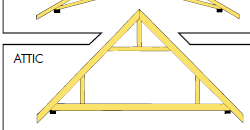
Good point from @George but what does he mean? Imagine you have the weight of the tiles and some snow acting down on the king post rafters.. they want to bend inwards between the eaves and the ridge. The rafters and ceiling joist act as a triangle which is strong. The rafters are getting bent inwards (a bending force) and to stop the walls from speading out the ceiling joist is in tension. Goerge calls these the principle members I think. Now you can see on the King post diagram that the ceiling joist is long.. and may need to support a heavy lath and plaster ceiling, a well built plumber going into the attic and your holiday suitcases etc. To reduce the size of the ceiling joist the span is split by the king post so it hold the joist up in the middle.. more efficient and this is where the tension load comes from in the King post. The Queen post truss is at times more efficient at times (depends on roof span and loading) as it splits the rafter span so you can use a smaller bit of rafter wood. Here the rafter bends down in the middle transferring compression into the diagonal struct which pushes the ceiling joist down in the middle, this downwards load is resisted by the vertical King post in tension which is in turn resisted by the main triagulation of the frame. @jayc89 and for all. On a traditional timber cut roof you'll see the that the timbers are checked a little. If you have a 2" thick timber it may be checked by about 1/2 inch and this gives you a direct timber to timber contact area that is good for transferring compression... here the nails just hold the joint together. But as @george says joints in tension need some king of mechanical fixing and they are less efficient and on big roof you need the straps etc. Once you get into how old roofs work you appreciate what is going on and how elegant they can be. @jayc89 Hope this helps a bit, post more info as interesting. Maybe you can convert you existing member arangement into something like this. Here you would move the vertical soldiers in so the ceiling joist is split into three equal spans and drop the top tie a bit so you divide the rafter span up also.. then you could maybe get you cylinder in?
-
More foundation fun - straw bale garden room on clay
Gus Potter replied to Nick Thomas's topic in Foundations
Well done having a go at this. Unfortunately it's not a simple task... I can see you have had a go at calculating the sliding resistance. Call this the global behavior of the structure. I have not looked at you calcs in depth but you are missing two vital things, the first is factors of safety, second and fundamentally when the wind hits the side of the building some goes round the sides and some over the roof. But there is already wind over the top of the roof so you need to squeeze this extra air into the envelope around the building. This increases the air velocity and particularly a flat roof starts to act like an aircraft wing and the roof lifts up. The uplift forces are large so you need to deduct this from the self weight of the structure. Now normally the sliding check is fine and not the critical check as say masonry structures are heavy.. bales less so. The structure could also hold together and overturn.. roll like a ball. My gut feeling is that even with a bale building this will probably not be the critical check. What I think will be the critical check it to make sure that the columns you are forming on the front elevation are able to carry the wind loads as individual elements. Around the sides of the door and at the corners you could get very big uplift forces.. unless you make the roof very stiff. In other words I think that even on a windy day the front wall will start to skew sideways (you also need to transfer what are called shear loads and the bales I don't think will do this well).. then you won't be able to open the doors... take this as an early warning you have got it wrong. To sum up the above. Wind loading is complex, there is a lot to it and the knock on effects are significant. For me.. you have a limited life structure, not occupied all the time.. you could compare this to an open sided farm building in terms of sideways stability (your front elevation with windows / doors), a marquee or similar temporary structure. When we design these we take a more pragmatic view, settlements are less important. What we say is we need to stop two main things happening. The first is that it does not suddenly collapse (without warning) and second is it does collapse say in the wind that bits don't fly away and hit people first and then other buildings ect. I think you really need to stop the front of the building moving sideways and will struggle with bales. One solution that springs to mind is to make the frame around the doors very stiff and strong so it resists the sideways forces. We do this when making big openings in the walls of buildings that are intended to hold things up and stop the building moving sideways. You door frame could be a portal (two columns and a top beam very well connected together) or a box frame, I think this may be best to look at first... the box frame You could make the structural door frame a feature to compliment your attractive design? To get your head round how the sideways forces work make a portal or box model out of 3 or 4 members.. bits of wood. Hold it at the bottom and push it sideways and see what happens. Look carefully you'll get a downwards load at one side and an upwards load at the other... this uplift load is the dangerous one! This load needs to be resisted by tying down. Encouragement! I bet there are loads of folk that would love to be able to do what you're doing and can see you are making a great effort. If you can do this for 3 -4k materials folk will chew your arm off! One way of really understanding this and how it will roughly behave is to get a cardboard box (or a few), cut holes in it to the scale of your windows / doors. Make a roof for it and pin / tape it with match sticks ( to represent your Hazel sticks) to the top of the box. Tape the thing to the dining table and start to push it sideways.. see what happens. This can be great fun for both adults and kids.. before you test it to destruction observe it first or you'll use a lot of boxes! This might sound a bit daft but this is how we teach SE's! Keep posting! -
Yes at the moment, as others often point out 1kW of electricity into an ASHP for say 3 -4 kW out.. depending on the outside air temperature but as gas is say 1/3 the cost of your electricity it ends up roughly the same. @Fallowfields you have probably thought all this through but for me if you are rural then I would look at your location and altitude. For example my sister lives on the island of Tiree. Here they benefit from warm seas relatively speaking when say compared with the North sea off the East coast of Scotland or say the sea off Newcastle / Norfolk. They also get a lot of wind. The air temperature never drops that low, say -4 deg C but even then only for a short period of time due to the warm sea all round. They have two ASHPs that really deliver, are economic to run.. they are delighted with them. Reports are that they never hear them having to work that hard, in other words a big drop in efficiency. But as they are rural.. well very the electricity can go off.. no heating and no hot water. The house is well insulated, pretty air tight and they have a gas hob run off bottled LPG and electric ovens. They actually find this cost efective as the hob uses not much gas although catering for a good number of people most days. They also have a wood burning stove. In other words the house has some redundancy built in. Before committing to ASHP I would have a look at your location. If say Wales / North Scotland at 250 - 300m + altitude then you could experience several days where the temperature is below -10 to - 15 deg C.. and regular days when the temperature stays below zero C all day and drops further at night.. what then and what if the electricity goes off? I'm not saying don't put them in... just that your location may influence the overall performance. You other option is oil fired boilers.. but I think their days are numbered (I had one in a self build out in the country and at that time it was great, oil was cheep and it ran a UF stystem over two floors of the house) in the sense that the oil is delivered by companies that don't often play fair and as demand for them drops off then probably the maintenance cost will go up and the oil price will also likely go up. Maybe in ten years time you'll get you oil delivered by an EV tanker? You could maybe set up you system so it can an easily take an ASHP later, use a cheep oil boiler and tank to start with and wait for the price of ASHP's to come down? It will impact on your energy performance calcs so you may need to add more insulation ect to compensate.. but that is no bad thing. Of course if you had a big plot you could have a ground source pump.. ideally a stream / burn with good all year round floor or right next to the sea so you can extract heat from that... but few of us are that lucky.
-
Planning are insistent on a dormer
Gus Potter replied to Fallowfields's topic in New House & Self Build Design
Like your idea here. Good luck and let us know how you get on. -
More foundation fun - straw bale garden room on clay
Gus Potter replied to Nick Thomas's topic in Foundations
I think it's a great idea @Nick Thomas as a project to do on a budget of 2.0 k.. quite a challenge for the walls and founds, with the roof extra over. Have not dug out my book on bale building but keeping the water out of it is a biggy. That means things like a big eaves overhangs to shelter the top of the wall and mitigating spashing up of rain.. @Nick Thomas mentions 300mm to the bales which is well above a normal spash zone. Also you want to get plenty wind circulating round about to dry things out.. not sure about how close it should be to the retaining wall for that reason. The vertical loads on the bales are not huge.. they will compress over time but it is not like a house designed for 50 years with more onerous loading from say floors, tiled roofs. If it was me I would make sure if the bales start to misbehave then devise a way you can prop the roof / jack it and insert a more traditional timber frame instead so you don't lose your shirt or do the bales again.. tricky as they need to settle in as you build. Normally a garden building like this could cost 15 - 20k (if you went to a turnkey outfit) once serviced with the slabs outside / drainage etc and that would be for a square box. But here we have a bit of character in terms of the shape and form.. and for that you could pay a lot more! Keep posting Nick! -
More foundation fun - straw bale garden room on clay
Gus Potter replied to Nick Thomas's topic in Foundations
Well done for giving this a go, thanks for posting as very interesting. Fair enough the walls are light in weight and I assume so will be the roof. How are you going to tie it down to stop the roof and walls lifting up in the wind? Are you going to use the long spikes to pin the roof wall plate down a good bit into the bales? Bit of house keeping on the maths mainly for all in case they use the same sums. 5 tonnes = 5000kg. Convert to Newtons 5000 x 9.81 (just say 10) / 1000 = 50 kN (not 5). If you have 2.5m^2 of pad area then roughly the pressure at the bottom of the pad will be 50 / 2.5 = 20 kN/m^2. If it is a temporary structure (say snow loading with a return period of 20 years as a ball park figure add some 0.35 kN/m^2 to the roof loading unless you are at a high altitude UK wise. A good bit of that soil you see next to the wall will be backfill (made ground).. ask how are the founds for the retaining wall formed. How far do they protrude into your garden? Is the soil you see just well compacted fill? The main thing here to watch out for is that if you are digging next to a retaining wall is that they are designed for two main things. One that they don't tip over and two that they don't slide into your garden. The sliding is important here. The sliding forces are resisted often by the friction under the found and also by the soil on your side and this can make a big contribution towards sliding resistance. I would avoid disturbing more of the soil close to the wall on your side or lowering the ground level on your side close to the retaining wall. I would give the OSB a swerve as I have my doubts about it performing well in this application.. it is thin and you have fixing issues.. and any long term moisture is not good for it. What about using cheep fencing slats with some 3 -5 mm gap between that are treated, these are more breathable than say OSB? Anyway it keeps the ethos of using more natural rather than highly process materials (lots of glue) such as OSB. If you have doubts get a bit of OSB and leave it out in the rain / in a bucket of water for a while and see what happens to it. As the thing is light weight how are you going to stop it blowing over sideways in the plane of the retaining wall? I assume you are going to make the roof like a stiff beam that transfers the sideways wind load to the rear wall? In high winds you could easily get 100 kg/m^2 wind uplift on the roof unless you live in a very sheltered spot. At the same time you get the wind blowing on the sides of the building wanting to push / suck it over sideways. I think it is these wind stability issues you need to concentrate on rather than the founds, although they are important.. settlement won't generaly hurt anyone (unless left unchecked) where as the thing collapsing or bits blowing off and hitting folk in the wind is a concern. -
What insulation for 38mm service void in MBC passive wall
Gus Potter replied to markharro's topic in Heat Insulation
No the spark won't and you are heading for big trouble if you start to insulate cables that are designed to be in a void for example. Your spark will have carefully sized the cables based on if they are in a void or have insulation close. You are now adding insulation on a whim. This is very serious and you need to talk to your spark. I have seen fires occuring in extensions to houses as a result of design changes like this... the house down the road from me went on fire for this kind of reason. Your other designers (and that now seems to include you as you are making technical design decisions) should be alerting you to this.. or do they not have enough experience and that includes you too? Now I may seem like a bit of a tosser but if you are making design descisions like this and you get it wrong then your insurance is invalid and the rest of the design team will probably leave you carrying the can! In summary I can see you are enthusiastic about what you are doing .. which I very much appreciate.. but you probably don't realise that something that seems innocuous (you are tring to make the house warmer) can have a dangerous impact. Now if you don't believe me about the wiring implications.. have you checked if what you are doing is going to shift the dew point in the wall and do you know what could happen if you do? .. you won't probably significantly but I say this just to make a point. I laid it on thick above but for your own safety.. give the spark a call on the phone.. if you don't then there may be no electrical IEE completion certificate from the spark.. and that is often a problem. -
True to you word! Excuse the spelling, quick response. Visually your soakers don't have enough upstand.. but I think you'll get away with it as the roof pitch is steep. I would recut the top line of the chase. Put a timber batten up the line of the roof, put safety boots on and hold the batten with your knee or get help to hold it at each end.. the easy way and much better, and recut a few mm higher with a 9" grinder with diamond disc, marked for depth of cut. Aim for 25 - 30mm depth of cut into the wall. Get your top side of the chase straight. That is the bit you will see. Get a brush and clean the chase, then get a Henry hoover / Dyson and really get rid of all dust from the chase. I'm not joking! Go to B & Q and get some SBR bond. Apply the SBR bond to the bottom of the chase only. Follow SBR instructions, let it go tacky.. if it dries out it is no good and makes the bond worse! Don't get the SBR bond on the slates and clean your tools pronto after. Cut the batten down to 25 mm less than the depth to the top chase. Hold it against the wall. Make up a mix of 1 part cement with 3 parts sand with some mortar plasticiser. Use the cut down batten as a guide to re level the bottom bed of the chase when the SBR is tacky. Clean up, keep it moist and go for a beer and let the mortar harden for a few days. Now you have a neat top cut and have sorted the bottom part of the chase that you need to be able to jamb the lead into the rebate. If you leave low spots in the bottom chase the water will get back into the wall and the flashing wiil get distorted when you are trying to fix it in place. If doing it DIY fold up your flashings but keep them to 1200mm long in length, then install as per Cookson Lead work guide. Be gentle when jambing the lead into the chase.. then point up and seal the chase. Make sure you use Patination oil and apply it to both sides of the lead (the bit you see and the bit you don't) and edges of the cut lead. This sounds like I'm laying it on thick but you have some good looking stone and slates there.. don't spoil it with crappy flashing work. In this case I would say the flashing should stop 10 - 15mm from the top of the slates.. stops capilliary action. As the soakers don't have enough upstand then just along the top of the soakers run a V shape line of lead mastic at the top edge. You can do this V by cutting a slot in a standard matsic tube nozzle. Ths will create an extra ledge which will mitigate the lack of upstand depth of the soaker.
-
Cracks showing under first floor landing
Gus Potter replied to jayc89's topic in General Structural Issues
Yes it could just be seasonal movement. Often folk see cracks and think "oh no the house is settling and going to fall down" in the next week. Observe the door over the landing and see how it sits in the frame when shut. Often if things start to drop then the doors start binding. If you want you can cut thin shims out of say a coke bottle and monitor the gap to a reasonable degree. If you can slip in 5 shims and a week or two later you can't then you can get a feel for how things are moving. You may find that once you put the heating for a few days the shims come slack. If the weather has been dry and warm then turns wet you should be able to detect that in the shims. This will give you an idea of how your house behaves on an almost week to week basis. You'll be surprised just how much things move, but it can also set your mind at rest.. it's just the old house doing what it does. To provide a bit of context. The major house buiders are tackling more and more difficult sites with less than favourable ground these days. They improve the ground, often by soil mixing using lime / cement etc. The new houses are designed not to settle more than 25mm over 50 years so even on a new house you can expect quite a lot of potential movement in the first few years as settlement is often not linear. Bonner makes good points. If you try the thing with the coke bottle shims let us know how you get on. Make sure you use don't mix the shims up.. keep them all together in groups for each gap, use tape to keep them together if need be (they are a cheep version of feeler gauges but not calibrated) or this could start to live in your head. The nice thing is that they are pretty flexible so can get round the odd bendy bit of wood. On doors push them in until you hit the door stop so you maintain the depth of penetration each time. -
That would help, lets us see what you have on your plate.
-
Thank you everyone for giving me the benefit of your advice. Very much appreciated. Looks like some type of white mould. Will get it checked out and also check for asbestos just in case. Thanks again folks.
-
Planning are insistent on a dormer
Gus Potter replied to Fallowfields's topic in New House & Self Build Design
Yes that can work. If you do hips.. it does soften the roof. Well done you sorting that out. You can do a Dutch type hip.. but sometime SE wise they are "hard to do".. but there are work arounds if you want to preseve the floor space in the roof.. you can do some cranked steels for example if you have a big house and have plenty money... that said it works fine in say in Surrey ( added property value ) but less often in regional parts of Scotland or Wales.



