


JohnMo
-
Posts
13292 -
Joined
-
Last visited
-
Days Won
200
Everything posted by JohnMo
-
 We were almost exactly 2 years from digging footings to our first night in the house. 1 storey, 190m2. No principal contractor, quite a lot done my self. We had six months prior to this getting a hill side plot ready to build on. Cutting down trees, cutting a road, soak aways etc. Started on site March 2020, within a couple weeks we were in first lockdown.
 -
Advice on cost-effective energy saving in older houses
JohnMo replied to Tadpole's topic in House Extensions & Conservatories
LED lights everywhere. Insulate piping. Drafts, find and fix. They will need to keep window trickle vents unless going air tight. Look to replace standard vent fans for dMEV (run all the time at low rate), if going airtight MVHR. Roof insulation, as much as practical, without blocking roof ventilation. All the above can done without taking house apart. Below needs to start taking house apart. Boilers older than about 15 years old, replace, install weather compensation boiler, consider installing larger radiators and run boiler at low temp, similar to ASHP. Insulated exterior doors. Exterior wall insulation, cavity, interior wall insulation as appropriate. Single glazing, replace with high performance double/ triple glazing. Older double glazing replace with high performance double/triple glazing, u value of 1.2 to 1.4 for double, 0.8 for triple. That should give them plenty to do. -
Does an SE need to be local?
JohnMo replied to CotswoldDoItUpper's topic in General Structural Issues
Mine was 70 miles away, never came to site, ground investigation was arranged by SE, but someone local did it. -
Boiler Upgrade Scheme Grant - Actions to Take Now
JohnMo replied to Green Power's topic in Air Source Heat Pumps (ASHP)
So to answer your questions - get quotes, decide on which company you are going to use. Be ready to tell company to go ahead with application ASAP. Plan on what if anything you need to do to improve EPC. Get quotes/DIY, be ready to implement. Hanging around, you may miss the boat. -
A quick look at current prices at ITS Technology (where I got my kit). A 12 panel kit (including everything for the kit to work incl mounts) is around £3500 (X2 for 24), 4.8kWh battery kit, £2400, so under £9500 incl vat. Plus install. (That includes 2x complete systems, some of which could be deleted) So they are charging you around £6-7k to install, which should be say 3 men for a day. £2k per man day, expensive. Unless there are some DNO charges for a big array, you have not shown.
-
Would only have some affect on wet/soaked brick/block work. So if it's dry no effect, really wouldn't bother, if really want to b&q and other sell the same sort of stuff, as mentioned above.
-
The instructions state. "HYBRIS can be easily cut with an insulation saw, standard hand saw or an electric alligator saw if preferred" Remember you need a 15-20mm air gap either side of the insulation to get the claimed performance
-
Warm v's Ventilated Roof - Which Way to go ?
JohnMo replied to bob the builder 2's topic in Roofing, Tiling & Slating
Not read the rest of the thread, but just took a look at the drawing, notice you have 200mm centres on the rafters, which would mean 153mm wide strips of insulation between. Would the insulation value meet building regs? Is this a typo? -
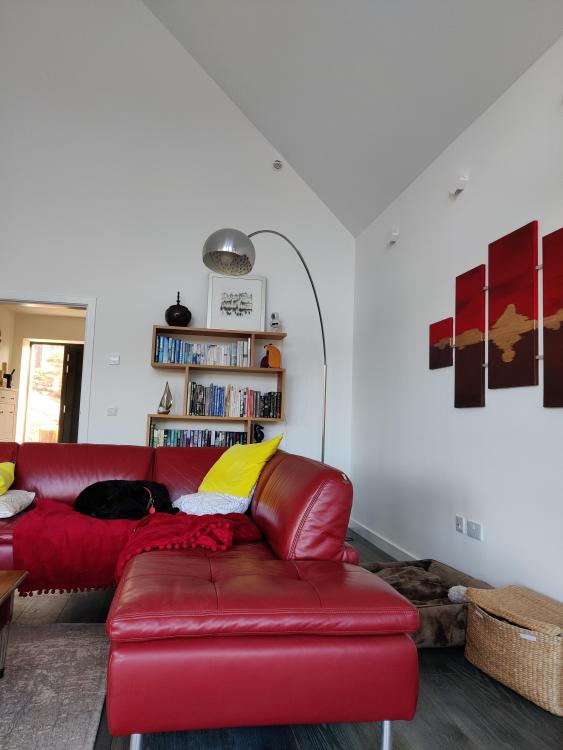
Heavy marble base in corner of room, light about 2m into room
-
Boiler Upgrade Scheme Grant - Actions to Take Now
JohnMo replied to Green Power's topic in Air Source Heat Pumps (ASHP)
First principles should be not to use fossil fuels, the electrical grid is full of it when it's not windy (still quite a bit when it is). Then you have nuclear, with waste products which are not safe for humans for 10 000 years. Perspective, my 190m2 bungalow, requires a similar amount of kWH to yours to heat. If the house was a third the size we would not need heat 99% of the time. If you really want to do your bit for the planet, insulation and airtightness should be where you spend your money. You would have a happy planet and happy tenants, with little or no heating bills. Then heat domestic water via E7. -
Wrong stuff, you need to use something more stiff. Acoustic insulation is the same R value but stiffer, but high density Rockwool (or others) would be better.
-
Boiler Upgrade Scheme Grant - Actions to Take Now
JohnMo replied to Green Power's topic in Air Source Heat Pumps (ASHP)
Not really sure why you would commit to spending a fortune on an ASHP, even with grants, just put in a new gas boiler and take the rent. Plenty of people have issues with ASHP set-up, read the threads on here, this would have to be managed by you, from a distance, not easy. An ASHP will need new radiators and possibly bigger distribution piping, if it's a combi also a cylinder. Even a system boiler will need a new cylinder, when installing an ASHP, due the lower operating temp of the ASHP. You may have to pay to re-home the tenants while the work is ongoing, which would not be refundable by any grants. New gas boiler, the plumber would be in and out in a day. Job done. -
Buying a 'traditional' new build! (Persimmon?)
JohnMo replied to Andeh's topic in General Self Build & DIY Discussion
Have you bought or are you thinking of buying? -
I just used some car anti freeze I had in the garage and tap water. Leave 50mm air gap for expansion. Look on eBay I got 3 off Rand new Termo One 400w elements for £28 delivered.
-
Hi, would agree to add later, even later in the design process will cost you. Once wall and roof thickness is set so is the installation depth to a large degree. Don't think of passivhaus a distant unachievable thing, a normal build can't do. Some aspects you may not do, but it worth reading up on, as most things make really good sense and can be added to a design for little or no cost at the design stage. Building regulations insulation is far from ideal and so is their airtightness. Would look to have a minimum of a 0.15 u value, for walls floor and roof. If you have UFH go to about 0.1, to save too much downwards heat loss. From your design be wary of overheating from your glazed gable ends. Extending your roof and walls out similar to the rear, could give some shading, when the sun is low in the west can be as much of a problem as midday sun. The architect should be able to model it, you need to know what spring, autumn and summer will do to your internal temperature.
-
"I will raise your point about the mutual design process with my builder as he deals with the architect." Think could end up a bag of worms. You say something to builder, his head interprets what you have asked, he does a sense check based on experience and his own expectations (which may not be same as yours or in same direction as your). The architect is working in the builders interest not yours, your just someone being a pain in the background, although you ultimately pay the bills. Personally I would have the architect work directly for you, so your options have to be heard.
-
Boiler Upgrade Scheme Grant - Actions to Take Now
JohnMo replied to Green Power's topic in Air Source Heat Pumps (ASHP)
Without having a well insulated house, the running cost of a heat pump could be huge. Are you sure, done the maths to make sure it's right for you. You don't say if you are on electric, oil or gas heating presently? If you get your annual heating usage in kWh, divide by around 2.5, then multiply by day rate electric cost, you will get a close approximate of the ASHP running cost. -
+2, about friends, different rates of work and expectations, for a couple of weeks is ok, for months on end, could drive you up the wall. Are you down sizing to a six bed house for retirement? UFH is easy enough, it sits above the ground floor installation and in the screed. Have a u value circa 0.1, this will limit downwards heat loss. You mentioned outer skin of building, how are you building the structure? Light, big windows are great, but the downside can be over heating. Even with big overhangs, the sun when it in the west and low can cause over heating, so watch for that. We have a well sound proofed internal walls, but a door open circumvents all that. So I would not get to hung up about it, if you have 70mm stud walls, use 25mm sound insulation job done. All the things mentioned about airtightness, contractors in the main have no clue about airtightness, don't care, don't understand the issue, generally think you are daft wanting an airtight house. Bamboo, lots of weedkiller, one that attacks the roots
-
New Ventive heat pump/MVHR unit
JohnMo replied to markharro's topic in Mechanical Ventilation with Heat Recovery (MVHR)
But is it really mvhr, as it seems to a MEV system with heat pump, doesn't seem to be doing the supply air. If you are going this route it really needs to be MVHR, and the air after the heat recovery, used for the heat pump. There are systems that do this. -
If a manufacturer combined the rainpower (but would need higher efficiency) into a PV panels, sun out power, wet day power, dull dry day not much power.
-
Daft question - Local isolation valve closed?
-
Where do you live, that a typical roof has 70 tonnes of water on the roof? That's a lot of water, are sure your maths is correct? A typical house may have a footprint of 70m2, so would need a 1m deep storage tank over the whole roof. Not sure you would get planning permission. Not sure what you would do with water when you finished driving the turbine, you could store it and pump it back up again, then it becomes a battery.
-
You be worth having a read of the regs, to make sure you have the required ventilation strategy in place https://www.gov.scot/publications/building-standards-2017-domestic/3-environment/314-ventilation/
-
The regulations state the size minimum for the shower, use that dimension and add to drawing. Activity space then adjoins the defined shower space.
- 9 replies
-
- 3
-

-

-
- scottish building regs
- bathroom
- (and 2 more)
-
Cost per square metre for single story vs 2 story dwelling
JohnMo replied to smart51's topic in Costing & Estimating
But they are all estimated, the estimate will change hugely, based on building shape, size, build type, external and internal finish, flat roof, pitch roof, insulation levels, ventilation/ airtightness, heating type (gas, ASHP,gshp, UFH radiators) etc etc. Two different kitchen designs can change a build budget by £50k, the amount windows can change it again by £20 to 30k with ease, uPVC or Ali clad can change it again by the same amount. My thoughts are for a basic start point. £2k to £2.5k per M2 with someone else doing all the work will be a basic ok performance house, so 400k for 200m2 two storey. Add a good 10 to 15% on for single storey but depends on roof complexity (our roof added about 25% to m2 cost). The more bells and whistles and any changes you make along the way will add quite quickly. The above assumes limited or no landscaping, painted internally a single colour.

