


JohnMo
-
Posts
13308 -
Joined
-
Last visited
-
Days Won
200
Everything posted by JohnMo
-

180m borehole cost per metre for ground source heat pump
JohnMo replied to Strak's topic in Other Heating Systems
Does drop a little, and you need more heat anyway - you still get a CoP of about 2.7, for the day you are down to that level. At -2 you are mid 3 and at 7 degrees, 4.5 for CoP. Noise don't really notice as the heat pump is behind the shed. -
I would say qualified - what does competent mean with respect electrics and signing things off?
-
Why a boost switch in the bedroom?
-
180m borehole cost per metre for ground source heat pump
JohnMo replied to Strak's topic in Other Heating Systems
Why? ASHP simple to install zero issues at -10 this year. We have a water bore hole about 45m deep, due to us being on a sand hill, nearly all the drilling money went on steel liners for the bore to stop collapsing. So really depends on on what they find - once you start you can't stop and you just have to pay the bill. If your rock for 10m they could be drilling for weeks -
If you have no mixer the flow temp from your boiler or other heat source. If you have a mixer does that have a temperature gauge, otherwise you need to measure the hot temperature at the hot manifold. Moisture reading low - who checked and how did they check? Was it done with floor moisture tester and left for 24 hrs?
-
-
Something like that
-
For a start 100mm just isn't enough with UFH - start at 150mm PIR (0.022). If can't do that would really reconsider the use of UFH.
-
I like Pert-al-Pert as it has no memory so is easy to work with. Modern UFH I would only use 16mm - easily available, carries plenty of energy, low pressure drop. Anything else size wise is just a bad choice.
-
Air Tight Wall Vent for Log Burner
JohnMo replied to benben5555's topic in Stoves, Fires & Fireplaces
I did see something like that I looked for ours, but concluded it was a waste of time and money so didn't pursue any further. If your ventilation is balanced it shouldn't, no combustion air should come from the room. Just make sure you get a stove where primary and secondary air come from outside only (some/plenty don't) - nothing should come from the house internals. -
Maybe they realised it was just huge, and just rattled around in the big spaces, possibly thought it was just two small houses when they looked at the plans. EPC A and the need all those fires, simply daft.
-
Just because you have to follow building regs for a new build - doesn't make it a new build. If your conversion process involves knocking the place down and starting from nothing, you are doing a new build. If you have a building you modify from one thing to another it's not a new build. You will need to provide your planning permission and completion certificate to the vat people. If your planning permission is for a conversion you are doing a conversion.
-
And 7 bathrooms, you wouldn't need a cleaner - you would need a team.
-
We did Sarnafil with standing seams. All welded together.
-
That just cut your argument short, stopped reading after that
-
You may have issues, really depends on the voltages at the moment. I would check your current voltage in the shed first and report back.
-
Or you could put vertical panels at less density and get wheat or what ever from the same area and solar electricity.
-
Permitted development rights do not exist anyway, while you are developing via planning permission, so it's irrelevant really. While under developing via approved plans, that is the limit to what you can do. Permitted development rights come after the completion certificate. You would have to a change to plan Ning for class Q and any other developments. Look at actual legislation for facts about what you can any cannot do. Then you can discuss with planning and state what is correct, not Joe blogs from this forum said....
-
Basically all the units are rubbish, they should all be the same, they just pluck any old units out the air, pun intended.
-
Wish this site would show people's location on your phone
-
Welcome, what prompted the use of straw bales?
-
Well that is just rubbish in rubbish out. The particle mass limit was significantly tightened going from Euro 5 to 6 for heavy duty vehicles, cut in half from 0.02 g/kWh to 0.1 g/kWh on steady-state testing, and from 0.03 g/kWh to 0.01 g/kWh on transient testing. Again using my stove for direct comparison, its allowed 335g per MWh, or 0.335 per kWh (as o could be 3x worse that a HGV), but achieves 1/13 the allowable or 0.025g/kWh. So way lower than that allowed by a HGV in practice.
-
Even the best carpet underlay combination is an insulator and requires the UFH to be run hotter that it would otherwise need. My sister had that for many years, hard waring but awful to walk on if you don't like slippers. If glued down to a hard floor (screed or concrete) it's almost silent, especially in bare feet.
-
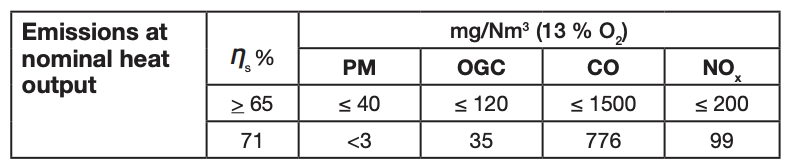
Not sure about grants. Short read https://www.mdpi.com/2073-4433/11/12/1326 Another opinion https://www.scan-stoves.com/this-is-scan/sustainable-heat/sustainable-wood-burning-heat-clean-burn-fireplace#:~:text=Enova (responsible for the net,as warmth for your house. My Experience Have a HETAS Scanline (nominal output is 4.7kW) is stated as particle emissions of 0.63 grams per kilogram of burnt wood. And emission levels of PM dust (at 13% oxygen) of < 3 mg / m³. Overall emissions are below Not quite resolved but reduced particulate matter. Interesting is the allowable limits and what my stove actually achieves. Another source of information says this (below), which again can be misleading. For example it says Defra Exempt Ecodesign stove is up to 335g/MWh for particulate matter. However using my example above, it is less it 13x less than the allowable PM emissions (less than 3 compared to an allowed equal to less than 40). I do know that one or a max of 2 decent logs is all I need to heat the house and the burn time is several hours, once extinguished the soapstone carries on giving off low levels of heat for many hours. However we have have the fire on infrequently, we only use logs that are old and very dry. Most of the wood is from trees that were ready to fall down (dead or starting to rot in the centres) and taken down for safety reasons. Other site generated wood is, timber off cuts from the build, and trees removed because they were in the way.
-
UFH and carpet is rubbish combi, other than that it's what suits your style and the house. If it is or isn't vat free, isn't really relevant.


