


JohnMo
-
Posts
13308 -
Joined
-
Last visited
-
Days Won
200
Everything posted by JohnMo
-
 Postcrete for me, it works, it's easy to use, not that expensive, easy to get hold of. Not sure I would trust foam when we get hit with 60 to 70 mph winds.
 -
How to predict heat pump size from your EPC
JohnMo replied to sharpener's topic in Air Source Heat Pumps (ASHP)
Doesn't section 8 not have the heat loss rate in Watts for each month. So wouldn't it be the figure for the worst month (Jan in my case), then allow enough for dhw heating. Mine said 2980W, Jeremy spreadsheet pretty similar, heat meter said the same. Using a 6kW ASHP, which is really a little large, but works fine. -
Obvious question, that's a lot of work, why not just install bigger rads (double or triple panels) or even a fan coil. Your system will run at the temp of the highest flow temp rad, so zero gain in CoP.
-
Your in Scotland - no such law. Such as? Your approved drawings should be black and white in what they say, so not sure where personal opinion comes in to play.
-
Ground array: future project, what cables
JohnMo replied to Post and beam's topic in Photovoltaics (PV)
Bit of a vague question without specifics about volts and amps. Or just duct with a pull rope then specifics can be sorted later. You may be best to size the cable for DC instead of AC as DC tolerate voltage drop more easily. Amoured cable can be surface run, so could follow a fence line for example. -
Your joists are on different centres, one at 350 the other at 450mm, so they wouldn't be the same. Neither seem very good.
-
Builder's upstand vs proprietary
JohnMo replied to JackOfNoTrades's topic in Skylights & Roof Windows
You only show what they ask to see. My inspections were prior to mass fill of foundation concrete, prior to plasterboard and when everything finished. Could have used anything for the upstand no-one would have seen or cared (except me). -
Builder's upstand vs proprietary
JohnMo replied to JackOfNoTrades's topic in Skylights & Roof Windows
No one asked anything. Think there was about 5m linear in total, within a 200m2 roof. Our drawing just said proprietary upstand, which have been PIR insulation so no different really. -
Think it came in manhandled sections and was pinned to the ground with bent rebar pins.
-
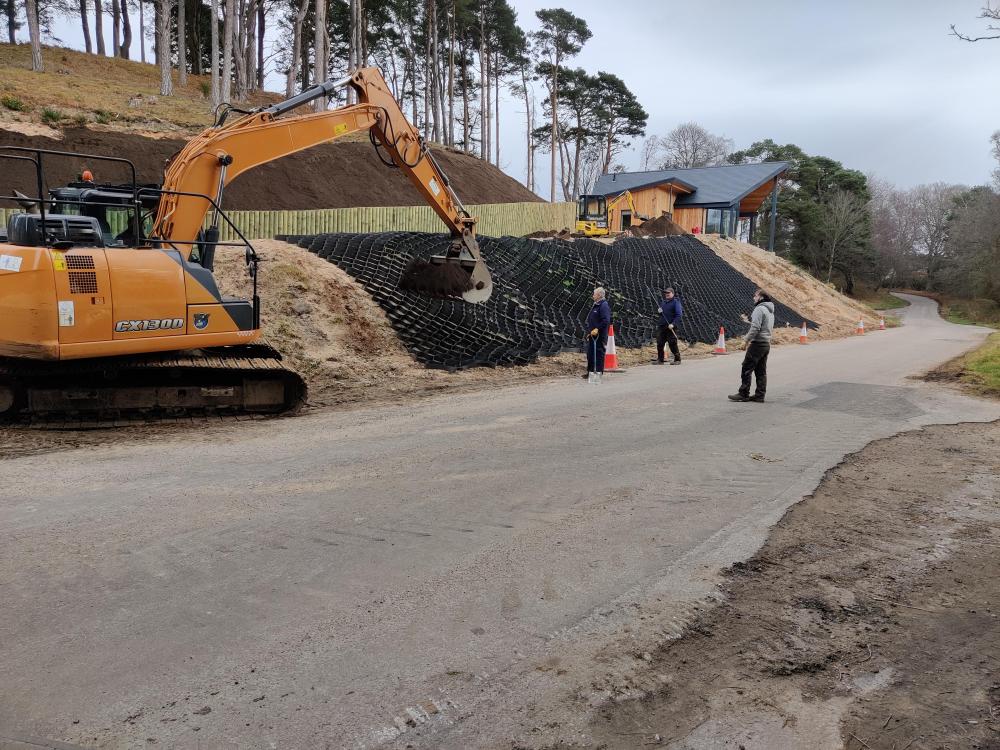
Big scale
-
I did a small area on a 50 deg slope, a couple of years later the bags have all rotted away, but it does give time for the plant roots to take over. Much less labour intensive is the correct landscaping mesh then back fill with soil.
-
Builder's upstand vs proprietary
JohnMo replied to JackOfNoTrades's topic in Skylights & Roof Windows
Use Compacfoam CF200, 75mm x 100mm. From Green Building Store. Took the joiner 30 mins to do 2x roof light up stands. Might look expensive, but not paying a joiner to faff about for 1/2 a day. Super simple, zero cold bridges. I also lined the whole space with 25mm PIR for belts and braces. -
Sounds super expensive - any other practical route to get to basement, do you need the sand craned in?
-
Mvhr plenum placement
JohnMo replied to Russell griffiths's topic in General Self Build & DIY Discussion
Why not? Get rid of the worst condensation where it occurs. Have 2 directly above showers, the other directly above bath. -
dMVHR air quality question
JohnMo replied to chromaticmind's topic in Mechanical Ventilation with Heat Recovery (MVHR)
What does that mean in reality? Have you looked at cascade MVHR, such as blu Martin or Fresh-R? Or a home brew version? -
Not sure then either, as long as it's filter and UV treated, and you use most of the cylinder contents daily again no need.
-
Steico Flex / Pavaflex for sound insulation?
JohnMo replied to Sparrowhawk's topic in Sound Insulation
Our 1830s house (last house) had the rubble, stones and general building waste all shoved in there, almost no noise transfer. Lathe and plaster ceiling and thick pitch pine floors. -
You actually run that? Why?
-
MVHR and windows open
JohnMo replied to Trw144's topic in Mechanical Ventilation with Heat Recovery (MVHR)
I have just been away since Thursday visiting. Was like a breath of fresh coming home, light, fresh airy feel, as soon as you walk in the door. Good old MVHR. -
My Atag boiler did that also, unless you have UFH then it just screws the system up because the dalay caused by the floor heating up, same as Mitsubishi heat pumps do - they say not to use with UFH.
-
5 requires dMEV or MEV, this has been the case for quite a while also
-
We have 4 houses about 1/2 a mile away all use WBS and if not windy it stinks.
-
My sister replaced a pellet boiler last year for oil, saved a £1000 in energy cost in one year
-
Evaporator is on the wall side of the heat pump, so always in the shade, sun would never get close to the area to be effective with aiding defrost. Your heat pump reads the air temperature it sees going via the evaporator, compare it to ambient on a sunny day and report. Mine is exposed to early sun, if it's cold and sunny the air going through the evaporator is also cold.
-
Off-peak energy storage for cheaper heating
JohnMo replied to Originaltwist's topic in Other Heating Systems
You do need to start with this approach as the heat pump is really needed to be 3x oversized for the house (so maybe a typical MCS install). And have a smart meter that actually communicates (unlike mine). I run E7 with 6kW heat pump and 60T of floor. My heat demand is 3kW and on the coldest days I need to pump heat for 12hrs. So in my case the cost for the same amount of energy (electric 14p kWh) is £560 instead of £300.



