


JohnMo
-
Posts
13308 -
Joined
-
Last visited
-
Days Won
200
Everything posted by JohnMo
-
Here is what I did If you can buy a kit, mine is 70mm thick timber and fully insulated top bottom and sides. Way easier and not that expensive for what you get
-
Your missing something Be careful with Jeremy spreadsheet as it's only really works well with just about airtight and very well insulated. Your downwards heat loss is ground temp and means UFH flow temperature - not room temperature. Rubbish insulation means high mean flow temperature, your mean temp could be around 30 to 40 degrees, so 4 to 5kW downwards or 100kWh a day. Rethink - Everyone mentions 150mm min for good reason.
-
Mine is in plant room. GivEnergy all in one - MCS install.
-
Concrete or postcrete, mix it well as you add to make sure no water pockets. Level just about ground and slope top away from post so any water naturally runs away.
-

Mitsubishi vs Samsung Heat pump
JohnMo replied to Slippin Jimmy's topic in Air Source Heat Pumps (ASHP)
Again do your research, any heat pump (almost) will perform well if system design and operating philosophy is good. -
Fire and fire risk really depends on technology used for the battery. 1st write-up I found https://www.fogstar.co.uk/blogs/fogstar-blog/how-safe-are-lifepo4-batteries
-
Do I need relays to switch pumps / zone valves etc
JohnMo replied to Tim S's topic in Air Source Heat Pumps (ASHP)
Running at a higher flow temp just for that is bonkers. Just make them electric, TEMA do various output immersion to screw in to rowel rads and external thermostat for programming. Ok the control of an external pump then would still be controlled by the heat pump. If you dump the water heated rads, no need for mixer or additional UFH pump. You just need to control zone valves. -
If you are well insulated I would put provisions in for electric panel heaters in bedrooms, many on here have no rads or heating on bedrooms. Upstairs bathrooms will need heat. Electric towel rail is good, would also look at electric UFH directly under the tiles.
-
Do I need relays to switch pumps / zone valves etc
JohnMo replied to Tim S's topic in Air Source Heat Pumps (ASHP)
Have made life really difficult for yourself? A simple 3 port diverter would be fine. Cylinder heating is normally done with the heat pump circulation pump, this pump is controlled by the heat pump it's self. Also your zone valve would be powered from the heat pump control or directly by the thermostat on the cylinder. That valve needs to fail closed for G3 requirements. Your UFH pump would be controlled by either wiring centre or directly from the zone valve micro switch, valve open pump starts. A normally close and normally open two port would have made life easier. But you can use the micro switch on one DHW two port as the opening switch for the other valve. With a heat pump both shouldn't be open at the same time, but should open and close in unison so flow path is never closed for the heat pump, otherwise you will trip the hp on low flow. Next question do you need the wiring centre at all? You may get an issue on pump start delay caused by wiring centre. The 5 minute delay in pump start is slower than the heat pump start up and will cause flow issues. Do you need UFH pump at all? If you do, could you not wire zone valve directly to thermostat? Then pump to zone valve micro switch? -
Do I need relays to switch pumps / zone valves etc
JohnMo replied to Tim S's topic in Air Source Heat Pumps (ASHP)
Things I have seen, the wiring centre you mentioned gives a 230v or volt free output to the boiler/heat pump, so no idea why you need additional relays? Assume you have a buffer to keep heat pump happy with zoning? -
Mitsubishi vs Samsung Heat pump
JohnMo replied to Slippin Jimmy's topic in Air Source Heat Pumps (ASHP)
You really need to find the technical manuals for each model and do a little research. You need to understand turndown (min output) and your likely flow rates. Most likely you will run Weather Compensation, so compare the headline SCoP for say 35 degs, for each model. And try to find out the min kW output, your normal running point 50% or less than the coldest day. But more important than any of the above is system design, complex design with lots of zones, timers can lead to piss poor performance from the best heat pump. Why do you need R290, because it can do 70 degrees? A good design should never flow above 55, even for DHW. -
Have PIV (VMI), what next? Humidity-sensitive ventilation? HRV?
JohnMo replied to Garald's topic in Ventilation
Did you end up installing vmi unit? As they seem to have humidity sensing as an option?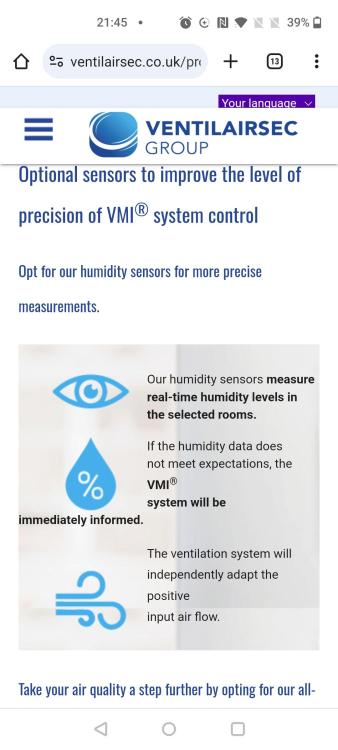
-
Have PIV (VMI), what next? Humidity-sensitive ventilation? HRV?
JohnMo replied to Garald's topic in Ventilation
PIV wouldn't be my first option, my options would be 1. MEV operating demand basis. With either humidity operated trickle vents or self regulated. Very low losses only ventilating when required. 2. As above but dMEV fans, slightly more losses as always some background ventilation happens. 3. MVHR cascade system such as Fresh-R or self built system. Or get an assessor spend 1000 euro, get told to spend 5k more, gain 1 to 0.5 euro a day for 5 months a year. You really need to put your losses into financial numbers. Electric at 0.3 euro, is only about 0.08 after its been through a heat pump. The energy required to raise one cubic metre of air through one kelvin is 0.33 watt-hours, i.e. its heat capacity per cubic metre is 0.33 Wh m–3 K−1. Thus the total ventilation heat loss, Qv , will be: Qv = 0.33 × n × V × ΔT watts 0.33 x 0.3 x 300 x 23 = 683W So 100m2, 3m tall room, 0.3 ACH, by 23 delta T, looses 683W or 16kWh a day on the typical coldest day. Your heat pump generate that heat at about 3.5:1, so about Euro 1.28 ventilation losses on the coldest day - half that on a typical 7 deg day. A good MVHR would drop that by 90%, assuming the rest of the house is airtight. If it's not it may not change anything by much. So care should be taken a) none b)best option would be not bother with PIV at all if you go MVHR. Do a cascade MVHR system, only need ducts in wet rooms. The supply works similar to PIV, depending on layout you may need an addition fan between rooms to move air around difficult rooms. c) your starting to expensive and over thinking things. Based on what you have and least spend, biggest gain for least effort. Shelly bits as mentioned earlier. 100 euros, 1 to 2 hours, done. -
180m borehole cost per metre for ground source heat pump
JohnMo replied to Strak's topic in Other Heating Systems
But in cooling mode especially with flow temps of 15 (suitable for UFH) power input is tiny, so running speed and noise is also on the very low side. Last summer I had to walk right next to the heat pump to see if it was doing anything. 25 degree day and 15 flow, the unit is doing an EER of 6+, so next to no work. -
New build or existing house? may make a big difference. UFH is just too slow to react for bedrooms - do you need any heating at all, electric panel heater, quick blast of heat then off again for the next 23 hours? We are well insulated, airtight, but have our bedroom window open at night, so really no heating is needed. We are single storey, so would be even less need in a normal house. If new build and well insulated flow temperature of UFH is around 30 (or below), floor temp 2 to 3 degrees above room temperature so not much effect.
-
Have PIV (VMI), what next? Humidity-sensitive ventilation? HRV?
JohnMo replied to Garald's topic in Ventilation
Trouble when the op tries to talk about two subjects in the same thread - summer cooling and ventilation heat loss, you get random answers -
180m borehole cost per metre for ground source heat pump
JohnMo replied to Strak's topic in Other Heating Systems
We had -1 the other night and zero last night, our bedroom door shut window open, nice temperature bedroom. -
180m borehole cost per metre for ground source heat pump
JohnMo replied to Strak's topic in Other Heating Systems
Flow rate through MVHR is out by a factor of 10 to useful for cooling. Heating is only useful at passivhaus heat demand levels - 10W/m2. Otherwise it burns the dust in the air. We use similar but like a cone shape, they come with 10 to 15mm of dust attached after 6 months. Don't you find you CO2 levels get a bit high in the bedroom doing that? Or do you have the bedroom window open? -
Have PIV (VMI), what next? Humidity-sensitive ventilation? HRV?
JohnMo replied to Garald's topic in Ventilation
It is just about everywhere. But the relative humidity drops with temperature rise. We are currently at 7 degrees outside and 74% humidity outside. Our summer house for example with a simple dMEV fan is at 19.5 degrees with a humidity of 35%. Our house with MVHR 20.5 is at 40%. That is exactly what I was recommending, but to make the piv responsive to internal humidity. The shelly H&T sits in room or two, it then uses a shelly relay to move the speed up or down on the piv unit. You now have closed loop control of the piv responding to internal humidity. No extra fan etc or upheaval. -
Have PIV (VMI), what next? Humidity-sensitive ventilation? HRV?
JohnMo replied to Garald's topic in Ventilation
Could you not control piv based on humidity? Low rate and higher rate when needed. Less ventilation is less heat loss. Or even configure as on or off? Use 1 or 2 Shelly H&T's as the trigger and Shelly relay to setback flow rate or boost it or even to start or stop. Low rate at below 55% humidity high rate (normal rate really) above 55%? Really depends on what wiring options your piv unit has. Keep it simple. -
That was never my plan, but couldn't get what I wanted without doing myself, so took a work break for a couple years. When assessing build method, you to consider two things, thermal loss or U value and how quickly the house heats and cools or decremental decay. Example assuming same U value. A lightweight structure (use a cube) will respond quickly to heat input (sip for example) as there is only a 18mm of wood to heat and the air inside. Now build the same cube in block work, you now have to heat the air and block work to get the air space warm. Sounds bad but... Once up to temperature the block work remains so for hours or days, acting like a big storage heater. The sip only keeps a small reserve of energy in the wood, so the temp will drop quicker. Now add a window and look at the summer. SIP heats quickly, but block work doesn't, the air will heat up, but the block work draw that heat in to even out out the temp quicker. It a juggling act to get things right. Cellulose insulation is wood fibre, so quite dense also hence mentioning earlier.
-
180m borehole cost per metre for ground source heat pump
JohnMo replied to Strak's topic in Other Heating Systems
If you want weather compensation almost all do it straight out the box, you don't need internet connected anything for it. Are you doing a new build or refurbishment? -
Mvhr flow rates..
JohnMo replied to jkh2022's topic in Mechanical Ventilation with Heat Recovery (MVHR)
Read building regs? They will give you flow rates min requirements by total floor area and for wet rooms. There are plenty of recent discussions in the MVHR section on here about this subject. -
180m borehole cost per metre for ground source heat pump
JohnMo replied to Strak's topic in Other Heating Systems
Fan coil work well for cooling and heating. Be aware they have a fan, the noise from that can be affected by the quality of unit you buy - you get what you pay for. Also they generally use a fixed flow temp so no need for weather compensation, just set the flow temp at 30 to 35 depending on how you size the fan coil units, the fan coil control does the rest. Vaillant units are good, but very expensive, an R32 unit can be just as good for way less money - if you don't need high flow temperatures, and a heating system that needs high temperatures shouldn't have a heat pump attached anyway. -
That's the whole point really, closed shops or monopolies are not allowed, hence the wording or equivalent. A competent person following a set of procedures is directly equivalent, even if they don't pay for a closed shop membership. It's exactly as stated below.



