


JohnMo
-
Posts
13296 -
Joined
-
Last visited
-
Days Won
200
Everything posted by JohnMo
-
And use a concrete pump lorry, makes life easier. Not cheap but worth every penny.
-
You are only supposed to do 6 layers of blocks with Durisol or Ecobrix and fill 5.5 layers and apply a temporary patch panel to blocks where a cut joint is. They had blow outs because they did follow the rules. Our house 70m perimeter, no blow outs - I just followed the rules set out in the manual. No training available when I did ours due to COVID either. But I'm strange and like reading product manuals. Product has been on the go since the 1940s. So if it says do something in the manual its normally for a very good reason.
-

Can't connect the SWA cable. Practical help please.
JohnMo replied to saveasteading's topic in Power Circuits
You don't put the metal gland through the grommet. A different junction box would be easier. You need a 20 or 25mm hole and the gland gland goes directly into JB More like this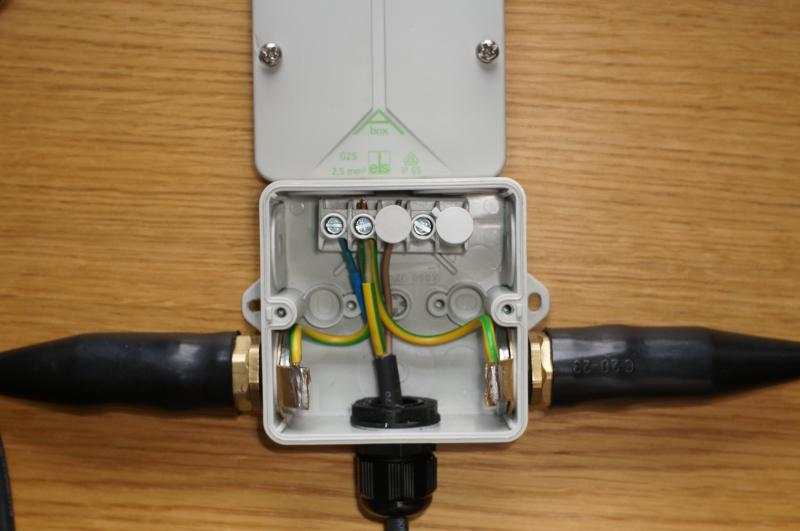
-
Was on a renewables forum, too much advertising, too much pandering to advertisers. In the end I just deregistered myself.
-
Well you have certainly convinced yourself it's the way to go. I priced, reviewed and then went self construction with ICF. With additional trades as needed. Best choice for me.
-
Trade account - electrics and plumbing
JohnMo replied to Lincolnshire Ian's topic in General Self Build & DIY Discussion
I gave up mostly with trade accounts, bought same item, (tape) 3x over about 2 week period, price was a random generated nonsense. Think each time was a complete rip-off. Screwfix, Toolstation, B&Q (Dulux Trade paint) were my go to places a lot of the time. City Plumbing has some good prices, they have some bonkers ones as well. -
Economics of DIY and Self Building
JohnMo replied to Gus Potter's topic in General Self Build & DIY Discussion
The maths makes sense in money terms, in part. Most people will go to a builder and they will be the main contractor for all trades. They will be be adding a sum on for the project management scope, the internal invoicing etc. Materials will be obtained from from a single merchant. I had quotes to build our house from single contractors the prices were daft, I came in 100s of thousands cheaper doing what I did. That being build the parts I wanted too and manage sub contracts for the other bits. But you will also put some time into finding the best price for goods. Example the best price on offer for PIR insulation was double what I paid for it. When you are buying a 145 sheets of 100mm PIR, that is a big lump of money saved, Had a similar issue with many items. Plus is it a real self build, when a company builds it for you? -
Beware of lots rubbish spoken about great thin insulation it doesn't exist. If it got a reflective surface it needs space to work - i.e. big air spaces. Insulation like I linked to (or similar) could be used under wooden flooring. Thicker the insulation the better it works - but 12 to 25mm will make a world of difference. This in 12mm would possibly need to be bonded to the floor, so it doesn't lift or bow. https://insulationstoreonline.co.uk/product/12mm-celotex-tb4012-thermal-pir-insulation-board
-
Insightful piece on more or less today.
JohnMo replied to MikeSharp01's topic in Environmental Building Politics
That depends, what is your cost of energy now, and what could it be. Even with a pret ty rubbish week for solar, we have used nearly all of it. So over the week our average cost for a unit of electric works to be 3p. Also depends on the export profile you can get, I don't anything, but my payback is more than acceptable. Other thing, why are paying 10k for a battery, our GivEnergy AIO, was no where near that cost for 13.4kWh. On Octopus Cosy I only need to charge to 50% each time to get me through day with no solar. Don't expect to pay more that 12p per kWh even on the coldest day with zero solar. Simple maths average 20kWh per day over the year, flat rate tariff is 25p/kWh, Cosy is 12p, so a £1000 per year saved. I will get 6 months with a real cosy close to 4p. So saving per year gets closer £1250. -
Non-Compliant Upper Floor Windows (Low Sill Height)
JohnMo replied to tg77's topic in Building Regulations
Bought a lot of houses, and found if it's not in a solicitors letter, it just gets ignored, pushed back and lands in your lap for no good reason. Make what you say above, part of the contract of sale. Let them faff about and fix it, not you - it's not yours until you hand over the cash and get the keys. If they want to sell it will be sorted super quick. -
Insightful piece on more or less today.
JohnMo replied to MikeSharp01's topic in Environmental Building Politics
But the unit cost makes up for it, especially the first few. You have to use 86p worth of energy at a high rate before cheaper rates apply, so first 4 or 5kWh is 20p+ per kWh! I just ditched gas because it made no financial sense to keep it. -
Spray foam, allow to flash off and not stick fingers when touching and squish together (dampen surface first). Bit like foaming plasterboard to the wall. Or you can use double sided tape, the decent scrim stuff used for sticking vapour membrane together.
- 100 replies
-
- 1
-

-
- mvhr vents
- filter
- (and 1 more)
-
Non-Compliant Upper Floor Windows (Low Sill Height)
JohnMo replied to tg77's topic in Building Regulations
Why - your solicitor should be insisting you do! Or at least he should be. Another issue is he representing two parties, is that even allowed, as it a conflict of interest? -
But does it fail if you add local reinforcements (metal or wood) in local stress areas. You can make strong corners by using dowels, and even screw in to dowels etc. An idea here
-
Thoughts on proposed layout for self-build
JohnMo replied to Ben Brewin's topic in New House & Self Build Design
Elevation look a bit bitty. Front elevation lots of odd size windows? 02 side elevation windows on gable end need centering around upper floor window. 04 elevation, dump chimney. Utility and office take up as much space as living room, living room looks very narrow and cramped compared to other rooms. WC and front door hit each other, so needs fixing Assume ASHP will be installed, need to find a home for that and an easy route to cylinder. Wouldn't be my choice to have just one bathroom between 3 bedrooms. Quite a bit of wasted/lost space upstairs. Do you really need a chimney? -
Sizing ASHP according to heat loss calcs
JohnMo replied to flanagaj's topic in Air Source Heat Pumps (ASHP)
One on eBay at moment for about £1k nearly new, removed as under sized for heat load. Billy bargain if you are down south. -
Non-Compliant Upper Floor Windows (Low Sill Height)
JohnMo replied to tg77's topic in Building Regulations
Easy, you make it a condition of sale that suitable measures are put in place by seller. Seller does what ever to make compliant. Gets note removed from survey at their cost. Or you remove several thousand from offer price, to take risk of lender not playing ball. Lender needs to know nothing then. You change as you see fit, once in house. Or leave as is, you maybe compelled to be fixed by the lender, and they may make it mandatory, for you to fix prior to getting any money anyway. -
I was thinking some more like this. https://www.advanceappliances.co.uk/product/70-multi-fuel-universal-thermal-store-sfuts/ So you have main pressure hot water, no cold water cylinder needed. One cylinder does it all. Connect oil boiler, connect solid fuel, connect heating system flow and return to your UFH pump and mixer.
-
No experience but some questions What is driving the change in insulation? Can you not do carpets and add better underlay? Have you insulated to death every other area, sorted drafts and add suitable ventilation? Why not something like this and wooden carpets https://www.carpet-underlay-shop.co.uk/collections/thermal-insulation-underlay/products/56oz-heat-insulation-wool-carpet-underlay If hard floor some insulation board and tiles on top
-
Sizing ASHP according to heat loss calcs
JohnMo replied to flanagaj's topic in Air Source Heat Pumps (ASHP)
You don't even need that. As you see my heat pump was off (except spike doing DHW at 0500) from 0100 to 1300. That's just letting the ASHP run when it's controller says to - nothing in house at all controlling that, just sensing return temperature and outside temperature influences. -
Sizing ASHP according to heat loss calcs
JohnMo replied to flanagaj's topic in Air Source Heat Pumps (ASHP)
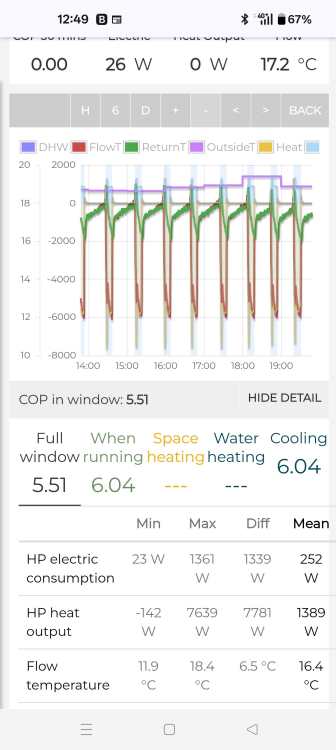
Here is mine, put out 22kWh in 24 hrs, so less than 1kW average. In cooling mode, note the cop when running and average CoP over day. . Zoomed in to show cycling, which all nice and controlled. That's how they do capacity control below minimum modulation.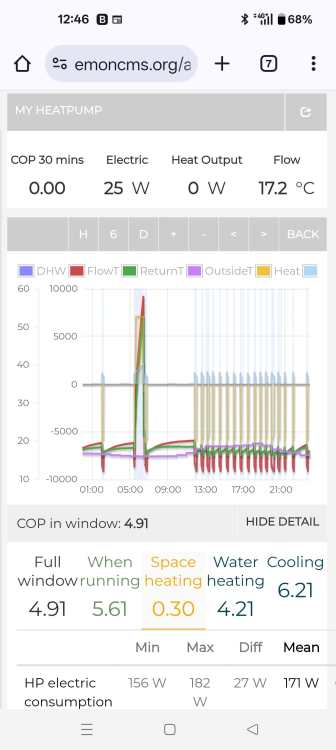
-
Sizing ASHP according to heat loss calcs
JohnMo replied to flanagaj's topic in Air Source Heat Pumps (ASHP)
So why bother with 2x systems just do A2A for heating and cooling or A2W for heat, cool and DHW. I touched my cooling switch in April not touched it since, will most likely touch it again in October to flick over to heat. Nothing else in the house. Why have 2x systems and 2x the cost? Two systems to size, two outdoor units, two different companies. Double your spend. Twice the thinking time. Your just making your own life complex. Stick in either a direct cylinder for immersion heating or a heat pump integrated cylinder if you go A2A. A 100A supply is all you really need. -
Would avoid if you can, it's just more time faffing about, try to keep jobs simple and idiot proof and unlikely to be missed and then hidden never to be seen again.
-
Not sure I would do kingspan between studs too much faff and getting it done well not easy. Mineral wool between studs something like frametherm 32, you should be able to fully fill, as you have external battens. Then PIR in full sheets over with a decent tape joints, service battens and plasterboard.
-
Or stick build on site? Our just simple cassettes made so joiners on site can quickly assemble. Which is the normal way in Scotland to build. Full house kits carry a big convenience premium.



