JohnMo
-
Posts
13296 -
Joined
-
Last visited
-
Days Won
200
Everything posted by JohnMo
-
Wish my heat pump controller only used that much electricity. It pulls 17W and often bumps up to double that.
-
These are your friend https://amzn.eu/d/2A1Z9iM
-

Advice on bathroom heat strategy
JohnMo replied to SomethingSensible's topic in Air Source Heat Pumps (ASHP)
So will you have to an additional circulation pump? Is 50L enough to stop short cycling if zone 2 is only running? A topic never really appreciated with low temperature UFH (assuming you are doing low temperature) is the nature of its self regulation. Especially when running weather compensation the floor surface temp in mild weather is 1 to 2 degs warmer that the room it heats. This small temperature difference means small fluctuations in room temperature, affect heat output from the floor. So as room gets close to floor temp heat output drops, as room gets colder floor output increases. This difference is sense by changes in return temp, to ASHP and it modulates output accordingly. So in effect you just don't need to zone. Your floor is your buffer, without buying stuff you don't need - buffer, additional circulation pumps, valves, thermostats, actuators, more antifreeze (if you use it) They are just towel dryers not room heater, your UFH is the room heater. So you have on for an hour or so after baths or showers, think mine have a 300W heating element in. If room is already warm the thermostat doesn't kick in. So running is not excessive. That's down to your ventilation strategy, more than your heat strategy. So maybe something to wrap your head around in another topic? -
My front door is inward opening, all others (4x bedroom and french doors) are all outward opening. They get caught by the wind easily so be careful.
-
Advice on bathroom heat strategy
JohnMo replied to SomethingSensible's topic in Air Source Heat Pumps (ASHP)
Read the grant BUS details, basically all DHW and Ch had to be supplied by the heat pump. -
Advice on bathroom heat strategy
JohnMo replied to SomethingSensible's topic in Air Source Heat Pumps (ASHP)
You are vastly overthinking this, each step add inefficiency. Have all your heating as a single zone, leave bathroom heat on as with the rest of the house. No keep to one. Then no need for a buffer or volumiser. No need for mixers or additional pumps either. Sorry that is daft. You automatically excluded yourself from grant money. And why would you both when you have a heat pump? Heat pump work most efficiently left to look after themselves. So one zones, no time schedule (except DHW), no boost settings, no buffer. Just a fully open system with a 3 port valve. Just set WC and let it do its own thing. It will only run as needed. Once your house temperature demands it flick over to cooling. Run above dew point, so about 12 degs and above. With a little tuning the system will run heat and cool as neededa Towel rail I just use an electric one with timer/thermostat. Even in summer the bathroom floors are cooled. DHW have the thermostat or temperature probe and run a time schedule to 1 or 2 times per day only. Your scheme over will yield at a best a CoP of below 3 and even less taking into account the additional electric boiler. On the other hand a simple single zone scheme a CoP of 4 and above including DHW. This is ours running, the big peaks are DHW heating via a fixed schedule. The shaded areas are heat pumps actually running in cooling mode. Note after the first DHW how the heat pump runs longer, this is just due to heat pump having to run harder to manage heat loading. Ove time it has nothing to do so it switches it's self off. The numbers in different colours below graph are the average CoP in the window (24 hrs) Similar is true in heating mode.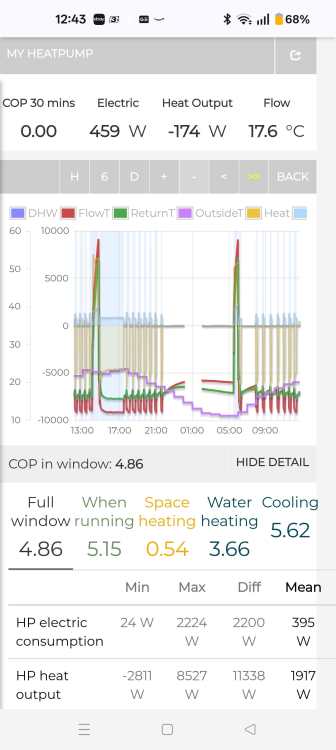
-
Expected In House Usage of Solar PV Output
JohnMo replied to John Carroll's topic in Photovoltaics (PV)
If anything like the UK, an approved install and the price you quote would be approved. Export prices without a smart meter is circa 4p and with a smart meter tariff closer to 15p. The reason many on here do DIY installation of PV is the cost difference. 10 to 14k to save 1k is 10 to 14 years payback. Looking at your spreadsheet, it seems there are some errors Have you made allowance for rainy and cloudy days? Allowed for angle of the panel and sun? i.e. used the link I provide to give a more accurate reality. In May you aren't going to get 29.7kWh every day, maybe not any day, no cloud, no shade, and a tracking system maybe, but a fix array very unlikely. -
Expected In House Usage of Solar PV Output
JohnMo replied to John Carroll's topic in Photovoltaics (PV)
Do you get a feed in tariff (FIT) still. Or that the rate for export with an approved system? So savings are one thing, cost to install another. What sort of cost would the install be? -
New Self build, Northern Ireland
JohnMo replied to Kevan Marshall's topic in Energy Efficient & Sustainable Design Concepts
13.4kWh battery. PV is around 7kWp, but at different angles and plenty of shadow from trees. So really more like a 4kWp system. -
New Self build, Northern Ireland
JohnMo replied to Kevan Marshall's topic in Energy Efficient & Sustainable Design Concepts
We are 200m², currently cooling with ASHP, with solar and battery, we are not paid for any export and ALL electric is costing about 30 to 40p a day. Heat pump efficiency is all about design, the simpler the better. You run 24/7, you have one heating zone, no buffers are needed, no thermostats are needed if run on Weather compensation. A CoP of 4.5 and above is pretty easy to achieve, including DHW heating. The ideal design is, ASHP, 3 port diverter, UFH manifold (no actuators, mixer or pump) UFH loops and a cylinder, interconnected pipes insulated. Cylinder (3m² coil)£1k or less, heat pump shop around £1500 upwards, UFH several hundred pounds. -
New Self build, Northern Ireland
JohnMo replied to Kevan Marshall's topic in Energy Efficient & Sustainable Design Concepts
If you can install a boiler and ASHP is easy. -
New Self build, Northern Ireland
JohnMo replied to Kevan Marshall's topic in Energy Efficient & Sustainable Design Concepts
No it won't, you want opening windows to enable purge ventilation to get rid of excess summer heat -
A little detailing and thinking through any cold bridging, you can exactly the same thermal performance. Both can be thermal bridge free. Locals you know and trust is half the battle. But do not expect them to understand thermal bridging, airtightness etc, you may have to drip feed them. You don't need to comprise with either system and it doesn't have to cost more than a rubbish design, think, plan, think a bit more, tell your architect exactly how you want drawn. Be an active client, that reviews and has final sign off, on all aspects of the design. I was the final approved on all the architects drawings.
-
New Self build, Northern Ireland
JohnMo replied to Kevan Marshall's topic in Energy Efficient & Sustainable Design Concepts
These are quite straightforward, but you will need to think about cold bridges where you meet the SIPs Really need PIR or EPS, 200mm for PIR and 300mm for EPS ideally, little less is ok if not going UFH. UFH is pretty cheap to install, we have it at 300mm centres, think @TerryE is similar. I use an ASHP, so I can get cooling, @TerryE uses a time of use tariff and a pair of Willis heaters. Don't under estimate how little heat moves about in a bungalow, MVHR flow rates are low and don't help distribute. A heater matrix in the mvhr will help with heating (not cooling), at Passivhaus MVHR flow rates it will distribute 10W/m2 floor area - no more than that. I would get a decent boiler with good modulation. UFH helps with boiler over sizing as the floor will buffer the heat. Last year with boiler with min turn down of 7-8kW, I was able to heat house with little or no overshoot and without boiler stopping once started. A +0/-0.1 thermostat is your friend and so is thick screed (100mm plus) as it will buffer heat freely. What ever you do you need to consider weather compensation for UFH or radiators or opentherm for radiators, this will give low flow temperatures and limit any likelihood of overshoot of room temps, plus its way cheaper to install than multiple thermostats. Don't do Y or S plan, do X or W plan (or Priority Domestic Hot Water), so you get one flow temp for cylinder heating and another for CH. This will get efficiency from boiler. For me this makes an ASHP a no brainer, shoulder season all heating is just about free. -
Expected In House Usage of Solar PV Output
JohnMo replied to John Carroll's topic in Photovoltaics (PV)
Make life simpler use the link to work it all out fir you. Big array unless you get paid to export and or have a battery - lots of energy will go to waste. https://pvgis.com/en -
Correct sarking boards, from memory 22mm x 150mm
-
Anyone used MVHR floor vents?
JohnMo replied to Alan Ambrose's topic in Mechanical Ventilation with Heat Recovery (MVHR)
Through flow, use a coanda extract terminal. It's also open plan to kitchen, or is the white line a wall with no doors? -
Anyone used MVHR floor vents?
JohnMo replied to Alan Ambrose's topic in Mechanical Ventilation with Heat Recovery (MVHR)
I would delete the extract form bed 2 & 3 storage, there is no need. They cause air to short circuit. Pantry should be an extract Master bedroom supply move to near wardrobe, but do not uncut bedroom door. This gives better cross flow across room. You don't really need the dining supply, move the kitchen extract to the white line between kitchen and dining area. Or better for routing may be on the kitchen side of the pantry wall -
Buffer Tank Hot when Heating Mode Turned Off
JohnMo replied to James1234's topic in Air Source Heat Pumps (ASHP)
First if Daikin hold the MCS licence the design has to be installed per your layout at the start of this thread. If the plumber was the MCS licence holder and issued the certificate, they are the designer, not Daikin, Daikin sketch is just that a sketch not a drawing. So you need to get your head around that side of things. Running multiple circulation pumps kills CoP, often the second pump is driven from an unmetered (not metered by ASHP) supply. So secondary side circulation is missing from CoP. Example I just changed my pump in the ASHP from running all the time (manufacturer default) to intermittent as demanded from temp controller and cop increased by 1 to nearly 5 for the last week. I only have a single pump, imagine deleting multiple pumps. Your design as given by Daikin, was sound, zero issues. Don't fret about heat pump size, you can run an oversized heat pump with very little impact on CoP, as long as you cycle rate is is ok (especially with UFH), 2 or 3 cycles per hour in mild weather is ok. Run the system in weather compensation without thermostats, should yield a SCoP over 4 easily. Convert buffer to volumiser or delete and get rid of the additional pumps. You have the design, find a plumber to change it for you. -
Battening for Vertical Timber Cladding - Tips, Hints and FAQs
JohnMo replied to Thorfun's topic in General Joinery
Just make sure you seal everything (ventilation gaps etc) really well with stainless steel mesh to keep rodents and wasps out. Wasps will find the smallest gap. -
Using PIR boards to backfill garden path
JohnMo replied to miike's topic in General Self Build & DIY Discussion
Insulated your shed or garage Box in you cylinder to reduce heat loss. If you have loft, insulate more, cut in to strips just small enough to get through loft hatch, then using cut line, foam the pieces back together again. -
MVHR and cooling
JohnMo replied to flanagaj's topic in Mechanical Ventilation with Heat Recovery (MVHR)
Could imagine coming to a pool of water, and a new picture on the wall. And then getting the blame for it. Who's stupid idea was to put heating in the wall. -
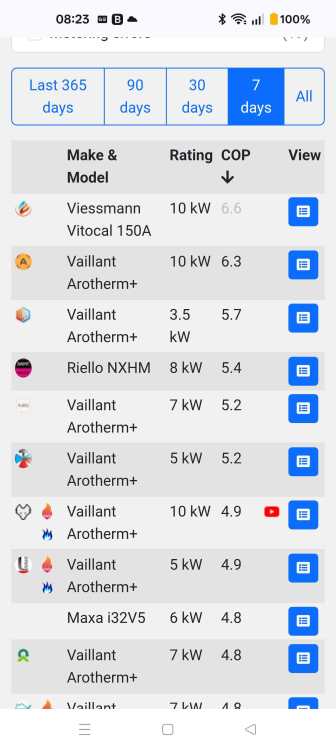
Quite a few are, some of the ones above me in the chart are still doing heating - in England, many aren't doing DHW lol.
-
Sorry I was thinking more Scotland and the mandatory use of sarking boards for increased wind loads. Bit different from fencing - but not much. Mine in the process of being installed. Gaps are used to traverse the roof and are back filled when finished.

-
After the minor change to circulation pump settings and leaving a week to settle in, thought I would check the heat pump monitor SCoP leader board to see how my system looked compared to others. So currently sitting 9th overall based on 7 days of figures Mine is Maxa i32V5.