


JohnMo
-
Posts
13296 -
Joined
-
Last visited
-
Days Won
200
Everything posted by JohnMo
-
Has the above assumed you leave all your blinds up and just let your room flood with heat. If so that's a flaw in the maths. Also taking some basic things, if your windows are facing south and have no shading, the solar gain doesn't start until you get sun through the window, so late morning onwards. Your peak load is at 9am. So would say your windows are facing east, is that correct? At 9am even on a hot day, it's still cool outside, so open the windows and doors have a blow through, as day starts to get warmer than inside close everything up. Let your cooling, whatever you choose do what it does. AI is great but you need to add a dose of common sense, or you are down a rabbit hole, shite in, yshite out.
-

Installing a woodburner in a SIPS house with MVHR
JohnMo replied to pedragon's topic in Stoves, Fires & Fireplaces
We did quite a bit of research before buying our stove. An all metal stove heats up very quickly and output all it's heat to the room. A stove covered in soap stone, takes a while to heat the stove, heat is much more gradual and controllable. But pile it with logs you will melt. We light add a log, turn down the air to minimum and that's about it, if really cold we may add an additional log or two but only when the first log has just about disappeared. -
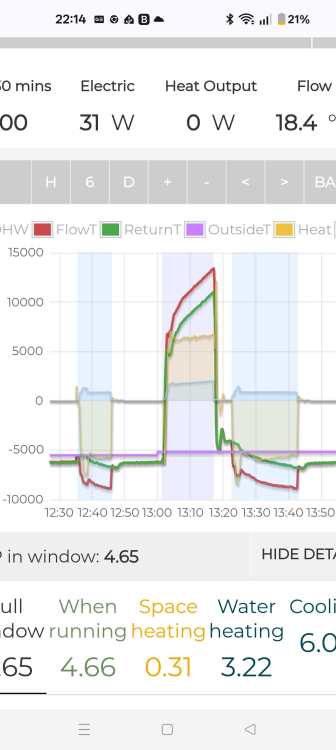
Yep, just like below, centre is DHW heating, the blue sections either side are cooling. As soon as there is a DHW call the heat pump swops duty from cool to heat, the diverter valve moves to direct hot water to the cylinder, once complete it all reverts to cooling again.
-
Some ASHP do not support cooling at all, some require a few bell and whistles (cost adders), other do it out the box. To switch between heat or cool is generally a volt free input. I just use an spare light switch, that's it. DHW continues to work as normal in either heat or cooling mode.
-
Dew point is nothing complicated, people would have you believe there is, for some reason. House at 22 the dew point is around 12 degs. Keep above that the dew point issue isn't there. You don't need to lag pipes any more than you do for heating. I would do A2A or A2W not both. Both can do heat and cool. Make you choice and move forward. You could look at Panasonic squares loop system also. Things I like with UFH No noise, everything is hidden, silent. One switch to go from heat to cool. Thing I didn't like with A2A, drafts, but liked the coolness in the house. But got to a point where we switched the Aircon off and just slept with windows open (34 degs and 100% humidity) because the drafts just bugged us and made us feel dry.
-
Up to you really. I didn't even think about cooling until after the first year in the house. So my floor is designed around 18W/m². Floor surface is a property of flow temperature, pipe spacing, insulation below UFH and depth from surface. My floor runs at 18 to 19 depending on solar gain. The more solar I get the harder the ASHP works and cycle time increases from 10 to 12 minutes to a few hours. This brings down mean flow temperature, hence the difference in surface temperature. Surface covering makes a big difference, carpets kill cooling.
-
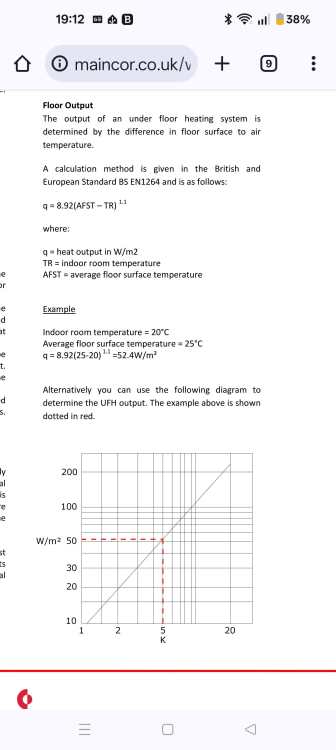
The output of cooling is just the inverse of heating In simple terms if the room is 24, the floor would need to power of 63W/m² (700W /11m²), so floor temp of 24-6 (from chart below), so 18 degs floor surface temperature. As room temp gets closer to room temp output reduces eventually hitting zero.
-
Assume get very little solar gain through windows?
-
Sounds similar to us, but we have 210L cylinder. Generally heat twice per day, to a thermostat setting of 49, it actually settles to about 51 after heating. A lower set point means a larger turn over of water, as less cold dilution is needed. It adds efficiency to the boiler as you can set flow temperature lower. I keep DHW away from home assistant, I tend to keep all systems that I need simple and well detached from anything so called smart. DHW is local controller - a simple time switch between the thermostat and heat source, heating is now just weather compensation and not even a controlling thermostat, just a manual switch between cooling and heating.
-
Internal blinds?
-
Except you get into the realms of applying for dno permission at that size of unit, your cables all get bigger etc. start up current gets bigger. You would be surprised how different it makes the house feel. It's important equally for A2A. A2A is a different cooling mechanism, as air holds very little energy and next to no inertia. Sizing for peak means you can control room temperature with precision, but do you really need too?
-
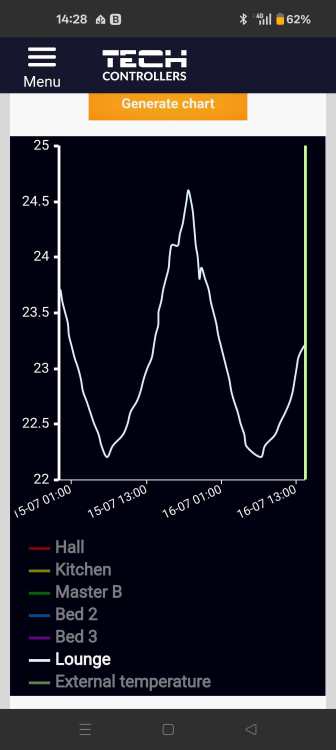
Sorry s bit of a rant below. Cannot believe that. Our lounge is 6m tall, one end is fully glazed, to make it worse it's a bay window, even with roof overhang gets full sun from around 4pm, we control the heat with internal blinds and UFH at 300mm centres, so not even ideal for cooling. Our typical temperature trend for the lounge is below. Gets to 24.5 degs, but feels cooler due to cool floor sucking your heat away. And temp drops pretty quickly. In total we have around 50m² of glass facing south west on the front elevation of the house. A 6kW ASHP pulls about 4.5kW max. But that is not real. You have zero need to size for peak load or the way the average is done, or close to it in a house. We get peak load for a few hours per day. The other day 30 degs outside and no cloud, floor pulled 50 kWh from inside house, so an average of near 2kW. According to your calcs I need nearer 50kW cooling input - that's just bonkers. You only get solar gain when sun is actually on the window and could or should only be a a few hours per day. You will have curtains or blinds (internal or external) these slash the heat gain numbers. People aren't in the room all the time. A floor a couple of degrees cooler than the air will pull a huge amount of energy out of a room. When we are at 24 degrees we have a room air to floor delta of 6 degs over 38m². You need to take a series of average heat gains and then make an average of that, then you just trickle the cooling in 24/7. What is important here is comfort, not the actual temperature.
-
I would go on the heat geek website and read up on legionella and do a risk assessment. Heating to 50 is more than acceptable (do a risk assessment). Heating to 50 will just about half the heat the cylinder and piping add to the room. Storing water at 65 to 70 will release a couple of kWh of heat per day, store at 50 could reduce that to 1kWh. Which may be enough, without spending additional money.
-
We used Rockwool Flexi, but most products are similar except PIR which is rubbish for sound. Your insulation material needs to be thinner than the stud so neither side touches the plasterboard. Denser insulation stay in place well, but needs more careful sizing. Gaps are bad and will circumvent the insulation. We used standard 12.5mm and dry lined no issues.
-
Our house was originally planned for a mix of vaulted and flat in bedrooms, kitchen/diner and wet rooms. But we changed to all rooms are vaulted, way easier to make airtight, no vertical bits to insulate, construction is cheaper and easier to do. Various layer of insulation you have to be careful you don't get moisture ladden air in and it ends up with no where to go. All vaulted makes very little difference to heat loss, goes up a little, but the feeling of space trumps that every day. Assuming you are using a low temperature heating system. If you are using a high temperature heating system, you really shouldn't be anyway. Airtightness details are very easy all vaulted. Any loft space treat the same way as all other vaulted areas, the airtight layer is the roof line. You really need to do the following 1. Determine your air tightness and vapour tight layer, this should be continuous around the building. 2. Decide where your insulation layer is. Get a cross sector building - take a pencil can you draw a continuous line through insulation and only insulation, around the building without lifting the pencil? If not you need to add insulation to bridge gaps. The MVHR is building ventilation and has no bearing on your insulation layers. Condensation within the insulation is factor the temperature gradient within the insulation and control of moisture or lack of by a vapour protection layer, normally coupled with airtightness layer.
-
MVHR and cooling
JohnMo replied to flanagaj's topic in Mechanical Ventilation with Heat Recovery (MVHR)
A DIY approach could UFH gypsum boards attached to wall, fit pipe and plaster finish. Floor finish can be carpet etc. -
Or an alternative to UFH and fan coils https://www.variotherm.com/en/products/modular-wall-heatingcooling/technical-information.html
-
MVHR and cooling
JohnMo replied to flanagaj's topic in Mechanical Ventilation with Heat Recovery (MVHR)
A link https://www.solray.co.uk/effective-and-efficient-cooling/ https://www.variotherm.com/en/products/modular-wall-heatingcooling/technical-information.html -
MVHR and cooling
JohnMo replied to flanagaj's topic in Mechanical Ventilation with Heat Recovery (MVHR)
A link https://www.solray.co.uk/effective-and-efficient-cooling/ -
Almost any breathable membrane will be fine, use what's on your drawings. We used Proctor. Would you be better to use sarking boards instead of osb, once installed these will shrink a little and give lots of small slots to let moisture ladden air out.
-
Only thing to add about fan coils is the heat pump NEEDS to be sized correctly, if it's too big the heat pump will cycle, sized correctly with decent modulation, iit will just tick away all day. The fan coil will switch on off in response to heat pump cycling. We have that issue with the summer house and our oversized with limited modulation heat pump, so we end up getting a 2 deg swing in temperature, on all but the hottest days. Once we get to 30 heat pump will run for several hours at a time.
-
MVHR and cooling
JohnMo replied to flanagaj's topic in Mechanical Ventilation with Heat Recovery (MVHR)
I would concur with that, why dick about with two systems. If you wanted cheaper DHW you could do a heat pump cylinder. -
UFH throughout (single storey) does heat and cool. Cooling isn't the be all, end all of cooling, but with none of the blowing air of Aircon (which I started to hate after living in Asia). But does make house more comfortable for zero additional equipment and zero costs, house doesn't have the extreme of heat and cools down before bed time. But we have huge amounts of solar gain, once outside is as cool or cooler than inside we purge ventilate as well.
-
Your missing the point. You will have a battery - all your available DC power can go direct to battery charging. The battery inverter is basically pegged at 3.6kW. So can give 3.6kW to the house or the grid if battery is full. If you want a bigger inverter get a G99 etc. With 11kW on the roof, you are going to be exporting or wasting a bucket loads of energy in the summer. You will.not know to put the energy after lunch most days
-
All my room temps are in an app, all the rooms have a thermostat, but the boiler output isn't connected. Anyone could change any set point but it doesn't actually do anything. It's just a monitoring tool.


