


JohnMo
-
Posts
13296 -
Joined
-
Last visited
-
Days Won
200
Everything posted by JohnMo
-
 It called overclocking. Big array and smaller inverter. In full sun PV production is great, but 95% of the time we don't have that. So in 5% your panels produce loads but the inverter clips output to only output 3.6kW max. The rest of the time you are still limited to the inverter capacity of 3.6kW but you are more likely to actually produce that. Not all inverter like overclocking. Quite a few hybrid inverters do.
 -
I paid too much using a gas boiler ASHP hybrid, just because of the gas standing charge. So gas meter had to go.
-
Possibly why the app says estimated below the graph.
-
I am a 4G meter, but that sends data direct to DCC and everything gets read from there. But strangely I have consumption data from prior to the 4G hub being installed. So the smart meter must store a period of data as well. Communication was established last Friday, but I can see 30 mins data back to 15 June on the octopus app. I am also using an octopus mini, which connects to your meter wirelessly, so that my be reading directly from the smart meter and utilising the app to display data?
-
If you reduce the bedroom flow rate the mean flow temperature for that loop reduces only. It adds less heat, so over the 6 hours will add just enough to get that room to the temperature without any need for a thermostat. But if only this room is using a thermostat to limit room temperature rather than call for it, you just don't need the buffer, especially if batch charging the floor. I just used a single window for batch heating floor, but used a 0.1 hysterisis thermostat to stop overshoot. Could do the same for boiler and ASHP. Both would run a single cycle (so start at start of time and run continuously until the end), only ASHP having to defrost when required. Once outside the running window the thermostat was set a couple of degrees below actually room temp. But don't bother with any thermostats any more.
-
Or Sunsynk are supposed be good
-
All heat pumps are cooling (not aircon) enabled in the software, but some manufacturers choose not to enable or make difficult to enable for the end user. Vaillant for example requires a hardware but added. The cooling thing predates bus scheme, the scheme prior to, or even prior to that required a heat pump not to be enabled to allow cooling, so was heat only devise. Although it uses a cooling function during defrost.
-
Couldn't you just trim the flow rate down, so the dT goes up on that loop and it naturally gives less heat to room? Then dump the buffer and additional pump(s) and use a single thermostat timer, to control batch heating?
-
Moving in before completion
JohnMo replied to Lincolnshire Ian's topic in General Self Build & DIY Discussion
We were similar, sold house as late as possible, but sold second car to release funds. Used credit cards. As mentioned above, once in, nothing has any urgency so takes for ever. So put off as far as possible. -
I use heat pump all year, if it's not heating it's cooling. Yesterday I paid £1.17 including standing charge, so 67p for all electric. Can live with that.
-
He should have no standing charge. Just a monster of a tank that he will fill once every decade. The clues in the name BUS (boiler upgrade scheme) - how you cook is nothing to do with scheme. Boiler will be removed heat pump plumbed in instead. But would think the best way to manage it would be via MCS umbrella scheme.
-
But you store water at circa 45, does the OP?
-
So what temperature is cylinder kept at? That could be your biggest heat source. How well is it insulated?
-
Why is that too hot? Our is at the same temperature all summer without issues. Do you have equipment failing if it hasn't failed in 3 years it's unlikely too now.
-
No, if it's leaking, past a valve seat you wouldn't get any indication except heating system getting warm.
-
From other manuals I have read it varies between annual and every two years. I would do it annually, then you will get to know what the material loss is like.
-
So you have a heat pump, why all the thermostats? Do you have a buffer or volumiser in the system, where is this actually connected. Is it downstream of the 3 port diverter on the central heating side? Have a feel of the 3 port valve, when doing DHW, the central heating side of the valve piping should be cold, if it got I would suspect the internals of the valve are leaking.
-
Not really - no air in mine, always comes out very easily - have one on cylinder very top of system, one on flow and return near ASHP at a high point, two on UFH manifold, and one in ASHP. All are closed off after initial filling and once no more air being caught. Then a week later go around and make sure no more air coming out. @Nickfromwales may be able to help. He fits Telford cylinders. But have you tried to increase system pressure, this will dissolve any air bubbles. Run for an hour or so then slowly decrease system pressure and then air trapped air will have been transported, and could back out suspension and hopefully come out of auto vents. "UFH buffer tank has 2 coils which are connected serially" That is a strange configuration?
-
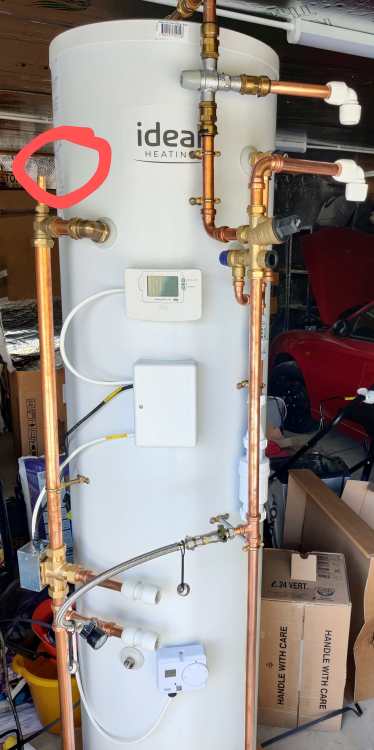
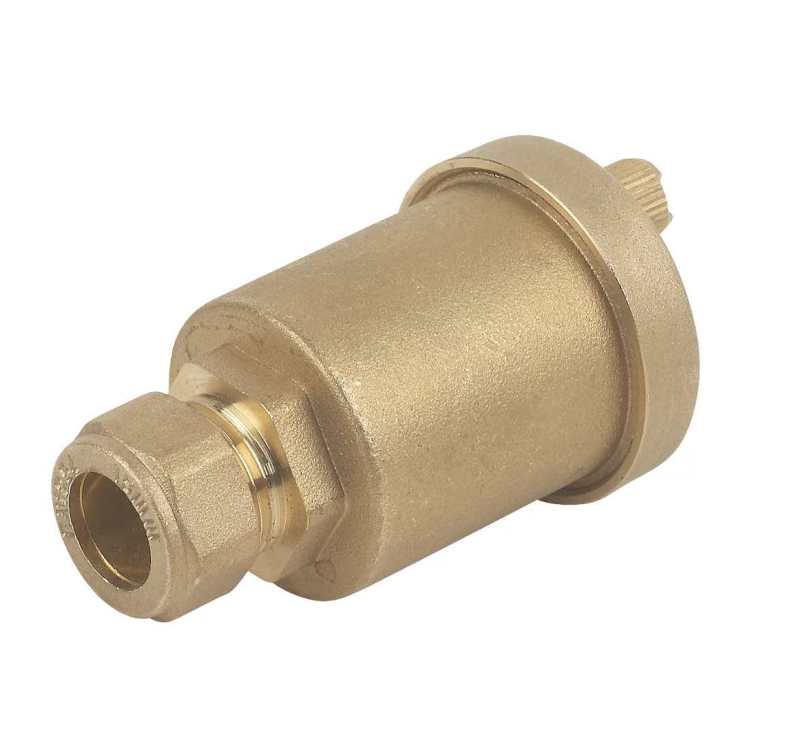
You to fix the air in the system first, as any makes the flow meter of the heat monitoring system stop working. You also need to fix to stop corrosion in the system. Mine just has an auto bottle trap where the red circle is. Including Tee was less than £20.
-
Well that wasn't very effective. First charge was ok, second charge and third charge didn't work well. At this time of year even with cooling running, I just don't need that much charge in the battery. Second charge was changed to a smart charge, based on solar prediction, so it now charges to a minimum of 70%. If first charge period was ok battery is past that point anyway from PV. Also during that cheap slot system set to consume from battery if battery charge is above 75%, not from the default which is from grid. Third charge at 100%, meant I still had 80% charge remaining at time of first charge the next day and no room to accommodate much PV. So I exported - not being paid at this point. So that was changed to charge to at least 50% based on predicted PV generation and to self consume from battery if SoC is above 75%. Hope the changes give a good balance between, import cost, limited or no export and battery not running out, if predicted PV is out.
-
You don't have to use GSE there are other systems. If not an MCS install, MCS rules don't apply.
-
Just stating obvious - if you get paid for export, a diverter may not be best for your pocket, with a heat pump. In summer heat pump will generate DHW with a CoP of around 4. Leaving you 3 units of PV kWh to export and be paid.
-
Introspective of how installed you still need G98 up the 3.2kW allowable export and G99 above that. Regardless of any plans to export or not. G98 can be completed after install, G99 has to be done prior to install. You need a decent grid tied inverter anyway. Something like a Sunsynk hybrid inverter of any size will allow you to export limit to 3.2kW which I think (?) makes ok for G98. Battery & inverter needs some thinking about, depends if you need full house power backup in event of a power outage. Hybrid inverter will give very limited output during a power cut, grid tied AC systems will give whole house backup during an outage.
-
MCS isn't applicable if you do it yourself. But only Octopus will pay for export, after going through a few hoops and paying then £250. No - the panels are cheaper than tiles or slates. If you are paying more than £70 per panel get other quotes, look at City Plumbing. Cram lots on roof, but to make use of it you need a battery really, otherwise most will be exported for free. In summer you will struggle to use 3kWp let alone loads more.
-
MVHR and cooling
JohnMo replied to flanagaj's topic in Mechanical Ventilation with Heat Recovery (MVHR)
And see how it goes. If you want to future proof for little cost, have a think about how you would implement a2a if you need it? So add ducts for pipes now and seal off then no drilling later when everything is finished. Measure photo etc so you know where they are hidden later. Or better still for fan coils, pre invest 15mm Hep2O pipes for fan coils upstairs. If you want 3/4/5 fan coils just add 3/4/5 ports to your UFH manifold or if already in place add an extension manifold.



