


JohnMo
-
Posts
13296 -
Joined
-
Last visited
-
Days Won
200
Everything posted by JohnMo
-
Thing often missed in oversizing ASHP and then adding buffers is the huge impact on running cost. You have additional pump(s) to run, but more importantly is the ASHP cycling because just too big. If my heat pump was smaller or modulated better, I would be getting close to a CoP of 6 at the moment, but due to cycling it's just under 5 most days, a month ago it was closer to 3 (switching circulation pump off between heat cycles made a huge difference). Add multiple pumps running, a cycling ASHP and buffer that could easily drop to sub 3 CoP, doing the same job. Heat / cooling circuits oversize to hearts content, all good, but ASHP no, not good for life of the heat pump, or your pocket. Tried just about every combination of heating and cooling setup (including the one being discussed by OP), and paid the bills. By far the best performer and cheapest to run (by a huge margin) is a single zone system, no buffer, mixers or additional pumps. If I installed a 4kW heat pump my ASHP running costs would drop by another 10 to 20%. Add a couple of additional pumps, an ESBE mixer and a big buffer, add 2 to 4k to the bill. And all they do is degrade performance and add to annual costs. Sounding like a broken record now.
-
MVHR and 4 ach doesn't sound correct. You certainly do not use the air test figure in the calculation as that is artificially pressurised. If your house leaks like seize you wouldn't have MVHR. You would use the flow rate of MVHR. So about 0.5 or less. That is nothing to do with heat loss, that is opening windows and maybe doors for getting rid of hot air. It's the inverse of heating really. If it's 30 outside you need to remove 8 degs of heat if you want it 22 degs inside. Solar gain add to that, but from memory you have a couple of hours early sun from the East? An average of 30 over a 24 hrs period isn't that likely to occur often. Morning solar gain, keep curtains shut and if cooler outside temps just fling a couple of windows open for an hour. Job done, then let cooling tick away the rest of the day.
-
12kW is a huge heat pump for a new build. Isn't it a 3 phase heat pump? For a heat loss of 7kW, big house circa 400m² I assume? You need a minimum system volume of 150L to ensure back up heater isn't used during defrost. Piping needs to to be sized to cope with 2000L an hour flow rate. Even the 7kW puts out over 7kW at -3, that is big enough. The 12kW machine doesn't turn down that much I believe, so when it's a more normal day in winter of 7 degs, your heat pump is just going to be massive. Get a new installer - would be my advice. A mitsubishi 8kW (not 8.5kW) would be better or a Panasonic. Plus the aerotherm your installer will charge extra to get cooling to work! It's not a standard feature so needs an expensive widget added.
-
So going back to basics What is your heat loss - the number to start heat pump sizing from? What is your average heat gain on the worst day? 7x 1.5kW and UFH is a huge heat pump!
-
No, just run whole lot on a single circuit to achieve a mean flow temp of about 16 degs and no lower than about 12 which is at or slightly below dew point. You are making things complicated and expensive to install for little or no gains.
-
Easy get him to order - your trying to save a few pounds, get it wrong could cost you thousands.
-
Get company installing to measure, then any mistakes are in them.
-
Too many snippets of information and no real drawings to what's what. It can't be hard.
-
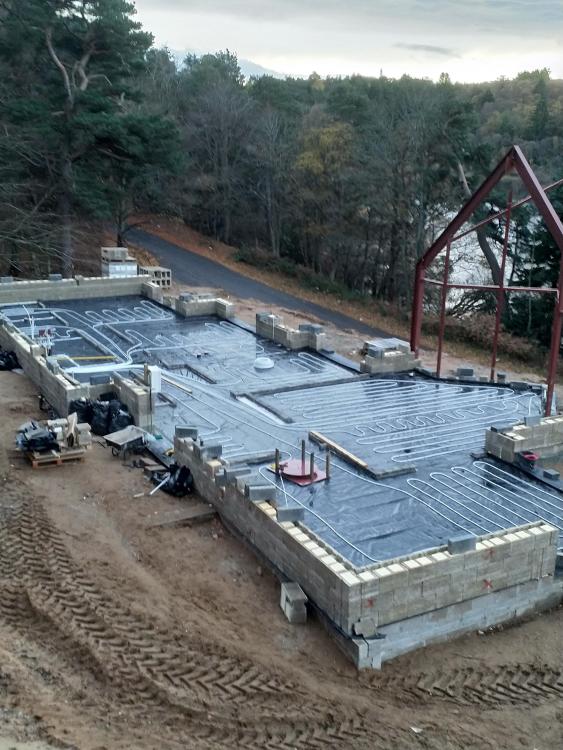
Still confused about all the ground beams and where they fit in with the insulation. If they are actually ground beams and insulated raft, will it be with lots of thermal bridges?
-
So daft question where is your insulation for the floor?
-

Insulated pipework for ASHP fancoil cooling
JohnMo replied to SBMS's topic in Air Source Heat Pumps (ASHP)
Not if it's closed cell insulation. If it's not closed cell then vapour barrier is needed -
Insulated pipework for ASHP fancoil cooling
JohnMo replied to SBMS's topic in Air Source Heat Pumps (ASHP)
Most insulation is fine it's all generally closed cell. If you are concerned about pipe condensation you need to install condensation drains for the fan coil also, with a dry trap. Or just put a small container under the drain point and empty as needed -
MVHR and cooling
JohnMo replied to flanagaj's topic in Mechanical Ventilation with Heat Recovery (MVHR)
Most heat pump have the settings built in, but the logic is to basically control a mixer to let down (or up) one set point to the other. -
So I assume internal walls will be going in. Map out where the rooms/internal walls are. Then do circuits/loops in each, and take those loops through the doorway into room. Your loops do not go the the very edge of room, so stay either side of a wall by 150 to 200mm then you have quite a bit of leeway. Sort of like this
-
You could do the same or similar with a wet system I assume, with UFH scheme in the ceiling and then run from heat pump, and you would have pretty effective cooling also.
-
Electric not metered so not that much idea, but pump will only run for a short while. Annual service is about £100 to £150, filters, UV light etc.
-
Our only treatment is particulates filtering and UV. But due to our borehole being in pure sand (34m depth of it) we had to steel line the bore hole, so an additional treatment was needed to eliminate iron oxide. If left untreated would turn all water users brown. So treatment may not to to expensive any way for whole house use.
-
0.07 (W/m²) x 192 (my house area) x 24 (hrs) x 0.25 (kWh price standard tariff)
-
Isn't there an issue with pace markers? Many manufacturers not recommending it? Wouldn't include 'only' as 70W per m² is still high. That would 'only' be £80 a day for me on a standard tariff. Where as with my heat pump and some decent insulation I would be closer to £3 (at -9, on octopus cosy, and 192m²)
-
No, unless you are a BIG user, like a farmer, domestic user no.
-
Do I need a HP specific cylinder?
JohnMo replied to Beelbeebub's topic in Air Source Heat Pumps (ASHP)
Don't think it gets confused it just monitors return temp and responds to that. But will it modulate down, while doing hot water. Mine certainly doesn't, it runs full load and full circulation pump speed throughout the whole DHW heating cycle. Some heat pumps allow different settings. Not so sure about that. Once heating cycle is complete the cylinder will stratify as normal I did a slimline cylinder -
Do I need a HP specific cylinder?
JohnMo replied to Beelbeebub's topic in Air Source Heat Pumps (ASHP)
Based on not just you, but future buyers of your house, as it's a bunch of tax payers money. So bedrooms, rather than sizing for me and my wife, in any number of bedrooms. -
Do I need a HP specific cylinder?
JohnMo replied to Beelbeebub's topic in Air Source Heat Pumps (ASHP)
The other bit in MCS rules to which the BUS is linked to has a specification for cylinder and number of bedrooms - is the cylinder big enough to comply? -
Get a borehole? Then you stay in control of costs, not some big corporation, that passes it's fines on to you to pay.
-
We generated a 3kWh today, far from self sustaining here. The joy of being north.



