PeterW
-
Posts
18480 -
Joined
-
Days Won
207
Everything posted by PeterW
-
Yes it’s called load shifting - works really well. Probably one of the better reasons for solar PV although in winter you need a lot of panels to offset the usage
-
@IanR I do the opposite as find it’s easier to drop the gate onto the bottom pin and then pull it back with the bolt at the top but agree - unless you weld pins on they do walk !!
-
The whole lot that goes into the ground. Give it plenty of treatment
-

Glass splashback or . . .
PeterW replied to canalsiderenovation's topic in Bathrooms, Ensuites & Wetrooms
EN 14428 is the standard for shower screens so highly likely it is toughened. When you say it is smoked can you see through it at all ..? You can paint the back of glass to make it opaque and then bond it or use a channel to hold it to the wall - will be fun to try lifting it over that bath ..! -
Advise required around new roof - not straight!
PeterW replied to Ryan G's topic in Roofing, Tiling & Slating
Yep find that when the brickwork is slightly high and the tile battens run over the gable. More noticeable with those sorts of tiles but top marks to the roofer to cut the second to last ridge tile so you don’t see a cut end. -
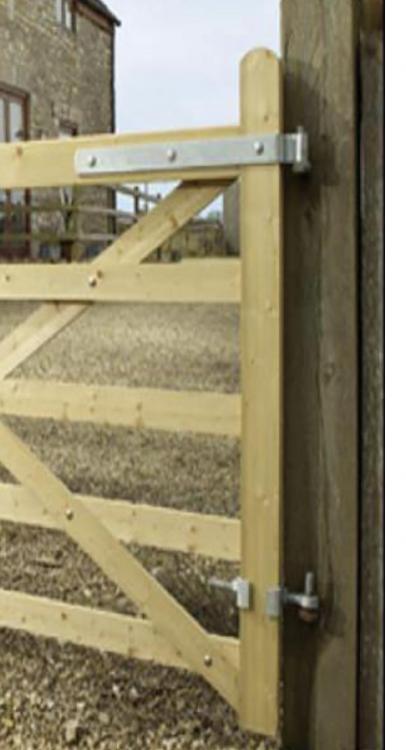
top hinge is the peg with the threaded end that goes all the way through. It’s in tension so the nut and washer stops it pulling through the post. bottom hinge is the spike peg that goes in as far as you can then you use the threaded bottom hinge to adjust it in and out from the post. Most have a set of square plates that grip the bottom of the gate as in this pic Hole in the ground will be fine while it’s wet - use the time to get a couple of coats of preservative on the bottom of the post if you can.
-
Correct !!
-
What is the heating ..?? Are the ASHP just for DHW..? And is 3 phase available ..?
-
Peg goes in the bottom. Drill a 50mm deep hole with a 25mm auger bit, then reduce to a 19mm bit for another 50mm Square the pin up so the pin is parallel to the post and knock it in until it starts to tighten up. If it goes off square then just realign it and start again, or if you’re handy with a chisel you can cut the first 25mm or so with a chisel to keep it straight. I’d want 60-70mm between the gate pin and the post. Then the top pin is similar but you bore the hole all the way through. Washer is too small - I would get a big galvanised plate washer for the back - and then it’s a case of knock it through and put the washers and the nut on. Ideally it needs to be tight in the hole so you adjust with a hammer both ways ..!! You also need to make sure you bolt through the top rail of the gate with the strap and get it tight - this takes all the gate weight in tension so has to be done well. The bottom threaded eye also needs flat plate washers on it too.
-
Depends what your water provided requires. I always put a drain valve and a full bore lever valve past the stop valve as I don’t trust gate valves. NRVs can be restrictive - if you’re up past 7 or 8 bar then a PRedV is a reasonably good idea before you get to the control set for the UVC
-
If BCO is signing off the whole build then anyone can fit the windows - most of us have done that with “standard” windows, when you get into the big Aluclad or big sliders which are best left to the professionals
-
Add an extra 1/2 litre per bag, get the floor sopping wet with a mop and bucket and clean water first and then mix / pour etc using a Plasterer’s bucket and a power blender. Have 3 or 4 marked up water buckets filled to a line and then just keep filling …
-
Could always give the flint work a couple of coats of Thompson’s or similar to stop any water ingress but I’d also want to get the lead in a decent 30-40mm. Don’t give it any opportunity for water to sit on the lead.
-
Catnic ANG2100 SWL is 7kN so around 700kg. There is 50kg of bricks there, the window fixings will take some of the window load and I’d expect another lintel at the top for the last few courses. Seems fairly reasonable to me unless the window is very heavy. At about 2m square there is around 80kg of glass in the units plus another 80-100kg max of timber.
-
Not enough glue in 22mm Egger Chipboard installation?
PeterW replied to Adsibob's topic in Floor Structures
If they aren’t glued together either then they will easily lift off the joists and away. It’s a fairly big job to lift the floor but can be done. The issue is the glue bond to the joist is part of the structural strength of the posijoists so it needs to be done for a lot of reasons. -
we have a pair of Fujitsu A2A and a Sanyo CO2 12kW A2W heat pump on maintenance contract for a local place and it’s £275 per service and they are done twice a year. The main service cost is the fan coil units on the A2A as they are stripped every 6 months to have filters and coils cleaned and check the drains etc. The Sanyo has had its cover off once, and that was to check the insulation where a mouse had been chewing it !
-
Wrong again A non MCS install is similar to a gas boiler. There is the same amount of water pipes, same connections for a timer, the difference is the electricity vs gas connection. I can run a 20m 6mm T&E in a single length in less than 2 hours in an open ceiling. Find me a gas fitter who can do the same with a 22mm gas pipe and test it in less than 4…?? Any plumber can fit an ASHP. No MCs premium, no GSR… I think on here there are probably a dozen or so self installs vs how many gas boilers that members have installed themselves ..? None. And your £2k boiler ..??! That includes all gas pipework and commissioning and something that can do 18 litres / min ..? That didn’t fall off the cheap shelf in B&Q..?? Any main brand is £12-1400 now plus the half as much again on install for a replacement, probably £1k or more for a new build where they are pulling the gas in.
-
Site at green dot and turn at 90 degrees so perpendicular to the building.
-
300 litre UVC with all fittings £750, install £4/500 depending on location. 9kW ASHP £3k, install equivalent to a gas boiler. So compared to a standard boiler at £1500 or so, you have an additional cost of around £2750 on a standard build. Over 10 years, that differential is lost in the reduction of any standing charges or servicing for gas, and the guarantee that the price on gas is only going up.
-
INCORRECT STATEMENT The “heat energy” in air is registered on the Kelvin scale so runs to absolute zero, not 0°C that you’re using. Energy in the air at 5°C vs -5°C is around 3% difference. Most ASHP are rated at 35/7 which is flow of 35°C and air temperature of 7°C so if the cold is a problem then all the manufacturers would be calling this out. The limitations run to the liquification point of the refrigerants, and that’s around -35°C which in the U.K. is highly unlikely.
-
Not correct .. 300 litres at 56°C gives you around 430 litres at 40°C so you’ve got 43 minutes of flow without any top up. If you’re in the situation you know you want more then simply you increase the heat capacity. Taking the temperature to 70°C and you have 560 litres at 40°C or 56 minutes of flow at 10lpm… All of this is predicated that you have purely stored water and not decided to recharge it - as soon as you hit the button to reheat then you extend this. The key fundamental difference is that the UVC can comfortably cover a pair of showers at that flow rate, a combi will struggle. So you have 5 people sequentially so can’t really have anything more than one concurrent shower whereas the designed solution here can do concurrent showers.
-
So with UFH, and the losses that you find in a decent tank, then there is the key option of using E7 and load shifting. For example I programme E7 DHW from 01:30 to 03:00 at 54°C from the ASHP then programme UFH from 03:00 to 07:30 as it is UFH running at 35°C into a 10 tonne concrete slab. That means all core heating is during off peak hours. Floors and towel rails in bathrooms and en-suites then come on at 07:00 to 08:30 which give low level boost heat in those areas. If required then the tank can be boosted to 70°C by the immersion from 05:30 to 07:00 which adds a fair additional volume of usable water to the tank.
-
So you can if you wish - bath is 185 litres, tank is 300 litres at 56°C so it will be full in 8 minutes however it won’t run cold until the floor is under approx 30mm of water and the rest is running down the stairs … That 300 litres btw was at a CoP of 3.43 yesterday, and at an overnight run of 10.2p/kWh, so at 13.26kWh of heat that used 3.86kWh of electricity or ~39p Take your favourite combi boiler, at 90% efficiency you would need 14.73kWh of gas at 3.23p, so your combi would cost 47.5p to heat the same volume of water. So your combi has a lower flow rate (15 litres/min vs 22 litres/min), higher maintenance and service costs, and is over 20% more expensive to run than a heat pump. Do you have any factual and empirical statements to challenge this ..? Or should we go with hot air and baseless conjecture ..??
-
rubbish again still peddling the combi boiler as being the answer to full mains pressure hot water at a flow rate of more than a small child with a hose pipe ..?? You still - 5th time of asking - haven’t justified your position on this using facts. If you could put some facts down - based on your experience - to back up these claims it would be appreciated. If not, can you stop posting on a subject you plainly know nothing about.
-
+1 to testing - you may need UV sterilisation on it plus a few other things such as ferric iron washout using filtration.