Ian
-
Posts
751 -
Joined
-
Last visited
-
Days Won
3
Everything posted by Ian
-
A sworn “Statement of Truth” would be useful to your case.
-
Maths is not my strong point but I'd have thought that the difference between 1.2 W/m2K for double glazing and 0.8 W/m2K for triple glazing is a huge difference. Given how little extra £ that 3G costs I'd have thought it was a no-brainer. For the sake of argument, if we take an average house with a total wall area of 100m2 of which 20m2 is window then: wall of 0.1W/m2K x 80m2 + 2G windows at 1.2W x 20m2 is an average U value over the wall of 0.32 W/m2K It's the equivalent of building your wall to basic building regs compliance at 0.2W/m2K but installing 3G windows with a U value of 0.8 W/m2K. The U value is the same at 0.32 W/m2K
-
Yes The procedure for making a BR application to an Approved Inspector is very similar to the application that you would make to LABC. IE you send your submission to the Approved Inspector and they will write back to you with a list of any further information that they need from you in order to satisfy BR. Once you've given them all the info that they need then they'll let you know in writing that it complies with the BR.
-
@GrantMcscott I’m not endorsing this but the way this would be solved on a commercial building would be either A) locate the gutter slightly higher up the roof with all the downpipes located internally or B) Use a syphonic rainwater system of gutters & downpipes. These are very popular with designers of large buildings as they can offer big savings https://fullflow.com/syphonic-explained Personally speaking I’m not a fan of either option because of the greater potential for leaks inside the building if anything goes wrong but I’ve inspected plenty of buildings with these 2 options which are mainstream in commercial architecture.
-
New glazing, leave the pins in post putty?
Ian replied to epsilonGreedy's topic in Windows & Glazing
Use a push pin setting tool. I re-glazed an old timber greenhouse using one of these tools and it was so much easier and no glass breakages https://www.google.com/search?q=push+pin+setting+tool&rlz=1C1CHBF_en-GBGB789GB789&biw=1280&bih=658&tbm=shop&sxsrf=ALeKk00KmfqaCA5syIvgy2gSP6Xa6IPjBw%3A1617796174850&ei=TpxtYPKgM7GD9u8PyraUmAU&oq=push+pin+sett&gs_lcp=Cgtwcm9kdWN0cy1jYxABGAEyBAgAEA0yBggAEA0QGDIKCAAQDRAFEB4QGDIKCAAQDRAFEB4QGDIKCAAQDRAFEB4QGDIKCAAQCBANEB4QGDIKCAAQCBANEB4QGDIKCAAQCBANEB4QGDIKCAAQCBANEB4QGDIMCAAQDRAFEAoQHhAYOgQIABBDOggIABCxAxCDAToCCAA6BAgAEAM6BAgAEBg6CAgAEBYQHhAYOgoIABAWEAoQHhAYUJYwWMxRYJFjaABwAHgAgAHAAYgBkAmSAQQxMS4ymAEAoAEBwAEB&sclient=products-cc -
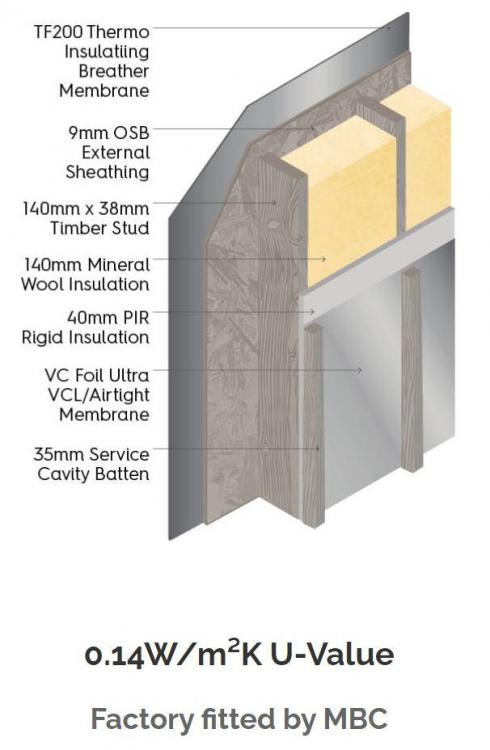
not intended as criticism of you in any way....I just thought it looked wrong so checked and I couldn't get it any better than 0.16W/m2K using 2 different 'U' value claculators. It's more likely 0.17W/m2K. I still find it very strange that MBC seem to have got it so wrong (maybe its me that's wrong?)
-
I had a look at the MBC examples in that link and I think they've got the 'U' value calculation wrong for this one. I reckon it's somewhere between 0.16 and 0.17W/m2K instead of the 0.14 they are showing on the website.
-
Is the SIPS kit company going to be responsible for the Building Regs application? If so, make sure they are okay with the larch cladding and Part B 4 (fire and unprotected areas) of the regs, in particular the proximity to property boundaries. They’ll need to see the proposed location of the building on the site.
-
mesh is cheap and it was more of a guarantee that we wouldn't have issues with the UFH as it was about the bearing capacity of the concrete or the EPS 70. (my slab has no screed on top)
-
No benefit I used 300mm of EPS 70 under our ground floor slab. It's been down 4 years with no issues. The slab was 100mm concrete with a D49 mesh with UFH
-
Sounds like @Tetrarch is infilling what used to be the void of a suspended timber floor so it's unlikely that the ground underneath will be properly compacted hardcore.
-
but it's not a screed. Screeds are laid on top of a concrete floor (not 250mm of insulation)
-
300mm of EPS insulation would be the cheapest way to improve things and would result in a U value of about 0.1.
-
@canalsiderenovation I agree that it's likely to be a leak from the cisten but, playing devils advocate, I've also had vinyl flooring fail on (commercial) projects like that because its been stuck down onto screed that hasn't had a chance to properly dry out. What happens is the moisture coming out of the screed emulsifies the water-based adhesive of the vinyl flooring. If you've ever had a cylinder head gasket fail on a car you'll know what to look for when you lift a section of the vinyl floor.
-
BBC Sounds link to Evan Davis in 'The Bottom Line' discussing insulation & heat pumps in 'Net Zero in the House' https://www.bbc.co.uk/sounds/brand/b006sz6t
-
Has anyone got around the Openness issue in Green Belt?
Ian replied to Paul Leigh's topic in Planning Permission
I'd try shopping around. A few years ago I went through something similar and the Planning Consultants fee was £4,300. It was for a new-build house in the green belt in an AONB (in Wales) and involved them preparing 2 planning applications and an appeal. (I did the drawings and they did all the paperwork). I regularly do planning applications myself but I knew that I didn't have the necessary expertise with this one. We would never have got PP without the consultant. It's probaly the best £4k I've ever spent in my life. -
@Adsibob Any grade F2 (frost proof) brick below DPC should be acceptable to the engineer. You’re not building a railway viaduct so I’d be very surprised if the engineer specified engineering bricks because of their high strength - it’s probably just because that’s what is often used below DPC level.
-
@tanneja what about using a protective layer on top of the rubber? Traditionally with older flat roofs this would be a layer of gravel but you could use other products eg Astroturf
-
1000 litres = 1 cubic metre
-
I wasn't sure if you've already installed the felt but recently breathable membranes have become available that are suitable for use with bats eg: http://www.tlxinsulation.co.uk/tlx-batsafe.aspx
-
Last thing inspected by building control?
Ian replied to Lets's topic in General Self Build & DIY Discussion
They will want to check that you've actually finished the work listed on your application plus they will want copies of the electrical completion certificate and gas safety cert (if you've done work on the gas & electric). In my experience during the various Covid lockdowns some Inspectors will accept a set of photos or a video of the completed building instead of a visit to site. -
I did a new-build holiday home 4 years ago. It is timber frame construction, single-storey and naturally ventilated built to minimum building regs. Using no air-tightness membrane or tapes and no special design or workmanship measures used to increase air-tightness it achieved an air-test score of 3.7 m3 /h/m2). On this particular house this equates to 4 ACH @ 50pa. There's no draughts and it is very cheap to keep it warm & comfortable.
-
@paulc313 I did a self-build holiday home a few years ago which has UFH controlled by the Hive app. I really like it as I can remotely check the temperature in the house in Winter to make sure the 12 degree 'frost' setting is working okay. It also means that I can remotely increase the temperature ready for when we go there at the weekend.
-
Most people (even many building professionals) don’t realise that the published Approved Documents (AD) are simply non-statutory guidance. The actual regs are the short extracts printed in green at the start of each AD. The Building Inspector has wide ranging powers to accept variations to the AD guidance and on large commercial projects it’s very common that alternative solutions are adopted that satisfy Part B - usually to the design of a specialist fire consultant.