


Russell griffiths
-
Posts
7971 -
Joined
-
Last visited
-
Days Won
65
Everything posted by Russell griffiths
-
Hi anybody use this product? im having a bit of a go at redesigning and I'm stuck on colouring in doors. Sorry for being a numpty.
-

Garden wall: DPC ?
Russell griffiths replied to ToughButterCup's topic in Landscaping, Decking & Patios
If this is just a garden wall. I.e. No roof, then finish the house exterior up to nearly ready for paint and then think about garden structures. Any reason for building it now? i bet if you put it in you will find it will be in the way to do jobs on the rest of the house. Im going to go way out on a limb here, but try not to go around doing jobs just because your capable of doing that bit and avoiding the bits that need doing but your a bit stuck on. Hows the house going and piggery, Obviously you need to have all the outside bits in your grand plan in case you need to run services or put footings in but keep them in a schedule in line with the rest of the build. -
Garden wall: DPC ?
Russell griffiths replied to ToughButterCup's topic in Landscaping, Decking & Patios
Hmn had to think a bit about this without sounding like a c##k i think I may do this the opposite to what @nod has said. To work out out how to do things correctly sometimes you need to look at what has failed in the past. Garden walls or other exterior structures attached to the house can be a path for damp. In a former life I've I spent a lot of time looking for reasons things had failed damp was always a big thing we had to look into. How are you finishing the the top of the wall? What is preventing rain hitting the top of the wall and bouncing against the house. How are your durisol blocks being finished they look to be a bit porous, are they? How are you providing the rainscreen layer for the house. Two ways to look at it 1.you are building a big bridge across the damp course and a route for damp penetration 2. Is always been done like this tie it in slap some render on it go to pub it will be fine. Hope that didn't sound to c##k like. -
Like this pic.
-
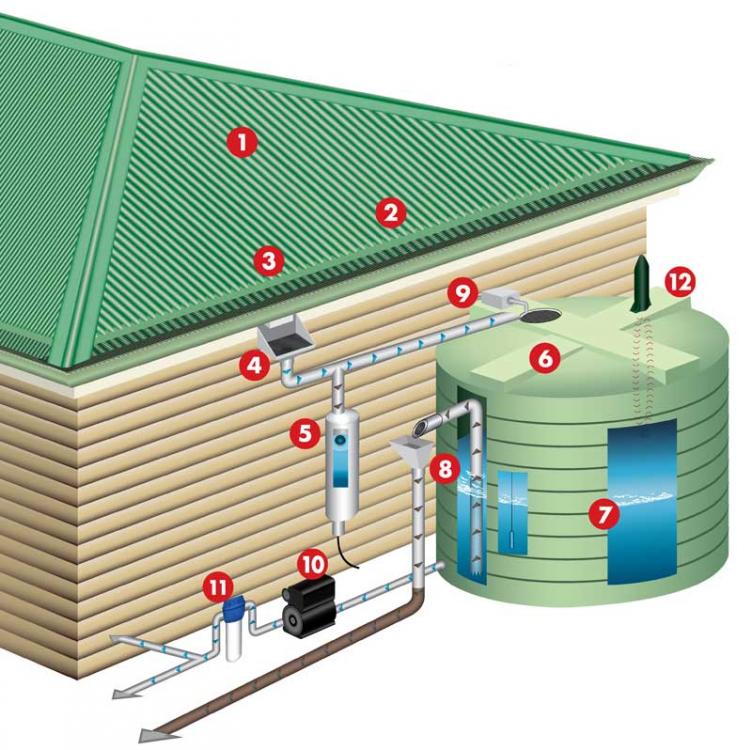
In oz they fit a system called a first flush it allows the first so many litres to go straight to waste, a floating ball in a pipe then rises to shut off a valve this then diverts the water to a tank. Before the water even gets to the first flush the downpipes empty into a hopper with a stainless mesh in it this gets rid of the big things like leaves.
-
From all the work that was done on our place I've found out that this is not really how it is looked at. Without a house all the rain that falls will land spread evenly around the whole plot by building a house you are collecting all the rain and condensing it into a couple of down pipes so it comes out in a concentrated area, this is the problem that needs addressing. 100 litres of water falling over an area of 400 square m is not a problem, but send that 100 litres down a pipe over a 4 hour period is when you get dramas.
-
We have some major issues with rainwater collection and it's cost a small fortune to sort out something so obvious. Our place is probably the polar opposite to yours, no clay but gravel so the percolation test is perfect tip a bucket of water on the floor and it disappears in seconds. The problem is the water table is only750 mm below the surface. So we cannot have a soakaway the solution is to have a soakaway with out a top/ lid on it. What is this? It's a pond, the down pipes will discharge to the wildlife pond and slowly filter into the surrounding ground. I think you will will be looking at a soakaway with a larger area so it can hold the volume until it can migrate into the surrounding ground no matter how long this takes.
-
How did you get pp without stating where the rainwater from your roof was going to go. Is it not a condition in you pp what did they say you had to do. What did you say you would do.
-
How is having a rainwater tank solving the problem of where your roofwater goes? Do you have to provide a solution for bc we have had had to do a full flood risk and rain water analysis, and they wouldn't except a rainwater tank as any form of mitigating measure. The reason being what happens if your tanks are full and it rains? It goes straight out of the overflow and into your drain field. So why not just put it in there in the first place. Unless you really want to flush your toilets with it it seamed like a crock to me when we did our assessment.
-
Hello again - work has finally started
Russell griffiths replied to AliG's topic in Introduce Yourself
Love the house. What is it with bloody tradesmen. Why are those windows not fully masked up. I wouldnot consider working near them without full masking or an indemnity from any damage caused. Sorry rant over. -
Help me identify this, please
Russell griffiths replied to ToughButterCup's topic in Bathrooms, Ensuites & Wetrooms
Can we all look at that pic again. Is it just me or does the reducer from the grey 22 to the white 15 not look like it is pushed fully home. @recoveringacademic have you actually got any water drips or just on the valve that floor looks very stained for a small weep. -
How to match grouting?
Russell griffiths replied to TheMitchells's topic in General Construction Issues
You basically need to experiment. Chances are they used local materials look at the mortar and work out how gritty it is so go to the local merchant and buy a couple of bags of different sand one soft one a bit sharper and see what cement they sell get a bag of ivory cement as well as a bag of lime. Go home and make up half a dozen very small mixes use a coffee cup as a gauge so 5-1 sand and cement 5-1 sand ivory cement 5-1 plus 1 of lime its going to be very trial and error until you get a close match after you have done a couple you will get an eye for weather it's a bit grey or to creamy. Only way I know to do it to be honest. Let them dry indoors so you reach finish colour quickly. -
I have a feeling this is something that has been done this way for years. Pattern to inside so outside flat so it stays cleaner, that's what I was told many years ago.
-
Go and get a piece from wicks you can get it in single sheets there, if you can't find the profile you need run another shape(angle facia) through your table saw until you have the profile you need, this is only a mock up so a bit of fettling may be needed until you get what you want. Have you thought of a completely contrasting colour maybe in grey, anthracite? How about getting a coloured flashing folded. What about a cement board and acrilic render, or eps and mesh and render. I wonder if the upvc will look a bit sterile and add a massive amount of white.
-
You think rebuilding with stone is dear. Wait until you try and tie the new building into the old one. Knock it all down and rebuild it replicating the deep windows and inner stone skin. I knocked down 3/4 of a house and rebuilt it, total pain should have flattened it and started again. Can you get the neigbours involved so you can both have a new place.
-
Hi @Ian can you give us some more information on your findings, I'm looking at this roof system also, is it only the gutter your not happy with or the whole system. Cheers.
-
Plant room location
Russell griffiths replied to Russell griffiths's topic in New House & Self Build Design
Thanks all. -
Evening, having a re,design due to our planning officer ? Ive just re jiggled the location of our plant room, and think I've may have made things hard for myself. Should i I try to have the room situated on an outside wall? will the pipes for the ashp be easier to route from out side to inside straight through the wall rather than ducts in the floor. What about the ducting for heat recovery system, better on an outside wall. Still plenty of time to jig things about. Cheers.
-
I have noticed this on many projects and believe people building there own place underestimate the need to have materials ready weeks in advance if only to take dimensions of or have a quick look at how it's meant to go. On our last place I had a garage full of toilets, taps and all manner of fittings. I found I needed to know what toilets we where having to determine the offsets from the wall for the drain runs, so they probably sat in that garage for at least 4 months. As a contractor nothing bugs me more than standing discussing the location of something that the client should have thought about weeks ago. This I believe is what @Grosey means by removing risk and hassle from your tradesmen, then you will get better prices. I have a neighbour i Work for who is a nice enough chap, but he messes about and we flit from one task to the next whenever I work for him I add £20 per day so it softens my annoyance factor a bit.
-
Well done son looks cracking. ??
-
Materials and approval
Russell griffiths replied to Russell griffiths's topic in Building Regulations
So what do I actually look up to see what certification a roof sheet needs. And if I buy sheets over here will anybody actually want to see where these sheets came from. -
So 533+533+5 what about the gap at the hinge side even with nicely rebated hinges they don't close tight to the lining there is still a couple of mill clearance i would think it may be a bit more like 2+533+3+533+2 but as I said I would not try to get it this accurate with out the doors.
-
So why do you need your linings in to board up. There is no reason to put linings in first. We board over the door openings and chop the doors out so you use a full sheet covering the head of the door this prevents cracking at the door corners and is the correct way of doing it but very rarely seen as it's easier to just board up to an opening and put a piece in above the door. If you are keen to get the linings in then why not. Do it like below. so I presume your having architrave? if so than fit your linings temporarily couple of screws in each. Board up to them. Then when you get your doors you can pack your linings to get perfect gaps all around. The architrave will cover the gaps. If your not having achitrave and having a fancy trim on the edge of your boarding you will need your doors, trying to guess how big they are will lead to uneven gaps.
-
Hope this is in the right place. So im thinking of importing some of the materials for my build. I will add bits as I think of them,what I would like to know is what type of approval do I need so I can use them, I don't mean planning approval, I mean do they have to have BBA to be used. The first item I'm thinking of is roofing sheets we have planned on having a raised seam metal roof, what does a metal sheet have to comply with to be used and how can I find out information on this. Confused as usual with the over complicated way things are done in our country. Cheers russ.
-
Self Levelling Compound as finished floor ..?
Russell griffiths replied to PeterW's topic in General Flooring
I had a levelling compound on my garage floor for years without any covering, it stood up well to the jack but not so well to axle stands. Mine was only 3-6 mm thick as I wanted a very flat floor to work on. I did paint it in the end. If i was doing it again I would put an epoxy over it. Maybe if you get a cream colour epoxy it will look similar to the tiles.



