


joth
-
Posts
2918 -
Joined
-
Last visited
-
Days Won
5
Everything posted by joth
-
Yes and the nice thing about the Willis heater (or any direct resistive heating) is you just have to log the electricity used by it to know how much heat energy has been delivered into the house per day. Heat pumps complicate matters as you either have to make a guess at the CoP or log the actual heat output from the thing. In the case of ours (ecodan) I know it has the data inside it (it will show periodic graphs of energy consumed vs delivered) but trying to extract this info from its brain is nontrivial.
-
If you want simple flow temperature control something like this can work. https://www.amazon.co.uk/Temperature-Controller-All-purpose-Thermostat-Calibration/dp/B00KYL3W32/ref=asc_df_B00KYL3W32/ The relay is too small for the immersion but you could use it for the pump (and rely on the immersion thermal cutout, set to minimum, when the pump is off) or use an additional contactor breaker on it. Put the probe on the return water pipe as a proxy for measuring the slab temperature. Agree with @Nickfromwales that running the Willis from an extension lead is very risky. Our contractor had a couple leads burn out their plug during our build, including one that had been left on overnight. We got lucky but could have easily been a disaster.
-
I think the general consensus here is "don't use RHI" and then you don't need any metering at all. Alternatively, if using RHI, work hard not to hit any of the conditions that require metering. (For me this meant delaying my application until we'd "moved back into" the renovation house, so I didn't trigger the "unoccupied for more the 180 days in last year" clause)
-
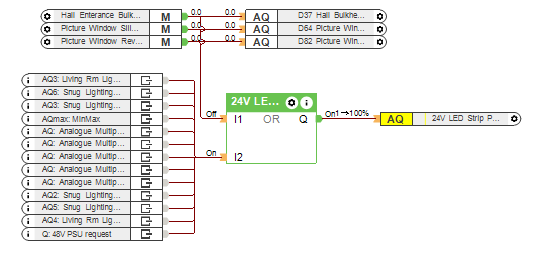
Loxone is driving the DMX dimmers so knows when any channel on it is set to >0 brightness, so you can split this out to a big OR block to say "if any of these DMX channels are non-zero, turn on the relay to power up the dimmer bank" I use something similar to shutdown the 24V LED lighting power supplies when not in use: Yes that works fine. One tip is as dimmers work by modulating the L feed, not N, I did figure out I could route the N from the LED fixtures directly back to the RCBO not via the dimmer, and then if I used a relay on the N terminal of the dimmers only it was only having to switch a much lower current (i.e. just breaking the current needed to power the dimmer internal logic, not the current needed to drive the LED fixtures themselves). This is a sneaky trick though (generally switching N is frowned on, right). I'll look out for the PM ?
-
I think you said you've done a PHPP model? If done properly (and/or reviewed by independent PH certifier) that should flagged it. We had detailed THERM models done for the various potential issues flagged, and iterated on a few of them to reduce the impact. The concern was generally less about the energy losses, and more about the cold bridge causing condensation magnet and possibly encouraging mould/rot to form in the service void hidden behind the plasterboard, or in the wood flooring around the front door. So worth getting right! Our architect used http://www.heatflux.co.uk/ very recommended
-
This is an interesting point. Permitted development rights only cover one heat pump per property, and for heating not cooling purposes. There's a tiny bit of sense in that, as during the cooling season neighbours are more likely to have windows open overnight and hence be troubled by the noise. However I'd be interested if anyone ever successfully enforces removal of an ASHP in violation of this rule, i.e. that is used for heating and cooling without planning permission. I mean, they could hold it up with appeals, and ultimately all the owner has to do is turn off cooling mode, and they're back within permitted development space. I can flick it on and off from a mobile app, and it's virtually impossible for anyone outside the house to know it's being used for cooling vs just heating up the DHW tank anyway (DHW is in fact the noisier operation, although even that is still nearly silent for ours). Wth 30M retrofit ASHPs being installed in the next decade (or whatever it is we're supposed to believe is the goal) I can't see this PD clause standing very long. It's simply unenforceable at that scale
-
Yes that's the ones. They work fine, but have 1.5W vampire load each which over 16 adds up (and makes the cupboard quite hot). You can mitigate this by using a higher powered SSR to shut them all off when not in use. (Loxone makes this very easy to do). Anyway I replaced most with the UK designed 2x16 channel dimmers. http://whitewing.co.uk/acdim.html These are much more efficient, energy and space wise. Only downside is much lower power per channel, and they do make some LEDs flicker a bit if loaded near their current limit and running at half brightness. I've kept a few of the 2 channel AliExpress ones for a few higher power applications. So I've got about a dozen of those AliExpress ones spare if you want them for 50% of whatever they're charging for them new?
-

Prosumer alternatives to Ubiquiti?
joth replied to Dan F's topic in Networks, AV, Security & Automation
@Dan F I'm using a 4 port "Security Gateway" (predates Dream Machines). Partly chose this as it has dual WAN connections to allow redundancy failover. Unfortunately our contractor accidentally ripped up the open reach cable while putting in the new soak away, so we've been getting by with Virgin for the last year but it is very inconsistent as @Rob99 says, especially for uplink speed. Their network is designed for broadcast TV so not surprising really. I've been waiting for FTTP but while the rest of the town (on overhead poles) now has it, it seems the conservation areas are bottom of the queue so yesterday I gave in and placed an A&A order to reinstall a copper pair line. I had a quote for FTTPonDemand, £7000 just seemed not worth it when the rest of the town has it for £0! (We have two of us working at home now, both on video calls and running service support, so 4G just doesn't cut it the couple of times I tried failing over to that. Too flaky, and mobile carrier grade NAT seemed to mess up ubiquiti's own internet availability detection) -
That's a good list from Dan. I was going to do 5A sockets but working with a lighting designer meant I was confident the installed lighting was enough that we didn't need it. The main use case is moving furniture around and finding an extra table lamp or whatever would be useful, chances are I wouldn't have a 5A outlet in the right location anyway Instead I have some WiFi smart light bulbs I can control directly from Loxone. This means any old mains socket can become an extra lighting location all controlled from the main room light switch (or night time automation) I also have some plugin switches e.g. for the Christmas tree lights.
-
Increasing flow temp further will start to put the bamboo flooring at risk. Doable, but definitely more faff as from Loxone I currently only have on/off control, no way to modulate the flow temp. And their cloud API does not support setting the compensation curve at all. The Ecodan has a couple of dry contact inputs specifically for "smart grid" readiness to indicate cheap or surge prices. The built in function for cheap rate is to boost the cylinder up to max temp and likewise heat the buffer tank up. Without a buffer and temp probe, it doesn't have much purpose for heating. Only found that out after we installed. But using these would be much simpler and safer than messing with cloud API (that could muck up normal running mode functionality)
-
1kW is from looking at the primary energy monitor of the heat pump, so it's delivering 3-4 kW into the slab assuming a reasonable CoP. The UFH circuit doesn't have a flow rate meter, but yes I could try increasing the secondary circulation pump speed.
-
Yes undersized fan coil for the ashp is definitely the main reason, but trying to maximize energy use during the short 4 hour cheap rate is a secondary benefit if we had it. If we had fixed rate energy 24/7 it would be much better to just let the ashp run any time it needed to at a low temp to warm the slab.
-
Our MVHR installers (subbed by Enhabit) turned up in an (expletive deleted) RAM pickup. One of those 5L monster things. [OK I used to love occasionally hiring them when traveling in the US, but using it as everyday run around in London ?)]
-
Good tip. I hadn't heard of CI-Sfb Another idea I had was to put everything in Google Drive, and make "sure with link" to the various folders. Print them out as QR codes, laminate, and then stick inside the HA cabinet, ASHP controller, CU cupboard, PV inverter, etc etc etc. So a future maintainer can just snap the QR code and go directly to the docs for that "thing". The slightly more shady bit is getting access to the login credentials for those things. i guess in many cases I could just write them on the bottom of the QR code. I also have hand-written code for several integrations (Internorm blinds, MVHR and Tempest sensors, Firmware in some smart bulbs and plugs, import/export monitoring, 1-wire temperature sensors, Anthem AV amplifier integration, Fakro roof lights, customer PV diverter; god now I write it all down it's actually quite a lot!) so knowing where the source code is, how to build it, and what machine it's running on is even more of a hurdle, but generally those things are driving non-critical services. (Loss of the blinds and rooflight automations would be very annoying though)
-
ssh, with pre shared keys (ideally stored in a hardware security key)
-
Well sleuthed! I totally forgot about that. Yes, not obvious at all was it.
-
This makes sense, but the one thing you need to remember is you only have 4 hours to achieve this (if using Octopus Go cheap rate). For our house, without a buffer I can only run the UFH flow at ~30º which means the ASHP is only drawing about 1kW. So over 4 hours I achieve 4kWh of "cheap rate" energy draw. However with a buffer, I can run the ASHP flow at max temp say 55º which means the heat pump is drawing about 3kW, thus would give me about 12kWh of cheap rate usage. This does require a 300L tank though as mentioned ? Ideally a big TS would act as both DHW and heating store, and over that 4 hour period I'd run ASHP and (if appropriate) the immersion heater at full whack to maximize my energy draw during that cheap rate period. However, that's not what I've tot, so I've given up on this whole idea, and now just looking into batteries (And indeed, pushing the slab up 2ºC during cheap rate. The Loxone "Cheap rate heating" input on Climate controller seems to do a good job for this)
-
Yes basically radiators with a fan, my concern is are they noisy? Do they have a condensate drain? If not, the cooling function will be limited to 14ºC or so to avoid them dripping. (Also you need really good detailing on insulating all pipework, valves, pumps etc to run cooling at lower temps without creating puddles everywhere)
-
In the OP you mentioned 7 kW 3-phase, which is 2.3kW or about 10A per phase. So anything rated at 16A sounds ample (pun intended). Gotta admit I have little what's going on here though: how you can have such a low rated 3ph supply? Also I thought load shedding was for grid overload scenarios, and relied on detecting the drop in a.c. frequency, which would be useless for detecting a specific phase is approaching it's 10A limit.
-
We need about 25kWh per day, so would be quite doable with a 8.5kW ASHP in a 4 hour window, if I could run it right up at that max power. EDIT: although yeah take the point about it being a TS - I'd need a 300L buffer at 55ºC to store 12kWh, assuming I can put the rest of it directly into the slab as it's running. Hmmmm. Definitely agree that there's no point designing a system specially around the existence of octopus go, but my point is if you have the buffer tank it gives flexibility to adapt as tariffs come and go (or indeed, make better use of self generation too), and adds little downside even if you don't need it. E7 has been around a long time and word is dynamic pricing is only going to increase in availability, so sooner or later it would come in useful
-
A buffer tank makes a lot of sense if you ever want to use cheap rate electricity (e.g. Octopus Go currently gives 4 hours at 5p/unit) A buffer obviously allows maximum runtime during the cheap rate window that can then be pushed through the UFH when needed/more useful later in the day, but also it allows the ASHP to run at a higher energy consumption by storing the water at a hotter temp (e.g. 45ºC as suggested here) which both maximizes the amount of useful work done during the cheap-rate window, and also increases the storage potential of the buffer vessel (i.e. a small tank can store a the same energy as a larger one by holding water at a higher temp). Skimping on a buffer tank was definitely a mistake in our build, and I'm struggling to make space now to install one. (The plant room layout was not well thought out, and it's bit of a mess to try and retrofit it).
-
Prosumer alternatives to Ubiquiti?
joth replied to Dan F's topic in Networks, AV, Security & Automation
If I was starting over I'd probably use QNAP for CCTV and hosting VMs and put the Unifi controller on that too. https://www.qnap.com/en/how-to/tutorial/article/how-to-set-up-a-unifi-controller-in-container-station -
Prosumer alternatives to Ubiquiti?
joth replied to Dan F's topic in Networks, AV, Security & Automation
I use ubiquiti Unifi for WiFi, switch and router. Tried their CCTV but didn't like it and really don't like the vendor lock in. I don't see any reason CCTV should be combined with network infrastructure. Yes their router FW is annoying when you hit the limits, but core functionality is very good. I've found it all very stable. By far my favourite WiFi management yet. Some friends recommend their Edgerouter instead of Unifi, but that looses a lot of the Apple esque convenience. I think the cloud account is still entirely optional, but convenient enough I do use it as the default way to connect (i.e. any time other than when virgin are down). -
When researching devices I find it useful to lookup the Home Assistant integration docs. Even if you don't plan to use Home Assistant, it's a useful guide for whether the devices need cloud connectivity or can just work directly via the local network, for more advanced API integrations. For example here's the page for Hive TRVs, which says the IoT class is cloud polling, which is not ideal. https://www.home-assistant.io/integrations/hive/ Most people wanting home assistant integration seem to land on generic z-wave or ZigBee TRVs. There's several threads on it e.g.
-
The wall plate should be F-type female. The pin of the male connector is effectively sacrificial (it's just the inner core of the solid core cable) and will need replacing after so many insertions and removals, so always put the male connector on the easy to replace fly lead. I'd stick with non-isolated unless you're doing an elaborate multiroom distribution which calls for something else

