
joth
-
Posts
2918 -
Joined
-
Last visited
-
Days Won
5
Everything posted by joth
-
On the bridges, If it's any consolation, even when employing a passive house certified designer as architect, I still had to employ a building physics expert to do thermal bridge modelling *and* an independent assessor to review the whole lot and find any missing gaps, so if you're employing a nonspecialist architect it's not surprising you need some extra eyes on this. Their lack of attention to the better than BR insulation request is disappointing though. RIBA have been sat on their hands for the last 2 decades, they really should have been pushing the agenda on upskilling architects - so at the very least they know what they don't know and have more ability to flag this to customers and advise them on having specialist input in these areas.
-
Altering the DHW flow temp is less about the temperature of the water delivered to the taps, and more about adjusting the volume of heat energy stored in the tank. If cold weather increases the demand on DHW in terms of L per day, then I guess weather compensation makes some sense, but for my setup I adjust based on number of people in the house as this seems to be the main contributor. The weather forecast is of some vague use to predict how much solar redirect I want to leave space for for tomorrow, or making use of any export generation as it's happening.
-

Prosumer alternatives to Ubiquiti?
joth replied to Dan F's topic in Networks, AV, Security & Automation
LOL I bought myself a QNAP tvs-672xt as a Christmas present and so far I hate pretty much everything about it. Everything seems unstable and half arsed. VM station, container station and QVR pro have all failed to setup several times. I think it's going back to the supplier, and I'll switch to proxmox on a broadberry Xeon 3U server as originally planned 18 months ago! -
You probably mean 10 or 9 kWh - that is a measure of energy storage, not power delivery? You need a large invented cylinder and PV redirect to immersion heater. If the combi can't accept 60°C+ hot water as input (and I don't believe many can?) you need a complex 2 position valve to switch over to the combi as the UVC empties which will very likely give a slug of cold water during the transition No, you draw 4.5 kW from PV and 6 kW from the battery (or whatever their power limit is, often 5kW) and the remainder from the grid, unless the battery is empty...
-
Did they give you a specific reason for recommending you not use ASHP cooling? Condensation would be the main potential issue. We only heat/cool our downstairs floor. The ASHP pipework comes into the plant room and is connected to the manifold only a couple of feet away, so there's very little exposed pipework. I run the cooling at a temp of 15 or 16 degrees, from memory. In this situation, we get a slight breath of condensation on the metal parts of the manifold, but nowhere else and there certainly isn't enough to drip. I'm certainly not worried about condensation on the floor surface itself, as I doubt it ever drops below about 19 degrees. It might be more worrying of you're running long sections of pipework inside walls and within floor cavities. But if you keep the temps reasonable, I doubt it'll be an issue. Agree not too much risk of condensation if only cooling UFH to ~16C. However, note that @Mr Blobby said he was planning to install FCU upstairs. These work better the colder you can make them. Ours is a delight down at 5ºC, but that's when we got floods of condensation in the plant room until I ripped out the MCS lagging and did it all properly. Also, if running UFH and FCU cooling simultaneously, there will be colder water in the system right the way up to the UFH mixing valve, which (depend on the schematic and layout) may cause more issues even in UFH-specific pipework than if cooling UFH alone. (Also if running both together note you need some way to set separate heating vs cooling set points on the UFH mixing valve. I can vouch for the ecodan FTC6 with electronic mixing valve being very good for this)
-
+1 to all that. Whichever way you do cooling, you'll need to ensure all the pipework, clips, pumps, valves etc are all 100% insulated with no gaps, otherwise you'll get condensation dripping, which would not be good for a pipe buried behind plasterboard. Installers will do basic pipework insulation, but rarely to the detail level needed for cooling. (e.g. the primary pipework should first be insulated *then* clamped into place, rather installed then insulated which is standard practice in UK) If using FCU remember to size the buffer tank accordingly. This was my main mistake. Planning to fix this once the heating season finishes.
-
LOL! Yes that was not at all clear given the title of this thread. Sorry. Yes, power line APs, not wifi APs.
-
"Ideally" != "Has to be". It might work, but likely not as reliable and fast as it could be. They work better (faster throughput) the shorter the length of mains wire between access points. Putting them on different circuits almost certainly increases the distance, putting them on different CUs probably increases the distance further, and different phases... Well. MCB/RCBOs can add further signal attenuation. electromagnetic signal propagation is more of a black art than a science in most engineering books.
-
3-Phase - Connecting to Caravan...
joth replied to Mulberry View's topic in General Self Build & DIY Discussion
Slightly OT, but my "new" EV Charger is an old school design that requires TT earthing rod (much to the sparky's disgruntlement). It was installed with the SWA earthed at the meter head end, but not connected to the TT earthing rod at all at the charger end. The armour and spare earth core from the SWA are isolated floating loose inside the case. This is the correct way to provide a TT earth I understand? -
Is a cooker extractor necessary with MVHR
joth replied to SBMS's topic in Mechanical Ventilation with Heat Recovery (MVHR)
If by "necessary" you mean "legally required per building regs" the answer is a clear "no": so long as the MVHR has a kitchen extract vent with sufficient capacity, there's no obligation to have any kind of hood/air capture/filter for the hob whatsoever. Note the general recommendation is to not put the MVHR extract too close to the hob (i.e. not directly over it) to avoid grease heading straight up it. For grease and smell management, we also went with downdraft recirculating hob (Bora Pure-X) with a filter that gets washed in the dishwasher as needed, very easy. -
OK so there was a clear error with this, lets call it an exercise for the reader here that went unspotted. sin(x) gives negative as well as positive result, and the input should range from 0 to 2π through the year, not from 0 to π. So the result of this expression was a threshold "good" generation power from 0W to 3400W, not 1700W to 3400W as I had intended. Doh! Second attempt gives me a threshold power 1500-3500 based on 2500 W ±1000 2500+(1000*cos(2*pi*((I1-1624242741)/31557600))) Much better. I do enjoy messing with this Loxone system
-
Although I compare it to the 2min average rather than instantaneous. But a time-averaged W is still measured in W. (I mean, even the "instantaneous" W is a 5sec average due to the way my energy monitor works)
-
W
-
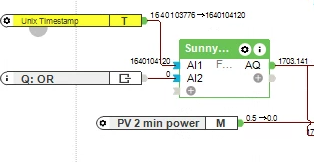
Perhaps a more geeky way of observing the shortest day: in my Loxone config I have a little formula that estimates what "Good" solar generation value would be for a given day of the year, and it's 3W off of its low point (1700W), which it should hit in the next few hours. The formula being : 1700+(1700*sin(pi*((I1-1608565080)/31557600))) where I1 is the current unix timestamp, 1608565080 is the timestamp of a previous winter solstice (2021 as it happens), and 31557600 is the number of seconds in a year (on average -- allowing for leap years). That shows the threshold at 1703.141 W so soon be at at the inflection point (in 6 hours, I think) ? And yeah, 1700W is very optimistic for December, even on an 8kW array. I last calibrated it in November and seemed about right then...
-
Interesting. My (DIY) PV Immersion redirection also has a 200W export threshold, mostly because my grid import/export monitor (emonpi) only reports the value once per 5s so I need to leave some slack as the natural variation from one second to the next would cause it to spend 50% of the time importing otherwise. You can blind the lower priority device to the higher one by doing fancy tricks with the CT clamps - e.g. if you put the main grid tail plus the battery feed through one clamp then the PV redirect will see everything being exported PLUS everything going into the battery, so will only start to consume power when the sum of them goes below zero (e.g. if the battery is full and PV still exporting) For your case it's probably the other way around: put the battery's CT clamp around the main meter tail PLUS the feed to the immersion, so the battery controller will see whatever is being exported (aprx 0W) PLUS the 200W the immersion is taking, thus will be satisfied its export threshold is being met and settle into a steady state. Of course doing this in practice, in a regs compliant way, is a exercise for the reader ?
-
Both (/all) access points need to be on the same phase! Ideally, on the same ring main / breaker. Don't plug it into an lead/socket with any sort of surge protector / conditioner / isolator. Plug directly into the wall socket, not an extension lead/splitter. Finally, throw it out and run some cat6. A bit of cable stapled to the skirting never goes out of style.
-
It's slightly an ASHP issue: ASHP are *much* more efficient if operating longer periods at a lower temperature. Low and slow. If your house construction and usage pattern is "let the house get really cold when no one is home, then BLAST the heating at industrial furnace levels when we get home" you're less likely to be satisfied with ASHP. (But to be fair, anyone going for all UFH in a slab will find this to be true regardless of heat source)
-
By the way, if you've not seen it many have found Jeremy's heat loss calc to be very useful to get an idea of payback for improvements in insulation and airtightness :
-
That's just meeting building regs levels isn't it? Generally around here when people say "we are building well insulated" it means at least 50% more. 150mm walls is common for many builds here, and 200mm+ under floor. Also, you need a specify an airtightness goal. Building regs is 5 ACH (lower is better) but most folks here wouldn't consider anything above 2 to be that well built.
-
Best is to send if over CAT6. Ethernet over Mains is an inferior second place to that. Another happy +1 user of Ubiquiti here, but it is at the higher tech (and cost and complexity to use) end. I hear good things about the TP-Link mesh products too.
-
Not consistently. TLS has support for compression (prior to encrypting the content) but it's actually dropped from TLS1.3 because of side channel attacks like CRIME and BREACH HTTP GET has fairly wide compression support, but not POST. HTTP2 adds dictionary header compression, but no major changes to the payload IIRC. If you're talking traditional email the more important thing is compression at rest. SMTP is conceptually like 50 years old now and really doesn't have much idea about compression of encryption, or anything needing more than a 1MHz CPU. All this is transport (session) layer only. And MIME just leaves it to the application to solve (i.e., JPG or MPEG file formats) Most of the size optimisations these days are proprietary in the various email providers. e.g. internally gmail could share storage for large attachments across users: if a common file is being sent by thousands of users, why bother to store thousands of copies? This is especially common for the business users.
-
My guess is if you quote for the very cheapest LPG combi boiler and then look at the difference to upgrade to ASHP + UVC + buffer tank then it looks a bit expensive. But if comparing like for like, including a mains pressure DHW with UVC in either case, then it's a lot more palatable.
-
If your build is insulated and airtight enough, you might not need to do either. A lot of folks on here find direct electrical heating (Willis immersion heater with wet UFH, or plug in radiators) is sufficient. 280m2 is fair size - how many people will normal live there? If a large family, with all the bodies and cooking and XBoxen, not a lot of extra heat is required. If it's 2 people you'd need more. Overall, the lower the annual heat demand, the less financial sense there is on investing in higher efficiency heat sources. There is a new £5k grant on ASHP coming in in April, but seems unlikely it will apply to new builds. But at least you get the VAT saving
-
Ecodan taking 30min to switch over from DHW to heating
joth replied to joth's topic in Air Source Heat Pumps (ASHP)
The main logic is in Loxone miniserver (I just use Home assistant to do analysis/logging, and SW interface to things Loxone doesn't have native support for -- Z-wave roof windows, ASHP and MVHR controls, media devices, etc). The logic is driven from the alarm integration, for each room: "if the alarm is night armed, and the given bedroom door is closed but any motion is sensed within the room, assume that room is in use for the night" . Logic resets at 2pm each day, or something. This is a very useful signal to disable automatic blinds and lighting in that room (we've had some "exposure" to the neighbourhood first time we had guests and the blinds opened automatically at 9am!) and I can count up the number of rooms in use to gauge extra hot water needed. -
What cables to use within a HA cabinet?
joth replied to Hilldes's topic in Networks, AV, Security & Automation
@Hilldes I don't have any experience using them, was just commenting on @Rob99 suggestion (quoted above) - he might have ideas on suppliers.