joth
-
Posts
2918 -
Joined
-
Last visited
-
Days Won
5
Everything posted by joth
-
 We recently obtained our EnerPhit plus certification, with airtightness of 0.6 ACH which is good enough for a new build passivhaus. We could easily of exceeded even that (our initial test was under 0.5), except for a couple very annoying leaky components that weren't really anything to do with doing a retrofit: - The ground floor shower trap is "low profile" and got sucked dry on the depressurisation test. (Should have left the shower running during the test!!) - the stupidly expensive PH certified Moralt garage door was specified as outward opening and the threshold leaks like a sieve - one of the internorm windows was poorly adjusted and leaky (but we fixed that med test). Really interesting comments about the longevity of the airtightness work on a retrofit. May thought was by overachieving we'd eventually settle to a "reasonable" level, but there is a lot depending on sticky tape so time will tell
 -
Air source heat pump with log burner
joth replied to Nikki Locke's topic in Air Source Heat Pumps (ASHP)
Are you replacing a gas boiler with ASHP? f so, you already have a dependency on both gas + electricity both being available simultaneously for heating, so moving to ASHP actually slightly reduces the probability of an outage. Likewise, a log burning feeding into the heat store will be useless in the case of a power cut, as you need electricity to pump the water from the log burning to the store, and from the store to the heat emitters (and to run the control systems). Aside from the RHI complications, plumbing a log burner to an ASHP system massively complicates the system and will increase install and maintenance costs. If you're worried, put the log burning in as a stand alone heat source and huddle around it when there's a power outage. Technically domestic hot water shouldn't be delivered above 48ºC, so 55 is plenty. The only downside of storing it at this temperature is you need a larger volume of store to hold the same amount of energy. i.e. the lower the temp you store it at, the bigger the cylinder. This is why ASHP are typically installed with a 200-300L cylinder. btw most people find an unvented cylinder is better than a thermal store, as it performs better when being run down to lower temperature. (Stratification means you get more useful HW from it) -
(Assuming that is a typo for EnerPHit, the retrofit standard) EnerPHit is 25 kWh/m2 per year, so at 45 you'd be a fair way off that standard. The AECB Building Standard is 40 kWh/m2 and 1.5 ACH airtightness, which would be something reasonable to aim for.
-
Errr.... buy a less-cheap USB ethernet dongle.
-
Couple thoughts: - the closer the tolerance on anything, the greater the risk it doesn't work in practice due to unforeseen whatever. A contractor will always charge more contingency on very tight tolerance work, or try and pass on extra costs if it doesn't work out, or bodge something inelegant - ideally you need enough space to ensurr the fcu is hung on tension rods to reduce vibration transfer to upstairs, and to ensure it is perfectly level so the condensation tray clears properly - the condensate needs additional vertical drop below the FCU so the horizontal drain pipe can be angled downwards slightly, to drain reliably. The nearest the FCU is to a vertical waste pipe the easier this drain run will be (less slanting drop required) If really stuck you can use a condensate pump, but that feels like defeat to me
-
Sick Building Syndrome? Airplane colds?
joth replied to puntloos's topic in Mechanical Ventilation with Heat Recovery (MVHR)
One thing about a.c. is it requires condensation trays, which if not perfectly installed to drain out can collect a pool of stagnant water which incoming warm air then passes over. Probably a bit of a leap to claim that causes all sickness, but still, not a desirable thing to have. -
That does seem slow. It should only take 3.5kWh to heat the entire 200L by 15ºC, so a 8kW pump should be able to do it in under 30mins. I looked at my data again, I'm nearer 22ºC rise which is about 7.7kWh demand so I'm doing very well to get that in 45mins with a 8.5kW heat pump. However as mentioned this is a mid-point temp measurement so the actual volume heated is likely a bit less. I guess I should empty the tank sometime for a real test.
-
Interesting. What size ASHP is this? (Sorry if we're repeating this thread). I have 8.5kW ecodan and it can heat my 300L UVC from 25 to 45ºC in half an hour. (Caveat: temp measured at the mid-point so it probably has a bit more heat up top prior to that recharge). I'm squeezing all our heating+DHW into the octopus Go 4 hour cheap rate. It's a push but the main thing was running heating first then DHW for the final 30mins, otherwise you loose about 20mins of time while the system cools back down from DHW to heating temps. [I only run the ASHP at 45º for DHW because solar divert and or a make-up ASHP "boost" mode tops it up to 55+ most days]
-
One trick is to lower the ceilings in an ancillary space (e.g. the Hall if it had standard height ceiling) and then put the FCU in the doorways into the important rooms, so it spits into the room through a wall, often via a vent above the doorway. In practice I think this means placing the lintel high (if it's a supporting wall) so the door is full height of the room, then framing it out below the FCU to build out the door frame. This has the added benefit of making the living areas feel bigger as you enter them as you're coming in from the lower ceiling corridor into the taller room. Obviously need to take care about sound leakage through the big hole poked in the wall. Hotel rooms are often built this way too (lowered ceiling in the "lobby area, example) around the door, bathroom, minibar before entering the room itself, and continental apartments often are too. Or using a dropped pelmet around a room. I think in your plans, you could consider lower ceiling in the office (or an area of it) and have the FCU blow into the living room from there. (Need to check the return airflow path is sufficient for that / might have to duct both the intake and supply paths) FCUs work in recirculating mode. In general, if putting the FCU "in" the room it serves, it draws intake air directly from that same room and vents back out into it, generally one or other would be ducted to try and get the in and out vents far enough apart to perturb enough air that the whole room cools down. Putting the MVHR outlet / fresh air supply close to the FCU intake means the FCU has added benefit of moving the fresh air around the room too. (I can show you all of this on a super scale model in an office near Kings X, if we're ever in that area around the same time ?) Take a look at "linear slot diffusers", these can make for a stylish feature. If they continue unbroken along and edge of a room, it doesn't even stand out as M&E services at all. https://www.pinterest.com/rmurphy1981/linear-slot-diffusers/
-
"The other option is to take a bridging loan for the 9 month build time" - I wouldn't make any plans that depend on that remaining at 9 months, unless you are happy to cut scope and quality, or can let it go over budget. (The old project management triangle: controlling cost vs time vs quality - pick any two) Throwing in some other options: - speak to a mortgage broker and your current mortgage provider and see if they can provide the liquidity needed (with "early repayment" terms so you can clear it when selling) - speak to self-build mortgage providers and see if they can provide anything secured on the land + stage payments (maybe with a second charge against the existing house deeds?) - again with option of early repayment. When we moved house we broke the chain (bought then eventually sold) and went for the second mortgage approach rather than bridging loan as it worked out much cheaper. I think a lot of funding questions come down to variables not mentioned: how much capital ( savings / deposit) you have to start the project with, and what your income stream looks like.
-
Yeah, I'm definitely not suggesting they complete a full PHPP model, but the thing MCS installers do (or the Jeremy Harris sheet from this forum) is fairly limited in the granularity it goes down to and an architect could whizz through it fairly quickly after they've done it a few times, I'm sure. (The first time anyone does it it'd definitely take longer, but that makes it even more surprising that architects aren't). (My suspicion is most would start out copying the one from the most similar house they previously worked on, and then editting as needed). You don't really need M&E knowledge/tools as the goal is not designing heating solutions, just calculating the room by room heat demand.
-
Looks a good "square" shape so quite possible to get good level of heat retention. There's some thick walls separating upstairs to three areas (B2&5, B3&4, and master+stair void), so at very least you'll want to consider those three "zones" for heating needs. To really do any heat loss analysis you'd need plans for the other floors too, to see losses/gains between floors. Honestly I can't believe that architects don't do this already. Heat loss calcs probably take 2 hours of training to learn how to do, and 20mins to complete once they're familiar with it, and the architect already has 100% of the data needed to do it right under their nose anyway. And having the heat loss calcs is an important tool in the iterative design process. RIBA really are sitting on their hands while the planet burns.
-
Unless you really micromanage your trades (or DIY everything), this is pretty much impossible in the UK, IMHO. Every electrician/plumber/decorator/joiner/kitchen fitter/etc etc needs to know not to puncture the plaster, or know how to use unfamiliar airtight fittings and techniques wherever they do. Plus there's the long-term longevity of that strategy. We had OSB3 (smartply) for airtightness, then 25mm service void then plasterboard, and even here it was tough work ensuring everything from intentional penetrations (outside taps, lights, ASHP pipes) to slips with a multitool that hit the OSB got remedial work needed. Not saying it's impossible, just a matter of whether the project style actually supports it
-
Yes I'd increase the under floor insulation as far as you can. (why not dig out a bit deeper?) Regarding upstairs, 150mm EPS bead is only about 0.17 U-value. People talking about having no heating upstairs are in near passive houses, so around 0.10 U-value. We have a mix of build type in our retrofit, 0.10 - 0.13, and even so the guest room drops to >17°C when unoccupied. (Putting humans inside the rooms is actually the primary heat source). There's masses of variables here though. E.g. where in the UK are you? do you just have bedrooms upstairs (that typically should be kept 1-2 ° cooler) or other types of room? How much glazing, and what orientation? What is the internal wall build up and how much isolation between rooms due to shape and layout of building? Do you have MVHR? Etc. Strongly advise gathering all that info and then getting a room by room heat loss calculation done, which will give a clear guide how much you'll be spending heating those rooms. But yes, without improving the building quality I'm sure you'll need some sort of heating upstairs. HTH
-
Interesting video. Makes it even stranger that part L2A (section 2.43) is pushing for more zoning and finer control in modern installs.
-
You need to build building regs on a renovation too, if more than 50% of the element (e.g. roof pitch) is being renovated, or if more than 25% of the entire envelope is being done. From the sounds of the project it will easily hit both those criteria If you're bringing a house back into service after 20 years of dereliction, and claiming the zero-rate VAT discount for doing so, now really is the time to get it up to spec for insulation as the insulation will be cheaper with that discount, and it will cost a lot more in making good to retrofit it after this opportunity. https://www.energy-saving-experts.com/wp-content/uploads/2017/04/Part-L1B-and-what-you-need-to-know-to-get-your-building-to-pass.pdf section 6.1 https://www.atamate.com/atamate-blog/uk-building-regulations-made-simple-part-l1 Part L1B: How much renovation can we do to a residential building before the guidelines apply? Britain is full of older buildings that do not conform to the energy efficiency standards set out in Part L1 but do occasionally need repair, and there's scope to do a fair amount of work on a building before hitting the threshold above which it must meet the defined standards. If repair or renovation work hits any of the following, the building must conform to the Part L standards: • Major renovation, defined as replacing more than a quarter of the building's surface area. • Renovation of up to half of the area of either a wall, floor or roof that forms part of the dwelling's thermal envelope, which separates the dwelling from either the outside or another part of the building that is likely to be at a different temperature.
-
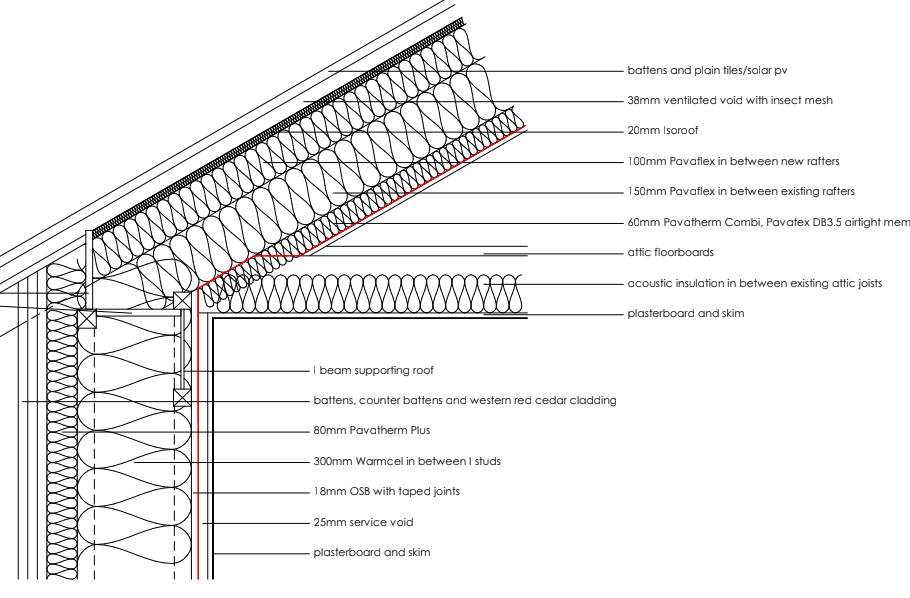
A diagram might help? From part L1B you need a U value of 0.18 W/m2K at a pitched roof, or 0.16 if insulating between ceiling and a cold loft. Your 75mm of PIR only delivers 0.3 I think building regs would require 120mm PIR minimum (Our passive house retrofit we took it up to 300mm of wood fibre board) @Iceverge had some interesting thoughts on PIR for (pitched) roof insulation here Here's our retrofit build up
-
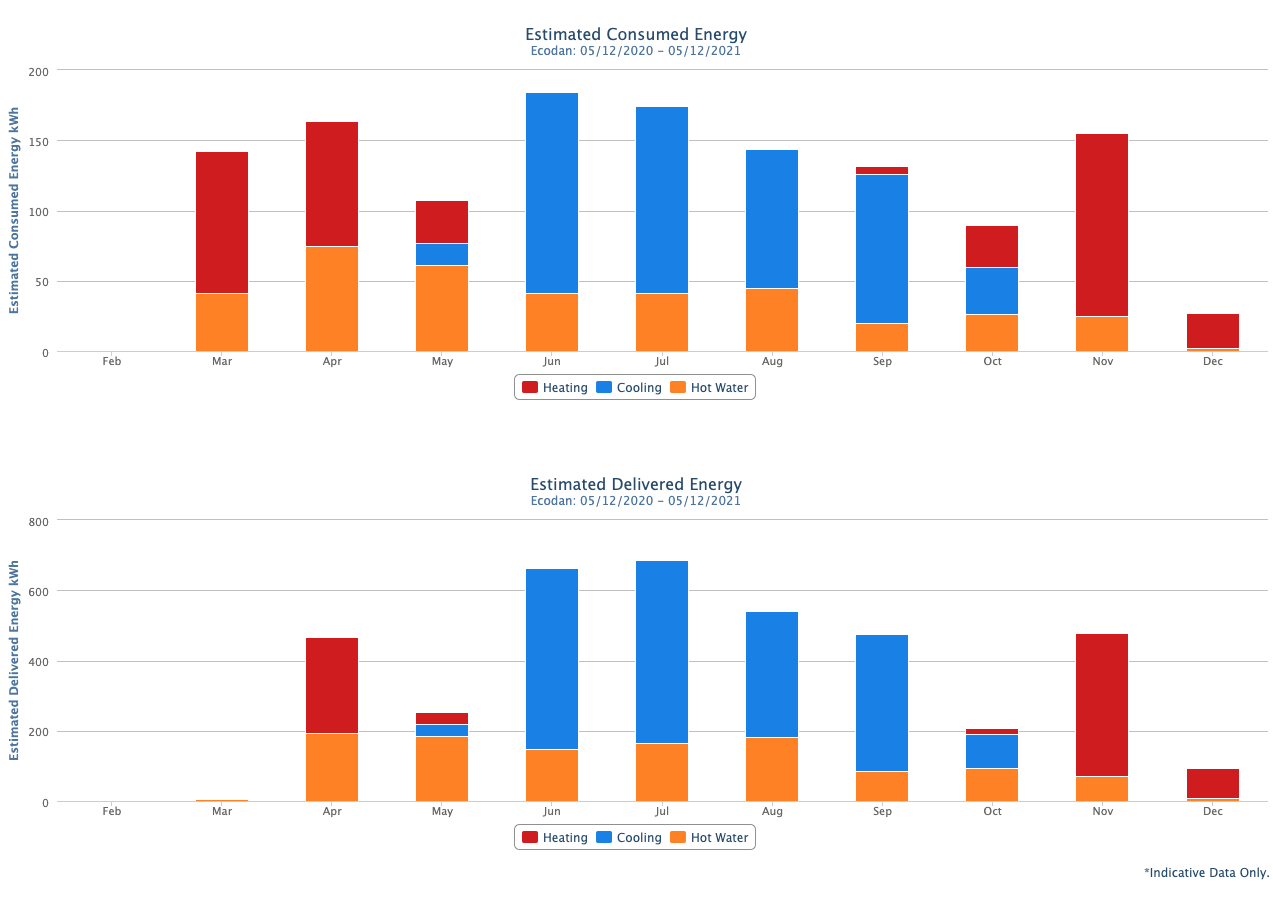
I thought about it a few times, but hadn't got around to trying It's not obvious in the page source (just the pixel height of the bar chart elements) but reloading the report with Network logging on makes it easy to find. (I'd previously used that trick to discover restful commands to turn it from heating to cooling mode and back, meaning in principle I can automate switching the unit over at the start/end of cooling season) That spat out some JSON numbers for consumed and delivered DHW figures for this year, by month. HotWater: [0.03, 41.129, 74.68999999999998, 61.456, 41.15999999999999, 41.328, 45.029, 20.189999999999994,…] ProducedHotWater: [0, 5.39, 192.41999999999996, 184.10899999999998, 148.61900000000003, 165.85999999999996,…] consumed delivered COP Feb 0.03 0 0.00 Mar 41.129 5.39 0.13 Apr 74.69 192.42 2.58 May 61.456 184.109 3.00 Jun 41.16 148.619 3.61 Jul 41.328 165.86 4.01 Aug 45.029 182.04 4.04 Sep 20.19 86.418 4.28 Oct 26.348 93.619 3.55 Nov 25.089 69.9 2.79 Dec 2.21 7.28 3.29 December is suspiciously high, but maybe just data error as we're only a few days into it. But ranging from 4 in summer to 2.8 in Nov seems healthy. EDIT: I'm a bit suspicious though of why the overall demand dropped so much from Sept onwards. We have PV divert in addition to this, but do run the ASHP to heat DHW when the sun is strong too. Give me a grim feeling that when running in Cooling mode, it actually spends a bunch of time chilling then reheating the cylinder. GOD DAMN IT I bet that's the damn Honeywell VA4073A they installed getting stuck in the mid position ?
-
One bedroom easily overheats. It has a FCU for cooling, but it is woefully undersized for the ASHP so results in a lot of short-cycling so low COP. Once we're through this heating season, I'm looking to install a buffer tank to fix it. Probably makes sense to post on the relevant linked conversation ?
-
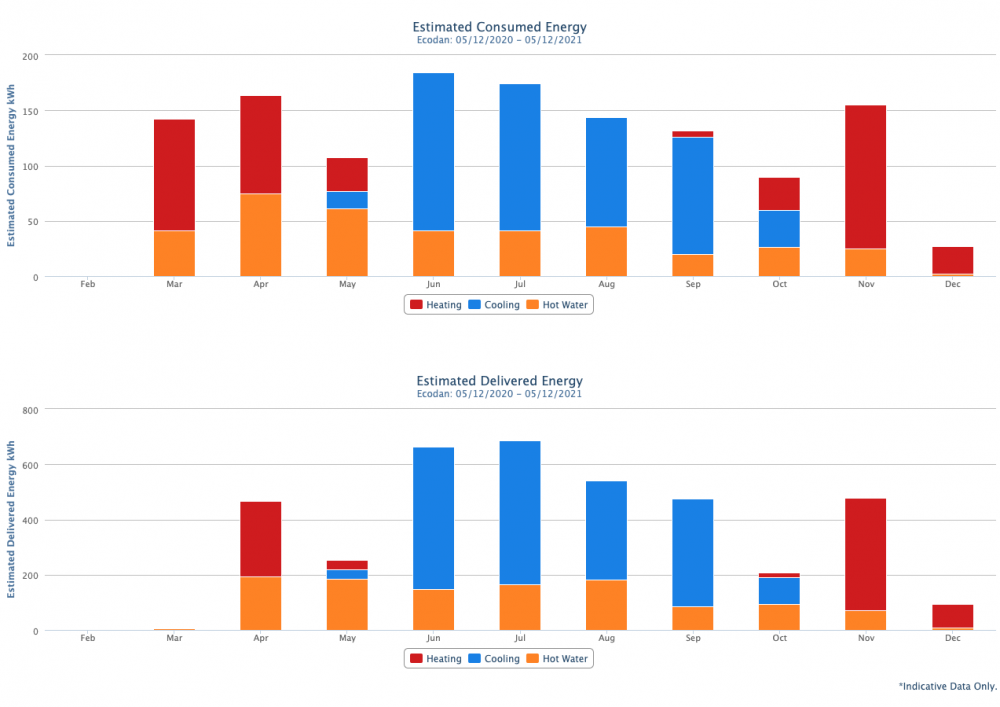
Sorry really dumb question but how are you calculating the COP? I have an ecodan 8.5kW, the MELCloud gives a very vague bar chart of energy consumed and delivered per month, but I can't see how to extract actual numbers from it to get a ratio (Yes my cooling usage was through the roof this summer, working on that)
-
I'm also disinclined to have core building service like heating be driven by Wifi or other wireless protocols, mostly for a stability and maintainability reasons rather than fear of EM waves. Pi is OK for some tasks but I find them rather heavyweight for simple device control, and another thing I have to "keep up to date". For this sort of use case my preference would be an ESP32 with PoE support e.g. https://www.olimex.com/Products/IoT/ESP32/ESP32-POE/open-source-hardware This has 16 GPIOs so could easily drive a couple of those relay boards linked by Radian. And other than an ethernet drop, no more power or data connections required. Annual power consumption would be virtually nil. My personal preference is using ESPhome to configure and drive them, but loads of other options available. I have a Pi running emonpi for energy monitoring, the damn thing has 2 wall warts wifi and ethernet but falls over every few months, but the ESP devices I have are virtually zero maintenance (and when I need to do anything, it's all via the Home Assistant web UI). Each to their own but I do like this setup.
-
Do ASHPs work with heat batteries?
joth replied to ReedRichards's topic in Air Source Heat Pumps (ASHP)
I came across this on the Octopus blog the other day: https://tepeo.com/thezeb Startup working on "better than PCM" density for heat storage. (Even if the rest of the product website is hot air, I do like their use #ShowYourStripes poster in their mock up images) -
(Nit: The auto balancing valves are by Salus, not Wunda, although obviously that's one place you can get them). I was wondering about this very idea this morning. I'm considering getting 2 more fan coils (FCU) for the loft, to have one per bedroom. I was debating between a pump per FCU (ouch and yuck), and zone valve per FCU (ouch), or just branching to all three and simply not running the air valve when a given room is not calling for cooling (slightly yuck). But then I thought why not add a manifold in the loft, with actuator per room. (perhaps chained to the air fan for each room). Does that sound sensible? It'd make a very nice isolation point too, if maintenance is needed on a FCU without having to drain down the system. I don't think I'd want self-balancing actuator, as a FCU will work much better with substantially more than a >7ºC drop I'm sure.
-
First you need to figure out what brand you're getting and share that. If you use Nest/Google products (inc Android, Home Hub, "OK Google" etc) then the Nest Hello is probably best. Otherwise most people go for Ring. Or if you like to avoid big tech / cloud dependency and like to DIY this stuff (sounds like that's a strong No here, but for completeness for future readers' benefit) I can reservedly recommend the "Amcrest 1080P Video Doorbell Camera Pro". (There's also even more niche options like Doorbird and Ubiquiti, but I'll ignore those for now) Once you know the brand, you can research the colours they come in. From a quick search I think the answer is approximately "They all have a choice of Black or silver/aluminium, the Nest Hello also has the option of White"
-
Do ASHPs work with heat batteries?
joth replied to ReedRichards's topic in Air Source Heat Pumps (ASHP)
It's a bit surprising SunAmp still aren't on top of this. It would be ~fairly simple to integrate a Willis (immersion) heater inline on the water coil input to the heat battery, and have a tiny bit of control logic that monitors temperature and flow rate on the coil and automatically "tops up" the incoming water temp to whatever is needed to achieve the phase change. This would make it a "drop in" replacement for a UVC on thermal store, and could work out of the box with any hot water source (be it air or ground source heat pump, or gas/oil system boiler, back-boiler or solar thermal). And it could serve as the backup if the primary heat source failed, and the basis for a PV divert solution. Instead they seem to be on a path to developing many different PCM types and making custom controller firmware and in-house compatibility testing with every heat pump, which is really struggling to scale. Even if over the long-arc they do find a market for different PCMs, in the meantime they really need to establish themselves as reliable and easy to install, and a catch-all solution like this would help them get there.