joth
-
Posts
2918 -
Joined
-
Last visited
-
Days Won
5
Everything posted by joth
-
 So on top of the first floor flat roof? Does sounds ideal in many ways, but can see probably needs special access/handling HSE procedures to install, and you'd want some sort of flat rood hatch and "loft ladder" to get up there for service from time to time. Have you had quotes from other installers?
 -
kitchen tap not WRAS approved - is this a problem?
joth replied to Adsibob's topic in General Plumbing
Technically, if it's a new-build you have to have WRAS everything, but if you're renovating you (probably) don't. If your mains has already been hooked up to enable the build (as most are) the odds of it being retrospectively checked are low, but technically the liability is there e.g. for when you eventually came to sell. (Heck, it's just a tap. Odds are you'll replace it again some time anyway) -
What is the layout upstairs? Have you considered options to wall-mount a monoblock higher up? This would reduce the pipe distance needed but obviously might have some aesthetic and access drawbacks.
-
My very rough understanding: it's fine for all the "inside the house" vertical stacks to be purely on AVVs, so long as the horizontal drain they feed down into has a open-to-air vent at its furthest point from the main sewer. Typically this is done by extending the horizontal drain right through under the house and out the other side. The open vent can be down in the garden somewhere or whatever. But different BC might see it differently. We were going to do exactly this, but my main contractor removed the vented extension and got the architect to approve the change, and then poured the slab without telling me (this was last April, and I was bed ridden and in quarantine with 'rona). Their argument was because nothing was feeding water regularly into the open vented end, it would slowly get blocked up with "back splatter" at the point the furthest upstream vertical stack drops into it. They debated swept bends, but never considered the obvious option that our extended pipe was going out to the garage and passed an outdoor tap we could have fed the drain down to it to keep it cleared out. So anyway in the end we had to punch an extra hole through the roof so our final vertical stack can have the open vent on top. (They tried to charge me extra for that variation, so I asked for the money back on the horizontal pipe and foundation lintel they failed to install without my approval and they backed down ?)
-
Ecodan taking 30min to switch over from DHW to heating
joth replied to joth's topic in Air Source Heat Pumps (ASHP)
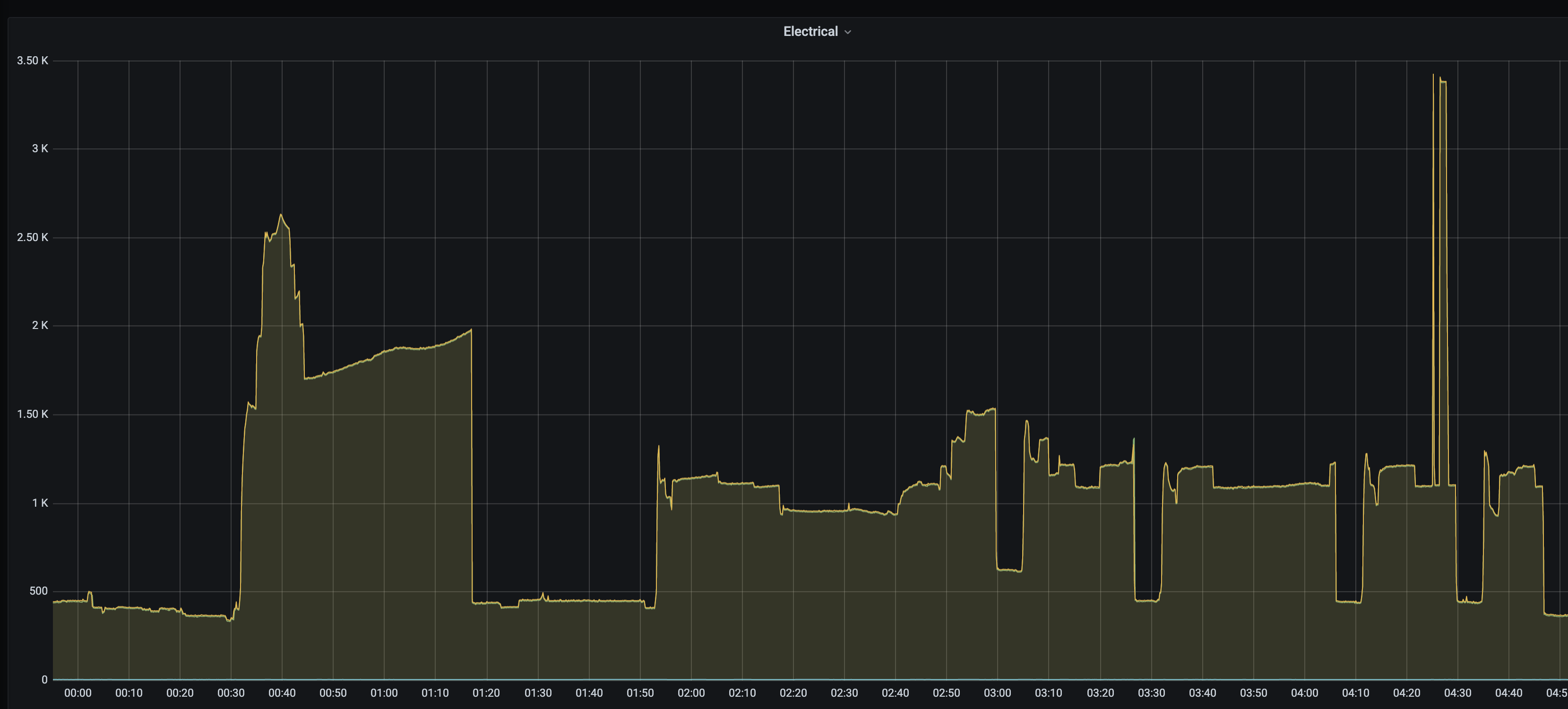
Cheers both! Interesting to know I'm not alone! The 30mins is based on the power consumption graph. e.g. here you see the DHW run from 00:30 to 01:17 and then it's all systems idle until 01:52 the UFH starts running. So yeah, 35mins idle ? The tank temerature graph also lines up with this - it reaches target temp right on 01:17 so isn't any overrun while the pumps circulate to get it finally to temp or anything. [yes, my domestic base-load of 400W sucks, that's a different conversation though] I'm using the "dry contact" Z2 input to call for heat on UFH, and the "smart grid boost" dry contact to fire up the DHW. This is not ideal as smart grid boost pushes the target temp up to 56ºC. I think the ideal would be to just take it to about 50, and have another option to really boost it to 56 when we have lots of guest over or masses of excess sun or whatever. I enable both these relays simultaneously at 00:30 so it's the built in priority in the FTC6 that runs DHW first then the UFH zone. Having it run both at the same time was sort of a joke, but I think the immersion may actually be my best option here.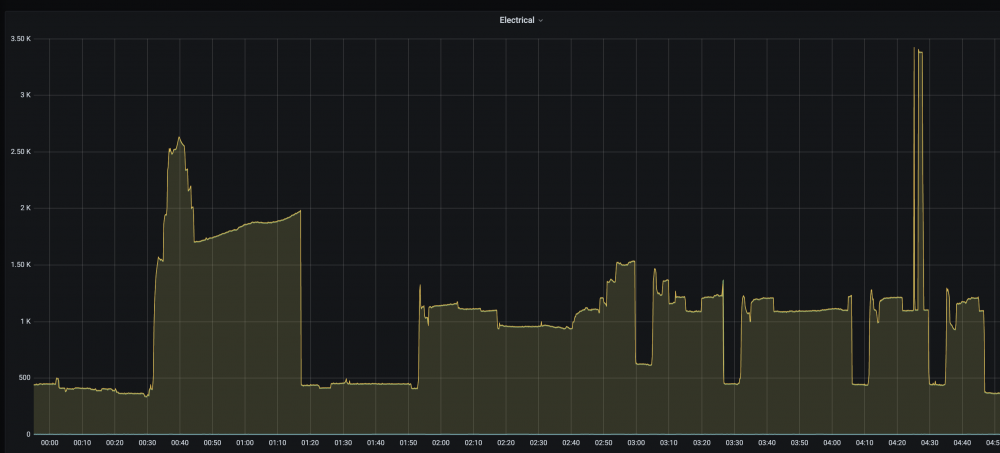
-
I have an 8.5kW Ecodan R32 with the FTC6 controller. I'm (now) on Octopus Go, so trying to get as much DWH and heating action in the cheap hours of 0030-0430 Currently I have the loxone system call for heat and turn off my "DHW setback" at 0030. I find it takes about 30mins, to 1am, to get the cylinder up to temp. Then the system sits idle for about 35mins before firing up the UFH zone. Anyone else seen this long change over time? Any idea why it is there, or how to reduce it? having the system sit for 30mins idle during the cheap rate is going to be an issue as it gets colder. Ideally I'd run in parallel, have the "mid position" value use it's mid position and get the UFH circulating at the same time as it is running the DHW cycle, but I know it doesn't support that so I'd happily run the two serially, so long as I can remove this dead time between them Worse case I can disable ASHP from heating DHW at all during cheap rate and just sling on the immersion on then instead, 5p/unit is comparable to gas even without the ASHP COP but it does feel a, er, copout.
-
Thanks. Overall sounds like another 6 months of wait-and-see then! The windandsun kits only seem to support 3ph inverters so no use for us. Interestingly they are for 48V batteries so not sure how that corresponds to @Johnnyt comment about needing 400V batteries I'll check again what exactly happens when I try and change WiFi settings on the inverter @Dan F. Got to admit I didn't even find the MI that says a physical button press is needed to get into admin mode or whatever.
-
Background: I have a SolarEdge SE8000H HDWave inverter with 8.1kWp solar array (inc mico-optimizers) all G99 signed off and commissioned for 1 year. 2 strings on the inverter used, one spare. I just spotted this: https://www.eibabo.uk/lgenergysolut.europe/special-solar-battery-48v-9-8kwh-resu10-eb15114885 £3,726.58+VAT for 10kWh seems approaching good value. It's one of the few brands supported by SolarEdge for I've only done very cursory research before thinking about contacting an electrician or installer for a quote. Details are hard to find on their kit, what I'm still not sure of: - what other hardware is needed to DC couple this to the inverter. There's a solaredge box some inverters need, but not others - does SolarEdge support battery failover in the case of grid power cut? Not a game changer for me, but curious to know - how do I get "admin" login to my inverter? At the moment I can't even change its wifi network, so I'm sure setting up a battery needs more privileged access. It was setup by the MCS installer and I only have user access. Not sure if I need to go via the original installer, any authorized installer, or direct to SolarEdge customer support - Logically, by DC coupling, the total inverter output (8kW) still caps the max possible export so I'm still within my original G99. But does the letter of the law say differently. Any input form anyone with experience of SolarEdge DC coupled batteries much appreciated.
-
Put all the mess (main rising cable, cut out, meter, tails, blocks and CU) into an outer cabinet, paint it a pretty colour, and call it the "meta-consumer unit". Job done
-
Oh my oh my. We just hit the 1 year mark since ours was installed , 6600 kWh generated. To think if we'd been on that FiT .... £4,000 per year, plus the use of free electricity! I just looked and PVGIS-5 estimated 6882.7 kWh not too shabby especially as we had scaffold by it for 4 (winter) months.
-

-
High Capacity heat recovery?
joth replied to puntloos's topic in Mechanical Ventilation with Heat Recovery (MVHR)
Just leaving the heat where it's created doesn't work. I have a overheating comms cupboard that warms up the bedroom next to it and it has much less power demand than you are talking about. We put an MVHR extract in there but it's no where near enough even for just a network switch, multizone amplifier, and the loxone server and dimmers. Pumping cold air in is annoying as that is automatically wasted energy during the winter heating period. Pumping warm air out to redistribute is the obvious first choice. Perhaps doing so via an exhaust air heat pump would make sense and direct the hot water generated into the hot cylinder and UFH, but what you do with the excess in summer is then the challenge. At some point luxury domestic installs might as well go for 4 pipe refrigeration like a commercial system then you can simultaneously heat and cool rooms depending on their needs, but 4 pipe heat pumps don't really come in small enough sizes for domestic use. -
A GCSE in maths and physics doesn't pay the bills.
-
I think everyone can see we need many more, and better trained, installers for heat pumps to be a success. But other than paying a premium price for the installs in the short term, subsidised by government, are there any practical suggestions how to make up this shortfall?
-
IP = copyright + patents. First, I doubt they're "selling" the IP as it can only have one owner and so it'd hardly be a business model by making only one such sale. The article should really say "buy a license to an IP package". But then, the price is insane. This is just plans, blueprints, rights to build a house. It doens't get you the plot, materials or labour. There maybe some implied warranty with an IP license, but I'm sure it'd be caveated to the eyeballs around "change so much as the colour of the paint and you are on your own, matey". someone could trawl all the posts on buildhub to gather a lot of the "IP" needed to build an energy positive home and not pay a penny for it. If they wrote it up in a book and tried selling it, you'd be violating the copyright of the authors of the posts on here, and in violation of the site terms It is trendy to form companies that license IP rather than build actual stuff, as you don't need to scale operations linearly to scale up sales, and you can offshore the IP ownership to a country with favourable tax regime and still sell it globally. I cannot see this taking off in domestic property construction, and especially not in the UK where ever damn street has it's own planning code and special cases. By way of analogy (for anyone familiar with software development), they're trying following a closed-source mode to license out the "source code" needed to build a house, but at an insane price. If you actually want to solve climate change, open-sourcing it would be the way to go. Much like other open-sourced hardware projects such as open energy monitor. And a bit like telsa providing free licenses to a lot of their EV patents
-
UFH on ground floor only in three storey EnerPHit renovation?
joth replied to AndyRP's topic in Underfloor Heating
This was our goal too (Enerphit, only 2 story, but the warm loft is kind of like a your top floor). We have ground floor UFH and hoped first-floor bedrooms would be cooler, but in practice are 1-2ºC warmer even without heating. Warmer than we want, really. We were going to run electrical cables for radiators just in case, but didn't bother in the end, as loft access and service void makes it very easy to retrofit these anyway if we ever need. -
personally, I disconnected the immersion from the FTC6 and hooked it up to my own SSR solar PV diverter instead. I had to dig around in menus and the dip switches to stop the FTC trying to power the immersion all the time as you say anyway, as the contactor in it makes an absolute din of a buzz which could be heard right across the house. I have the FTC6 DHW set to 48ºC target, and also use the "smart grid" input on it when we have 4kW of excess solar available, or guests staying over, which causes it to boost the target up to 56ºC, which it can reach fine on its own even without the immersion. Caveat: I live in mild Herts so haven't stressed test this with colder outdoor temperatures yet.
-
We had pipes in place throughout last winter, but kept them pressurised with air, not water. This means if anything gets damaged during first or second fix it's easy to see the pressure meter has dropped, but no damage done from leaked water. ASHP won't cool water below freezing (ours only gets down to 5°C) so no risk of that damaging pipes. However anything below about 12-15° is liable to cause condensation which needs careful planning to manage / avoid
-
Haha ignore me, I get my PIR and EPS crossed all the time. (I was thinking of our Cellotex GA4000 taping party)
-
Aluminium foil tape for silver foil faced EPS.
-
How deep would that then be below the surface? If only superficial depth then it would be liable to being disrupted / damaged if any work is ever done above it (e.g. changing patio slabs) or if there a french drain around the wall, it would need some provision to drain passed the wing. I think these were also the sort of concerns our builder had. ISTM the deeper the wing is, the more protected it is from disturbance over the long term. But also, that only makes sense if combined with the skirt. Still, whatever, we didn't do it so it's all academic for me ?
-
Hahaha thanks! Yes we did the skirt insulation, and that received enough grumbling on its own. I can see how the wing insulation is helpful on a new build in areas of 'merica where it can be below freezing for months at a time and ground frost is a real issue, but here in Herts the 30 day average never drops below 5ºC, so does feel like it'd be diminishing returns. We're not in an exposed location either.
-
Interesting! To be fair, it was the PH architect that authored the detail but couldn't back it up with evidence on longevity of the construction. IIRC the detail on our plans didn't mention what base the EPS should be laid on, which would be a lot of the issue. Either way I can see this would be easier done on a new build than a retrofit around existing founds, as ours was. Thanks
-
Are you aware of anyone who has done the external horizontal wing? It was a detail on our plans, but our builder really wasn't happy to install it as they felt it wouldn't be very robust and likely cause whatever is above it to subside. We could still achieve Enerphit without it, so it was removed
-
Confused on electricity supply needs and ASHP
joth replied to pstunt's topic in Air Source Heat Pumps (ASHP)
Depends how the pole is loaded up, but it's possible they won't want you both on a single phase so might pull 3ph as far as the neighbour's plot at least. With UKPN i was able to get a verbal "estimate" from the surveyor when they made their visit, prior to putting in my formal application, but sounds like that's not an option here.