


joth
-
Posts
2918 -
Joined
-
Last visited
-
Days Won
5
Everything posted by joth
-
Well, I do have full back access so most things can be easily wired from the office. The front I want as unobtrusive as possible. Do I recall correctly that the rack going to be full height 40U or something, so this is just the bottom 10U or so poking through to the living room? If so, will the top 30U face the opposite way, i.e. front panel towards the office not the living room? Else there's no way to get to the rack screws on the front, and most network gear is oriented the opposite way to media gear (i.e. with majority of the connectors on the front panel not the back). But of course they all have a couple of useful connectors / buttons on the opposite face so in practice you need some way to get at both sides of each unit.
-

Ecodan taking 30min to switch over from DHW to heating
joth replied to joth's topic in Air Source Heat Pumps (ASHP)
Just to close the thread here: setting the DHW to heat at 4am for 30mins mostly solved this, giving me 3.5 hours of cheap rate heating (octopus Go) followed by 30min DHW heat up with no time wasted in system cool down. One thing I found was my dry-contact relay control was a bit blunt and also messed up historic charts making it hard to see what was going on (as I was descreasing the thermistor reported resistance to emulate a "setback" temp, which causes it to report a higher tank temperature than actual). So I've switched to a 100% software approach: the Home Assistant Ecodan integration works very well to set target temp and also enable "force heat hot water mode". So I now have very fine control, based on the electricity price, PV generation, number of people staying in the house, and forecast sunshine for the coming day, I can tweak the target temp from 40 right up to 55C, set force heat mode, and turn on the immersion heater as needed. Here's a few days of it working nicely. (Spare room was in use on the 19th so you can see the elevated target temp at work, and some extra showers in the day causing a larger DHW draw off) I've made a similar algorithm for house heating --- if it's really cold out and the house mean temperature is falling behind target I sling on a variable number of the electric bathroom UFH and towel rails in the cheap rate too, just to boost up total consumption during cheap rate. (likewise if the PV starts making a lot of excess -- very unlikely in December!!)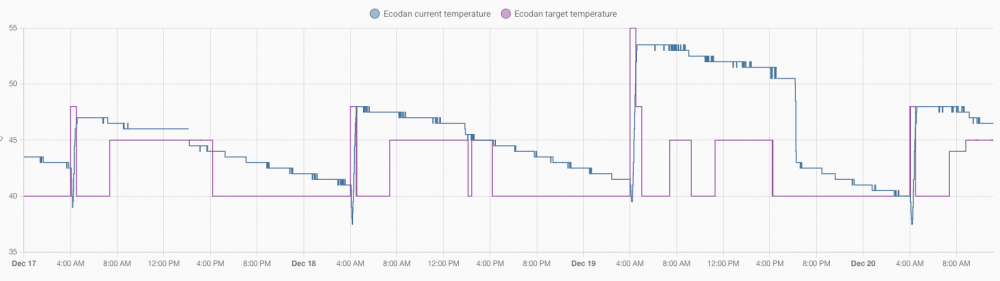
-
Sick Building Syndrome? Airplane colds?
joth replied to puntloos's topic in Mechanical Ventilation with Heat Recovery (MVHR)
I don't know about other brands but the Zehnder has this built in: https://www.zehnder.co.uk/download/29630/118734/en_uk-72926.pdf "Humidity sensors to operate the unit in response to humidity spikes above natural background humidity levels as opposed to a single threshold humidity point to activate the high set point Humidity boost continuously monitors the humidity level within the home and looks for a man-made spike before boosting the unit, irrespective of distance or dilution" I also trigger a boost when the showers or hob or oven are in use. I haven't yet worked out a boost when the cat lays a stink bomb. -
WF100 coax - this is the spec Virgin Media use, in case you ever want to route cable TV between rooms. Solid copper U/FTP Cat6A is best for future proofing if you ever come to put HDMI over it. Otherwise any standard solid core CAT6 is fine. Avoid CCA. Avoid Amazon as lots of sellers are misadvertising cat6 as cat7 or cat8 and hard to have any trust at all what you're getting on there
-
Sounds quite plausible / in line with the general findings. I think ~10yr payback on PV is what most find ballpark, and batteries twice that. Aside from the cost of energy increasing (and inflation pressure), PV and batteries in particular are expected to drop in price, so there's a good case for leaving it 5 years and seeing. The only case for PV now is if you have the scaff up and doing a lot of roof work anyway. Maybe you can save on tiles by doing in inline inroof system (which also look nicer and lower maintenance). But if you're not tackling the roof now, leave the PV until such time as you are? As joe (and all buildhub) says, fabric first. Fancy tech later ?
-
Yes, it's a good point that not all smart TRVs are alike. I assumed they all had some kind of sensible call for heat behaviour but obviously not! With loxone it's fully (and infinitely) configurable, but be default a heat source only activates when >30% of zones are open. It sounds like the Drayton system is functionally no better than dumb TRVs in this respect: can help avoid a room overheating, but not address the "one room is too cold" scenario. Agree with the other comments on calculating it, but I've seen (but now can't find) a "rule of thumb" sizing on here of 10-15L per kW of heatpump output, which "feels" reasonable? I stumbled on https://homemicro.co.uk/download/lzc_buffer.pdf which says: "BS EN 14511 recommends for the purpose of defrosting, and as a guide, a buffer tank should be sized on approximately 25 litres per kW output of the heat pump." which sounds on the higher side.
-
Will you have TRVs on the radiators? If so you'd be highly advised to get the buffer tank, as the total system volume reduces (probably quite substantially) when several of the TRVs close off, and then the ASHP will very likely short cycle. This will be accentuated if there's any variability in the house e.g. on a mild winter day most rooms keep a nice temperature but one or two get more cold because of draft/wind/exposure or some-such. Oversizing the ASHP and having it work at the very minimum end of its operating range further increases the odds of this happening. You can use smart TRVs and have the system only call for heat when some majority of them are on, but that means letting those few cold rooms get even colder before there's enough demand. And often ppl with smart TRVs actually WANT to let some rooms get cold (e.g. if they're unused guest room, or all bedrooms during the day, etc) and again a buffer tank will help a lot with that sort of usage pattern. On the flip side, we have LLH and UFH and that works fairly well for the designed mode of operation. In a (retrofit) passive house there's less need to have room-by-room control so we just run the whole ground floor UFH as one zone and it's enough that the 8.5kW ASHP generally does a 20min on / 5min off cycle, which is ~OK, and not sure how much a buffer would help with that. But I still wish we'd done a buffer tank tough for secondary reasons I'd not considered during initial design (e.g. getting more value out of cheap rate electricity by charging the buffer up to a higher temp, using a (small) FCU for cooling in summer, etc)
-
You are of course right. It looks like all the solaredge 3phase inverters have a G98 cert, and anything up to SE10K (10kW model) will provide <16A per phase so does not require additional permission https://midsummerwholesale.co.uk/pdfs/solaredge-g98-se3k--se17k-2.pdf Still, a 3-ph SE4K is over £1000 vs under £800 for the HD-Wave single phase inverter.
-
So in that case the payment for export is irrelevant, but the import bill is still £0. let me rework the example to make it easy: .. With net-metering you could generate say, a constant 2kW all delivered into phase A (while drawing no load on that phase), and extract a constant 1kW from each of phases B and C, and end up with a usage bill of £0.00. 2 - 1 - 1 = 0kW net usage. There's no financial benefit from splitting generation across phases.
-
Hmmm only had a quick skim (the reports themselves are behind a registration page) but I don't like the reporting methodology. It seems they're mixing up two different study endpoints: - installing 742 and reporting that by large "installation" was successful on them all (i.e. just to the point of commissioning, not report a month let alone year of successful operation!) - publishing a few cherrypicked case studies with individual participates giving glowing reports of how well the thing works. To give confidence that they work at scale we need to hear multiyear results from all those 742 participants (or a statistically powered subset of them) really.
-
Huh, I see. I actually read the OP exactly the opposite way: Err, if a single phase inverter feeds into one of there phases, how would the PV generation get to ph-2 and ph-3 without that methodology? It wouldn't. Why would it need to? With net-metering you could put a constant 3kW into phase A, draw a constant 1kW from each of phases B and C, and still generate revenue on the 1kW of export (and charged no import). Trying to balance generation vs consumption across the phases is pointless*, adds cost, and unnecessarily complicates pretty much everything. * - for domestic installs. Larger commercial users are a different matter.
-
And don't forget to be valid you need to run the test during cold weather, e.g. several day sustained period below 5º for most of UK.
-
@Nickfromwales you also seem to be under the impression that net metering across phases does not work, and the house needs to equally divide its usage across all phases and supply generation equally across all phases to maximize self consumption? Why do you think this? We solved the "net metering" question 2 years ago (for SMETSv2 meters..), and I've still not found any counter-evidence that this doesn't work: Why not just ensure the meter works correctly (i.e. with net metering) and then you can do whatever you want with the phases (up to the statutory limits) Well, aside from the extra cost and needless effort on a G99 application, sure, no brain needed. (Who mentioned anything about a 3-ph CU?) Personally (i.e. for my house) for such a small array, I'd sling the single phase inverter and single phase house CU on one phase (just to minimize the standing voltage rise/drop on that line), and use other phases for "outdoor" things like garage/ashp/EV charger(s). But it depends a lot on the building size and layout as to what makes sense, and I don't know any of that info.
-
G99 only needed if you want to connect an inverter > 3.68kW (regardless of how much if any you expect to export). Your array is slightly larger than that but fine to use on the SE3680 and you won't lose anything in practice, so I'd keep life simple and go for that inverter and less paperwork. In this case you'll also need to pay your supplier to move the meter (as well as the dno to move the cutout), and I'd use that opportunity to get onto a digital meter that can handle net metering of generation correctly, even if you're not planning on being paid for any export. Asking for a SMETSv2 smart meter is *probably* easiest, but there maybe a wait time for you. Ask your supplier.
-
+ they have safety cut out to 1V when the DC cable is not connected
-
No - they said the optimisers are already up there:
-
Looking again at the new SolarEdge battery. https://midsummerwholesale.co.uk/buy/storedge/solaredge-energybank-10kWh - Price looks reasonable, especially if it can be a DIY install (no mains side changes). - Unclear if it will support grid outage backup mode in the UK. (It just says "depends on country"). - Doesn't seem to have any main contactor to properly island the house from the grid during backup operation, and I think you need per device/appliance smart sockets to shut off individual appliances when in backup mode - Only supports inverters up to 6kW in size so far, so no use for me (SE8000H). Slightly odd product choice, given larger systems are where battery storage makes most sense.
-
Even after factoring in the cost of climbing back on the roof, removing the optimizers and installing microinverters and new AC cabling (and possible new roof penetrations), and disposing of the optimizers and DC cabling?
-
Sounds moot as he' already installed them, but FWIW they have a couple other benefits besides handling shading: - smaller, cheaper, cooler running and more reliable inverter (as it doesn't have any MPTT built in) - per-panel lifetime performance tracking
-
Any sort of idea on age? Is it digital or analogue? If you can get the model number of it you might be able to google. Unless you're happy to do research/testing, dealing with the supplier, and/or just upgrade to a smart meter, then you do risk it billing you for import even when you are net exporting. Note that even if you get a 3phase inverter, it's not plain sailing as you'd still likely be putting 2/3 of generation onto unused phases and "wasting" it. Are you planning on doing MCS registration and getting pair exports? If so a smart meter maybe simplest path anyway. Alternatively, you could ask to have the meter replaces with single phase and cap the others phases off, but you may regret that when you come to add EV charger(s). One that is correctly sized for you array and HD-Wave enabled. keep it 3.68kWp or less, to avoid G99 paperwork e.g. SE3680H https://midsummerwholesale.co.uk/buy/SolarEdge/solaredge-3680-screenless The 3 phase inverters are all >4kW so will require G99 application, even if you only connect <4kW of panels.
-
This should not be necessary. We've discussed it many times already, but 3 phase meters should not require you to put generation on the same phase you draw from. They employ net metering across the phases. This is true for smart meters, and should be for legacy meters too you just might have to get the supplier out to configure it correctly as they don't always set them up right if it was installed before energy export became common. I can point out the SMETSv2 spec if needed. Do you already have a smart meter?
-
Sick Building Syndrome? Airplane colds?
joth replied to puntloos's topic in Mechanical Ventilation with Heat Recovery (MVHR)
anybody that's modelled it in PHPP would have. IIRC for us it was basically a wash. The extra latent energy recovered is mostly offset by the enthalpy exchanger being not so efficient at recovering sensible heat. So the decision for one or other is largely driven by other criteria. Of course that's just a model based on typical values; someone running a weed farm in Denver would get atypical efficiency results in practice. In terms of recording actual numbers... My Q350 UI gives an overall score for heat energy saved (3.7 MWh in one year) but doesn't break it down latent vs sensible. I do log air temp, humidity and flow rate so I suppose I have what I need to calculate this. -
Under-sized vs over-sized ASHP conundrum
joth replied to muhrix's topic in Air Source Heat Pumps (ASHP)
Yes - if you have smart TRVs and a possibly over-sized heat pump, a buffer tank makes a lot of sense, as it allows individual rooms to call for different times satisfied from the buffer, and the buffer is then recharged as needed from the HP, without any risk of short-cycling. Buffer in the attic only makes sense if it's a warm loft. If so, and if the rest of the plant can go there too (circulation pumps, valve, and the HW cylinder) it's not a bad call, assuming it doesn't make the circulation loops gigantic. Otherwise, you can can UVC with an integral buffer tank, which might save space. -
Sick Building Syndrome? Airplane colds?
joth replied to puntloos's topic in Mechanical Ventilation with Heat Recovery (MVHR)
More common these days maybe to use Enthalpy exchanger rather than heat exchanger (so ERV rather the [M]VHR system), to recover latent as well as sensible heat from the outgoing air. This is generally not needed in UK with its low altitudes and moist marine climate. However if you're heating the house via forced air (i.e. if you were using FCU) then this can dry the air out more, so using ERV can avoid further loss of air moisture. -
Samsung EHS Mono, R32, Heat Pump 16.0kW - model AE160RXYDEG
joth replied to Siggles's topic in Air Source Heat Pumps (ASHP)
Is your RHI reporting for payment or reporting for usage? If the former, it should be a dedicated meter, I believe. Otherwise I'm not sure it's mandatory to report (unless you signed up for the extra incentive to report data? I didn't so can't really help. But I recall my ecodan has an application note stating the web interface should have the data needed for that scheme but they don't guarantee it would remain available and acceptable for the full 7 years) Your existing cylinder won't be designed for a heat pump so will take longer to heat whatever . But this sounds like it never worked at all? I expect there's an existing mid position or diverter valve somewhere that redirects water between heating and hot water, that has failed or simply was not wired in correctly. I've had at least two professional plumbers that wired a valve wrong and needed my help to figure it out! Does the supply pipe feeding into the cylinder coil heat up at all?



