
TerryE
-
Posts
3806 -
Joined
-
Last visited
-
Days Won
30
Everything posted by TerryE
-
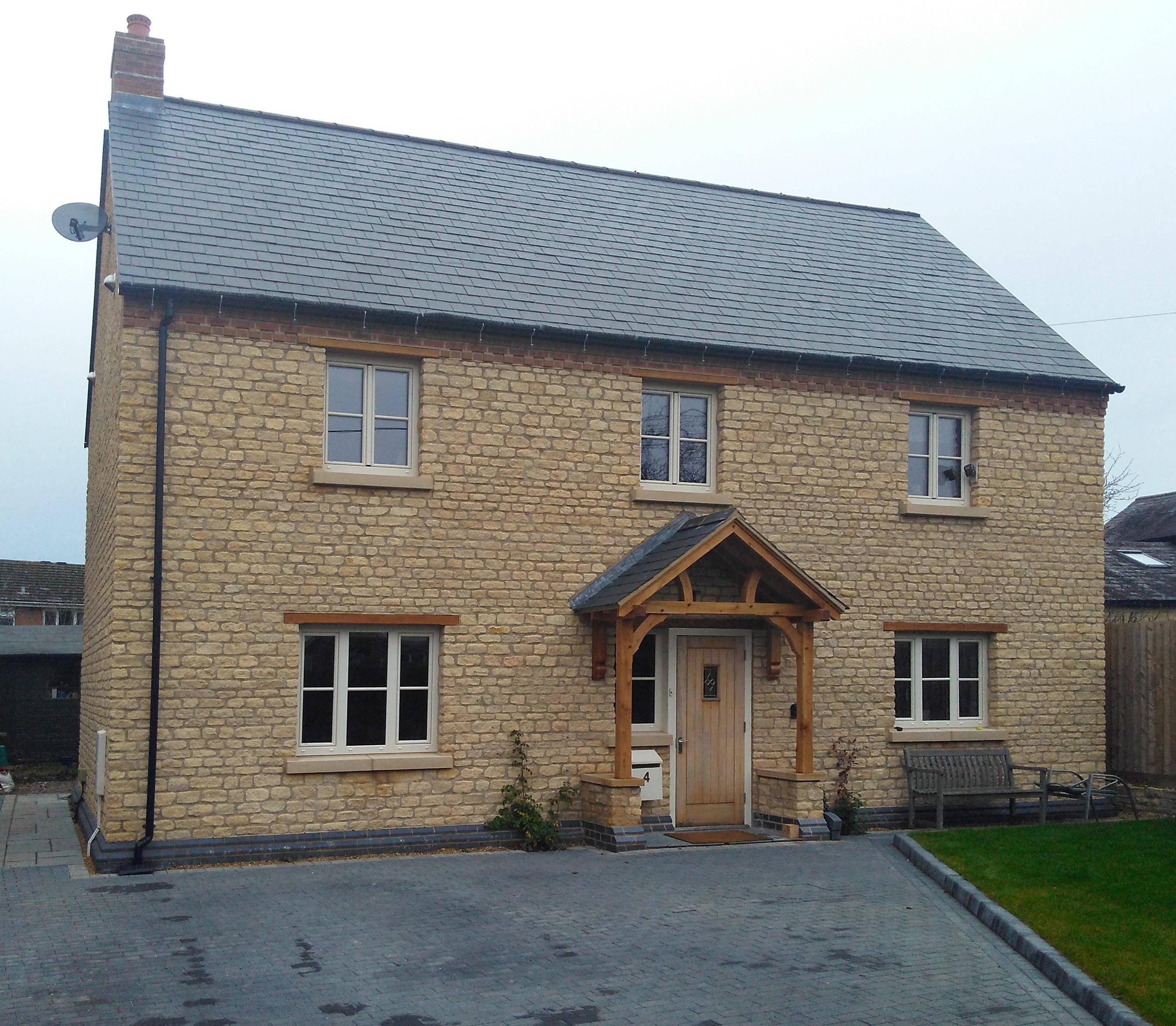
Russell if you look at the first of the pics in my blog entry, then you can see how the concrete spanned the eps and I also put some wood shuttering n the outside (and rebar reinforcing inside wired to ringbeam box rebar) so that the concrete tongue spanned the ring EPS and closed the 50mm airgap to the out stone skin. We had slate throughout the ground floor and I also used the same as the external steps. Beneath this I used a line of foamglass butting up to the tongue to break the bridge. The test was the really cold spells in winter. The inside floor next to the doors was maybe a few degrees colder than the ~22-23°C elsewhere but not noticeably so and well above condensation temperatures.
-
I am curious as to why your spec has the sarking over the battens. Our TF warm roof is sarked with the roofing fabric directly on the sarking and the counter battened and battened on top of that and then slated. We have Fakro room lights and you need to choose the frame model and mounting kit depending on the covering profile, so you need to choose the correct combination for a top sarked profile. I assume that the same is the case for Velux. Your figures are for a batten over sarking profile.
-
1=physics, 2=maths ?
-
Yup, a green roof looks so much better than other coverings if viewed from above. Keeping the neighbours on your side really helps with planning very approvals, IMO -- not so much formally but the odd letter of support helps with comfort factors for the LPA. It can also help during construction, because the build process does inconvenience neighbours and they are far more likely to grin and bare it if they like the outcome.
- 10 replies
-
- 1
-

-
- roof lights
- roof
- (and 3 more)
-
The problems will start with insurance -- you might find that your house insurance is invalid if BControl refuses to sign it off -- and trying to sell your house in the future.
-
In plain speak, just like N-glazed windows, the decrement delay is tiny -- effectively zero. That means what whilst the aggregate U value might be small, there is little or no lag in that thermal leak passing through the roof. If you want to integrate up / average out the heat then the simple way is to add some mass above the roof, but rather than concrete, why not go for a green roof? This will also give you shade and some evaporative cooling as well as looking a lot nicer than most other finishing surfaces.
- 10 replies
-
- 1
-
-
- roof lights
- roof
- (and 3 more)
-
Does self building improve health?
TerryE replied to epsilonGreedy's topic in General Self Build & DIY Discussion
Try sticking to a PK diet and we'll get you down to 15! @JSHarris, at one stage, I did consider volunteering to be a Cochraine reviewer, so I do understand the process, but you have to work within the ToR of the published review and the data underpinning it. In the case of medical trials, because of patient confidentiality, you rarely get to see anything other than sanitised data, and you only get access to the published content, as historically contemporaneous change control was rarely maintained in the trials process, so it is very difficult to pick up practices such as in the PACE trials where they changed the study design during the study when it became clear from early results that the original design wasn't going to produce the desired outcome. As I said the drug companies funded 18 statin trials, and no doubt Cochrane made sure that their conclusion that statins reduced fatal and non-fatal CVD compared to "do nothing". No argument. But taking Clive's case are statins@20st more effective than no statins@17st or even having someone on his case to get him to lose another stone or two and do a bit more exercise? We can't say because this type of trial will never be funded. At least statins are now available as generics and so the cost per patient is perhaps 10p /day. But this isn't the case for more recent drugs. -
Does self building improve health?
TerryE replied to epsilonGreedy's topic in General Self Build & DIY Discussion
The limitation of the Cochrane approach here is that it largely does meta analysis to aggregate the results of a related cluster of trials, and use statistical aggregation to draw out stronger conclusions than the individual studies can make. The process does not deep dive into the individual studies to assess how well they implement best study practice, nor do they attempt to mine all of the abandoned studies that were coming up with the wrong answers. So whilst Cochrane can remove silly outliers and represent the study consensus, they don't highlight systematic flaws or biases. So in the case of use of statins for cardiovascular disease they correctly aggregated 18 RCTs comparing the use of statins against with usual care/placebo. So yes, treatment A which involves long-term expensive drugs is better than do nothing. But treatment B which involves lifestyle changes on the part of the patient and potentially reduces the income of the drug companies has absolutely no chance of finding funding for trials, and so we can make no trail-based statements for treatment B vs do nothing or even treatment A vs treatment B. I remember looking at a similar Cochrane review on ME/CFS and even went through the actual studies, and came away deeply uneasy and dissatisfied. The average of a pile of shit is still a pile of shit. -
Does self building improve health?
TerryE replied to epsilonGreedy's topic in General Self Build & DIY Discussion
My real point here is that Fluoxetine is an SSRI that might be an effective treatment for certain types of clinical depression, but there is evidence to support that CFS patients are in general suffering from clinical depression so IMO its use is entirely inappropriate. As I said to my GP: I am fed-up with being bed-bound, but being fed-up is not the same as clinical depression, so no thank-you. Most trials are funded by the drug majors who have vested interest in proving that long-term repeat prescription of some drug is an effective treatment. The trials are badly constructed and often have shifting success criteria. Those which reach negative conclusions are quietly shelved on cost grounds before being reported. @JSHarris, I think that your being prescribed ARB is a good case in point. IMO, another case in point is the use of statins. I accept that they are effective in reducing the risk of heart disease if you have high blood pressure or other arterial problems, and especially if you don't exercise. However, surely patients should be supported in trying to use dietary and life-style changes to address these risks first? Or do we just give up and put everyone over 50 on the bloody things? -
Does self building improve health?
TerryE replied to epsilonGreedy's topic in General Self Build & DIY Discussion
If you've watched any of Hans Roslings GapMinder talks then these provide a slightly different interpretation. Basic stuff like A basic understanding of sepsis, hygene, clean drinking water and sewage disposal Adequate nutrition Vaccination programs Improvements in anti and post natal care are the dominant factors here. That's why places like the province of Kerala in India has a higher overall life expectancy than Washington DC in the USA. A lot of the improvements in healthy care are now largely nullified by the -ve consequences of the high-carb excess western diet, leading to obesity, high blood pressure co risks and diabetes. IMO, UK healthcare is good (or in fact great) in parts, but there are whole areas where it performs poorly. A good example is CFS/ME that @Cpd and I suffer from, and people with other systemic diseases like IBS. If you read the NICE guidelines, they attempt to distill all diagnosis and treatment down to simple ladder logic: do this test, if +ve then proscribe this drug; treatment by the application of point drugs to remove point symptoms. But the human body is not a simple linear system. You must use a systemic approach to diagnose systemic problems. Any mathematician or systems architect will tell you that linear approximations only useful in defined domains, and that you have to take a systemic view to understand the system better. In the case of CFS, a typical GP will offer Prozac and referral to a psychiatrist for CBT. A homeopath with expertise in treating CFS will cover lifestyle, diet, sensible exercise regimes, massage, etc. and yes they will often offer sugar pills. I believe in Avogadro's number over sugar pills any day, yet in this second case the whole treatment bundle is often effective and can be boosted by a placebo effect from those little pills; it is far more likely to lead to the patient's recovery than "Prozac and piss off". -
It depends where you live of course, but in the UK the number of days per year where the average temperature is below zero is small, and the number below -5°C is tiny. I feel it is a mistake to optimise your heating for the worst case. So what is the life expectancy and annual maintenance costs of your quoted eDual 12s? I suspect 10 years and 5% might be a good ballpark, or roughly £1K p.a. amortised cost. My total annual energy bill is just over that with my twin SAs and Willis heater and no PV. And we also have a largish 4 bedroom house with 3 ensuites and a bathroom and 3 occupants. We have UFH on the GFL only so the 1st floor does get about 2°C cooler than the ground floor when it gets really cold but we don't find this a problem for the bedrooms. I do have a Dyson fan in my office, which might run for an hour or so on really cold days when I am working up in it.
-
Does self building improve health?
TerryE replied to epsilonGreedy's topic in General Self Build & DIY Discussion
Depends on how you approach it. I see diet is what you eat and how you eat it for the long term. Individuals can find that they have different food intolerances, so you should understand if you have any and simply avoid those foods. High carb diets can cause a lot of problems for many of us as we get older: obesity, high blood pressure, diabetes, etc. In my case I have a very specific problem because a course of antibiotics probably saved my life, but also totally buggered up my gut ecology as a side effect leading to this candida explosion. In my case, changing my diet can address this. Horses for courses. -
Does self building improve health?
TerryE replied to epsilonGreedy's topic in General Self Build & DIY Discussion
Use of PK diets is very controversial in the NHS except for some narrow cases such as epilepsy and some diabetes treatments. Anyone who eats a normal convenience high processed carb diet will find this a hard change, but luckily we eat a Michael Pollan-style high vegetable, low carb diet, so going to a Ketogenic is only one step away for me. I am not sure that I will totally eliminate dairy as cheese is such a pleasure in life. But any dietary change is a price worth paying to getting this f***ing candida infection eliminated soon. -
Does self building improve health?
TerryE replied to epsilonGreedy's topic in General Self Build & DIY Discussion
I've had my liver function tests done a couple of times, and all clear. I am taking oral flucanozole which has at least cleared the worst of the oral, larynx, tracea and upper oesophagus of candida, as well as the canidemia. I've also switched to a ketatonic diet for the next month or two: human metabolism has two pathways: glycolysis and ketosis; yeasts only the former -- so this will starve the bastards out. Oh yes, and I am definitely HIV -ve. My GP insisted that I take the test for "elimination purposes" with the not so implicit threat that I would be flagged as a non-cooperating patient if I didn't. I won't go into the backstory but this made no rational sense. -
My only tweak that I am currently thinking of is to double up on the Willis -- mainly to remove a single point of failure, but also allow me to put in more heat overnight (E7) if we do get a long sub-zero spell in the depths of winter. At the moment we have almost nothing in our design that requires regular (££) maintenance. We need to clean the MVHR filters quarter and replace the secondary filter on the MVHR annually. That's all really.
-
Does self building improve health?
TerryE replied to epsilonGreedy's topic in General Self Build & DIY Discussion
Could agree more, but the catch-22 about the place we bought is that Alonissos isn't that easy to get to, so the upside is that it hasn't been totally wrecked by tourism, but the downside is that out of season the trip is usually a couple of days because of stop overs. Even in season when to can get a direct flight to an island a couple of ferry stops from, it is still a very long day's travel. All a bit of a strain if you can hardly walk ? -
Does self building improve health?
TerryE replied to epsilonGreedy's topic in General Self Build & DIY Discussion
When we finished our house last December, I was mentally exhausted, and physically fit but tired. I am also a largely recovered Chronic Fatigue sufferer. (This is similar to being an alcoholic: there is no such thing as a recovered CFS patient; once you've had it, then it will recur if you recreate the right conditions.) So I suspect that the main consequence of all this long term stress was that my immune system got suppressed. This year I have been pretty continually ill. Cold; Hand Foot and Mouth Disease (HFMD); another cold; going to nasty bronchitis; start of pneumonia; antibiotics; a bitch of a systemic candida infection that has collapsed my energy levels. I am still largely bedbound, and still struggling to get over it. So I've paid quite a price for all of he mental strain. I regret that I didn't proactively manage the stress better: never allow the build to be all consuming; be hard about scheduling in a couple of days a week away from the build and take proper holidays to charge the batteries; be realistic about timescale. This all being said, do I regret building the house? Never at any time. It was the best thing that we did. We will have all of the benefits for the rest of our lives, and I will hopefully get over this illness in a month or so. -
To be honest our twin SunAmp configuration + Willis for UFH is working very well and we are very pleased with it. OK, the planning restrictions on PV means that we lose 8 points off our SAP rating, IIRC, but the running costs are so low it's going to be hard to make a case for an ASHP.
-
I am another retiree with lT PM experience. I also did the PM on our build. Peter Stark made the point that you need to be on site pretty much every day. Do you honestly think that any architect would do this for £15k? Our build went very smoothly, and I feel that this was because of a number of factors: We treated our tradesmen with respect, and became friendly with pretty much all of them. Most of the trades were either subcontracted to Alan, our ground works / skin contractor, or were at his recommendation. He is a bit anal on quality, so all of his subs were excellent. We also kept a close eye on any issues and were prepared to be flexible if something was eating into their contingencies. We also made sure that there were no unnecessary hold ups, as most tradesman will do a good job if they like you and they are working with their budget. It's always on the interfaces between subs that things can go badly wrong, but so I was a bit anal about tying these detail and responsibilities down. Especially in cases like the windows which involved the interface of three subs. Trust but verify. There are critical periods, which when you must be on site: the foundation / slab pour, the TF erection, ... You need to check, check, check. Have a very clear idea of what trades you want to do yourself. We did all of the thermal design, plumbing, and carpentry, but that's because Alan's plumber was a bit traditional and we had a passive house design. I am a lot better carpenter than Alan's. Jan did a lot of the procurement over the Internet. We could get better prices and faster delivery than using Alan's trade account with the local BMs.
-
Have a look at my blog. We put UFH in our slab during the pour so it cost very little, less than £2K. We use a Willis heater as our heating source, and I did the work myself. We use 2 x SunAmps for DHW, and our cooking is electric (though we do have 2 Propane gas rings on our hob as backup). So excluding the SAs, the cost of the installation including the cost of control system was around £1K. Because of planning constraints, we only have limited glass, and this has upsides as well as down. We stopped adding heat about a week ago, but the arrival of spring temperatures was unusually late this year. Have a look at At the moment our daily energy costs are ~£2, (but no PV; thanks to the planners). And we are absolutely delighted with how the system works.
-
What did your surveyor say about the settlement crack running up from the join of bricks 2/3 at the bottom LH of your pic all of the way up to your verge at the top RH by the looks of it? Is there equivalent settlement on the inner skin? As to the inner profile and make up, have you had a look at the original Planning / B Control docs? Failing that, then a quick exploration core should give you a good idea.
-
Ditto. It makes the roof a lot stronger and racks the whole thing.
-
Controlling underfloor heating in passive house
TerryE replied to dogman's topic in Underfloor Heating
I have tried to keep my system as simple as possible. So for example, my 230V side is isolated from from the low voltage stuff by using some Crydom SSRs. This enables my Sparky to raise his Cert to keep BControl happy. I haven't added any extra valves in my system since they weren't needed, but I will need at least one extra if I add an ASHP. As to extra expansion, why not just add a trickle bypass and avoid this. -
Floor screeding, why so late in the build process.
TerryE replied to epsilonGreedy's topic in Floor Structures
I support everything that the Js say. Our MVHR stays at 30% except for the occasional boost, and doing the airflow calcs this does a complete air change of the house roughly every 4 hrs, so the house smells airy and fresh all of the time. When we do our 3-monthly clean of the MVHR filters, we still get a covering of fine white dust on the outbound filter which I suspect is a result mostly of the rubbing down as we finish off our P&D. What horrifies me is the black particulate matter on the inbound filters. Our house fronts onto the street through our village, but this is quiet except for the ½hr rat-run period morning and evening; and the inlet and outlet are 5m up and ~12m from the road, but we still clearly get diesel particulates (and perhaps wood smoke) being taken out by the MVHR filters. As the slab, our ground floor is slated, but Jan prefers to walk around bare foot in the house because it is a nice steady ~23°C. We haven't put in the upper control on our UFH, so we still do fixed heat chunking over night. The conversation that I've just had with Jan went along the lines: "the average temp has risen by 0.8°C over the last 7 days because the average temp outside is starting to climb at last -- OK, I'll trim the overnight heating from 5½hrs to 4½." Life is tough in a passive house. We used to live in a traditional farmhouse: wavy floors and walls, draughty windows, wood-stoves, classic CH, walk from one room to the next and the temp drops by 5-10°C; within 1hr of the CH going off overnight, ditto. Do I miss it at all: not one jot. -
We have one as well, and it definitely reads long. I have 0.3m, 0.6m, 1m and 1.8m steel rules which are all consistent with my steel tapes to around 0.1mm / metre (using the standard mobile phone camera trick to take the measurements). If I use the Boch to gun an internal door frame height and then compare this to the two overlapped steel rule method, the Bocsh consistently comes out 1.5 -2 mm longer over ~2.1m. I trust the steel rule measurement to 0.2mm, so there's no way that my DLE40 achieves the claimed 0.5mm accuracy. So IMO, the Boch is brilliant for measurements up to maybe 15m accurate to 5mm, say (though you do need to do the longer range measurements after dusk because of S/N ratios.) However, it isn't good enough to measure up for cutting oa piece of wood and to get it right in one cut. PS, isn't it about bloody time that you arranged to come and see us or @RandAbuild one W/E when you are next in Roade. We've got to build up the local self-build mafia!