

.jpg.c21f3ac78c9b7efd90cbdcb312744dc5.jpg)
jack
-
Posts
7460 -
Joined
-
Last visited
-
Days Won
41
Everything posted by jack
-
.jpg.c21f3ac78c9b7efd90cbdcb312744dc5.thumb.jpg.7adcad4c0e384f5ecd7d56b0618df6e5.jpg)
A few ASHP / UFH bits of information.
jack replied to ProDave's topic in Air Source Heat Pumps (ASHP)
The plumber we used wasn't MBC registered so couldn't do the RHI. He said he looked into it but the paperwork and costs of maintaining currency in the legislation itself wasn't worth the hassle. He may not have realised how much of a premium could be involved! -
Yes, all of the alarm sensors are fed back into the home automation system, as are the external PIRs (well the wirings there - still haven't got the PIRs up yet!). Once it's all up and running, the "all off" button will set the home automation side of the alarm to night mode.
-
No, it's just a dumb retractive switch that's wired to the home automation system. It can in theory be used to control anything that's controlled by the home automation system. In fact, the upstairs one was intended to be a lightswitch for a light right beside it, but there's no light installed there yet. The upstairs "all off" function is actually intended to be controlled from the master bedroom bedside switches, but we're still in the guest room while restitution of our ceiling takes place, so I temporarily re-mapped the "all off" functionality to the spare switch in the upstairs landing alcove. Once we finish installing everything, hitting the "good night" switch will turn off the driveway and internal garage/workshop lights (if on), and shut the garage door if it's detected as still being open.
-
I have one of those. The standing joke (although I'm certainly not laughing) is that I'd come home from work in winter to find literally every single light in the house on! I'd spend the first five minutes going around turning off lights that were on in rooms that no-one had entered for hours. I get that the kids don't pay attention but it drives me mental that my wife just doesn't see this. It's the same with the dishwasher - she'll put it on at 10 o'clock in the evening in summer, when it's dark, rather then the next day when we may have several excess kilowatts being producing from the PV for several hours. Or she'll put it on 75% full right before we sit down to dinner! I've managed to claw a bit back recently by changing the programming on our home automation system. Now, the utility room, bathrooms, and the kids' bedrooms are on timers. Since I'm the only one who can program it, there's nothing they can do about it! Oh, and I've also installed an "all off upstairs" switch in a central downstairs position, and an "all off downstairs" switch in a central upstairs position. Very convenient way of turning off an entire floor's worth of lighting, and something worth considering if you'd doing home automation.
-
You're using the same plumber I did, yes? He expressed some scepticism in our situation as well. From memory, this all happened around the time of the big discussion on ebuild about the potential chimney effect of an uninsulated (or at least poorly insulated) SVP in a highly insulated house. We didn't use AAVs anywhere, and ended up with everything venting via an SVP on the roof. We did manage to realise what was going on in time to at least limit it to a single SVP - originally there were two. Because we don't have AAVs, I was planning to look into an exterior AAV to try and reduce the chimney effect. Apparently they work okay, although I suspect they quickly end up not completely sealing. Still better than a completely open pipe, I suspect. I'm sure someone (Jeremy?) had a vented a treatment system that satisfied the need for sewer venting without the need for a separate SVP.
-
We used these guys for our external balcony glass and fixtures. Very helpful (they seem happy to work with self-builders).
-
The town I live in has been fighting a horrible piece of over-development in its centre for the last 15 years or so. It's had planning approval for years, followed by year after year of amendment to the point where the current scheme bears no resemblance at all to the original. They then faked a start so that they could avoid the planning permission expiring. It's finally gotten to the point where judicial review is the only option, because the council (which, of course, is not located in this town) simply won't follow the law. This is the same council that has recently admitted to separately extending a car park and building a new changing room for a council sports ground without seeking planning permission. But it's okay, because they're applying for retrospective planning permission! Oh, and the new car park breaches a covenant under which the land was donated to the council after the second world war.
-
Useful stuff, thanks Sensus. I think what was interesting about Joe's case is that the council made some clear errors (errors obvious enough that a non-professional - no offence Joe! - could spot them). It's concerning that people who are paid to know and implement the law could not only get it so wrong, but would then spend taxpayer money fighting it. Bear in mind also that Joe did, in fact, engage a professional at the start of the process. Given how far they got him, I can understand why he took it upon himself to take the process further. Also, Joe already had planning permission to build something. He cleverly used the same footprint for that as for the application he was appealing, so he was able to crack on knowing that whatever the outcome of the appeal, he'd still be able to build, and the appeal wouldn't be holding him up. Perhaps not general advice to go it alone, but I suspect each case needs to be looked at on its merits. I've also little doubt that there're planning consultants and planning consultants. In our case (and I think this is pretty common), there's a planning consultancy directly across the road from the planning department, and it's staffed mostly with ex-planners, including the ex-head of the department. I personally know two people who've employed them with huge success. Poachers turned gamekeepers (or is it the other way around? )
-
Sounds horrendous, but hopefully all sorted out in the end. Having good workers onsite makes a world of difference to how this sort of thing pans out.
-
Affordable heating option for new SAP regs.
jack replied to Gavin's topic in Energy Efficient & Sustainable Design Concepts
Interesting numbers. To be honest, In the past I've just assumed it's somewhat worse than they say it is, so a very rough 35-40% recovery, on average. If it's probably better than that (as suggested by your numbers), then great! -
All of the above, unfortunately. We have some places where the gap is noticeably vertically wider than it is elsewhere. In other places, the edge trim (unfortunately, I now know we should have used a proper profile) isn't completely flush with the edge of the board, so the plaster surface is slightly proud of the underlying skirting board. And then the skirting board just wasn't put on with as much consistent care as I'd have liked. There are a couple of corners where it's out by 5-7mm, which is quite a lot! As I said, by the time we got to this point it was already a long story with the builder we had in to do some of this work. I think he'd basically lost money on fixing the external cladding because he underestimated the amount of time it would take. From then on, he just dug his heels in about everything we tried to call a snag. Irrespective of whether it was a day rate or a fixed price, it was always "I don't have the margin to re-do adequate work just because you're an unreasonable perfectionist" (not those words, but the attitude was pretty clear by the end of it).
-
I can vouch for that. The guys that did ours didn't do a particularly good job in places, but of course, you couldn't tell until they'd more or less finished. By this time the relationship with the guy supplying the labour had deteriorated and it was pretty clear there was no way he was going to make it good. I have plans to improve some of the worst sections, but this is waaaaaaaay down the to-do list, unfortunately.
-
Affordable heating option for new SAP regs.
jack replied to Gavin's topic in Energy Efficient & Sustainable Design Concepts
Yes, I know you can do all that, but it isn't a linear as, say, measuring how much water is in a bath and determining its temperature. For example, when you first get into the shower, it takes some unknown amount of time to come up to operating temperature. Efficiency is initially zero, and then rises to maybe 50% recovery when it reaches equilibrium. But every day is different - two longish showers in a row will allow much higher average efficiency out of the unit than two shortish showers an hour apart, but you're more likely to run out of hot water with the longer showers. So yes, you can work out some really rough and dirty numbers, but it's a big and complex step to do much better than that. From memory, we have the Recoup Pipe+ HE. It was a toss-up between that and the Powerpipe - I don't recall why we chose the one we did! -
Affordable heating option for new SAP regs.
jack replied to Gavin's topic in Energy Efficient & Sustainable Design Concepts
I wish I could determine what impact the waste water heat recovery system has. No doubt it makes difference, but I don't know whether it's like an effective 20L or 100L of hot water. -
Good question. We don't have E7. My current setup is largely a function of inertia and a long to-do list! When we moved in, there was so much to do that I didn't have time to optimise things. I therefore just set it up to give us a full tank of 55C water in the morning (which is when we typically use more water), with an hour's top-up of the top portion to absolutely make sure we didn't run out. I had grand plans to revisit this and at least reduce if not do away with the boost entirely. Further complicating things, I originally wanted to control all of this via my home automation system, but of course things don't really want to talk to each other. The Panasonic apparently has an RS485 module that I could use to talk to the HA system, but it costs over £500 from memory. I can't see the value in spending £500 to get slightly easier control over hot water! So the whole thing's been put on the backburner, and it's only now I'm starting to find the time to look at things like this. You're right, there's nothing stopping me from doing a top-up during the day with the ASHP rather than the immersion, and that's what I'll likely look to if one tank at 55C is enough for the morning but not the whole day.
-
Affordable heating option for new SAP regs.
jack replied to Gavin's topic in Energy Efficient & Sustainable Design Concepts
Yep, my reply was directed at this comment from Mike, which as I interpret it suggests the possibility of mixing high temp water to a lower temperature for use in UFH: My bog standard Panasonic controller allows different temps to be set for heating and DHW modes. I seem to recall Jeremy's offered that option as well. Worth checking with the manufacturer you're using (or thinking of using), but certainly it doesn't appear to be an uncommon feature. -
All hot water is fed via a TMV on the UVC. Can't remember what temp that's set at - it's whatever the standard is for that kind of valve. That's an interesting question actually! We have good static and dynamic water pressure here - something like 6 bar static. Our plumber was concerned about making sure we had good water pressure throughout the house, while still comfortably satisfying the water usage requirements for a new build. In the end, he installed a 1.5 bar pressure restrictor on the way into the house. This means that our showers are fairly low pressure. I thought this would really annoy me, but it isn't that bad, and it does force us to use less water (I'm the only one in the house who would ever turn a shower on less than full bore!) The main problem is the pressure drop when the shower is on and someone else turns on a tap or the water softener goes into a regeneration cycle. There's still a tolerable amount of shower flow when that happens, but the pressure drop is quite noticeable. The plumber will come back and put in a higher pressure valve once the house is signed off. Let me measure the shower water usage tonight and get back to you. Edited to add: are you going for a single immersion? I've got one just above the ASHP coil, and another about a quarter of the way from the top, and I can choose which one to boost. When it's sunny, the diverter does the top portion first, then switches to the bottom immersion. Many days in summer we ended up with a full tank at 80C by lunchtime - for several months the ASHP simply didn't ever turn on!
-
Yep, I know 55 is plenty hot enough, but as you say, it's a matter of stored usable energy. I need to figure out whether I need the extra energy associated with the top-of-tank boost. Also, having the tank sitting at 55C should reduce standing losses over having some of it at 80C. Complicating matters: - I still haven't insulated all of the pipework yet, as I'm waiting on the final okay from the people doing the RHI stuff for me before fitting it. At the moment, standing losses are a lot higher than I expect them to be once the insulation is done. - We have waste water heat recovery on the two showers that are generally used. That should increase how much usable hot water can be delivered, but by how much I haven't a clue! (edited to add) And yes, in my experience, showering is the massively dominant factor for DHW usage. We use a dishwasher, so only occasionally use hot water at the kitchen sink. The runs to bathrooms are long enough that we don't bother with waiting for hot water to wash hands after using the toilet. Other than washing up things that can't go in the dishwasher, and shaving every couple of days, I'm struggling to think what other DHW we actually use! I get what you're saying, but I don't completely agree. It is a fact that I presently boost the top portion of our 250L tank to a higher temperature than the 55C generated by the ASHP. It is also a fact that we don't ever seem to run out of water despite my particular family's usage of 4-6 showers a day. I speculate that I can reduce the amount of boost while still not running out of hot water, and when I get the chance I'll do so and report back. Unfortunately, our bathing activities can't be as simply characterised as "X litres of water at Y temp", because our day-to-day showering activities are hugely variable. 80 degrees is the stat temp on the immersion element. There's a one hour boost controlled by our immersion diverter after the ASHP is finished its work. I haven't yet got things set up to be any more clever than that!
-
Affordable heating option for new SAP regs.
jack replied to Gavin's topic in Energy Efficient & Sustainable Design Concepts
Mine's set up to do DHW between 5 and 6:30 am every morning. Temp for that is set at 55 deg. It then runs the UFH for several hours during the middle of the day (the most likely time it'll be able to use the PV) as required. This is set for the lowest possible temp of 25 deg - I wish it would go a little lower! There's a bit of weather compensation (max temp of about 28 degrees if it's below zero outside), but frankly I suspect weather compensation in the short-term sense is a bit pointless in a well-insulated house. I suppose you could run the UFH at the same time as the DHW and allow the TMV on the manifold to mix the temp down, but in my case there's no need to have them both going at once. I also don't like the idea of generating high grade heat at lower efficiency, and then mixing it down to a much lower temp. -
This isn't quite our experience. We have an ASHP that runs to 55 degrees (5kW Panasonic Aquarea). I haven't experienced (or at least noticed) a lot of defrosting going on, although I only have last year's very mild winter to refer to. We presently top up the upper quarter of our UVC with the immersion to 80 degrees early every morning once the ASHP has the entire tank up to 55 degrees. Based on recent analysis, I'm not sure this is actually required - we always have quite a bit of hot water left at the end of the day. I'm about to start some experiments to see whether I can reduce or even do away with the boost, which would save up to 3kWh per day. We don't have a buffer tank. With in-slab UFH, I doubt there's any need, as the slab is its own buffer. I'm not sure whether this would be the case where a thinner screed is used.
-
Affordable heating option for new SAP regs.
jack replied to Gavin's topic in Energy Efficient & Sustainable Design Concepts
As an aside, I believe Panasonic manufactures more air-conditioning & heat pump compressors than any other company in the world. I don't know how that translates into completed units - I assume they manufacture for others as well. But the general point is spot on: heat pumps are one of the best understood pieces of tech around. It's the same tech that's in every consumer fridge and aircon unit, and they are, in general, incredibly reliable. The important thing is to make sure that it isn't being asked to do more (or too much less) than it's designed for. In general, the bad reports from air source heat pumps installations have been in leaky, poorly insulated buildings where they just weren't the right answer. Build it insulated and airtight, and ASHPs are fine. You also need to think about whether your heating and hot water will be supplied by the same system. -
Thanks all. First point, the architect did show a suitable detail, but in the heat of the moment (erm, several months long moment), we overlooked it. Second, there are no physical impediments that would allow me to argue for an alternative solution. There's an almost completely flat 5m wide driveway extending several metres directly away from the door. A bit of additional background for the sake of any other naive fools like myself reading this in the future: I wanted a built-up porch that mirrored the overhang (about 5m wide and 1.2m deep, from memory). I was concerned, however, about how to handle bridging between that and the house, given the porch would be at the finished floor level. I put off thinking about it far too long and the next thing I knew, the people doing the external hard landscaping were onsite and looking for direction. Annoyingly, if I'd given just a bit more thought to this at the time we'd have been able to sort something out fairly easily I'd have thought, but I didn't, so here we are. All part of the risk of not having a main contractor to blame! That would have been the plan if I'd thought about this before having the driveway completely laid and many square metres of large-format basalt concreted in place! If we go with a temporary solution, I have my eye on the side door (still accessible from the drive), which is a less obstructive place to put it. The additional issue with the side access door is that we'd need to widen a 600mm (one slab width) path to 900mm. No an insurmountable issue, but I need to compare the two solutions against each other. How do you think a BCO (private) would react to a clearly temporary structure? I guess they all know the games that are played, and perhaps this isn't an area they'd be interested in long arguments about given how little they have to gain.
-
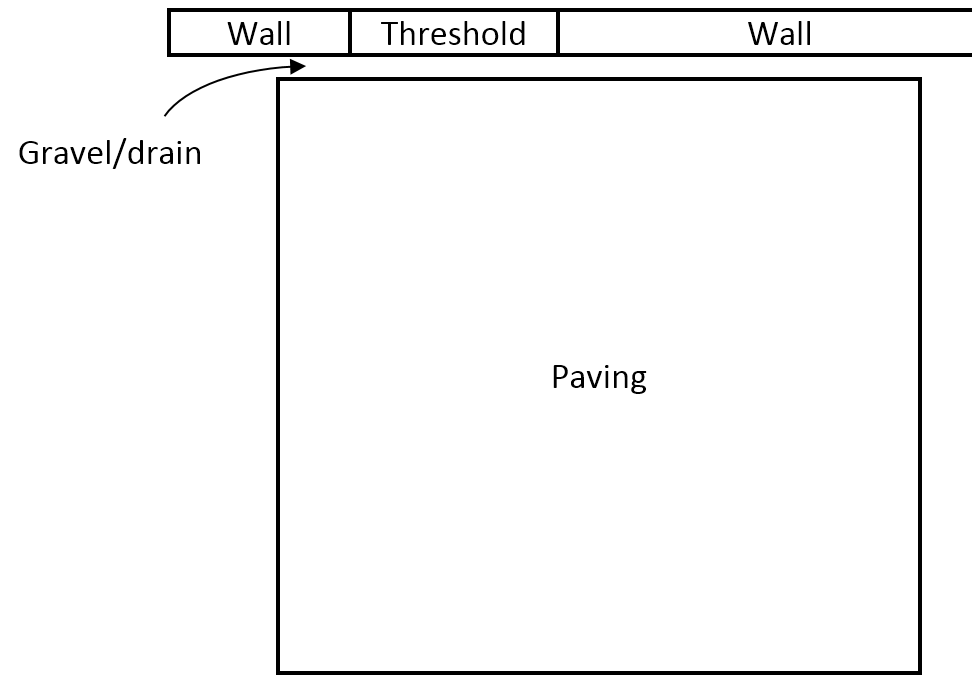
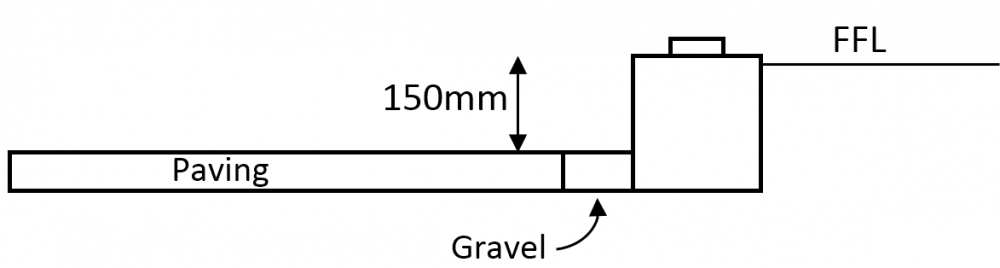
Hi all Slowly working my way through our remaining to-do list for sign-off and have hit the access requirements of Part M. To be honest, I've been putting off dealing with this, as I know we're going to at least incur some annoying costs. My preference would be to have a collapsible ramp that we can put in front of our step if anyone in a wheelchair ever comes to our house, but I suspect our (private) building inspector won't go for that! So before I talk to him about this, does anyone have any experience in this area? Quick explanation of what we have at the moment: there's a large, flat paved area that a car can drive up onto, with plenty of space for a wheelchair user to exit the car. I believe that satisfies the approach requirements. The paved area is about 150mm below the highest point of the threshold, which in turn is about 10mm above the finished floor level. There's an 80mm gap filled with gravel between the threshold and the paving that allows any water making it near the door (there's quite a large overhang) to drain away. Here are some very rough not-even-close-to-scale drawings (plan followed by section): I clearly need some sort of ramp to allow a wheelchair user access. Looking at, eg, the NHBC's guidance document, I should be building a 3m long ramp at 1:20, but that would be ridiculous in the circumstances. There are alternatives given for steeper ramps with landings, which would shorten the necessary ramp, although then I'd need to include a landing just outside the threshold which will leave me not much short of a 3m approach anyway! So what options are realistically available? The simplest one would be a temporary ramp made out of, eg, wood. That would strictly satisfy the requirements, although I suppose the inspector could argue that it's clearly a temporary structure and refuse to sign it off. I know someone (Jeremy?) knew of someone who cast a temporary ramp out of weak concrete and demolished it after completion, but that seems a lot of work and waste. Before I talk to the inspector, does anyone have any thoughts or ideas? Many thanks
-
Cordless Makita multitool with tool-less blade change, as was discussed on another thread by @Ferdinand I think: http://www.ffx.co.uk/tools/product/Makita-Dtm51Z-0088381667418-18V-Lxt-Multi-Tool-Bare-Unit
- 76 replies
-
- 1
-

-
- black friday
- amazon
- (and 1 more)
-
Surely the title of that article should have been "Pitch Perfect"?
.jpg.c21f3ac78c9b7efd90cbdcb312744dc5.thumb.jpg.7adcad4c0e384f5ecd7d56b0618df6e5.jpg)
