

.jpg.c21f3ac78c9b7efd90cbdcb312744dc5.jpg)
jack
-
Posts
7460 -
Joined
-
Last visited
-
Days Won
41
Everything posted by jack
-
.jpg.c21f3ac78c9b7efd90cbdcb312744dc5.thumb.jpg.7adcad4c0e384f5ecd7d56b0618df6e5.jpg) Our cats ended up going to another home. I got sick of being woken up every single night to let them in/out, since I'm the only one in the house who can be roused from sleep by noise. I don't miss them at all, and I'm sure the surrounding wildlife is pleased they're gone too.
Our cats ended up going to another home. I got sick of being woken up every single night to let them in/out, since I'm the only one in the house who can be roused from sleep by noise. I don't miss them at all, and I'm sure the surrounding wildlife is pleased they're gone too. -
The problem is that the zeitgeist - and more importantly the legislation - isn't interested in your beliefs about common sense. If you properly fulfil your obligations, then some numpty doing something stupid when your back's turned is far less likely to result in you being sued, or worse.
-
Bath Surround / Boxing In, and concealed pipework
jack replied to Onoff's topic in Bathrooms, Ensuites & Wetrooms
What the...? And I feel guilty for letting ours play for a couple of hours on the weekend! -
Exactly this. We have a camping stove and spare bottle in the garage. Worst case we need to cook on that once or twice, not the end of the world.
- 98 replies
-
- 1
-

-
- gas safe register
- lpg
- (and 3 more)
-
Am I being too sensitive or should I be concerned.
jack replied to MikeSharp01's topic in Surveyors & Architects
Come on gents, it's the festive season. Let's all talk nice. -
Am I being too sensitive or should I be concerned.
jack replied to MikeSharp01's topic in Surveyors & Architects
Agreed, but to be fair, you guys are a small minority within a small community that has self-selected itself on the basis of an interest in self-build that goes far beyond that of the ordinary person having a house built or renovated. I know a handful of people who've done large refurbs (double house size sort of thing) and built from scratch, and every one of them looked at me blankly when I asked what sort of insulation they are using (I didn't even bother asking about U values or airtightness). I was unhappy with our first architect. Not incompetent, but we didn't like what she was designing us, and the way she positioned the house on our block would never in a million years have passed planning. I'm hugely positive about the architect we replaced her with. He had great ideas, was technically excellent (with the possible exception of some of his weathering details) and really helped us think about how to approach house design. We would never have come up with the layout he suggested, but it works really well in practice. There are, of course, things I'd change in hindsight, but they aren't his fault. Design is an organic process, with lots of compromises, some of which aren't apparent until you're living in the space. Friends of ours had a highly awarded architect design them a house. It's a hugely contemporary glass thing to sit on a country plot. They've just had it costed, and the cheapest he's been able to find so far is over twice the budget he gave the architect. To be fair, I do think they (the friends) were ridiculously optimistic on price and indeed may have contributed to the higher costs based on their insistence on luxury spec throughout. It's also a difficult house to build, and I know lots of builders simply refused to quote. Other friends of ours used an architect to convert their bungalow into a two story house and are wildly happy with what he did. So what does this tell you about architects? Very little, I suspect. Like any professional qualification, it's just confirmation that at some stage you ticked all the boxes to get it. How good a practitioner you subsequently become depends on your talents, experience, motivation and a bit of luck. You should expect competence, and for most people that's sufficient (see first paragraph above!) If I found an error, I'd point it out to the architect and have them fix it. As you say, the "correction" isn't my responsibility. -
Yep, spring-loaded clips I believe. Just be careful!
-
Good luck.
-
Stick to your guns on this one, would be my answer. A year after moving in I can still see every compromise and imperfection in our house. I wish I'd stood up and demanded better in some cases.
-
I think they do keep an occasional eye on the forum, as they know they get discussed a fair bit. Suspect they don't get involved because they don't want to be seen to be touting their wares.
-
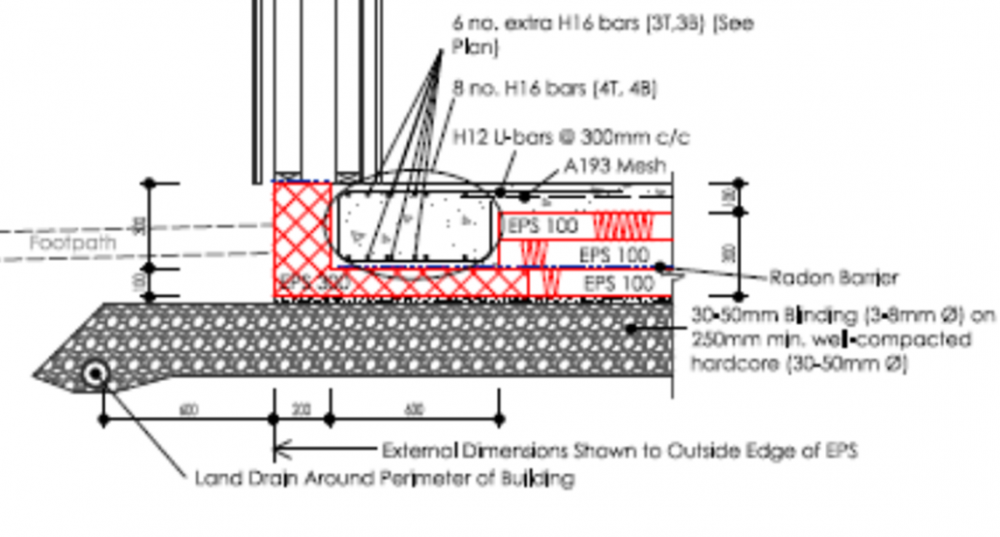
I was sure that we had 1 metre specified too, but looking at the drawings, all I can see is a perimeter land drain 600mm out. Maybe assume the worst (1m) and ask him to be ready to quote differently if you can get away with less once you've spoken with MBC? Also, have you tried Hilliard Tanner (MBC's consultant engineer) directly? I found him very approachable and helpful when we had a couple of issues along the way. His details are here: http://www.tsd.ie/aboutus.html Maybe he hasn't knocked off for Christmas yet!
-
" The tariff for new ASHPs will be increased from the current level of 7.51p/kWh to 10.02p/kWh. ... To deliver the benefits of this change as soon as possible, the tariff increases will be applicable to those participants who make an application on or after the date on which this document is published, though the increased tariff will only apply from the date on which the regulations which make these changes come into force."
-
Yes, although presumably this effect will become less efficient as the external temperature rises (which is fine - it's when it's really cold outside that you want to be recovering as much heat as you can anyway).
-
A few ASHP / UFH bits of information.
jack replied to ProDave's topic in Air Source Heat Pumps (ASHP)
Agree completely. I was always surprised by suggestions that a "slab" temperature could be controlled to within a fraction of a degree C. -
A few ASHP / UFH bits of information.
jack replied to ProDave's topic in Air Source Heat Pumps (ASHP)
Sounds about right. I wouldn't get too concerned about insulation - if the sensor is held in decent contact with the pipe (+ thermal gel), even a small amount of insulation will be more than sufficient I suspect. Doesn't sound like overkill at all. I have exactly those sensors (or perhaps the other type that's nearly as ubiquitous) wired into my home automation system: one in each of two positions in the slab, another two at different heights in the UVC, and two used behind switch covers upstairs and downstairs as air temperature sensors. I've stolen one of the UVC ones now and then to temporarily attach it to the UFH manifold. I need another couple to do slab temperature control, but it isn't a priority at the moment. That's the best reason to do anything like this. I just wish I had the time! -
A few ASHP / UFH bits of information.
jack replied to ProDave's topic in Air Source Heat Pumps (ASHP)
Are you saying that if a loop on the sunny side gets warm, its valve will close, so the heat won't be distributed (and, even worse, the temp in that zone will continue to rise because the fluid can't get out of the loop?) I guess that's potentially an issue if you have per-loop/zone control. With a smart enough controller (ie, not your usual thermostat), you could actually control the valve on the hot zone to open wider in this situation, so that the heat is shared/dumped more quickly with/to the other zones. You could also potentially do some clever things like averaging across zones to see whether you actually need more heat or just need time for the hot zone to blend with the rest. I must say though, if you have enough insulation under your floor, single zone control is a lot easier! -
A few ASHP / UFH bits of information.
jack replied to ProDave's topic in Air Source Heat Pumps (ASHP)
Not if you only have a single "zone", as many of us running a passive slab have. That said, it wouldn't much more difficult to track the temperature of the return on each loop as it comes up out of the floor. I've had good success just using some plastic wrap to hold a one-wire sensor against a copper pipe. How much slower will multi-layer UFH pipe be to react? Given the time constants involved, I suspect it'll be fast enough. -
Welcome Jane. Sounds like an interesting project.
-
Small wins - make a coffee break worth having
jack replied to MikeSharp01's topic in Party Wall & Property Legal Issues
Nice one. We were surprised to get something similar when we convinced the council not to charge us council tax on a non-existent property. In our case, my wife got a reduced rate initially, but then while looking for something else several months later I noticed that we were actually eligible for zero rating. A couple of phone calls and a letter, and we got a refund (might have been a credit, actually) for several months of half-rate council tax. A rare result! Better than we managed with our broadband. Shortly before moving back in, we realised that my wife accidentally didn't manage to terminate our broadband. Since there hadn't been a physical line in place for over a year, I requested a refund or credit now that we were about to reconnect. "Nope", they said. "We can see there's no line and that you haven't actually connected to the service for over a year, but we were providing the service ready for you to do so at your convenience". I pointed out that we were moving in shortly and whether I would continue with them would depend on their answer. The guy checked with his manager, the answer was no, so we cancelled it immediately and will never, ever use them as an internet provider again. Superb long-term thinking on their part. Still in negotiations with our water supplier about paying for surface water drainage. We've pointed out that we no longer discharge into the drains, so should no longer be paying them to take surface water. They're now asking for proof, so the next thing is to show them our drainage plans and proof that the house was demolished last year. We'll see how it goes! -
We have a 250L UVC with 5kW ASHP. Seems to work fine. As discussed elsewhere, we boost the top part with the immersion every morning but probably don't need to. We've never run out of water in a year living here, although admittedly our water pressure is a bit low at the moment (temporary restrictor fitted by plumber to make absolutely sure we pass water calcs). We have two young kids who tend to take longish showers unless you continually hound them out of it. My wife and I both shower at least once a day, and what with sport, gym, etc, I'd say we average 5-6 showers a day between us, of anything between 4 and 10 mins each. We do have shower waste water recovery, and I'm convinced that helps a lot. One thing you could consider is plumbing in the basics for a second cylinder and seeing how you get on with just the one. If you make the room now and put the main pipework in place, it won't cost much, and you'll avoid outlaying for something you may never use. My inlaws have 2 x 250L in their 5 bed house with just the two of them(!) They basically turn one off unless they have quite a few guests. Personally I think they could do with just one by leaving the immersion running constantly on the odd weekend when they have guests. You might consider something similar as well, especially if your peak needs are going to only be occasional (might depend on how often you actually use the baths) . Bear in mind that although the occasional immersion usage seems wasteful, you have half the standing losses with a single tank. To be fair to her, she hasn't seen the restrictor you're going to hide in the plumbing to said shower!
-
Protecting Doors and Thresholds
jack replied to worldwidewebs's topic in General Self Build & DIY Discussion
That still leaves the problem of getting them to actually use it when you aren't watching! We built a nice, easy to install frame that I put in place each morning to protect the main door when I arrived on site. Worked a treat, until one afternoon when I was off somewhere, and someone decided that it would be easier to remove the frame to get a big bit of heavy machinery through the door rather than spend a few minutes breaking the machine down so it would fit through with the frame in place. Bingo - nice big gouge in the powder coating on the door frame. I suppose I should be thankful they didn't deny it when I saw it on the way back in. -
This is probably the best place to start: http://forum.buildhub.org.uk/ipb/forum/66-roofs-general/
-
Welcome to buildhub Jazzy!
-
A Little Aside On Radiance
jack commented on TerryE's blog entry in The House at the Bottom of the Garden
This agrees with our experience. In our house, downstairs (where the UFH is) is always warmer than upstairs, despite us having double-height areas and a massive space for the stairs (which themselves are open tread). -
One thing to consider is some sort of enclosure for deliveries. I haven't had a chance to look more closely yet, but I'm thinking of building a bin enclosure (a more stylish version of this) near the pedestrian gate at the end of our drive and incorporating something like this at one side. Remains to be seen whether it can be done without looking shite.
.jpg.c21f3ac78c9b7efd90cbdcb312744dc5.thumb.jpg.7adcad4c0e384f5ecd7d56b0618df6e5.jpg)
