

.jpg.c21f3ac78c9b7efd90cbdcb312744dc5.jpg)
jack
-
Posts
7460 -
Joined
-
Last visited
-
Days Won
41
Everything posted by jack
-
Okay, thanks very much Jeremy. As mentioned in a recent pm, lunch is on me at some point in the near future. At this rate it'll have to be somewhere Michelin starred!
-
I bought a pair of Milwaukee magnetic bit holders for impact drivers, one for the drill and one for the impact driver. They've both lasted for nearly three years with no signs of giving up. A bought a pack of 20 Erbauer impact driver bits at the same time and I still have half of them left (and not all broke - some have been lost). I was genuinely surprised at how good they were for the price. I once had a go with one of the cheapo ones that came with a crappy old drill and it managed to screw in about 5 tough screws before shredding itself.
-
You're too kind Jeremy! Honestly, I don't mind buying one - I'm sure you'll find a use for yours at some stage.
-
Interesting. We still have the temporary 1.5 bar PRV on our incoming main. Our plumber installed it as a failsafe, to ensure if building control decided to test anything, there'd be no chance of it failing. Of course, since we've delayed so long, we've been stuck with this for ages. We do find that the shower pressure noticeably drops during a water softener recharge cycle, or if someone turns on a tap full bore, but that's hardly surprising at this pressure. I was going to install a 2.5 bar unit, but it looks like maybe a variable one would make more sense, so we can tweak it to the setting that gives us the best results.
-
That is a steaming pile and no mistake. What's going on the outside of the SIPS? If it's render board or the like, then the battens will hold the membrane in place, surely?
-
We very nearly had these on our house, along the lines of the pinned example, but couldn't get the roof pitches to work for us aesthetically.
-
I know, it's mental. 11mm internal diameter is less than a third of the internal area of 22mm pipework. I don't know what the practical impact on flow rate and pressure would have been, but best case it would likely have been noisy.
-
I was looking at buying a couple of years ago and all the reports say that the older they are, the better the quality. The new ones are apparently a pile of cack.
-
I spent far too much time reading about water softeners before we chose one, and I definitely recall saying that occasional use of hard water (eg, if your softener temporarily runs out of salt) make no difference at all. Indeed, installing a softener will allegedly slowly break down existing deposits over time. Harveys make a big deal about their twin tank system ensuring that softened water is always supplied, but I don't think it's that big a deal. Re: the pressure drop, what size flex connectors did they supply? Mine was supposed to come with 22mm "full bore" connectors. The flex connectors supplied each had a 10-11mm diameter restriction at each end. I rang the supplier and told them that they'd supplied me with the connectors for the smaller kit. They sent new ones, but of course, it turns out that's what they actually supply. My plumber was frankly a bit of a dick about it, and tried to say that he'd been put in an awkward position with his supplier, but didn't have much to say when I asked him whether 11mm seemed like "22mm full bore" to him. In the end, we binned the flex connectors and connected it with Hep2O instead.
-
Good spot, thanks!
-
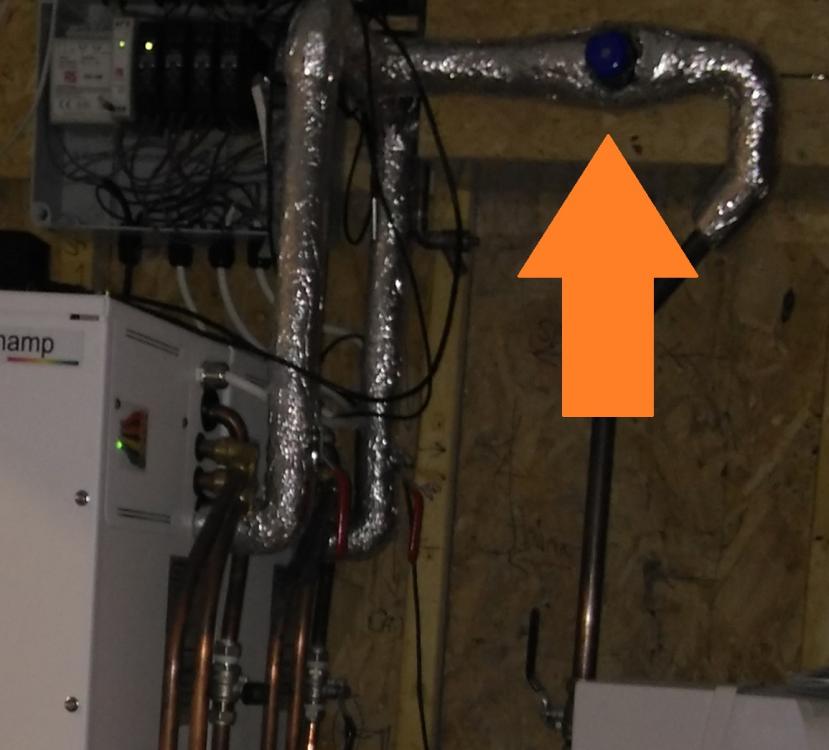
I know what a Willis heater is thanks (I seem to recall discussing whether to install one as the primary immersion way back on ebuild when doing our initial design), I'm just interested in how Terry's arranged it within his system. The arrow I put in the pic above points to something vaguely the right shape, and I can't see anything else suitable in the pictures.
-
Is this the Willis heater? How's it plumbed in? Is it in a bypass loop?
-
Interesting stuff @TerryE, thanks for sharing. Do you have handy a schematic and/or photos showing how and where you've installed the Willis heater? We're about to have some work done on our heating circuit and it would be a good opportunity to plumb in at least a connection point for a Willis heater for backup. Many thanks.
-
.jpg.c21f3ac78c9b7efd90cbdcb312744dc5.thumb.jpg.7adcad4c0e384f5ecd7d56b0618df6e5.jpg)
What does First Fix really mean?
jack replied to ToughButterCup's topic in General Self Build & DIY Discussion
This, this and this. We took hundreds of photos, and they've been incredibly useful. Even so, I wish we'd taken more - a full set as soon as the studwork went up, and another set after each trade finishes (or periodically if they're all working at the same time). You mention your electrician - oddly enough, our electrician was obsessive about this (he's the one that encouraged us to do this) and took a lot of his own photos. Occasionally, the ones he's taken have shown the relevant bit that we've missed or had a poor angle on. -
What does First Fix really mean?
jack replied to ToughButterCup's topic in General Self Build & DIY Discussion
Yep, exactly this. Drain runs can be hard enough even going first if they haven't been planned in advance. -
See page 26 of Part F - the minimum area is 7600mm2. I guess this is roughly based on a standard 2'6" door (7620mm) and a 10mm gap. Wider doors can get away with a bit less. This is the architrave detail we used.
-
I think you should balance the system with the doors how you usually have them. For example, our bathroom door is closed for less than half an hour a day. Bedroom doors are almost never closed. The only doors that're regularly closed are those on the utility room and TV room.
-
If you need to meet building regs, you strictly need to have a particular cross-sectional area, which ends up being 10 or 15mm (can't remember) across a standard door width.
-
The recommended gap is either 10mm or 15mm - I can't remember. It's a lot though! There's a formula for the size of the aperture, so you may get away with less if you have a wide door. I did a concealed gap in the top of the door frames, but I'm not sure it's actually worth it, especially given how infrequently doors are actually closed in our house.
-
Not a bad idea. I wonder whether it would leave it feeling top-heavy?
-
No, I've never noticed this with ours.
-
I just wanted to buy a garden but had to buy the house!
jack commented on mike2016's blog entry in The Fun Irish (House)
Great story, thanks for sharing. Careful with the magnolia paint. Too much and you could end up accidentally making the house worth a lot more. -
UFH in slab or screed, eps or pir insulation?
jack replied to Tin Soldier's topic in Underfloor Heating
It probably depends what's going on top. We have EPS 100 under most of our MBC slab, with EPS 300 under the ring beam and areas of high load. That's a structural slab though, which has to handle the weight of the entire house. I haven't read everything above, but if it's just a floor slab that isn't bearing any walls, EPS 70 may be fine. That said, it depends very much on what you're actually doing - I'd be checking with your engineer or the suppliers (and building control officer) for advice before committing to a solution. -
I also wish we'd thought about this at the planning stage. MVHR is great, but during hot periods in summer, the only way to keep the house cool is to leave windows open overnight. While we're not near any significant watercourse, we do seem to get a few mosquitoes in overnight. There are roll-down and magnetic screens available, but they look a bit cack in my opinion. Perhaps if you plan to integrate roll-down screens from the start, you can conceal them so they're aren't so obvious. You also have to consider whether your windows open in or out. If they're inward opening, you really need an external screen setup, and vice versa.
-
I've heard mixed reviews about Milwaukee. Apparently they used to be top drawer, but were bought out several years ago and quality may have suffered. AvE has covered this in passing more than once on his Youtube channel. His review of one of the largest Makita cordless drills is here. By coincidence, I'd already bought the Makita DHP481Z, which is either the same as the one he reviews or very similar. This thing is a serious bit of kit. Amazing torque. I used it to drill about 30 x 12mm holes through softwood to the full depth of the bit, and the motor speed didn't drop even when being pushed hard with the bit buried to the chuck. I burned out a cheapo corded drill from Homebase doing something similar. One thing though: it's heavy! I wouldn't want to be spending a lot of hours holding it overhead or at odd angles unless you have more masculine wrists than my dainty things. Looking back, I seem to have gotten a good deal (£105 delivered) from FFX when I bought it about 18 months ago. I also have the basic model Makita LXT impact driver, which again is amazing. I used it to drive long galvanised carriage bolts into the holes drilled above and again the whole experience was effortless. These were the first time I'd ever spent money on decent tools and there's just no way I could go back to cheap tools again. I'm sure you'd get a similar experience from DeWalt and others, but I'm very happy about having gone down the Makita route. Oh, and I use generic 4AH batteries, and they're brilliant. To be honest, unless you're drilling all day, you'll be hard pressed to empty one of these of charge in a hurry. Takes only 25 mins to charge from empty as well.
.jpg.c21f3ac78c9b7efd90cbdcb312744dc5.thumb.jpg.7adcad4c0e384f5ecd7d56b0618df6e5.jpg)

