Mike
-
Posts
1565 -
Joined
-
Last visited
-
Days Won
9
Everything posted by Mike
-
It looks like the Titan-Pro Sump comes with 50mm pipe reducers, and 50mm dry traps are available - such as the MacAlpine MACVALVE-4. BS 8102:2022 still includes it and NHBC still allow it, so there's no obvious restriction. Types A+C or B+C would still be my preference.
-
A Thermal Master P2 is currently heading my way. https://thermalmaster.com/products/thermal-master-p2
-
He's talking about the design temperature (i.e. the worst case the heating should cope with), and is correct in saying that when the outside air temperature is -3%C, the temperature below the floor will be warmer than that (he suggests 8 to 11°C). With good insulation, the soil temperature may remain be in that range throughout the heating season. With poor insulation the soil temperature will rise much higher than that as the heating season progresses, because the UFCH will be - wastefully - heating it up.
-
Yes, to create the Coanda effect. At the airflows involved, that shouldn't be an issue. It's because it's easy to adjust the flow at the valve during installation (25 different positions with that particular valve), avoiding the need to manually screw the valve in or out by X number of turns / avoiding the need to go backwards & forwards & cut sections out of a restrictor at the manifold.
-
I've used various respirators over the years and found that most of the filters became unobtainable. Now it's 3M only, but if you're planning to use them only for a single project it matters less.
-
In terms of comfort, UFCH provides a different quality of heat (even temperatures, with little variation in temperature between the floor and ceiling) compared to radiators (several degrees temperature difference from floor to ceiling + circulation of the air) and, when feasible, I choose it every time. Economically, the position is more complex. All things being equal UFCH is generally reckoned to use less energy, but things are rarely equal: The floor will be hotter and can therefore loose additional heat, so you need good floor insulation to compensate for this - preferably significantly more than you would get in a standard new-build, though at least recent regs require some heat resistance. On the other hand, high temperature radiators placed on outside walls - as they often are - also cause additional heat loss to the outside. The very low variation in temperature between floor and ceiling with UFCH means that the overall temperature of the rooms can be lower, so using less energy than radiators, which tend to be turned up at least a couple of °C higher to deliver a comfortable temperature at sitting height (and more than that if the radiator controls aren't well chosen or controlled). It also depends on occupancy and when you use your heating; with radiators it's easy to heat only during hours of use as they can deliver heat quickly (at least from a gas boiler), whereas with UFCH the whole system takes several hours to respond to a change in settings. Wet UFCH is the preferable - you can then use and switch between any suitable heat source over the life of the pipes, whether that's a gas boiler, heat pump, district heating, electricity, or whatever.
-
Suitable ducting
Mike replied to Tommy8884's topic in Mechanical Ventilation with Heat Recovery (MVHR)
Only if it can be jointed to pipes to BS EN 12237 sized joints - which is very unlikely. -
Yes if it performs well in the Passivhaus database, which lists models that have been independently tested to more accurate standards than those required in the UK and those used by manufacturers: https://database.passivehouse.com/en/components/list/ventilation_small. Vent-Axia do have 3 models in the database, but the Plus B isn't one of them. BTW, the 'Efficiency Ratio' (which takes into account electricity used as well as heat recovered) is the key figure for comparison. For example, the near-identical Zehnder ComfoAir 200 & 225 models both have a heat recovery rate of 92%, but the 225 has more efficient fans so has a higher Efficiency Ratio (0.69, rather than 0.67).
-
Cork is expensive, but a remarkable insulation material, however... ...if you have enough depth between the rafters, or are prepared to sacrifice head height, then that would b my preferred option. If it was installed without an external airtightness membrane, then it could be due to air movement.
-
Given any experiences you have had, what would you choose tomorrow
Mike replied to Makeitstop's topic in Windows & Glazing
And there's now another reason to add to the list. It's been reported in France that burgers have been meting PVC windows with a blow torch, so they can access the locking mechanism - https://www.dna.fr/faits-divers-justice/2025/01/28/les-cambrioleurs-faisaient-fondre-les-fenetres (in French) -
Are we targeting ASHP's at the wrong market?
Mike replied to ProDave's topic in Air Source Heat Pumps (ASHP)
The French budget, voted through last week, increases VAT on the supply & installation of gas boilers to 20%. It had already risen from 1st January this year from 5.5% to 10%, so a hefty increase, which hasn't been universally welcomed for multiple reasons: https://bati.zepros.fr/actu-generale/budget-2025-mesures-batiment-plutot-bien-accueillies (in French). It would certainly tilt the balance in favour of ASHPs if adopted in the UK (where, I think, they are currently zero-rated but due to revert back to 5% on 1 April 2027). -
I liked the look of them too, but decided against them because of the lack of a Coanda effect and lack of 'safe' placement options in my apartment. If you have larger rooms with have enough space to place them carefully, then they're not likely to be a problem. Though, from memory, I don't thing there's Zhender-type sock filter that you can add to them.
-
It will be a few °C in winter. For a real-life example: "In my bedroom the vent is about 0.5m to the side of the bed head and I only notice it on very cold nights." https://forum.buildhub.org.uk/topic/25366-directional-vents-diffusers/#comment-388570
-
As you turn down the airflow on a Coanda-effect diffusers the mixing-distance will certainly decrease; no doubt there's a formula out there for that. If you turn down the airflow on a regular diffuser the air will increasingly tend to fall vertically (if it wasn't already being pointing straight down) as cooler air is denser, and you wouldn't want that over (or close-to) a bedhead, for example.
-
You won't find flush ones, but those from Cavius are (or at least were when I bought mine) marketed as the World's smallest. Some have optional recessed bases to make them even less prominent.
-
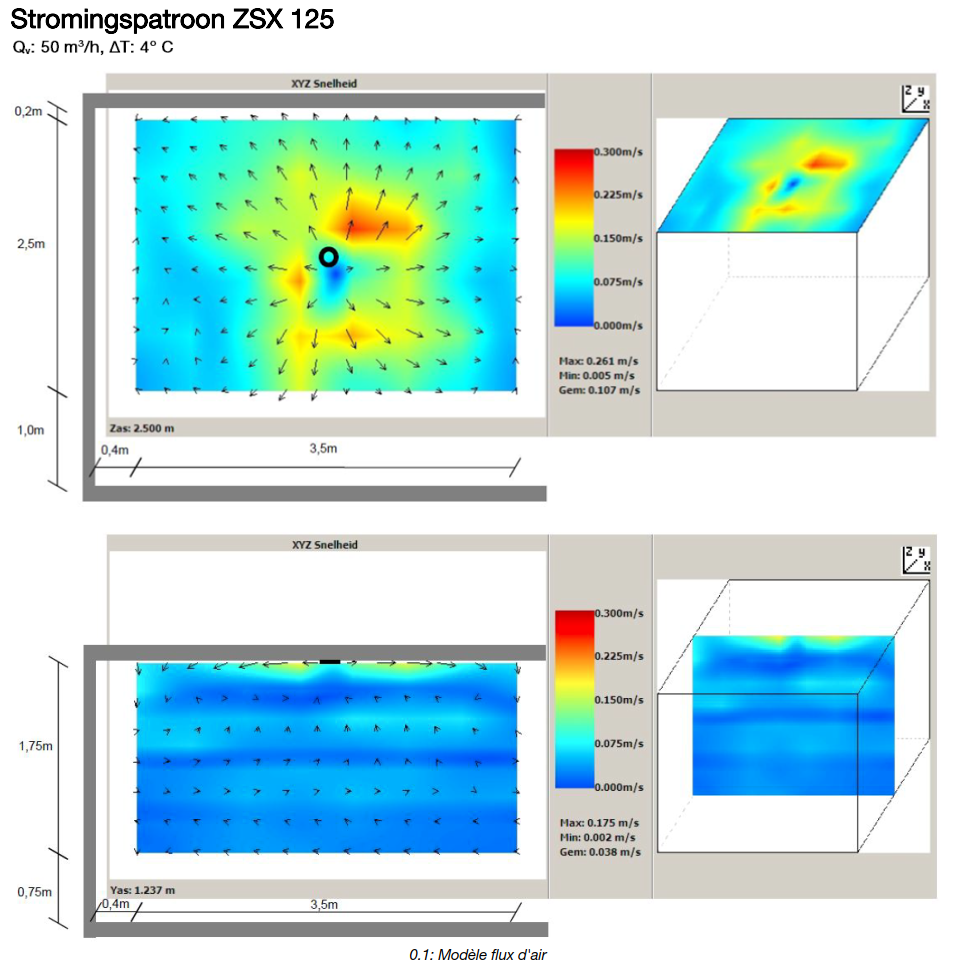
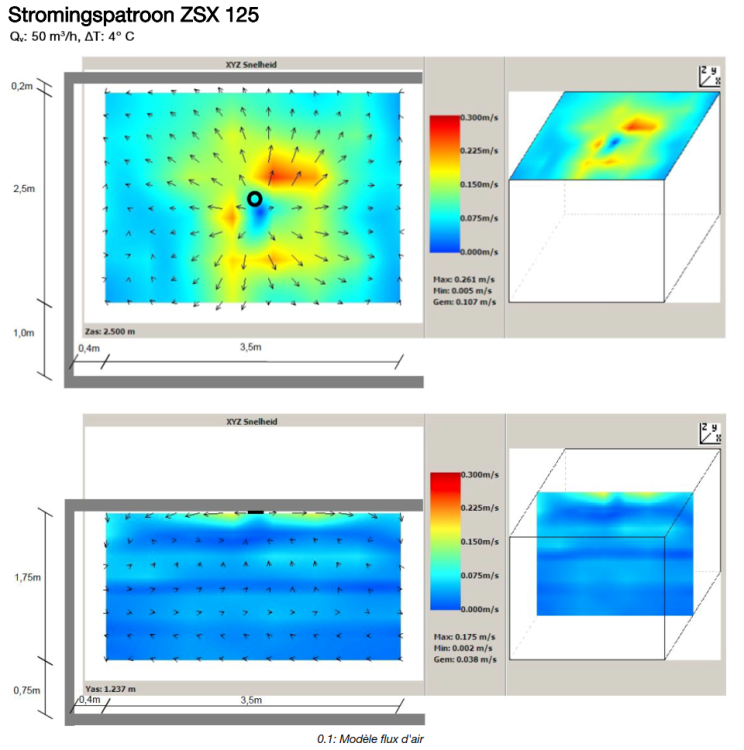
Wall-mounted Coanda effect vents are indeed very useful to protect supply air across large spaces. However domestic ceiling mounted Coanda-effect vents have the opposite effect and a different benefit. They're intended to mix the supply air (which will be a few °C colder than the room temperature in winter), with the room air, while the airspeed drops, the two effects combining together to avoid cool drafts. Here's an example in a domestic-sized room using the Zehnder ZSX 125 Coanda-effect diffuser; the colours show airspeed, but if you mentally swap them round (so blue = warmer & yellow = cooler) that would be more-or-less the temperature distribution. In a small room, especially a bedroom, where you can't avoid having a vent near a bed, that can be pretty useful.
-
All sounds good. The only reason I chose 'full' plaster was to even-out the undulations in the old brick / stone walls, so that the IWI had a snug fit.
-
Where I have internal wall insulation I've done similar with the ceiling joists on my current project - though plaster rather than just parge - where they meet brick / stonework. In the unheated & uninsulated entrance lobby the gaps between are filled with FM330 for airtightness. I also have a mansard wall where the joists sit between timber beams above and below. Those have also been foamed with FM330. Both solutions are perfectly airtight.
-
I'm using the same model and that is indeed their minimum distance. However I've seen it recommended that Coanda-effect vents should be >750mm away from walls, though I can't give you a reference for that. But since they disperse the air across the ceiling in all directions, there is no need to squash them in a corner. I'd prefer that in principle too. However if they don't protrude from the ceiling you don't get the Coanda effect; instead the air will blow in whatever downward direction the vent deflectors dictate, albeit gently. That's not a problem if you have space to site them away from where they may cause a draft, but not so good in a smallish room where you don't have that freedom. At lest the Zehnder Luna protrudes less than most and they look reasonably good.
-
If you have a stove <5kW, and if it doesn't have a flue draft stabiliser, and if the design air permeability of your house is >5.0m3/{h.m2), and if the manufacturer doesn't say otherwise, then the Building Regs say you don't need a permanent vent. Though why they use the design air permeability instead of the actual air permeability, I don't know. However you are planning to have more than one stove, so logic dictates that you'd need to add the outputs together and still be <5kW - which seems unlikely.
-
Building Regs Part H, section H3, sets out how to calculate the required gutter capacity. Your chosen gutter manufacturer will have information on the carrying capacity of their gutters when laid flat or to falls & the distance between down pipes. You need to match the two up to get your answer. By using a string line to set out the brackets
-
Cellulose-filled, cold, flat roof. Design & specification challenges help
Mike replied to Dunc's topic in Flat Roofs
Just been looking for an answer to that question and found a partial answer in this guide to BS5250 : https://assets.ctfassets.net/cd81nrotvav2/ujVUWjeQFoihtJkYoWsxY/878731b5e0c188d85afad93ba1dac78b/BMI-BS5250-Pitchedand_flatroofingguidanceAugust2021.pdf Page 7 shows a section of a cold pitched roof with a cold flat roof at the apex - not quite what you have, but on the right lines - that says "If the span of the flat roof apex is more than 5 m then additional ventilation to the cold roof space to a minimum free area of 5,000 mm²/m should be introduced, as close as practicable across the midpoint of the flat roof apex." You'd have to ask if anyone will confirm that as suitable for your monopitch version. -
Spit on! I shouldn't rely to stuff at this time of the night...
-
Cellulose-filled, cold, flat roof. Design & specification challenges help
Mike replied to Dunc's topic in Flat Roofs
Why did he design it then?! The best solution would, of course, be switch to a warm roof design. Failing that, you could add breather vents in the flat roof - Klober do a range, for example, but so do others. I'm not sure where the Building Regs have hidden the provisions on ventilating roofs, but it used to require vents equivalent to a % of the roof area in the case of large / complex roofs. If nobody else chips in, then the manufacturer should know, if your architect doesn't. -
Me too, for the quality of the finish as much as anything else (provided you find a good plasterer). However well dot & dab is done, you're guaranteed to see the joints in at least some lighting conditions.