


Mike
-
Posts
1565 -
Joined
-
Last visited
-
Days Won
9
Everything posted by Mike
-
I wouldn't put the ceiling supply vents right in the room corners & so close to the walls, particularly in the bedrooms. Many such vents use the Coanda effect (which is recommended) so that the air disperses evenly across the ceiling. However, if a wall is in the way, the air will be deflected down the wall and may cause an unwanted draft; from memory 750mm is the recommended minimum distance from a wall. Zehnder's Luna S (and probably others) have an optional deflector that can be inserted to get around that. What @JohnMo says. Just add a double pipe to the extract over the sink. Zehnder's advice is to place the extract near a shower, but not within / over it.
-
Good to see the pictures - it looks excellent!
-
When the storm hits is a great opportunity to detect the leaks - if the wind is strong you'll be able to detect if by feel. Just as useful as a second blower-door test!
-
Yes, the Regulations require fire door sets; that is a door + frame tested & certified together.
-
Well it would be against the Building Regulations - though you'd only be prosecuted if you survived the carbon monoxide poisoning. You'd need a 'room sealed' stove installed in according to the manufacturer's guidance - I've only seen horizontal of under-floor supply pipes. The alternative is to knock a hole in the wall and install a permanently-open vent, in accordance with the dimensions in Part J of the Building Regs. If it's only a decorative effect you want, block the flues, install a TV screen inside an old stove and set it to show a flame video.
-
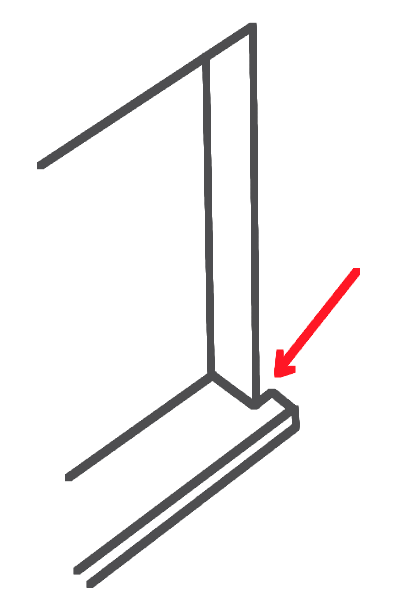
Sounds good, though I was thinking of something a little different! A sill would normally project through the render, where the red arrow is below (looking at the outside now, not the inside). But if you're rendering before the window's fitted, the render will be in the way, unless you make some provision for it, or have another solution - stone sub-sill maybe?
-
Slight deviation from the topic, but what are you doing for the window sills? They're not part of the window - or they are and you're pre-shaping the render to fit?
-
A very interesting history! I've not seen earth mortar before, though in several regions of France they built (as recently as 100 years ago and occasionally still today) 5 or 6 storey buildings from a mix of earth and stones, compressed in-situ (pizé) - so it can be very strong, if protected from the weather - they're usually covered in a lime or clay render. You'd certainly never use cement on them. I've just taken a look online and, if you're not already found it, there's a short pdf on clay mortars here: http://openarchive.icomos.org/1801/1/Historic Environment Scotland_Mortars for Masonry Buildings.pdf which, states that "most clay-bonded walls were externally pointed or harled with lime mortar to provide additional protection from the weather". There is a phone number at the back for Historic Scotland's technical advice department, though it looks like you've already talked to them. But maybe they can help with the identify the mix used, if you can find any original pointing mortar behind the existing. Having just looked it up, the process for what we now call 'natural hydraulic lime' wasn't developed until 1756, so lime putty would no doubt have been used - perhaps burnt & slaked on the estate if there is limestone in the region. Lime putty & sand, probably using a 1:3 mix, would therefore be my fist choice. That would mean repointing it slowly, starting no earlier than Easter so it has the best drying weather. There are courses you can go on to learn more if that interests you. Failing that, I'd go with the 3:1 NHL3.5 to sand, as per @jfb.
-
Suggest that with your reasoning & see what they say. I've used Tescon Profil too - it's easy enough to use, just takes a little time. Have some acetone on standby to clean your hands and scissors as it's rather sticky.
-
Willis heater UFH. Heaters in parallel or series?
Mike replied to Russdl's topic in Underfloor Heating
Good idea. I'll report back... That's possible. As above, it's nominally set to 40°C, but the dial on an an immersion stat isn't a precision instrument and the only temperature gauge is the one on the manifold (the one reading 38°C), so I've no way of knowing how close the Willis is to 40°C in reality. It will be getting a set of sensors & a Pi control system once the rest of the refurb is done - in time for next winter, I hope! -
If the build is as old as a 600mm thick rubble-filled wall suggests, then the chances are that it's lime mortar, so I'd repoint in that to maintain / restore the vapour permeability & flexibility of the original mortar. You'd need to knock through the existing pointing to see what's behind if you think the original could have been cement-based, but that's only been commonly used since start of the 20th century. 1:3 NHL3.5 or NHL5 to sand would be the easy mix; since it's granite the latter would typically be chosen to match the hardness of the stone (NHL5 is usually, though not necessarily, stronger than NHL3.5). Lime putty would be the traditional material with superior properties (more permeable & flexible), but would be harder to use on granite - it would take longer to dry - and isn't suitable if the wall is regularly wet. Having said all that, I'm not a lime expert.
-
I aim for 7.5mm (all round) to give some tolerance - so it it ends up being 5mm or 10mm, no problem. I wouldn't object to 10mm too violently - it's just that if it ends up at 12.5mm in practice, then it starts getting fat for the external sealant. I'd ask them what their plans are for underneath - it could be that they'll also fix the window using mechanical brackets down the sides. Or they may plan to use temporary wedges (not all the way through) while the foam sets.
-
Illbruck FM330 is very good stuff. If you have of suitable gap between the window and wall (at least 5mm - I prefer to aim for 7.5mm) fully filled with FM330, then it will be airtight. If that gap's too narrow to ensure full foaming, then it may not be. If it is properly foamed, then whether you then need an airtight tape or not depends on the rest of the structure. For example if you have an internal VCL that needs to be sealed against the windows, then you may well need a tape to do that. But I think you're using ICF - so chances are it's not needed, but it depends on exactly where and how you're fitting the windows. We'd need a detail drawing / sketch of the window-wall junction to advise further.
-
Hi, and welcome to the forum! I've seen 2,300mm in new builds and it was fine, so I'd not worry about that, but wouldn't go lower. I'd be more concerned by having only 2,000m in the loft rooms. Once you get below 2,100 it does start to feel oppressive. And if your struggling for that much space I wonder what it's going to do to the external appearance. I'd probably take a look at options for a regular extension first.
-
Willis heater UFH. Heaters in parallel or series?
Mike replied to Russdl's topic in Underfloor Heating
It's at 0.7m and reports 2W & 0.1m³/hr. But just below 0.2m³/hr, so somewhere in the 100 - 200 litres/hr range as it only displays to one decimal place. The latest generation (launched 2018/2019?) did improve the efficiency, so that will one reason the power is low. As it's UFCH there are plenty of smooth bends, but hardly any elbows or tees to hamper the flow and, being an apartment, no second floor to pump to. -
Willis heater UFH. Heaters in parallel or series?
Mike replied to Russdl's topic in Underfloor Heating
It's the latest generation of the Wilo Yonos Pico (type 25/1-4), running in UFCH (constant differential pressure) mode. It will go right down to 1W; there's a digital display that shows the power consumption & flow volume. -
Willis heater UFH. Heaters in parallel or series?
Mike replied to Russdl's topic in Underfloor Heating
That's interesting, I've never seen temperatures even close to that after 6 hours of running... Out of interest, what size is your UFH system? Mine is 824 meters of pipe (no idea how many litres that equates too). I've 5 circuits totalling 273m of pipe, 16mm diameter. If that has a wall thickness of 2mm that would be a capacity of about 31 litres, so call it 40 litres with the manifold, heaters & associated pipes. Pumping at between 100 & 200 litres / hour and assuming the manifold thermostat does no blending, that would circulate the water through the whole system every 12 to 24 minutes. The pump only tells me in 100 litre chunks, so not sure exactly where it is on that scale. On the same basis your system would have a capacity around 102 (93+9) litres, or 2.6 x the capacity of mine. So, at the same pump setting as mine, it would take between 30 and 60-ish minutes for one complete circulation. I've seen various figures suggested as optimum in the 5 - 10°C range. I don't have any calculations to justify my current setting - it just seemed like a good starting point to adjust the flow so the heater was running near the maximum I set it to (nominally 40°C) without it hitting the limit and switching itself off. -
Sadly it's not quite that easy. Just had to look it up, but the calculation is set out in BS EN ISO 10077. I can't spot an example in English, but if you turn to page 9 of this document in French, and look for Calcul de la valeur U, you'll see that there are quite a few terms in the formula: https://vitrocsa.com/wp-content/uploads/2017/11/certificat-v32-calcul-valeur-uw-et-isothermes.pdf BTW, it does occur to me that the Glass & Glazing Federation has a free conciliation service that you might consider, if your supplier is a member. Details at https://www.ggf.org.uk/complaints-service/
-
That's certainly more scientifically calculated than my interim finger-on-pipe method! But I guess you were intending to post in this thread?
-
Yes, you'd likely need that for the technical part. Another aspect would be to review the documentation, which you could do yourself - what you asked for, what they offered, what their quote / emails / brochures / website / said: i.e. would it be reasonable for you to believe that they would be installing a high-performing window, free of condensation, based on that documentation.
-
Willis heater UFH. Heaters in parallel or series?
Mike replied to Russdl's topic in Underfloor Heating
I'll qualify this by saying that mine is still running via a (suitably rated) extension lead, so I only have the temperature gauge on the manifold & finger on pipe to work with. So, based on my limited experience (the end of last winter and this), I suspect that you're just running the pump too fast. After experimenting manually with different settings, the pump tells currently me that it's running at 2W, pushing between 100 & 200 litres / hour, which seems to work well; It has no trouble reaching it's maximum of 38°C within a short space of time and without the heater cutting out. FWIW I corresponded with Elemex (one of the manufacturers of Willis heaters) on the topic when planning my system, who advised that "circulating of the pump /flow rate and heat transfer would ideally want to be smartly controlled to find the most efficient flow-rate : heat transfer ratio". Which I hope to do next winter. I do have twin heaters (pic), but only one active. That's mainly so that I can switch power from one to the other if/when a thermostat packs up; they're both permanently in the flow. And maybe so that I can get to temperature more quickly from cold / to take advantage of cheap-rate electricity. -
That's impressive! A very good point - a single start-to-finish solution would be much easier than the multiple moves that would be required to get it from van/pallet -> street -> corridor -> courtyard -> hoist -> floor -> final position. As long as a Zonzini can cope with semi-spiral staircases as well as straight flights, and provided the battery will hold out to the 6th floor.
-
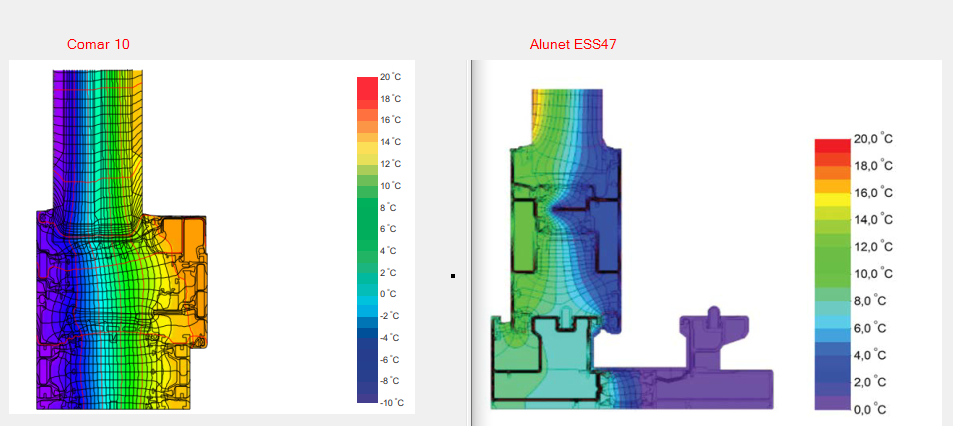
That's useful. Their technical manual (https://www.alunetsystems.co.uk/wp-content/uploads/ESS47-CATALOGUE_ALUNET_JUNE_2023.pdf gives the u-value for the frame as 4.18 W/m².K - which is poor. For comparison, the first Passivhaus-certified aluminium window I can across from a UK company (https://database.passivehouse.com/en/components/details/window/comar-architectural-aluminium-systems-the-parkside-group-limited-comar-10-1657wi03?), has worst-case frame u-value of 0.77 W/m².K, which would therefore loose 82% less heat through the frame. You see the difference in these isotherms. The Comar 10 keeps the cold on one side and the warmth on the other. The Alunet doesn't. Good to know that it has made a useful improvement. Unless it's changed, Build Regs specify a minimum u-value for the window as a whole - the average of the glass + frame, subject to it also not being worse than what was taken out. Probably not a lot else that can easily be done. I guess that other course of action would be to claim that you had been mis-sold the windows and / or to claim under the Consumer Rights Act 2015 that they're not of satisfactory quality - but you'd need to research that.
-
Thanks! I've added it to my collection. At 704mm high the 40L version - confusingly named the 50 - is interesting, but the manual requires a minimum of 500mm space below (and 50mm elsewhere), which is disappointing. The Ariston may require less (they don't mention it in their information), presumably determined by the length of the sacrificial anodes rather than the tundish as the discharge pipe connects to the top. Although I'd hope that my planned phosphate dosing water treatment device would avoid them having to be replaced in practice.
-
You are deluded if you think the SA can be anything other than floor mounted? Even more so in a confined space. It's a genie lift job for something like this, and if it ever fell on top of someone then the are brown bread mate. These things feel as if they are full of dark matter... @Jeremy Harris what say you on these being installed, elevated, in a confined space, in an apartment? Sorry - I was referring to the Telford Tempest suggested by Nickfromwales; I should have obviously quoted that in my reply to avoid confusion. No, I wouldn't want to suspend a SunAmp!

