Bitpipe
-
Posts
4118 -
Joined
-
Last visited
-
Days Won
53
Everything posted by Bitpipe
-

MVHR with active cooling
Bitpipe replied to worldwidewebs's topic in Mechanical Ventilation with Heat Recovery (MVHR)
By design MVHR moves air at a low rate, even on boost. Air has a very low specific heat capacity so is very inefficient at transferring heat (or coolth). This is fine for MVHR as its intended for ventilation and not heating or cooling. So even if you introduce some cold air, it will not be in sufficient volume to make a huge difference. It can act as a trim, injecting some heat / coolth but won't move the needle substantially. You're better off trying to install a split air con unit, will require making penetrations in your airtight fabric. An alternative, if you have a passive slab with ASHP, is to run it cold just above the dew point. We keep our passive house cool by doing stack ventilation at night and then closing up to keep the cold air in the house. Whats your solar gain like, that's the major source of overheating for most of the year. -
MVHR - New build with basement
Bitpipe replied to mike77's topic in Mechanical Ventilation with Heat Recovery (MVHR)
Depends on your external duct size - mine were 180mm but it was slightly complicated by the way the basement wall sits in relation to the timber frame above - meant that even when the ducts were tight against the basement wall there was a 100mm gap between the duct and the internal utility wall that increased the space required. Also keep in mind that the duct diameter increases by another 50-60mm due to the duct insulation. I was not able to get a sharp 90 either as the floor joists dictated where the ducts could rise so I used a combination of 45 bends and eventually got there - was quite fiddly and I remember there was lots of swearing I did get the TF team to fit two sections of 180 duct into the wall ahead of time to ensure these could be made airtight against the frame and be rendered up against, but it did mean I had zero flexibility in making the connections. However I think 300mm should be more than enough for you. -
MVHR - New build with basement
Bitpipe replied to mike77's topic in Mechanical Ventilation with Heat Recovery (MVHR)
1m separation is fine, sheltered means you won't get unbalancing due to gusts of wind either. My garage wall is directly opposite the vents (about 1m) away and it's fine, fresh air is fresh air Good thing about having unit in basement is that its very easy to access and service - check filters monthly, take out condensing unit for a clean every 6 months etc. Also you never hear it, no vibration hum etc. -
During the main build, I remember reviewing the skip contents every evening, pulling out recyclable wood, metal, plastic and cardboard and creating separate piles on site. Trades thought I was crazy but it was easy (and free) to dispose of the recyclables weekly at the local amenity site plus any kind of processed wood (MDF, OSB etc) and I offered the dry wood offcuts to locals for kindling - ended up with about 4 builders bags worth and only needed to take one to the dump in the end. Meant a paid for skip was just used for genuine rubbish which saved me the cost of a few over the build. I did need to get a plasterboard only skip during that phase and managed to squeeze every off cut into it. Many trades would also dump their lunch bags into the skip which is against the hire rules and will attract rats etc over time. I used to fish those out daily also and separate out cans & bottles , food waste etc into the respective weekly collection bins.
-
MVHR - New build with basement
Bitpipe replied to mike77's topic in Mechanical Ventilation with Heat Recovery (MVHR)
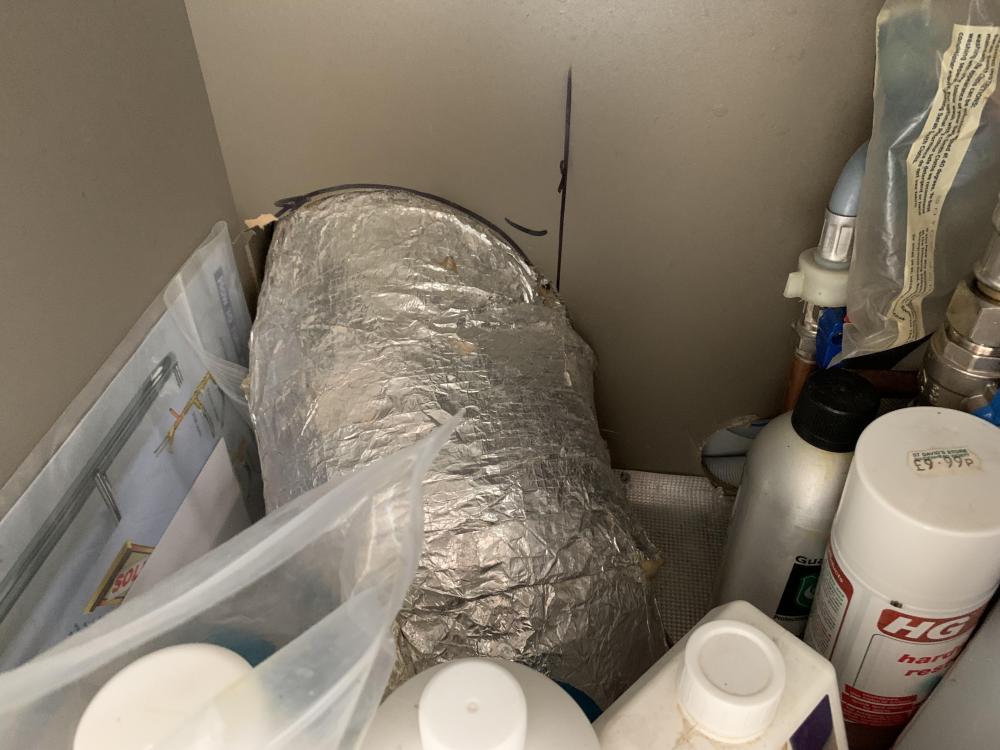
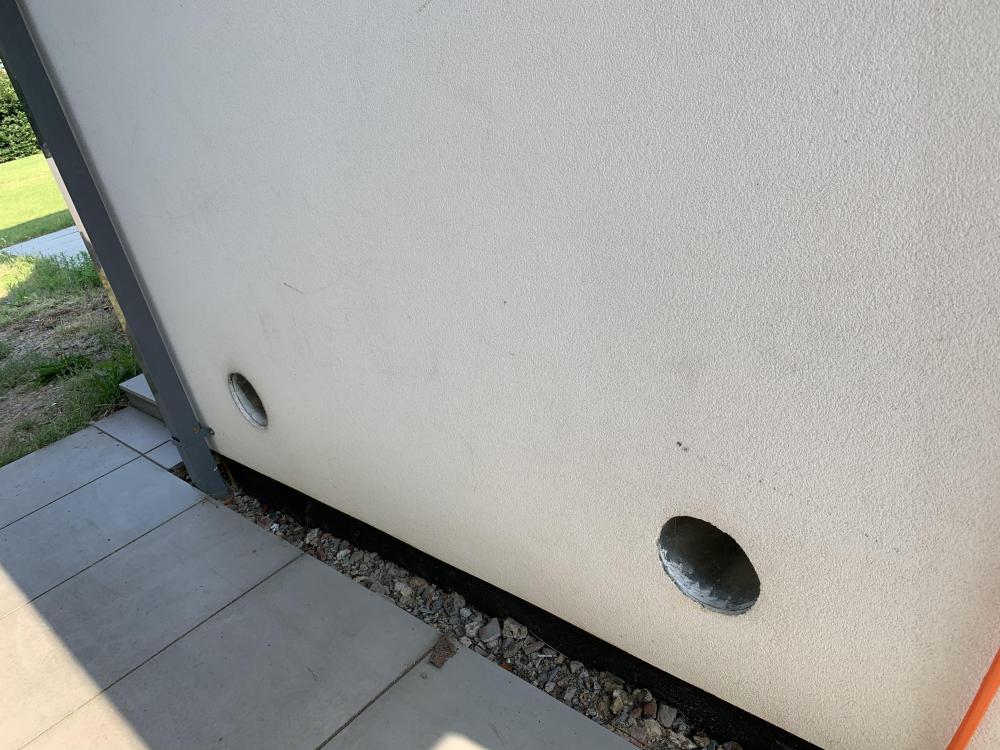
I have some nice external cowls to fit once the render gets replaced. Despite being near ground level, the internal intake filter does not get that dirty.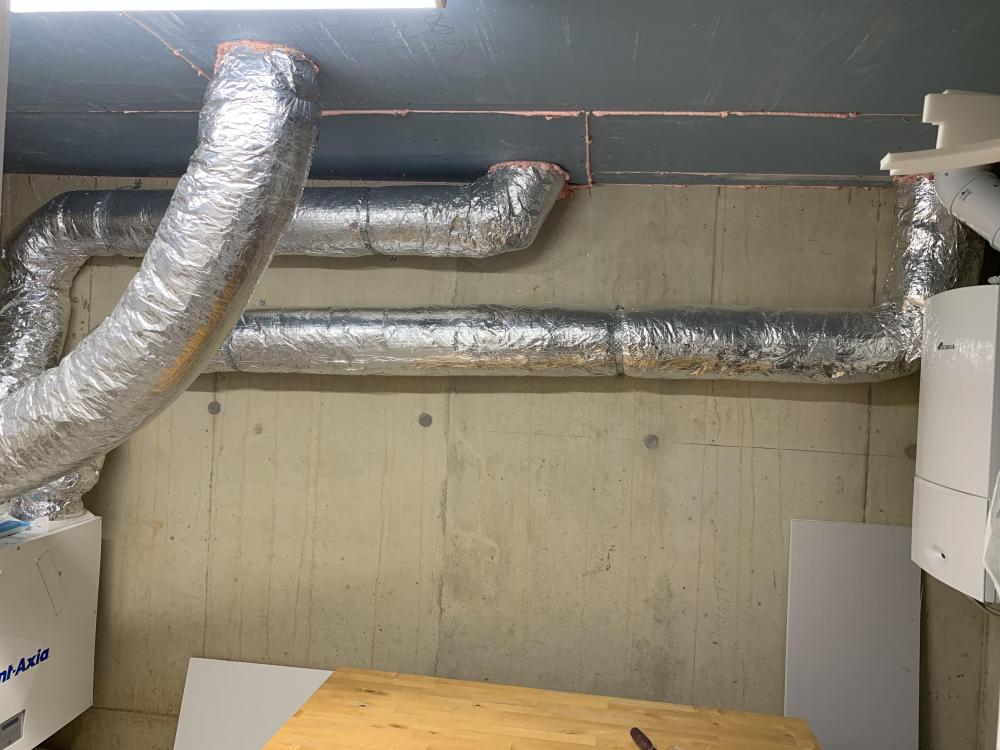
-
MVHR - New build with basement
Bitpipe replied to mike77's topic in Mechanical Ventilation with Heat Recovery (MVHR)
Our ducts go up into the utility room above the plant room and then exit the house about 500mm above ground level. They are obscured by the cupboards in the utility. Will get a few pictures. -
Surely if there was an opportunity to re-use walk on glass, this was it...
-
TBH unless its a very expensive car (like my neighbour's £250k Ferrari) I think most cars live happily outside, especially in the SE. Can count on one had the number of times I needed to scrape the car on a cold day in the last year. Plan for 16A power to be available in the vicinity of the parking bay and you're covered for future EV needs. I think what you've identified is a need for storage and you can address that many ways. While it's blunt - the per m2 approach is not a bad way to see how far your money goes. Flesh that out with site prep costs (demolition, services relocation, passive slab preliminaries). The rest is very discretionary, kitchens, finishes etc.
-
If you're looking to do some basic budgeting, assume £1750/m2 for SE England for demo and rebuild, assuming you're not doing anything too exotic. I agree that if you're just advancing the design to better estimate the cost, then once you have a basic footprint then probably stop there and take your budget to an architect to get some fresh thinking. Sounds like the garage requirement is the one you need to focus on, you have a requirement for storage but it feels that that element is driving the design.
-
We have some nice glazing design (courtesy of our architect) that we would not have thought of ourselves. We have an east / west aspect so north and south look onto neighbours gables. On the north wall we have floor ceiling windows on the GF that are only 600mm wide, more than enough to let light in but you never really look out of them. On south wall in bedrooms we have high level horizontal slot windows that are 2 long and 600 deep, again, let loads of light in but you'd need to stand on the bed to look out of them properly.
-
May be ceiling height - from https://www.labcwarranty.co.uk/blog/how-to-ensure-your-loft-conversion-complies-with-building-regulations/ Height: Is there enough room in your loft to stand comfortably? For your loft to be classified as a bedroom once converted you will ideally need a minimum of 2m headroom – but remember this will be after new floors, beams and panelling have been fitted, which may take up another 300mm of headroom.
-
What kind of stairs does it have at present? If it's a habitable room, it will need to meet building regulations so a building control inspector may be the best place to start.
-
Bed 5 could be a jack & Jill bathroom for the bedrooms either side? Will only be an issue when you come to demolish and every contractor will want to know what's there before quoting. You can get a non destructive survey and a destructive survey (best only done when you've moved out). Materials will be taken for testing & you get a definitive report that you can take to demo firms. Good plan, we bought our 40ft x 12ft van for just under £2k and sold it for £1k - if you're going to be scrapping it then don't pay much more than that. You can maintain the quality control without resorting to certification - you'll be able to hit all the fabric criteria, it's when it comes to things like approved MVHR units that the costs increase. Airtight door is between your dwelling and garage, otherwise you won't get the necessary levels to be passive. Warm garage may not be a bad idea - if you extend the same insulated slab and have reasonable garage doors then heat losses will be minimal - our UFH is only on a few months of the year anyway and is run at 35oc. Nope. You have 3 months from when the building is deemed complete. Usually that's when BC have issued their cert but HMRC have been known to reject submissions that are too late after habitation.
-
First of all, demo & rebuild qualifies for zero rated VAT, so your budget goes 20% further. You also hopefully have a less complicated build experience as it's all going up from scratch. You'll need to quantify the cost of demolition - get standalone quotes plus combined with your groundworks. Have you done an asbestos check yet? If it's not riddled with it then you're hopefully looking at 5-10k to just pull it down and cart away. Put a caravan in the back garden and live in that during the build (provided you can get it out again at the end). Worked for us and saved a lot of money, plus allowed us to be on site continually which also really helps. I built to passive standard, I am also an engineer. I did not bother with certification - it costs money, restricts some of your product choices and is a large waste of time, no-one will ever care and it won't help your resale value (will probably reduce it bizarrely). Get your satisfaction from owing a comfortable, low energy, cheap to run house. My only caveat on the design is including a large garage as part of your likely insulated raft foundation and whether you extend the low temp UFH circuit into it. You will need an airtight door into the garage as while you can get nice insulated garage doors themselves, don't think they'll be airtight. @HerbJ did something similar, MBC timber frame system & insulated slab. From a design pov, it's broadly square which will make it cost efficient to build. Small children quickly become teenagers and having 4 beds sharing one bathroom may be restrictive in future. I'd see if you can squeeze in some more en-suites - those bedrooms are quite large. Maybe drop that 5th bedroom and use for ensuite and the hall facing part as storage. I'd also plan to have that GF study to work as a guest bedroom for your parents should they start to find stairs a challenge - good that you've got a downstairs shower room. Last comment, you only have one GF lounge space - again, when the kids get older they'll want to congregate somewhere - maybe you're planning a summerhouse or similar but if not, you don't always want them needing to use bedrooms as social space.
-
What's in the filter in the unit itself, I think that is charcoal. Mine needs replaces anyway, £30 from Quooker direct.
-
Wavering on getting the limescale controller - have cleaned out our Quooker unit 3 times in last 4 years - they will send you the kit for free. However the cost of new filters is really of putting.
-
Tile backer board or Mapei on plasterboard (or both)
Bitpipe replied to Drew1000's topic in General Plumbing
Yep, Buildhub is the #1 destination for lazy teenagers . Have to say though, 4 years in, those bathrooms are bomb proof. Only issue I have is the floor has dropped maybe 2mm in the master bathroom just below the heavy stone bath - grout just needs re-instated there when I can be bothered. -
Tile backer board or Mapei on plasterboard (or both)
Bitpipe replied to Drew1000's topic in General Plumbing
Jeez - that all feels like a million years ago, you should see the state of those bathrooms now teenagers have had free reign for the last 3 years. Can someone invent the self hanging towel...? -
Funding a Self Build after maxing out on Mortgage..?
Bitpipe replied to Matt5100's topic in Self Build Mortgages
Welcome! Very sound advice above. We looked at, and walked away from quite a few plots that we 'fell in love with' - it is not easy and you can get caught up in the excitement - a hard nose is required. 6 acre is huge for a single dwelling and a modest house on that size plot would be a tricky sell subsequently. Also, that's a lot of land to landscape and maintain. We eventually built in SE England (East Berkshire J8/9) on a 1/2 acre plot that had an existing but knackered dwelling on it (so full services) on a mature street in a nice part of town. We bought it and moved in 2011 for £675k with big dreams, however we only really had £250k build budget (which itself was dependent on selling our original house which we had re-mortgaged and rented out) and it was quickly clear that it was nowhere near enough. We had some subsequent good fortune and finally sold the house which enabled us to proceed with the build, but for a year or two we were stuck and it was not pleasant. Developers had previously had several cracks at multi dwellings but failed so doubtful we would have been any more successful. In late 2015 we finally were able to get started having had 3 round of planning and some tap dancing on the mortgage - our finished property is just under 400m2 and we spent around £1500/m2, bit more if you include all the final landscaping. Involved living on site in a caravan for 18 months and doing all the PM and really sweating the budget. While it was valued at an impressive £1.2M back in 2017, that represents more or less what we spent on it (plot + build) so no profit, not that we were looking for one. We still have a sizeable mortgage to work off over the next 10 years also. You're in a very good position though for future opportunities. Get those properties sold, rent somewhere cheap and start doing your homework on build costs, what you're prepared to contribute aside from money (time, etc) and be open minded in your searching location - dilapidated properties in good areas are often overlooked by developers as too niche but can be the best starting position for self builders as you usually have all the expensive bits like services and access already established. Ideally try and find somewhere that you're happy living in for the foreseeable but with an eye on resale (so not too quirky) should you need to. I won't presume what stage of life you're at but keep in mind that even when you have a plot, things often take a lot longer than you expect (we had a LOT of zig zags) and life needs to go on while you build - living in a barn for a year might be tolerable but what if it's 3 years? Our kids were just starting at junior school when we moved in and went into senior school just as we were finishing -
Using MVHR for the first time
Bitpipe replied to jamieled's topic in Mechanical Ventilation with Heat Recovery (MVHR)
I had 14 extract ports on the manifold (7 double runs to kitchen, bathrooms & utility) and then 13 supply ports (single runs) and it all balanced easy enough. The extracts easily exceeded BR min requirements. When you get round to balancing the system, the order you normally do things is thus: 1) confirm BR min extract rates to kitchens & bathrooms (restrict ceiling vents if required - i.e. excessive) 2) balance supply & extract (by tweaking supply ducts as you've set the extracts in step 1) 3) confirm whole house ventilation rate (by adjusting central fan speed). -
Using MVHR for the first time
Bitpipe replied to jamieled's topic in Mechanical Ventilation with Heat Recovery (MVHR)
Mine was on for almost 2 years before balancing the vents etc. Like many here we used a system from BPC Ventilation that was based around the Vent Axia Sentinel range. There are cheaper and much more expensive solutions. The ducting etc should be the same cost whatever unit you choose, typically you will double duct the extracts and single duct the supply (one per room). Are you planning to DIY install? -
General retrofitting of Acoustic insulation in older properties.
Bitpipe replied to daiking's topic in Sound Insulation
Fair point - our lad is 15 almost 16 so less concerned about that - headset only minimises the incoming sound, you can still hear them yelling though Although if you soundproof too efficiently you won't hear what he's up to -
General retrofitting of Acoustic insulation in older properties.
Bitpipe replied to daiking's topic in Sound Insulation
Buy him a headset. -
Simple rule is that if it's movable (laptop, phone) it should use WiFi - if it's static (printer, TV, Sky Box etc) it should be wired. WiFi technology has improved massively but any radio based system will suffer the more devices are sharing it. Networking cables are point to point - they radiate out from a central place, usually where the BT router terminates (but not always) and go to where they are needed. The different CAT ratings indicate max bandwidth but they will always greatly exceed your incoming internet bandwidth - Cat 6 seems to be a decent tradeoff. Cables are best terminated to a face plate where you use a patch cable (plugs at both ends) to make the final connection to the device. At the business end where they all come together, depending on how many you have, they may be terminated to a patch panel which is a neat way of having a row of sockets connected to each cable. You then need a Switch which is a box that shares one incoming internet connection from your broadband to all the available sockets - as @dpmiller says above, you effectively have a small 4 port switch at the back of your BT Router to plug extra things in. @Declan52 explains it well - figure out what you need per room and work backwards from that. Cable is not expensive and putting it in at first fix is easy, retro fitting later is hard.
-
It's very difficult to eliminate noise transfer, you need to contend with low frequency transmission, usually through solid materials and higher frequency transmission which goes through air. I got to know a self builder (used to post on this site's predecessor) and his new build was designed to reduce noise - resilient wall bars, thick rubber acoustic matting, lots of rock wool between ceiling and wall joists, sound block PB etc. Spent a fortune. It made some difference but not enough for him. Ultimately unless rooms are airtight and isolated from surrounding structures then there will be noise transmission. It's concerning that there is no acoustic insulation between your ceiling and floor, that should be a minimum. We used blue sound block PB on our basement ceiling and GF ceilings but there is still noise transference, probably less than if we used regular. So I'd be inclined to do what you can but don't overspend.