

Ed Davies
-
Posts
1674 -
Joined
-
Last visited
-
Days Won
1
Everything posted by Ed Davies
-
That's presumably just a matter of how many cables you can fit in a hole and have attach securely? Another little box nearby with three Wagos or the like would presumably be fine? Rather academic interest for my house as I plan to bring all the lighting wiring for switches and lights back to central boxes (one in each of the two lofts). Given the geometry of the house this shouldn't add that much cable.
-
Ta. Knew there was a better word but couldn't think of it as I wrote the post. Still, the computer scientist in my just thinks of them all as branches of a tree rooted in a non-directed cyclic graph (the grid). Are there any reasons not to take spurs off a lighting radial? Yep, house wiring doesn't take many changes before it becomes archaeology.
-
I've seen a few references on here to lighting rings. Do people really mean “rings”. I thought it was normal for lighting circuits to just be spurs with, maybe, spurs coming off, without completing a ring. Am I wrong? @JSHarris's reference to a break in the ring really surprised me.
-
Google maps satellite view is pretty good for nosing around the general shape of people's houses, too.
-
But even a model can cause confusion. Apparently when they were putting in the application for the Hockerton Housing Project houses they had a scale model which you could lift the top off to show the internal layout of the houses and how they were built into the berm. Somebody (a councillor?) asked if the roof would lift off the real houses. ?
-
Welcome. Please tell us more about your project. Always worth putting your approximate location (county level) in your profile as it'll save time on advice where climate, house style, availability of materials and different planning or building regulations make a difference.
-
Assuming a fix is decided on, is there a need to replace the whole roof? Any way to replace just the liquid membrane and top layer of ply? I'm thinking something like taking them off, add a layer of sloped insulation then replace them.
-
FiT isn't deemed. You always have to have a total generation meter and the FiT payments are made based on readings from that. What is often deemed is exports. You can have an export meter and get paid for the actual exports made or you can have “deemed” exports where the assumption is made that you export 50% of the metered generation.
-
My broker insisted on my occupation being “builder” rather than “programmer taking a break to do a big DIY project” for my van insurance. Don't know what she'd have said if I'd, say, been programming full time, getting most of the house built by a builder, then using the van for all the extra stuff evenings and weekends. Being freelance I've always been insured “social, domestic and business use by the insured in person” so it didn't make any difference to that. I don't think that adds much to the insurance cost, anyway. My local Scottish chain timber merchant charges for small deliveries. Used to be £15 for orders under £150, now £25 for orders under £250 which is worth thinking about. I can usually find something to buy ahead to make the break point and sometimes they've not charged me on smaller orders just cause I've got enough from them but even paying once in a while it's probably cheaper overall than TP. Right, off to get one sheet of 18mm OSB3 from them while the wind's calm enough to get it out of the van on my own safely…
-

UFH in slab or screed, eps or pir insulation?
Ed Davies replied to Tin Soldier's topic in Underfloor Heating
Funny that, I got chucked off there for saying how bad the thread on Russ's fire was. (Long after the thread happened.) -
I've got a Toyota Hiace. Selection was basically the smallest van you can get an 8x4 in. They go diagonally on a side which limits the number which can be carried but I got 6 9mm sheets in with plenty of room the other day. Much more and I'd get it delivered anyway.
-
How to move, install and not smash hearth?
Ed Davies replied to Tin Soldier's topic in Stoves, Fires & Fireplaces
It looks like this one: https://www.amazon.co.uk/Wooden-Trolley-Furniture-Platform-580x290mm/dp/B074KL9VQB/ref=sr_1_8/258-7677335-5816811?ie=UTF8&qid=1536832021&sr=8-8&keywords=dolly+furniture+mover So it's not far off 500 kg. I'd think in practice you'd want two for balance anyway so should be fine. -
No, the inverter will just take less current from the panels so their voltage will rise. The inverter will always be able to withstand the full open-circuit voltage of the panels in any half-competently designed system so no harm will be done. The extra power will just be dissipated as heat in the panels, something like the panels being 14% efficient rather than 18% efficient so instead of 82% of the sunlight turning into heat it'll be 86%. Considering that the panels are quite safe in sunshine with nothing connected to the output so 100% of the sunlight becoming heat this isn't a problem. Yeah, OK, some of the sunlight is reflected. Depending on how the system is configured you might not have the option to use extra power between 3.8 kW and a peak of, say, 5 kW in the house anyway. Normally inverter limiting will be on the output of the inverter itself. I'm a bit behind the times on this sort of thing so maybe there are inverters which have a current clamp on the meter tails which limits the house export but you'd need to check with the DNO that they're OK with that. Direct limiting totally within the inverter is quite robust but having a bit of wire trailing down to the meter tails is a bit more fragile and they frowned a bit on that, or used to. The point of having more panels than the inverter can deal with is that most of the time the panels are not producing nominal power anyway. Even with a 3.8 kW inverter and 5 kW of panels you'll only be losing power for a few hours around midday on a few dozen summer days. Days you'll be producing lots of energy anyway so the loss doesn't really matter.
-
You're thinking of the FiT limit which is on the panels. The DNO should be happy with the inverter limit. Double check the 3.8 kW though; that's 16 amps at 240 V (3840 W) whereas I thought that if you were limiting on power (rather than on current) they'd want you to keep to 16 amps at 230 V (3680 W). Not sure, though, and might even be different per DNO. There likely will be an upper limit on the amount of panels you can have with the inverter, related to the short-circuit current in fault conditions, but it'll be quite a bit more than the nominal output. Worth checking though.
-
Help with kitchen renovation/ 1st house.
Ed Davies replied to zoothorn's topic in Bathrooms, Ensuites & Wetrooms
I've had good luck with a Lidl belt sander for about £20. OK, I burned one out but did use it quite a lot to sand about 50 metres of 225x45 joists which had been stored outside partly covered and got somewhat weathered. Indeed, a breeze helps, use it outside on a windy day and the dust is SEP [¹]. [¹] Somebody Else's Problem. -
The upstairs radiators don't really connect directly to the common return, do they? I guess it's a matter of what was already there but dropping the three-port valve and just have three two-port valves (DHW coil, upstairs, downstairs) would be a lot easier to think about. Does anybody ever go to the lengths of adding a non-return valve for this separation?
-
Yep, totally different between using yourself and having anybody else on it. I had my scaffolding put up professionally (for doing the ridge beam myself) but before I got some builders in to do the sarking I asked the scaffolders to take it down. They stopped inspecting but took a while to remove it so I took the ticket right off and agreed with the builders that they didn't need to go on the scaffolding at all. I didn't see them do it but various clues make me think they probably did. Thankfully there wasn't an accident so there's no point going into it but I was more than a little annoyed. So, there's also the issue of unauthorised access to the scaffolding. I tend to take my scaffold tower down each day unless I'm pretty sure I'll be using it straight away the next day just in case, even though my site is well out of the way and there are no kids around, etc.
-
New build - heat and energy considerations
Ed Davies replied to Tyke2's topic in New House & Self Build Design
Nah, just me graphing A_L's helpful numbers. Yeah, “efficiency” is a rather badly chosen word. As you say, I just meant the output as a percentage of the rated output. But that does bring us back to AliMcLeod's question about what temperature to run upstairs radiators. Given that it's off a gas combi in their case it probably doesn't matter that much but off, say, an ASHP it would be nice to estimate the lowest temperature which would give enough output. That seems to me to be one case where weather compensation (automatic or just turn the temperature up manually when it gets cold) might be useful. -
New build - heat and energy considerations
Ed Davies replied to Tyke2's topic in New House & Self Build Design
Thanks, at least it's not just me imagining it. ? So pretty much linear with temperature difference, as you'd more or less expect.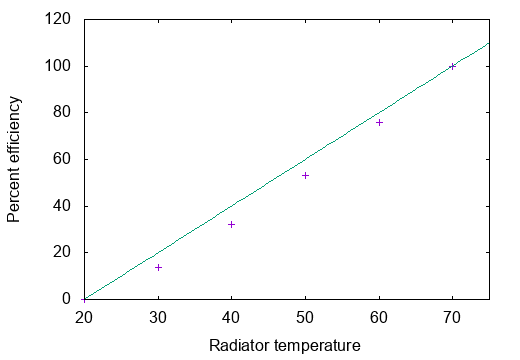
-
New build - heat and energy considerations
Ed Davies replied to Tyke2's topic in New House & Self Build Design
Tangentially, at what temperature are conventional radiators rated? I think I read that the power output is normally given for 50 °C above room temperature (e.g, room at 20 °C, water at 70 °C) but that seems awfully hot. But then the manufacturers would want to give the highest power which is plausible. Any references? -
Yes, understood - wouldn't lend my scaffold tower for more than a day or so even if I thought I wasn't going to need it immediately.
-
New build - heat and energy considerations
Ed Davies replied to Tyke2's topic in New House & Self Build Design
Yes, the usually reckoned highest temperature for washing up is 48 °C. Assuming that's the temperature out of the tap then the water in the bowl will be a tad cooler which matches perfectly. A shower's about 38 °C. Other washing somewhere in between. -
New build - heat and energy considerations
Ed Davies replied to Tyke2's topic in New House & Self Build Design
Nobody changes the pump on a fridge. Similarly, I'm not sure whether people change the pump on an ASHP because of the restrictions on the refrigerants. Still, the fan should be an easy change. I expect to own two fridges in my life. The one I bought in my early twenties which I chucked when I sold my old house in my mid fifties (because it was very grotty and a bit noisy) and the one I'll buy when I move into my completed house which I expect will outlive me. I don't see why ASHPs shouldn't be a similar deal. -
Do you still have it? Any interest in renting it out? Just a fire-from-the-hip thought as I'm trying to work out how to speed up doing my east gable and my scaffold tower is not ideal for handling sheet material on an exposed site.
-
Yep, have one 3 Ah LXT battery bought 2014-07-21 and two 4 Ah bought 2015-04-24. Still going strong, touch C24. From what I've read the problem is that the internal electronics in the battery runs off just one row of cells so that row discharges quickest when left on the shelf. Combine that with shallow charges and the cells can easily get out of balance. So my strategy is to run them to empty then recharge that evening, cycling through them fairly systematically (numbered 1 to 3, replace one that's empty with the next number in the cycle) other than if I'm using the circular saw a lot when I tend to jump to the 4 Ah batteries even if the 3 Ah is next in turn. Typically I start a day's work with one battery at whatever state of charge it was left at the previous day and two fully charged. I've only run out once on a day when I was doing quite a bit of circular sawing. I can see why Makita makes fast charge the default they sell but I would like at least the option to charge slower. Maybe it really doesn't make much difference or maybe Makita either wants to sell more batteries or doesn't dare admit that fast charge is sub-optimal. Dunno.


