
Ed Davies
-
Posts
1674 -
Joined
-
Last visited
-
Days Won
1
Everything posted by Ed Davies
-
 @JSHarris, would it be possible to run your system as an SBC_02 just ignoring the boiler input? Like the boiler was broken or something. The discharge direction is the opposite but would this matter? How does that work anyway? Pipes plumbed the other way?
 -
Somewhat off topic as it's about a much less well insulated and more leaky house but I did some experiments in November and December which seemed to say that running the heating continuously rather than timed for when I'm about did increase the heating bill a bit but nothing like as much as you might expect from the hours involved. Write up https://edavies.me.uk/2019/01/continuous/ with additional notes in the preceding and following posts. Extrapolating excessively, I doubt you'd save much fiddling with the heating hours.
-
If the sarking is traditional 150 mm treated boards then maybe the idea is that the 10 mm gap allows any moisture under the middle of a board access to the gap above or below. My house has 22x150 sarking boards which will have mineral wool underneath. The BCO was happy with the idea that the mineral wool is vapour open enough to allow this access but I doubt he would have been if it'd been planning PIR between the rafters.
-
Camberley But note that they only have those sorts of things in at certain times. Need to look out for them so not much good if you need one right now. (BTW, noticed the other day that they had the IR thermometers in again. £12.99. Very handy.)
-
CBS in Wick supplied OSB2 when I just wanted some expendable cheap stuff. Rembrand in Thurso ask if I forget to specify so presumably do OSB2 though they don't have it on their web site.
-
OSB2 will curl up and die pretty quickly. OSB3 ought to last a bit longer. I've had bits of both lying around outside and it's quite noticeable how differently they behave.
-
SVP = soil vent pipe. Good one for the acronyms and abbreviations page: https://forum.buildhub.org.uk/topic/268-acronyms-abbreviations-glossary-of-common-terms/ @ProDave
-
Scary info about air quality
Ed Davies replied to richi's topic in Mechanical Ventilation with Heat Recovery (MVHR)
Yep, lots of factors to take into account, particularly in an off-grid house. Obviously current and expected CO₂and humidity levels but also things like available power now and expected later, inside and outside temperature, midges, neighbour muck spreading, … I think the main consideration will be humidity as this is buffered more by the inside of the house so there's more choice about when to ventilate for it. E.g., if power is plentiful and temperature differences are small you might choose to ventilate more to drive down the RH to the lower end of the acceptable range (30% or whatever) to dry out the walls with the idea that this will mean less ventilation will be needed later. For CO₂, when levels are high you just need to ventilate but you might decide to put up with somewhat higher CO₂ levels when ventilation is tricky (there's not much power available or it'll result in greater heat loss). No idea how much that would matter in practice; it's the sort of thing to experiment with and tune. -
Rockwool Flexi? https://insulationcart.com/product/item/100mm-rockwool-flexi-insulation-slabs-1200x600-pack-of-6/252/show#iInfo-tab When I looked a few months ago it worked out the cheapest for my application from those people.
-
Scary info about air quality
Ed Davies replied to richi's topic in Mechanical Ventilation with Heat Recovery (MVHR)
Absolutely, that's what I got the monitor for - to be an input, together with relative humidity measurements, etc, into controlling the MHRV in the house I'm building. Measurements above are for temporary accommodation in leaky old rented house. -
Scary info about air quality
Ed Davies replied to richi's topic in Mechanical Ventilation with Heat Recovery (MVHR)
Monitor in my bedroom. -
Scary info about air quality
Ed Davies replied to richi's topic in Mechanical Ventilation with Heat Recovery (MVHR)
Interesting. I already watch Tom Scott's videos quite a lot but have now bookmarked Kurtis Baute's for later. Been meaning to look into CO₂ levels here overnight vs wind speed, to examine my assumption that more wind => more ventilation => lower CO₂ levels but a quick look at the data for so far this month doesn't seem to support that. Sure, the night with the highest CO₂ level wasn't very windy and the windiest night was low CO₂ but there are plenty of other nights which don't follow the pattern.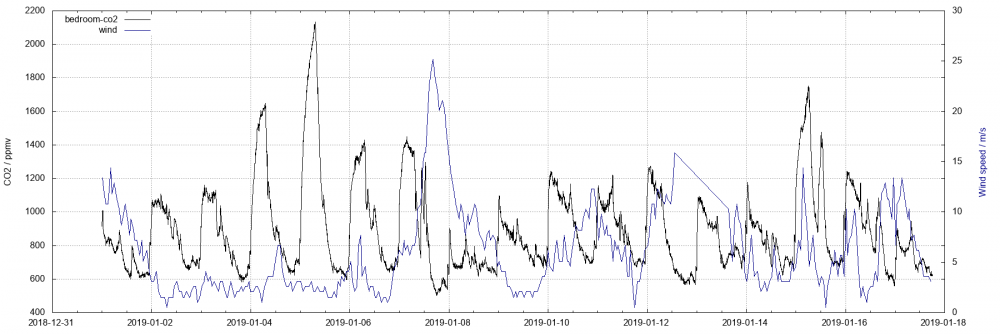
-
Not too surprising. Sun rises, warms ground, ground warms air, air rises, cools, clouds condense. Also, air rises, drags in moist air off sea, clouds form. Per the textbooks this gives puffy summer-afternoon cumulus clouds but in the real world it's often messier giving a deck of stratus.
-
Are PV Panels worth the investment these days ?
Ed Davies replied to Ballynoes's topic in Photovoltaics (PV)
Bimble Solar? Currently £140 per 300W black panel but it varies as the get different stock in. -
Is our winter generation amount about right?
Ed Davies replied to MikeGrahamT21's topic in Photovoltaics (PV)
What's the Current[1]/[A], etc, about? The current in and out on each string so the difference is leakage between the strings or from the string to ground? Residual current shown at the bottom? But they're a lot more different in the second set of readings. Otherwise, to my naïve eyes it all looks quite reasonable. -
You'd be very unlucky to get a 110 V shock off a 110 V supply, a 55 V shock is much more likely. A circuit breaker likely won't help much for shocks off a 240 V supply. A 30 mA RCD probably will save you, if it's working properly.
-
It's worth considering that Passivhaus, or at least building to roughly Passivhaus standards, tends to be proportionally less expensive the larger the house is because some costs are fixed and because some costs are proportional to the external surface area of the house which increases more slowly than the volume as dimensions are increased.
-
OTOH, the earlier it starts the earlier you can sell saying “yes. it's been complete for warranty purposes for more than 10 years now”. Since the chance of making a successful claim is fairly slim that actual seems beneficial on balance.
-
Preliminary plans have arrived
Ed Davies replied to Robert Clark's topic in New House & Self Build Design
Say electricity at 16p/kWh and gas at 5p/kWh (is that out of date?) so £0 .11 * 4000 = £440. Yes, that probably covers the gas standing charge and boiler service. More flexible than E7/E10 but it's all fine tuning at that point. -
Preliminary plans have arrived
Ed Davies replied to Robert Clark's topic in New House & Self Build Design
How does the cost of that work out, considering the standing charge for gas? Or do you have a requirement for gas for cooking? -
Is our winter generation amount about right?
Ed Davies replied to MikeGrahamT21's topic in Photovoltaics (PV)
What does the “/ 945Wh” bit mean? -
Looks easy enough: https://www.youtube.com/watch?v=PqIOKI02CB4&feature=youtu.be Only done about 5000 nails on mine so not due for a while, though quite a bit past the 6 month interval.
-
Is our winter generation amount about right?
Ed Davies replied to MikeGrahamT21's topic in Photovoltaics (PV)
If @MikeGrahamT21's arrays were on the south-facing end (4 kWp, azimuth 10° W of S but still 35° elevation) then PVGIS says they'd produce 116 and 124 kWh in December and January, so just about double an east/west split. E/W split is good for self consumption in the summer but really hammers winter production. Cranking the south-facing ones up to 45° elevation would increase these to 131 and 137 kWh. Then moving them to the N end of the runway at Old Sarum would up them to 135 and 158 kWh. So 200 kWh for half as much again for a month and a half is cromulant though a little below the estimate. By the way, for quite a while I collated and published people's reported monthly PV outputs and compared them with PVGIS estimates. Generally speaking, PVGIS at that time was very realistic but comfortingly pessimistic. About 3/4 of the time actual output was better, 25% worse. They've fiddled with the databases a bit since then but I'm moderately comfortable they're quite likely to be reasonable. -
Is our winter generation amount about right?
Ed Davies replied to MikeGrahamT21's topic in Photovoltaics (PV)
Using PVGIS and assuming azimuths of 100° (10° North of West) and -80° (10° S of E) gives 48.5 kWh and 59.9 kWh for December and January respectively so your 50 kWh/month looks pretty reasonable. That's for a point at the southern end of the main runway at Sutton Bank (Yorkshire Gliding Club) which will have a pretty clear horizon from east round through south to west. It seems to me that 1.5 kW would be a bit optimistic with the low sun and the awkward angle on to the panels. Still, 200 W does sound a bit disappointing. (Does the “T21” in your name have any gliding significance?) -
Yep, ordered one last night.