


Crofter
-
Posts
3484 -
Joined
-
Last visited
-
Days Won
11
Everything posted by Crofter
-
Floor Joists: Open Web Engineered VS. I-Joists VS. Traditional Timber
Crofter replied to Patrick's topic in Timber Frame
I used JJI joists and yes they are a bit more expensive than a solid timber joist. From memory I would have spent around £25 on each joist in solid timber, and £36 for JJI. So the total extra cost over my build was around £165 (it's a small house, only 15 joists were needed!). The advantages are several. Much much easier to work with- I installed them all singlehanded as they were so light. Every single one was perfectly straight. Thermal bridging greatly reduced. They use less timber overall so are probably a more ecologically sound option. I don't have any experience of posi-joists, but I imagine they offer similar advantages. -
I put a lot of research into my membrane choice- everything is there on the BBA certs fr tear strength etc. Ended up using Cromar Pro Vent 3 on the roof, it seemed good value for money given the specs, and it lasted very well exposed for many months on a fairly exposed site.
-
I had my membranes exposed for longer than most people (not quite as long yours though) and whilst the roof remained perfectly watertight and undamaged, the wall membrane at the SW corner suffered some rips and tears. After advice on here I put a patch of new membrane over the top, as there didn't seem to be any downsides to having multiple layers.
-
I had the same headache, ended up buying dressed all round timber and cutting out my own joints with a circ saw and chisel. Worth hand picking your timber at the BM to avoid anything badly twisted. When sizing the liner, the rule of thumb I was told was that you should be able to fit a 2p coin all the way around the sides and top. One essential thing to have to hand is a pack of plastic spacers in 1mm increments- these let you pack out the liner precisely. I didn't cut the doors down at all and propped them up in the doorway, building the liner around them. This ensured that everything was square. I screwed the linings and then filled the holes left by the heads. Primed and painted all skirts, arcs, liners and stops. The walls are all white so the pale blue painted skirts/arcs are a nice feature that gives necessary character. It's also so much easier and cheaper this way.
-
Roofing options for bungalow with "room in roof" potential
Crofter replied to howplum's topic in Roofing, Tiling & Slating
12m is a pretty big span. Playing around with the interactive span calculator on the JJI website (https://www.jamesjones.co.uk/interactive-span-table) shows that you can only go up to 8m span, and that requires 450 deep joists at only 300 centres. Unless you have a completely open first floor it will almost certainly be worth having a supporting wall. -
How to make best use of the budget?
Crofter replied to Nick1c's topic in General Construction Issues
With windows, I found the savings are to be made by keeping things simple. So go for big panes, not lots of little ones, and have them fixed where possible. Incidentally the bigger panes lose proportionately less heat than a bunch of smaller panes in the same frame. Other tips- source your own fittings where possible. I was shocked at what sparkies and plumbers are charging for fittings, despite them supposedly getting a good deal on their trade accounts. It might be worth checking with them beforehand that they are happy with the quality, just in case. You can also get good deals by being ruthless about pursuing low prices. There seems to be two different worlds out there- you get the people selling to the Grand Designs, Homebuilding and Renovating crowd, and then you get people selling on eBay/Amazon etc. I went online for my bathroom and the whole thing came in well under £1000. A posh high street design studio wanted to charge me double that just for the walk in shower enclosure alone. -
Log Cabin To Mobile Home Regulations Scotland
Crofter replied to iSelfBuild's topic in Building Regulations
I don't have the full breakdown as it's on my old laptop, but rough figures from memory are: - Fees £1200 (planning, building warrant, road crossing, road opening) - Access £5000 (plant hire and several lorry loads of stone) - Drainage £6500 (Puraflo system, septic tank, soakaway) - Services £3000 (water and e;ectricity- no phone line) - Foundations £700 - Structural timber work £4000 (cost to build the shell inc sheathing on walls and roof) - Roofing £1200 (corrugated iron) - Cladding £1000 (larch) - Windows £4500 (3G aluclad) - Bathroom £800 - Kitchen £2000 That lot adds up to about £30k- there was another £10k on the stuff I can't remember off hand, such as plumbing, wiring, plasterboard, joinery, flooring. I've not included the furniture or furnishings. If the site had been easier to develop, with services already in place, then the project would have cost under £600/m2 -
Log Cabin To Mobile Home Regulations Scotland
Crofter replied to iSelfBuild's topic in Building Regulations
My build came to about £1000/m2 with three years of DIY labour. So if I costed in my time at say £20k a year, my build actually cost £2300/m2. I would say getting a house built for you by someone else at under £1000/m2 is pretty good going. It's hard to build small houses down to a same price per m2 as a bigger house. Lots of fixed costs, or at least costs that become disproportionately large when the house is small. Fees, services, access, appliances, barely scale at all. -
Log Cabin To Mobile Home Regulations Scotland
Crofter replied to iSelfBuild's topic in Building Regulations
What does this requirement entail? I am aware of a couple of BS numbers for caravans and mobile homes but I concluded that these only applied to use in a caravan park or as a touring van. -
Log Cabin To Mobile Home Regulations Scotland
Crofter replied to iSelfBuild's topic in Building Regulations
Sorry I'm a bit late to the party here! There tends to be some confusion about the status and benefits of portable buildings in terms of regulations, planning etc. The planners want to know what a building looks like and what it will be used for. They don't care how you actually build it. Building control determine how you actually build, and if you satisfy their requirements you end up with a completion certificate, which then allows you get your VAT refund and lets you get a mortgage. To be exempt from building regs there are two routes that I am aware of: - stay below 30m2 and do not include enough facilities to make the building actually habitable (so think garden room, studio, man cave, etc) - build within the definition of a portable building, which is derived from the Caravan Act 19xx I'm only familiar with Highland Council's definition, which is very simple- 10ft ceiling height, and footprint less than 6x18m, with the building being monolithic or capable of being split into two sections. From my own correspodence with the local BCO, I was told that the building did not need to be capable of being moved off the site (mine would not fit down the single track road)- but if it could be moved around within the site, that is OK. Basically this means that you need to stick to the dimensions given, and make the structure from one or two boxes that can be towed, craned, etc. I ended up building on piers with a suspended floor- a more conventional build on a raft or with multiple sleeper walls would not, IMO, meet the definition as you could not really get underneath it and support it when moving it. A solid floor build would clearly fail because you would leave the floor behind! I'm not sure how Rich's supplier is able to zero rate the build, obviously good news for him if that's the case. I tried to get my own zero rated but it seemed that that would be impossible without a completion certificate, and anyway as it would not be my principle residence I was not eligible anyway. If you are building it as a letting business, you cannot claim back the VAT- unless your letting business is going to be VAT rated itself and charge VAT on all of the letting income, which would clearly be a bad move in the long term. From an engineering POV, I don't actually think a log cabin lends itself at all well to being a portable building. You would be far better off with SIPs. -
I can't answer your specific questions about using I-beams for walls, but I did look in detail into using them for joists, vs solid timber. For my 16ft span, solid timber would have worked out about £20 per joist, whereas my JJI engineered I-beams of the same dimensions were £36 each. So you are paying nearly double, for a considerably reduced quantity of timber! But the benefits are enormous. - much easier to handle due to reduced weight - totally dimensionally stable, giving perfect flat and squeak-free floors - easy running of services through the web - far better thermal properties because thermal bridging is almost eliminated To me, it was a no brainer to go with the I-joists. In the grand scheme of my build, it added less than £300. For walls, I believe that a Larsen truss may be a more common way of achieving what you are looking at.
-
eBay! e.g. https://www.ebay.co.uk/itm/1-2-Brass-Ceramic-Disc-Tap-Valve-Insert-Cartridge-Quarter-Turn-20Teeth-42-104mm/282979261875?_trkparms=aid%3D555017%26algo%3DPL.CASSINI%26ao%3D1%26asc%3D20151005190540%26meid%3Db804398d11e6482abbb37a30f2b242de%26pid%3D100505%26rk%3D1%26rkt%3D1%26%26itm%3D282979261875&_trksid=p2045573.c100505.m3226 (no connection/endorsement etc- simply the first one on the listing). If you get one with too long a spindle, it will still work, but you will see some of the brass part showing. How do I know this... It's a straightforward job needing a couple of spanners, but you will need to isolate both sides of the tap.
-
It's not just needing a new ceramic cartridge, is it?
-
The caravan was from the mid 80s so predates the need for plating. The axle itself had a plate saying 800kg. No idea what the finished trailer weighed, obviously much less than the caravan did. I've never been pulled over for a weight test, police are probably spread a bit thin round here. You hear of people trying silly things with converted caravans, like using them as car trailers, which gives them a bad name. But for picking up long or bulky loads it's ideal. I only had a hatchback to tow it with anyway so 800kg was about as much trailer as I could use.
-
I believe @iSelfBuild used Sioo. From what I understand it is primarily a method of obatining a uniform silvered appearance, without having to wait for natural weathering; I think it also provides some protection to the wood. Probably not necessary to apply it to unseen faces of the boards. I did consider it myself but it would have doubled the cost of my cladding, and in any case I actually prefer the fresh sawn colour.
-
Trailers are great. Mine was originally a caravan, I bought it for under £100 and used some scrap wood to turn it into a decent little flatbed. Axle is rated at 800kg but for long loads like timber and sheet materials it was perfect. The remnants of the caravan also provided lots of useful materials (or 'that bloody junk' as my wife calls it). Now that I'm finished, it's sitting taking up space but I can't quite bring myself to get rid of it! To say I got my money's worth out of it would be a massive understatement. On the car vs van/pickup question, I think a lot of us have looked at this and decided that the tax, vat, and insurance make it far less attractive than it might seem. An old people carrier is probably the way to go- things like Picassos are really quite cheap, maybe not a paragon of reliability but consider it a disposable site car that you don't expect to last beyond it's MOT date.
-
And he's building a stairway to decking
Crofter commented on Crofter's blog entry in Wee Hoose on the Croft
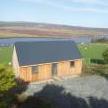
Curlew Cottage- named for the birds that live in the field and shoreline in front of the house. -
And he's building a stairway to decking
Crofter commented on Crofter's blog entry in Wee Hoose on the Croft
Yup, it's been a great first season. Was really nervous before the first booking- I was really worried about things like the garden not having all grassed over yet, or any unseen problems. But everyone's been delighted with it. The guys who left today even wrote us a poem in the guest book -
Firstly, for all you lot waiting with baited breath for my next blog update, my apologies! Since the house was opened up for guests I've needed a bit of time to switch off from what was a very full time project for the last few years. When we first opened to guests the house was missing its decking. I had gone through various ideas for the design of this, and in the end decided that less was more, and made it a fairly minimal affair, just somewhere to allow access to the big sliding door and give space to sit and enjoy a cuppa or glass of whatever, whilst looking out over the views to the loch and the sunsets. Due to the big change in height, I decided to make the seating integral and do dual duty as part of the step down as well. This has worked pretty well, I think, with the advantage of dropping the height of the decking and preventing the handrail from obscuring the view from inside the house. There's still some tidying up to do- paths around the house, and some cladding trim to finish off the decking itself- but it's a big improvement on how the place looked a few weeks ago.
-
This is probably not terribly helpful but I didn't use any scaffolding at all. Just a couple of ladders. I have some grey hairs now, mind.
-
Side hung may provide better means of escape- hence the use upstairs. But as Dave says top hung is more weather proof. If you really can't decide, then put the hinges on the longest edge, as that's going to put less strain on them.
-
I'm not sure what you have to do to kill a Makita LXT battery. I'm still using the original pair of 4Ah ones I bought three or four years ago, and they've built an entire house and a heap of other stuff besides. Still seem to be going strong.
-
@Thedreamer have you done your Trial Site Assessment Hole, and your percolation tests, yet?
-
The question isn't really 'treatment plant or soakaway'- it should be 'treatment plant or septic tank'. Both solutions need to discharge the effluent somewhere, and the generally preferred method is a soakaway. You are allowed a 25% reduction in soakaway area if you use a treatment plant, but otherwise it's all much the same. The reasons for not using a soakaway would be if you don't have enough space for one, or if the ground conditions are unsuitable (e.g. high water table, slow draining clay soil, rotten rock which drains too fast). The backup option is to discharge to a watercourse, which I don't think is possible with a septic tank. From my experience of building in Scotland, you won't be allowed to discharge effluent (from either a septic tank or a treatment plant) straight into a drying ditch. I was allowed to use a partial soakaway which in wet weather overflows to a ditch- in wet conditions there will be plenty of flow in the ditch for dilution. The partial soakaway does not seem to attract the same degree of scrutiny as a full sized soakaway- I was given very vague instructions on what sort of size to make it. Plenty of people are still fitting conventional septic tanks, and they can offer the cheapest solution if you have the right plot. However there's no denying that the effluent from a treatment plant is far less nasty, and the difference in cost is nothing really in the scheme of a whole house build. Don't worry too much about avoiding electricity use, it's never going to add much to your bills. FWIW I went with a slightly unusual system called a Puraflo, which is quite popular on Skye. This involves installing a normal septic tank, and then downstream of this is a pump chamber feeding into a big box full of peat fibre. The outflow from the septic tank is pumped into this and it trickles down through the aerated fibres, emerging from the bottom as relatively benign effluent- on a par with the best treatment plants. I chose this system as it is supposed to be quite tolerant of intermittent usage patterns. Finally, when comparing treatment plants, you need to look at three figures: suspended solids, biological oxygen demand, and ammonia (abbreviated as SS, BOD, and NH3). If a supplier doesn't deal in these terms, run away, they are probably snake oil salesmen
-
Not all- but thanks for the tip, have just ordered one that is!

