


Crofter
-
Posts
3484 -
Joined
-
Last visited
-
Days Won
11
Everything posted by Crofter
-
Log store roof: Onduline/Coroline vs steel
Crofter replied to Crofter's topic in Garages & Workshops
Yeah I see all the read-made stores use planked roofs... I'm not convinced it's a good idea, especially at the size I'm aiming for. I'd expect it to warp/shrink and start letting in water. They look nice on the smaller stores, though. -
Log store roof: Onduline/Coroline vs steel
Crofter replied to Crofter's topic in Garages & Workshops
I don't think it's going to sag... there will be a beam back and front, giving a span of around 1.4m. But maybe I should stick a third beam in. Or just use steel... I think I'll get prices for both options and go from there. -
Log store roof: Onduline/Coroline vs steel
Crofter replied to Crofter's topic in Garages & Workshops
Thanks... steel might be a bit OTT I suppose! I'd searched the forum and found references to bitumen sheets sagging in hot weather etc, but that was in the context of a garage roof with much longer spans. One mark against bitumen is that it comes in a standard sheet size of 2m... which almost certainly means throwing away a good chunk from each sheet (I probably need about 1.5m, so the off-cut is a bit small and fiddly) -
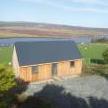
SWMBO has had enough of my shanty-town of log stores made from a motley collection of scrap (my favourite one is my Truckman pickup canopy mated to some pallets!). She does have a point since they are right outside the front of the house. Rough plan is a 16ft long open fronted free-standing structure. I'll probably use sarking timber as it's fairly economical and is pressure-treated. I'm swithering about the choice of roofing material. I was going to use corrugated steel, but maybe corrugated bitumen (e.g. Coroline or Onduline) would make more sense. It might be easier to get hold of, it's lightweight, and perhaps most importantly it's not going to take out anybody's eye if they walk in to it. The roof is going to work out reaching about eye level. In favour of steel is that it seems a better product for about the same money, and I've used it before. Thoughts?
-
Is the estuary subject to charges for even transient anchoring? Normally the actual right to anchor remains, but charges can be levied at pontoons/jetties. And it would be pretty hard to live on a boat without having somewhere suitable to get ashore. Of course it's a different matter if you start discriminating between being anchored and laying a permanent mooring...
-
A family near me are doing this- bought a derelict house (not much change from £100k mind you) and are living in it off-grid. PV, big log pile, veg garden. When the weather's like this it looks idyllic, but I felt for them over the winter. They're sticking it out though, must be hardy.
-
The existing boards are wood and are not standing up well. Obviously at only 5mm I can't use any sort of solid board. Maybe I could go for marine ply but tbh if I'm going through the hassle of replacing them I'd rather than choose something totally rot-proof.
-
Just getting back to this- looks like I may have some time on my hands this summer to do jobs like this... if I can get hold of the materials. I can't find uPVC soffit boards any slimmer than 9mm so that's out, unless someone can point me to a source. Cedral/Hardieplank cladding seems to be around 12mm. @Russell griffiths did you just use tile backer board and then paint it? How has it stood up to exterior use? I imagine it would take a few coats, it must be quite thirsty? I'm still tempted to use Foamex because it would be so easy to work with. It's supposed to be resistant to both water and UV for 7yrs... may be that's not long enough... and I'd worry that my preferred choice of slate blue would fade quite badly.
-
Better thermal performance, because of reduced thermal bridging. It's also likely to be lighter, for ease of handling, and more dimensionally stable.
-
Welcome aboard. Another Sgianach here. Having spent most of my school years in East Sutherland before moving west as an adult, I couldn't imagine going back- but maybe that's just me! For anybody self building in the Highlands, get used to the tedium of choosing suppliers based on their delivery fees. For those of us outside of easy reach of Inverness, monthly road trips become a fact of life. It's amazing the quantity of building supplies you can fit into a car...
-
3m is a lot! Steel might be the way to go. Probably worth having some sort of integrated structure rather than individual pillars.
-
Black 'tin' roof material recommendations, Scotland, please
Crofter replied to Grian's topic in Roofing, Tiling & Slating
Planwell only do box profile, not corrugated. I didn't find them any cheaper than Jewsons. But as they specialise solely in roofing they might have some advantages. -
Looking for advice: Log Cabin "Caravan" build Scotland
Crofter replied to morkus's topic in Planning Permission
We rent it out. For certain personal reasons we weren't ever going to be able to call it our primary residence so VAT reclaim wasn't happening anyway. -
Looking for advice: Log Cabin "Caravan" build Scotland
Crofter replied to morkus's topic in Planning Permission
I was also a bit apprehensive about the building warrant side of things. The actual regulations you have to follow for design and layout are easily available (https://www.gov.scot/publications/building-standards-technical-handbook-2019-domestic/) and you can spend many a happy hour poring over these to ensure that your design will comply. Even though I didn't have to adhere to these, I followed them anyway as I saw no downside to doing so, and it took away the guesswork for whether a space would work or not. You probably won't get very many actual inspections. Building control don't have that many people on the ground, and if you don't make them suspicious then they'll just want to know when you've reached certain stages. Other people who have done a conventional build will be able to advise you on this. The most daunting part, to me, was the need to provide structural drawings and calculations. I drew all my own plans for PP purposes, and did all my detailed design work using Sketchup (free 3D software, not really an engineering/CAD tool but excellent for visualising a project). My pencil drawings were fine for the planners, but building control would have wanted more detail. If you are buying a prefab kit, or have a main contractor, then they will almost certainly provide the building warrant drawings for you as part of the package. And if not, there are professionals (architects, engineers, etc) who can do it for a relatively small sum. Certainly their fees will be far less than the amount you save if you do a conventional build with a VAT reclaim. As you've said elsewhere you may want to make this your primary residence at some point. I would suggest you consider a conventional build route with a VAT reclaim, and don't mention anything about renting it out at any point. You will save 20% on your build costs, be eligible for a normal mortgage, and the finished market value will be solid.- 44 replies
-
- 1
-

-
- planning permission
- log cabin
- (and 5 more)
-
Looking for advice: Log Cabin "Caravan" build Scotland
Crofter replied to morkus's topic in Planning Permission
A big steel pallet would be one way of going about it, but something sturdy enough to do the job is not going to be cheap. Can I ask why you are so keen to do down the portable route, rather than just getting a building warrant? -
Looking for advice: Log Cabin "Caravan" build Scotland
Crofter replied to morkus's topic in Planning Permission
I don't think there is anything specifically in legislation about floor construction, it's just that the building must be capable of being moved in no more than two sections. You could split the building in two along the long axis, halving the joist spans, but each section has to be self supporting, which will complicate the roof structure a lot. @iSelfBuild knows more about this than I do- I was fortunate to not face too many questions during my build. As far as I am aware, the definition of a 'caravan' for the purposes of building regs exemption are simply that it must be movable in no more than two sections, and the completed building should be no more than 6x18m (Scottish rules- England allows slightly larger). Internal ceiling height maximum 3.048m. It doesn't need to be on wheels, and there doesn't actually need to be physical space to get a crane or other machinery in to do the lifting. The portability is innate to the building, and not dependent on its surroundings. As I've said before, I do think that the benefits of going down the portable building route are sometimes overstated. It worked for me because I couldn't do a VAT reclaim, didn't need to get a mortgage, and was doing all the design and build work myself. Of course if you're doing it because you want to cut down on thermal performance, fire safety, disabled access, and save a bit of time and money not having to do the building warrant and inspections, then go ahead. But most of those regs are there for a good reason, and you'll end up with an unmortgagable property and no VAT reclaim.- 44 replies
-
- 1
-
-
- planning permission
- log cabin
- (and 5 more)
-
Looking for advice: Log Cabin "Caravan" build Scotland
Crofter replied to morkus's topic in Planning Permission
It's not a trivial matter to make it capable of being lifted. How would you plan to do this, and what would the effect be upon the finished height and look of the building? -
I built on pillars. I had a few factors that pushed me in this direction: - sloping site - driveway was already going to be very steep, so lowering the house even further by flattening the site was not an option - house is a monolithic box structure, compliant with portable building definition- so not need for continuous support around perimeter - desire to make the building aesthetically low-impact on the site - budget! The concrete that went into the pillars is a fraction of what a complete underbuild would have needed. The biggest downside of building in this way is that you will get significant wind scrubbing underneath the building. This makes draught-proofing and insulating the floor absolutely vital, and this is an area where certain trades might not appreciate the importance of airtightness. Alsol, think carefully about all the service penetrations that you'll need.
-
VCL on inside of all insulation or in between
Crofter replied to Drew1000's topic in Heat Insulation
I went with a 25mm service void and and it was a bit of a pain at times. Yes you can fit a standard back box, but only if you cut part of the lugs off it. The 25mm battens were also very poor quality. In my experience the stuff that is stained blue was inferior to the normal ones, and was very prone to splitting. -
Looking for advice: Log Cabin "Caravan" build Scotland
Crofter replied to morkus's topic in Planning Permission
Bear in mind you don't really have to tie yourself down to "planning permission for a caravan". Get planning permission for a small 2 bedroom house if that's what you want to build. That leaves all your options open. I never told the planners how I was going to build my house, or whether it was going to need a building warrant, and they never asked me because that's not their remit. The only advantage of going with a portable building (i.e. caravan) is the building regs exemption. This saves you a set of drawings, an application fee, and some oversight from building control who will want to check up on you at various stages. It also allows you to depart from rules on disables access, restrictions on layout, fire escape, energy efficiency, etc, although IMHO most of these rules are there for a very good reason. If buying a prefab kit, you may well find that the manufacturer will supply building warrant drawings at little or no extra cost, which takes away one of the main reasons for trying to go building regs exempt. -
Looking for advice: Log Cabin "Caravan" build Scotland
Crofter replied to morkus's topic in Planning Permission
I notice some of the photos show it sitting on a concrete raft. That's definitely a worry if you're trying to claim that the whole thing can be lifted up without leaving the floor behind. I would ask the company for more details on how the floor is supported. It certainly doesn't look as though the floor joists are a single span without intermediate supports, as would be needed for a portable building. To give you one example, my wee house has a floor span of 4.8m (the log cabin in your link is just shy of 6m) and I had to use 300mm deep engineered I-beam joists in order to make the span without intermediate supports. This was fine because I wanted a lot of insulation in the floor anywhere. But there is noticeable bounce in the floor, despite me following the guidance of the joist manufacturers. Looking at the drawings on the link, the joist span is likely around 5610mm. On the JJI interactive span caulcuator (https://www.jamesjones.co.uk/products-and-services/engineered-timber/interactive-span-table) this gives a minimum joist depth of 245mm, and this is only possible if you have them a foot apart, which is a bit extreme. Going for a more conventional spacing of 18", your joists have to be 350mm deep. That's a pretty major modification to the kit, as there's no way the existing floor structure is anything like that deep. -
Looking for advice: Log Cabin "Caravan" build Scotland
Crofter replied to morkus's topic in Planning Permission
The main thing is probably the floor construction, and how it all attaches to the ground. Do you have a link to the sort of thing you are considering? I did all my own drawings, it wasn't difficult. I just did it with paper and pencil, rather than learn how to use a CAD package. But if you're buying a prefab kit of some sort, the supplier will likely have drawings already that you can use. The site plan was the most difficult, as that requires that you do a bit of basic surveying with a level and a tape measure. You're correct that a caravan could get PP for a holiday let and be exempt from BC. You will still need to get a warrant for your drainage arrangements. -
Looking for advice: Log Cabin "Caravan" build Scotland
Crofter replied to morkus's topic in Planning Permission
Just remember that to be deemed 'portable' the prefabrication can only go as far as two separate pieces. So even something like a garden shed may not comply, because it cannot be moved intact without taking it apart. Caravans, park homes, shipping containers etc are all fine. Anything that arrives flat-packed isn't, unless the finished building is itself sturdy enough to stand being moved. But you dont' have to have it arrive in one big piece, you can build on site so long as you can show that the finished building is movable. I had no problems with planning, nobody lodged an objection. Small and restrained design is preferable to big and fancy. You can do everything online, although from memory I may have made a few phone calls too. I didn't actually meet anybody in person. I went through 'pre application advice' which at the time was free- I think they charge about £125 now. This gives you a non binding statement on the likelihood of your proposal being accepted. I then went for full planning, which requires drawings of the site, each elevation, and a floor plan. You also have to detail how you plan your road access. There is a standard to which you must adhere, with certain prescribed dimensions and radii. I think I waited about six weeks for a decision. You can also apply for planning in principle, but this is only really worth doing when you are selling a plot and want to leave the final design open for the buyer. One final point- not everybody is aware of the distinction between planning permission and building control. Planning is concerned with what something looks like and its intended usage (they will consider impact on local roads, schools, etc, so need to know likely number of occupants). They don't really care about details of how it's constructed. Building control, if applicable, will go in to the details of the structure and the regulations around disabled access, energy efficiency, etc. But they don't really speak to planning. So something can be exempt from one set of controls and not the other.- 44 replies
-
- 1
-
-
- planning permission
- log cabin
- (and 5 more)
-
Looking for advice: Log Cabin "Caravan" build Scotland
Crofter replied to morkus's topic in Planning Permission
By the way, another thought on the 'log cabin' & 'portable building' thing: IMHO I don't think a traditional log cabin really lends itself all that well to portability. They are designed to be build in-situ, and not to be moved. Obviously it's possible to prefabricate whole walls etc, but even this way of doing it doesn't count as 'portable'. The only thing that makes log cabins in any way inherently suited to portability is that they tend to be small and do not have any masonry/concrete work in them. A far easier method would be to build a more conventional timber frame, or to use SIPS, which will create a big strong box. I think this would provide better value for money and almost certainly better thermal performance. You could still use timber cladding to create a log cabin look on the outside. Where log cabins do match up well is with 'hutting'. A hut can be assembled on site, they just have to be made of 'low impact materials' and be capable of being removed leaving little alteration to the site. Huts are another potential way to approach PP/BC in a different way, with advantages and disadvantages. -
Looking for advice: Log Cabin "Caravan" build Scotland
Crofter replied to morkus's topic in Planning Permission
Yes. Any building that is going to be used for some form of accommodation requires planning permission. You technically need PP to have people staying in a caravan parked on your driveway, although it would hard to enforce this if it wasn't obvious to passers by. You *may* be able to site a touring caravan without PP, it depends to some extent on whether your neighbours are likely to shop you. But you'd need PP for a static caravan or any kind of more substantial structure even if it falls within the 'portable building' definition. When I built, I just called it a 'dwelling' and had no restrictions imposed about how it was to be used. If you specifically say it's going to be a holiday let, you may be bound by that and be unable to use it for anything else. Yes, any type of sewerage connection/treatment requires a warrant. I found my local building inspector fairly easy to deal with (I'm Highland too).
