


MikeSharp01
-
Posts
5693 -
Joined
-
Last visited
-
Days Won
16
Everything posted by MikeSharp01
-
I have moved on and found an interesting bug. If I run the RTC on a nano it works fine, then I transfer it to the WEMOS, first run is fine but next upload it breaks and I get error 4. So for now I will put the RTC on the back burner and work on getting counts back to the server. See if can remember enough Node Red to get that going with MQTT from the device. Might be fun but no more time today. Chores🤨
-
Yes I thought of that but if I2C is not working then other things won't work and I need to have it available as I want the block to be universal - I have a few other I2C devices so I need to try them and see if it's the RTC, the library (which may not have been extensively tested on the ESP8266) or my circuit / associated capacitive issues. I have played with MQTT on it and thought I could use it to provide a time to all the subscribers so I still keep time if the internet is down.
-
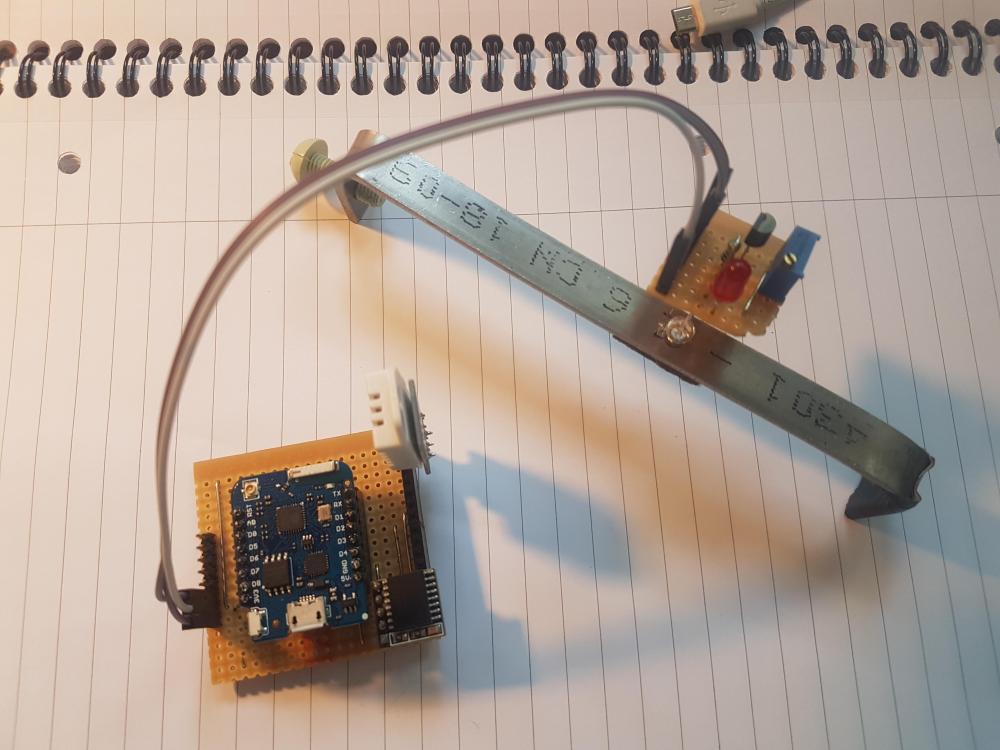
Ok so I have been working up a ESP8266 based equivalent of the Steamy counter. Although it broadly works I am having a real struggle getting the RTC to work reliably. Technically I don't need it as the receiver end could do all that, I could use the millis() functions to create quite good timing and I need that anyway to measure the interval and get a rough idea of instantaneous KWh. Could do this better with the 32KHz pulse train from the RTC if it was enabled on the boards I have - same as Steamy's. I have tried a slew of libraries but I still regularly get a bus conflict error on all three of my RTC chips and they all behave perfectly on an Arduino nano. As the RTC is currently managing the sensor timings - I put a DHT22 on the board as well for fun, I guess I need to fish out my logic analyser and look at the timing on the I2C to see whats going on although the scope would show me if the edges are fuzzy / noisy. I decided to echo the flashing LED on my sensor and made a bracket I can just tighten on the meter so nothing is actually fixed to it. So work still in progress I guess.
-
Very well, just conditioning the photodiode and getting the code working, just can't decide where to split the client / server activities. Might get to share something tomorrow.
-
Absolutely - just need to work out how to use it in reverse so as to get accuracy both ways. Simple question with a complex answer - did we already discuss this? Why not get another meter and connect it backwards so it flashes on export!
-
So really the energy monitor using the red light is not going to be universally useful but will work in non export situations or we need to add more features / intelligence to get a more universal solution.
-
Why would it come on if no chargeable current is flowing surely each complete pulse is 1Wh so turning it on and leaving it on means more than nothing is happening. Unless it comes on at 90% (or some such) of 1Wh expecting it to fill shortly but it does not. So then the falling edge is the full 1Wh and on means almost there - seems daft though.
-

How to 'option in' home automation in future?
MikeSharp01 replied to Andeh's topic in Networks, AV, Security & Automation
And presumably the lights on? -
We have LPG heating here at Millstone Manor and it has a standing charge - they call it tank rental or some such but same thing in the end.
-
MVHR with adiabatic cooling
MikeSharp01 replied to Garald's topic in Mechanical Ventilation with Heat Recovery (MVHR)
These threads are getting mixed up. I redid the sums and I think that I would need about 3.7Kw of cooling to achieve that but if I drop the delta and the ACH it obviously comes down dramatically (proportionally). Looking around this unit (https://www.paulheatrecovery.co.uk/wp-content/uploads/2020/07/ComfoPost-CW6-PAUL.pdf) will almost get to the above, assuming the ASHP can cope. -
Fan Coil Units for use with a (cooling) ASHP
MikeSharp01 replied to ProDave's topic in Air Source Heat Pumps (ASHP)
Thanks - that's all interesting but I don't think any of them will fit in our void, I also would need to plumb the condensate out and, because we don't want to bring outside air in, other than via the MVHR, we would need to recirculate which looks like it adds to complexity somewhat! I think I am going to look harder at getting the MVHR boost to deliver a modicum of cooling - if I get ahead of it I feel, just gut feel, we might achieve it so I need to get back to the sums. See this thread: -
MVHR with adiabatic cooling
MikeSharp01 replied to Garald's topic in Mechanical Ventilation with Heat Recovery (MVHR)
Good thought - I had expected to be able to control the fan speed continuously (so right down to very slow) but if I only have a few fixed settings it may be more difficult I guess. -
MVHR with adiabatic cooling
MikeSharp01 replied to Garald's topic in Mechanical Ventilation with Heat Recovery (MVHR)
Have not ordered the unit yet but thought I would go for a good amount of headroom to keep it quiet. -
MVHR with adiabatic cooling
MikeSharp01 replied to Garald's topic in Mechanical Ventilation with Heat Recovery (MVHR)
Is that equation right, do I have the units correct - I guess it must be, its definitely me, but I get an odd outcome: So 451m3 x 4 x 15 x 1.012 x 8 = 219077J = 7.6Js-1 = 7.6W of cooling which sounds all wrong - need to go back the Thermodynamics 101, which I hated I seem to recall, - or maybe that 451 should be in l rather than M3 and/or the SHC should be the capacity of the whole volume - what have I missed? 4 ACH is the boost rate for the whole house which I guess you would not object to if you needed cooling. -
MVHR with adiabatic cooling
MikeSharp01 replied to Garald's topic in Mechanical Ventilation with Heat Recovery (MVHR)
Yes, we have passive standard insulation and the PHPP gives us only a few days (2% = 7 days) of overheating but that is obviously based on past temp data (2018 was our last update to the PHPP package) so we are not far from comfortable. Our only heating upstairs was to be a towel rail in the family bathroom and let the slab do the but if we have an FCU post the MVHR unit then we have that option as well. -
MVHR with adiabatic cooling
MikeSharp01 replied to Garald's topic in Mechanical Ventilation with Heat Recovery (MVHR)
No Loft! Unit is in GF Utility room but I think I can find space to run 4 x 90 rather than 2 x 70 flexi pipes. -
MVHR with adiabatic cooling
MikeSharp01 replied to Garald's topic in Mechanical Ventilation with Heat Recovery (MVHR)
Yes maybe for those three rooms. Good thought! -
Maybe you could continuously / occasionally recalibrate if there was a portion of the day / fraction of a second when your CT could measure a known load (all dimensions) and then see if the resistance measured current value had moved.
-
MVHR with adiabatic cooling
MikeSharp01 replied to Garald's topic in Mechanical Ventilation with Heat Recovery (MVHR)
This is a really hot (pardon the pun) topic today. OK so we are at the install stage of the MVHR suppose I double up the pipe runs to the bedrooms and cool the air at the MVHR I wonder if could get close to replicating a fan coil unit in the same place. Appreciate that this will cost but its a toss up given the infrastructure fan coil units need. At this stage much easier to run ducts than highly insulated water pipes and we are squeezed for space in the ceilings. I dimmly recall you @SteamyTea doing some calcs on airs ability to carry cooling but I cannot find them on BH - probably looking in the wrong place. Did find this link which seems to say that if I can get to 2 ACH then it might be effective: https://www.greenbuildingstore.co.uk/can-an-mvhr-system-be-used-for-cooling/ -
Fan Coil Units for use with a (cooling) ASHP
MikeSharp01 replied to ProDave's topic in Air Source Heat Pumps (ASHP)
Just posted this on another thread thought it had better be here as well: We have the passive slab, will have the ASHP, so now if I can find some small fan coil units, we have only vaulted ceilings with a small flat spot at the top which has limited room but I found this fan coil unit: Image: https://www.hitachiaircon.com/hk/en/ranges/airside-systems/fan-coil-unit but I cannot find this on any Hitachi / Johnson controls UK site but scaling from the inlet/outlet pipes we might get it into the ceilings. Anybody recognise it? -
Which ASHP are set up to cool
MikeSharp01 replied to Triassic's topic in Air Source Heat Pumps (ASHP)
2 hours - I am in the middle of a heatwave wondering how best to cool the upstairs of the build so this is all very timely. Especially given you feel that your upstairs might be 30deg! We have the passive slab, will have the ASHP, so now if I can find some small fan coil units, we have only vaulted ceilings with a small flat spot at the top which has limited room but I found this fan coil unit: Image: https://www.hitachiaircon.com/hk/en/ranges/airside-systems/fan-coil-unit but I cannot find this on any Hitachi / Johnson controls UK site but scaling from the inlet/outlet pipes we might get it into the ceilings. Anybody recognise it? -
Why not use the wire to the consumer unit as your resistor and measure the voltage drop across a length of that.
-
Yes - sorry should have done that.
-
So it looks like your code is not using interrupts and this means your counter will miss events if the Pi is busy. There are a number of solutions to this Multitasking or Threading using simple call back interrupts. I found this article which covers the latter case and is probably the easiest if you are wanting to stick with python. It has two call backs (your code could be put in any one of them as they both detect a falling edge.) on different pins (17 & 23) and a wait until pressed on pin 24 (which ends the programme). https://raspi.tv/2013/how-to-use-interrupts-with-python-on-the-raspberry-pi-and-rpi-gpio-part-3 So you set up you GPIO (My example uses Pin 17 and you need global counter variables etc as well) import RPi.GPIO as GPIO GPIO.setmode(GPIO.BCM) GPIO.setup(17, GPIO.IN, pull_up_down=GPIO.PUD_UP) Define a call back function def my_callback(channel): print "falling edge detected on 17" # Put you count code here. Load the trigger for the call back # when a falling edge is detected on port 17, regardless of whatever # else is happening in the program, the function my_callback will be run GPIO.add_event_detect(17, GPIO.FALLING, callback=my_callback) #You don't need bounce time for a photdiode it should be clean. Run the rest of the programme as a loop servicing the saving of the counts. As I am working with WEMOS device I will be using a similar approach but in C rather than python.
-
I think you could use one of the GPIO counter timers to capture without reference to the software them just read the counter at whatever interval and work out the difference since last interval, and accounting for rollover of the counter at the top - not sure what that is 16 / 32 bits or some such. You don't really need the actual time of each pulse just a number at a given time.

