


MikeSharp01
-
Posts
5693 -
Joined
-
Last visited
-
Days Won
16
Everything posted by MikeSharp01
-
Why are BC insisting on a ducted version? Sounds liken an odd request.
-
Welcome to THE forum for self builders and like minded individuals. Look forward to hearing more about your project. I envy stone masons as the skills they have are amazing and they create such permenance - needless to say I dont have your head for hieghts.
-
Sorry forgot the emoji it was a joke ? as in 100mm lumps of stone rather than 100mm layer of 10mm pea shingle.
-
Cripes 100mm gravel sounds like something out of the flint stones any left over would make a great rockery.
-

The right tool for the job or just a right tool.
MikeSharp01 replied to MikeSharp01's topic in Timber Frame
Agreed but both were at the same temperature here and they should expand and shrink almost the same as they are the same material and from the same manufacturer! I will of course have the slight challenge of what to check them against that is not itself affected by the heat. -
The right tool for the job or just a right tool.
MikeSharp01 replied to MikeSharp01's topic in Timber Frame
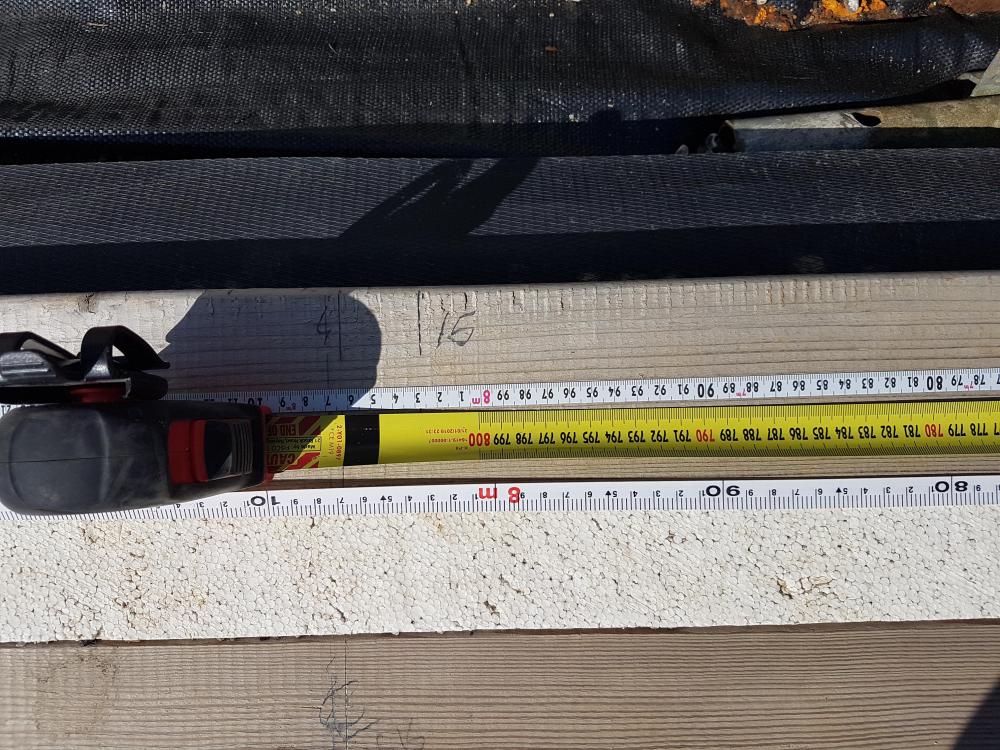
Trouble is 1m is not really enough @jack has the right idea with the outside length - but how did they know their length was correct, However the issue is not an absolute one as unless you have access to lab conditions you are unlikely to be able to get good enough conditions to reference measure within 0.5 mm over distances greater than several meters. -
The right tool for the job or just a right tool.
MikeSharp01 replied to MikeSharp01's topic in Timber Frame
Yes its normally used for setting out the croquet lawm at millstone manor. I have it here because its 50m amd allows me to do quick and, as you can see, dirty measurements over the full depth of the site. -
I wish I had paid more attention in Metrology lectures way back in the 70s! So which of these is a class 1 tape then? Actually 2 of them are class one yet they do not agree over 8m at any rate. The third is a cheap plastic tape and it clearly under reads the other two - the essential question is which one is correct? The yellow one is my everyday tape but only 8m long as you can see. The thin white one is 20m but still class 1. The other cost me £7 in wicks a fews years back. So as a rule they are pretty useless when measuring is shared across different tapes. Conclusion - using 1 tape for everything so that all the errors will be consistent at least.
-
Dont forget that Ratty had a boat.
-
That link points at a 98 strips 12" long so quite a bit of caulk for £26.
-
200 watts to keep my study warm? Please check my maths.
MikeSharp01 replied to epsilonGreedy's topic in Heat Insulation
Yep this will allow you yo keep warm in the upcoming ice age of course there might not be any power generation by then. Naturally ensuring you have a 10Kw supply will allow you to run on hell of a workshop / model railway / tanning salon / steel works / sound system / radio station in there until the time comes. -
Yes it has perforations.
-
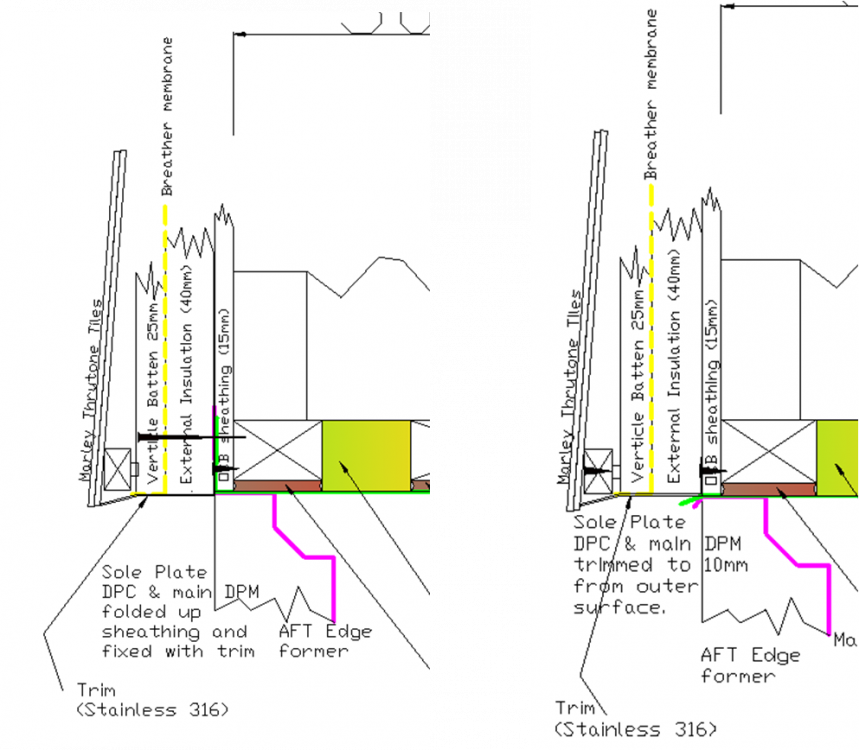
True if any water gets in there. If the breather membrane is outside it I am not sure how water can get there and any water that does will be dried out by the permiability of the structure will it not. As ever its the little details that frustrate. In the traditional case can water not get along between the two membranes if any splashes up there in a storm.
-
It is 40mm insulation but there 300mm on the inside and although it fixes to the 300mm sole plate that is split by 50mm of insulation ( the greeny / yellow lump) so it is well protected cold bridge wise. I do have a condensation worry but I figured that I could expect the whole mass of the trim to move slowley temp wise but I will review it again.
-
Thanks that is the traditional approach but I am not sure why - can you perhaps explain?
-
I need to now tidy up the DPM (Violet line) / DPC (Green line) on the outside of our frame. As I see it I have two options, see picture. I prefer the first (left hand) option as any splashing off the ground cannot get into the DPM/DPC as it is not accessible. Option 2 (right hand) feels more traditional but I am not sure it is as sound as the first in that the there seems to be a moisture path, by capillary action, between the two DPM/DPC layers. Any thoughts gratefully accepted as ever.
-
Quad glazed?
-
We didnt duct the ASHP pipes through the slab, felt like phaff, but decided to run them through and along inside the walls, timber I joists, so the insulation in the walls insulates the pipes.
-
And your definition of 'good' is....?
-
That is some serious windage.... I bet the foundations are humungus.
-
Neighbour has objected to our plans
MikeSharp01 replied to Robert Clark's topic in Planning Permission
Sound advice - it is out of your control to all intents and purposes, you will have to await the outcome and the time will be better spent not worrying about it. -
Looks good too, are the units handless?
-
Right of Way, Area of common parts
MikeSharp01 replied to success1980's topic in Party Wall & Property Legal Issues
Yes - I was refering to the case when there is no registered owner with the LR as was/is the case with the footpath next to our build. If there is a registered owner that is not you a new strategy will be needed. -
Right of Way, Area of common parts
MikeSharp01 replied to success1980's topic in Party Wall & Property Legal Issues
Yes this is the case. If it is not being used you can fence it off and wait 8 (might be 10 can't exactly recall) years, then you need to put an ad in the London gazzette, or local equivalent, and say that if nothing is heard from the rightful owner in 2 years you will assume it is your land. Then if nothing is heard it is yours and you can register it. First thing to do is put a watch on the portion of land at the land registry. This will trigger a message to you if anyone does a search / enquiry at LR covering the parcel in question. Beware that the local foot paths officer might drift by or, as was the case last week with our path, a local volenteer comes by with a clip board and notes any issues with the path. If the path has a number then this will trigger regular reviews of it. You should also look at local planning to see if any covenants have been placed on the path. In our case a small estate was built on the road behind ours and the footpath ran between two of the properties. As part of the planning the council made an order that the footpath should be a minimum of 6' wide. -
Welcome to THE forum for self builders.


