Iceverge
-
Posts
4487 -
Joined
-
Last visited
-
Days Won
32
Everything posted by Iceverge
-
Our resident @tonyshouse did this. As far as I can remembered it shortened the winter but didn't cover the coldest months. Probably better off using the insulation to make some insulated shutters I reckon.
-

1st floor beam and block v timber floor Price comparison
Iceverge replied to Canski's topic in Floor Structures
Ah yes. I forgot about that. Typically with well constructed new builds heating is not required upstairs save a few towel rads maybe or electric UFH over tiles. We have no central heating at all.... -
1st floor beam and block v timber floor Price comparison
Iceverge replied to Canski's topic in Floor Structures
Precast 1200mm wide X 150mm thick concrete hollowcore planks here with 75mm concrete poured over the top and some mesh. Very quick to install as craned from the truck in one afternoon. The 75mm concrete took any deflection out of the planks. Probability overkill and ended with a thick floor. A 25mm screed would probably have been fine. -
We had planning, went to the bank and asked how much money they'd lend us, based on income, it was as close as made no difference €300k. We committed to spending no more than 75% of that for a builders finish. Unfortunately the house we had permission for was 225m2 and was never going to happen without running out of cash. There were some very slow legal land issues underway so we used the opportunity to reapply for planning. We changed the design to a completely rectangular box, and knocked 40m2 off the footprint. I poured many evenings into balancing overall costs and came to the conclusion a passive House was cheapest if you omit a central heating system. The end result was that we ended up with about €85k left over after the builder had left to pay for everything else. Garage, carpets, kitchen, professional fees, furniture, pillowcases, paint, you name it. Lots of stuff was secondhand and I did lots of work myself but we still spent every single cent. However we were never under pressure, for money as all the important stuff had been covered and we moved into a house that was "finished" straight from out of our rental. I can attest to the fact once you move in nothing else gets done anyway. There was plenty of stress during the build as it was but I can't imagine what it would've been like had the money situation not been so under control.
-
Neighbour being rather ridiculous/arrogant
Iceverge replied to hendriQ's topic in Party Wall & Property Legal Issues
Taking a slightly different tact here. Might I suggest that your neighbour potentially isn't a bad character at all. Perhaps he was slow to have the works completed due to covid worries and felt a duty to accept a pushy contractors "take it of leave it" offer and he went ahead out of a duty to you to reinstate the fence. Almost all disagreements are due to physiological effects, ( pain, tiredness, fear, hunger) combined with narrow communication channels, (e.g forums!) when the meaning gets lost. Pop round with a cuppa coffee and a few buns, chat face to face and importantly listen to the neighbours thoughts before you go any further. This will ensure you have all sides of the story to make a reasonable plan to rectify the situation. Remember the saying " a good neighbour is better than a far friend". With a consideration you might be able to use this situation to improve life both sides of the fence. -
The core principles remains and unfortunately it's not very sexy. Seal up every tiny pinhole to prevent drafts. I don't know anyone who's ever regretted building a tight house. Use lots of insulation, in my opinion the "stupider the better" cellulose and mineral wool trump PIR, and aerogel any day for a building. Cheaper and almost complete inert they'll last for centuries without degradation, shrinkage or off-gassing. MVHR is my one concession to "gadgets" but that is essentially 2 X electric fans and a heat exchanger. There after a token amount of heating and cooling (if you've been sensible with glazing) will suffice.
-
Biofib trio every where for me. Chasing lower U values alone misses much of the bigger picture about house durability, heat protection and real world vs theoretical performance. Fire hazard, summer heat protection, construction waste, off gassing, thermal looping and high cost are all negatives with phenolic and to a lesser/greater extent with aerogel.
-
googling double flux = MVHR. Ask her what Airtightness strategy she plans on. If she has a good plan I think you've got a very good architect.
-
I had a look at the website for this product. I think your architect is on the right track here. The system requires a battened wall and hemp/linen batts, ultimately followed internally by a breathable lime or clay render over a board of some kind. The headline R value is only part of the equation. High density insulants (typically made from plants) lend to much higher decrement delays and thermal buffering than lightweight plastic based boards. This translates to more comfortable temperatures in summer and lower cooling bills. They are vapour open (breathable) which protect the existing structure by allowing the existing old wall to dry to the inside and reduce the lightly hood of high humidity trapped in the wall leading to decay. Vapour permeability is often confused with airtightness, They're essentially independent. Continuous lime plaster can be airtight while being vapour open. Likewise old fashioned "drylining" with poorly a detailed polythene sheet full of holes can be almost completely non breathable (trapping moisture in the wall) while while also contributing very little to airtightness. I know I will have to pay special attention to thermal bridges (is that what you mean?). What is best for that? Thermal bridging is typically non continuous insulation. For instance a a steel beam penetrating through a an insulated wall from inside to outside allowing an easy path to escape. Then there are geometric thermal bridges too like @SteamyTea refers to. This is where the insulation value will differ at a corner or a wall junction because the amount of surface for heat to travel through differs internally to externally. I wouldn't worry about this) Airtightness is measured in air changes per hour (ACH) where a testing fan sucks air out of the house to simulate a wind of about 50kph. Draft proofing is another word. Have a proper energy model done ( or even use the one on here) to get a feel of the relative benefit of upgrades. For our own build it was in this order, 1. Airtightness. 2. MVHR 3. Triple glazing over double. 4. adding extra insulation beyond building regs minimum.
-
The requirements here seem confusing. Are they insisting on the stored water being of drinking quality and if so how do they propose you take a tank of stored water in a powercut and appropriately treat it? This seems like an impossibility without building a water tower and a gravity operated chemical treatment unit, much like mains water. I suspect their actual issue is with the unproven reliability of the supply of the borehole and the potential need to buffer some dryer times of the summer if it dries up. I would propose a rainwater harvesting tank with a built in pump that could be buried in the garden and diverted through the house supply ( and treatment system) in times of poor borehole supply. It could supply the garden and maybe the toilets all year round untreated to reduce the draw on the drinking water.

-
Apparently when farm reps of yore used to visit in yesteryear they drank a capfull of Roundup to prove its safety. I don't know what their current state of health is. Glyphosate is regularly used as a desiccant (drying agent) on standing cereal crops for human consumption pre harvest (not without controversy). I would have no issues with exposing a dog to it post spraying.
-
Compact sand and gravel here so no heave. We did have a 215mm inner wall so I guess that could be considered structural all on its own. Also we had I think about 3-4 courses of foundation blocks below the cavity. It wasn't built directly onto the poured foundations like the above diagram. If you can assure drainage to a lower plane a French drain would help regulate soil moisture and prevent heave.
-
Once you have any kind of continuous insulation layer around your house, airtightness and ventilation losses start to dominate the comfort and heat loss equation. Windows too contribute hugely. Going from a U value of 0.25 to 0.15 W/M2K with the extra insulation won't make a damnedest difference if you are stuck at 5 ACH. I would pick a method that allowed for the best continuous airtightness layer, then make sure you have top class windows (great for city noise too) , maybe get those insulating roller shutters common in France. .
-
Gut feeling on this (not an SE) is that you need to have the raft on a consistent base underneath. One corner on rock and one on infill is a recipe for differential settlement. If it's only 400mm to the rock I would get out with a spade and dig a selection of trial holes for the engineer to look into.
-
We did this. Took the cavity 600mm below floor level and pumped full of beads. Didn't use any cavity tray either. Separate DPC in both leafs.
-
What are your exact motivations for hoping to live off grid? It's rarely the most economical or environmentally sound method. Independence from grid has a psychological boom until you arrive at the situation 5-10 years down the road when you have to scale a wind turbine after it breaks and wait for parts to arrive from the far side of the globe. Going to a petrol station for Jerry cans of petrol and running it in a small generator at <25% efficiency is hardly off grid either. A better method on my opinion, rather than isolating oneself from the world is to actively contribute to it with excess PV power and a grid connection. Turn your house into a mini clean power station. @Marvins mantra is on the money. AIM and then APE That is Airtightness, Insulation, Mechanical Ventilation with Heat Recovery, and Air Source Heat Pump, Photovoltaics and Electric Vehicle.
-
Heating & hot water for temporary accommodation
Iceverge replied to SuesieG's topic in Boilers & Hot Water Tanks
Try to avoid compromising your decision making by bending the design to shoehorn an existing (or planned) bit of equipment into the plans. The solar PV and the WBS are pushing you towards this here. It took me a long time to get out of this mindset as we're in a similar position re timber. However living with a a stove in a cottage was a pain in the end. Too hot when lit or too cold when it wasn't, messy and labour intensive. Putting one in our new passive house would have been a list of compromises as long as my arm. As the building will be used long term (and longer than you think for the build) you really need to get the fabric right. I'd bump to 100mm PIR in 2 layers with the joints staggered and taped in the top layer. Put a membrane under the roof joists and tape that too. If done well (use a DIY blowerdoor fan to check) your heating requirement will be tiny. Probably nothing with 2 bodies in residence. A 5kw minimum WBS would be unusable without opening all the windows and letting a howling gale blow through. As you're going to be using it as a gym long term a mini split with cooling is ideal. Sell the WBS and the flue to pay for it. However of you don't want to bother with the cost initially an electric heater is about £30. Sell the farm timber and it'll more than cover your electricity bill. As for the DHW. I lived with an instant shower for most of my life and it was perfectly fine. An instant 10.5kW shower will give you about 5l/m for £70. You'll have a useable independent system if the main house ever breaks. Put a small undersink water heater (£140) under the kitchen sink and run a 10mm Hep2O feed to the wash basin. No need to complicate anything with solar PV. No G3, expansion vessels or discharge pipework. You'll have a fully functioning DHW and Heating system for £250. -
Heating & hot water for temporary accommodation
Iceverge replied to SuesieG's topic in Boilers & Hot Water Tanks
A couple of questions. Is the garage built already? Are you planning on using it year round in the future? Like Nick said how far is it from the house? What is your planned heat source for the new build? Do you know the heating load for the new house? Do you have a free source of timber and enjoy the labour of processing it and cleaning ashes etc? Does the garage have a chimney already? -
This would work. If you can get extract fans that run constantly at a low level. You'll have better internal air quality and less noise.
-
Renovation: suspended floor, slab and block or concrete slab
Iceverge replied to Keymon's topic in Floor Structures
The floor rotted because of the elevated moisture levels. These were caused by the removal of ventilation and the elevated ground levels. You will need to. 1. Lower the existing ground level and reduce the localised water table through drainage ( French drains work well if done right). Damp proofing ( especially the injected type) is peeing into the wind against a high water table. 2. Remove the existing rotten/uninsulated floors. Get a mini digger + dumper in and mechanise as much of the process as possible. Dig out everywhere to 500mm below floor level. 3. Reinstate the floors with appropriate insulation. Given the problems and distance needed to ventilate the existing timber floor I would replace all with a ground bearing slab if possible assuming suitable soil conditions. The next part will take some planning. First fix all your ground floor services. Put ducting here for all your new electrics. Run your bathroom+kitchen extract ventilation ducts, drains and water pipes in ducts. All Preferably elevated say 100mm by chairs. Then pump is something like TLA insulating screed to a depth of 350mm enclosing the ducting in insulation. Then an appropriate membrane. Finally pump a 100mm concrete slab with UFH pipes clipped to mesh and a good upstand to all the walls. There's a fair amount of disruption +muck away (maybe) here initially but man hours and drudgery would be really reduced. An electrician mate first fixed a 1000m2 warehouse with one colleague in a day with this method once. You would be left with a perfect base to continue the rest of your build from. The thick slab (u value about 0.15) would be ideal for UFH and ASHP. It could be used to build lightweight stud walls from it if appropriately specced. -
An alternative way to look as this is the rather unintuitive mindset of "what can we really not get rid of" rather than " how much stuff can we keep." I watched an interview with Elon Musk about SpaceX. He said unless they were retrieving about 10% of the discarded stuff from the bin(metaphorical or real) you weren't throwing away enough stuff. Gordon Rambsy's kitchen nightmares follows a similar philosophy of being liberal with the felling axe.
-
Welcome and congratulations. Begin with a Cat D9. Seriously try try try not to get sucked into fixing old stuff when it's so much cheaper to knock it to the ground and start over. The big trap here is putting a lot of money into trying to fix the unfixable and thus being so mentally committed to refloating the titanic that the rational and cheaper option to start from scratch becomes unthinkable. I have a mate who bought a old stone cottage, economically and diligently improved it and lived in it for a couple of years. Put 100s of hours and maybe €30k into making it liveable. However life changed and they needed more space, got permission to triple the house size via an extension. They're approaching a point where a year into the build all that remains of the old cottage is 4 uninsulated walls. As they've progressed they've literally taken out all the electricals and plumbing by hand, removed an internal wall of maybe 50 tons of stone by hand, taken off the slates and roof timbers by hand. Dug out all the existing floors by hand. They're approaching a point with many 100's of man hours spent to arrive at like I said 4 uninsulated stone walls. The rebuild cost of those walls had they knocked would have been €4k. It's still €4k but the thought of all the work "gone to waste" will mean that their mostly new house is forever compromised as they won't start from scratch. I did warn him. Driving my digger through it would have been the best thing I could have done to help out.
-
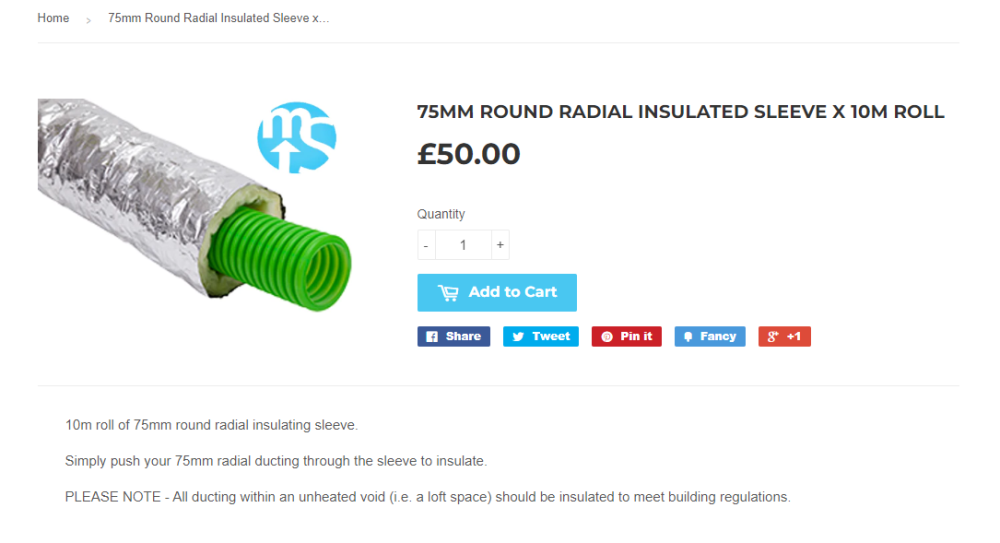
There's 2 types of flexible ducting. Floppy: Best Avoided. And Semi Rigid: Which lots of us have used to good effect.
-
Mostly marketing. There can be a benefit to using them in attic spaces below lightweight roofs in very sunny climates to reflect some heat away and reduce overheating. In theory when paired with a suitable airspace internally the reflect some heat back into the house. The effect is miniscule however. I'd just make sure you buy a robust and durable membrane. I was quite happy with this one. https://justairtight.ie/f-air-tightness®-membrane-EXTRA-1-5-x-50m-CE-certified-p161302002
-
That would do. Might help it not to freeze too.